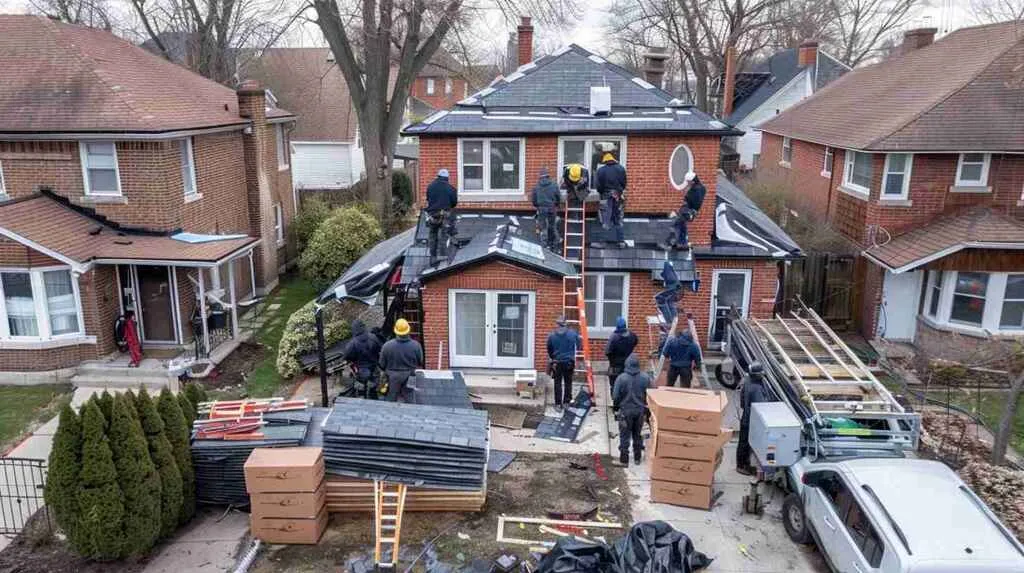
Wood Shingle Roof Installation Queens NY – How It Differs | Free Estimates
Sideways rain, sidewalk puddles, and that thick July air you can almost chew-if you install a wood shingle roof in Queens the same way you would in a dry upstate suburb, you’ve already guaranteed rot and cupping before you’ve even walked off the job. The first critical difference isn’t actually the shingles themselves-it’s the spacing and the ventilation layer underneath them, and that’s where most contractors who think they know wood roofs fall apart in our climate.
Why Wood Shingle Roofs in Queens Behave Differently
On a typical Jackson Heights row house, the first thing I look at isn’t the shingles at all-it’s the attic air and where that moisture’s trying to escape. Queens has humidity levels that swing from bone-dry winter heat to tropical summer mornings in a matter of weeks, plus salt air from the coast and pollution particles that cling to wet surfaces like they’re glued there. You cannot install wood shingles here the way you would on a Vermont barn or even on a lake house two hours north-the materials behave completely differently when they’re constantly taking on and releasing moisture in this cycle. My opinion? If you try to shortcut that reality and treat cedar like it’s asphalt or treat Queens like it’s the Adirondacks, you’re asking for a roof that looks beautiful for three years and turns into a cupped, mossy disaster by year seven.
One July afternoon in Forest Hills, about 3:30 pm, we were halfway through a wood shingle install when a surprise thunderstorm rolled in and the homeowner panicked because part of the deck was exposed. I had to explain, standing there in a poncho, that the real emergency wasn’t the rain itself but the way water was about to wick under the underlayment because another crew had overlapped it backwards years ago. Fixing that mistake in the middle of a storm taught me how different a wood shingle job is when you don’t control water flow from the very first layer. That day showed me that the underlayment isn’t just a barrier-it’s part of how the whole system breathes, and if the overlap isn’t right or the material can’t dry, moisture gets trapped right where the wood is supposed to be releasing it. Now, once that piece behaves, the next one is easy: you can move on to spacing the shingles themselves so they have room to swell without crushing each other when Queens humidity spikes.
Common Assumptions vs. Reality: Wood Shingle Roofs in Queens
| Myth | Fact for Queens, NY Roofs |
|---|---|
| “If it worked on my lake house upstate, it’ll work the same here.” | Queens has heavier humidity, coastal winds, and more air pollution, so wood shingles take on more moisture and need extra ventilation and spacing. |
| “Good shingles don’t need much airflow underneath.” | Without a vented assembly, trapped moisture teaches the shingles bad habits-cupping, curling, and early rot. |
| “A quick layer of felt under wood shingles is enough.” | On Queens row houses, you often need a breathable underlayment plus a vented mat or skip-sheathing approach to let the system dry out between storms. |
| “Any roofer who does asphalt can install wood the same way.” | Wood is a living material that moves; it has to be installed like a breathing skin, not a flat wrapper, or it will fail prematurely in our climate. |
The Queens-Specific Wood Shingle Installation Sequence
Let me be blunt: if your wood shingles in Queens are nailed too tight and laid too flat, you just paid extra for a fancy sponge on your roof. Installation here starts with managing how the wood will take in and release moisture, not with making the shingles look pretty from the curb. In Jackson Heights, you’re dealing with attached row houses where attic air has nowhere to go unless you design a path; in Bayside, you’ve got detached homes with more breathing room but often older framing that telegraphs every bump through the shingles. Ridgewood attached houses sit somewhere in the middle, with shared walls that trap heat and moisture on one side. Every neighborhood has its own personality, and the installation sequence has to account for how moisture tries to escape in each case.
The process isn’t rocket science, but it’s layered and unforgiving if you skip steps. You start by evaluating how the attic and deck are behaving right now-checking for condensation on nail tips, musty smells, soft plywood, and whether the existing ventilation system is even functional or just decorative louvres that don’t move air. Then you correct the deck and ventilation: replace any delaminated or mixed-thickness plywood, flatten the plane so it doesn’t telegraph waves, and design a continuous intake (soffit vents where you can, smart alternatives on row houses where you can’t) paired with a ridge or high-point exhaust so moist air has a clean escape route. After that, you install a breathable, vapor-permeable underlayment and, where the roof needs it, add battens or a vent mat to create an air gap so the wood can breathe from underneath. Now, once that piece behaves, the next one is easy: laying out the shingle courses with proper Queens spacing-staggered joints, consistent exposure, and precise side gaps so the shingles can swell and shrink without crushing each other when humidity spikes. You nail with the right pattern and depth, using corrosion-resistant fasteners that hold the shingle without pinning it flat against the deck like you’re trying to suffocate it. Finally, you finish edges, flashings, and penetrations carefully, because those spots where walls, chimneys, and skylights meet the roof are exactly where Queens wind-driven rain tries hardest to sneak under the system.
I still remember a Saturday morning in January in Bayside, 18 degrees, when a client insisted on wood shingles “the same way they did it on my grandfather’s farm in Vermont.” Once I showed him how the tight spacing and lack of proper ventilation that worked on a cold, dry barn would rot his Queens roof in under a decade, he let me redesign the whole assembly. That project made me start carrying photos on my phone of failed “farm-style” wood roofs I’ve ripped off in coastal New York. The Vermont barn approach-solid sheathing, shingles laid tight with minimal gaps, no vent space because the cold dry air kept everything in check-turns into a wet, rotting carpet here because our air is loaded with moisture year-round. Here’s an insider tip: before you agree to any wood shingle quote, ask the roofer to show you exactly how attic air will move from soffit (or intake) to ridge, and to point to where the shingle layer is allowed to breathe. If they can’t draw you a simple diagram or walk you through it from the sidewalk, they don’t understand the system well enough to install it right in Queens.
- Evaluate attic and deck behavior – Check attic humidity, existing vents, and roof deck flatness; identify any soft, delaminated, or mixed-thickness plywood that will telegraph through the shingles.
- Correct deck and ventilation – Replace bad decking, even out thickness, and design a continuous intake (soffit or smart alternatives on row houses) and ridge or high-point exhaust so moist air has a clean escape path.
- Install breathable underlayment and vented space – Use a high-quality, vapor-permeable underlayment and, where needed, add battens or a vent mat to create an air gap so the wood can breathe underneath.
- Lay out shingle courses with Queens spacing – Stagger joints, keep consistent exposure, and leave precise side gaps so the shingles can swell and shrink without crushing each other when humidity spikes.
- Nail with the right pattern and depth – Use corrosion-resistant nails, avoid overdriving, and place nails so they hold the shingle without pinning it flat against the deck.
- Finish edges, flashings, and penetrations carefully – Pay extra attention where walls, chimneys, and skylights meet; these are the spots where Queens wind-driven rain tries hardest to sneak under the system.
⚠️ Warning: Treating wood shingles like asphalt-solid sheathing, no vent gap, tight joints, and overdriven nails-turns your roof into a wet, rotting carpet in under 10 years in Queens humidity.
What Changes Compared to Asphalt or Upstate Installs
I still remember a Tuesday in late September, standing on a Corona rooftop at 7 a.m., realizing the carpenter before me had treated cedar shingles like asphalt. He’d laid them on solid plywood with standard felt, nailed them flush with no side gaps, and driven the nails so deep the heads were actually dimpling the wood. The homeowner asked me why his three-year-old roof was already showing dark streaks and curling edges, and I had to explain that the whole system was installed like a waterproof membrane instead of a breathing assembly. A few years ago, we did a cedar shingle roof on a tiny attached house in Ridgewood for a retired jazz drummer who insisted on being on the scaffolding with us at sunrise. Halfway through, we discovered the original builder had used two different thicknesses of plywood on the same plane, so every third course was telegraphing a weird ripple. Adjusting shingle exposure and hand-selecting each piece to blend that bump without tearing off the whole deck was one of those jobs that only works when you really understand how wood shingles move over time-and how they move differently here than they do in dry climates where the deck’s mood doesn’t shift every other week.
When you compare installation methods, the differences are huge. Asphalt shingles are manufactured, uniform, and designed to sit tight on a solid deck with minimal concern for expansion-they don’t breathe, they don’t swell, and their job is just to shed water fast. Wood shingles in a dry upstate town can get away with tighter gaps and simpler underlayment because the air isn’t constantly loaded with moisture, so the shingles dry quickly and don’t move as much. But here in Queens, you’re installing a living, breathing system that has to handle coastal humidity, salt air, temperature swings, and pollution that makes everything stay damp longer. You adjust exposure to compensate for deck irregularities, you hand-check every nail depth because overdriving kills the shingle’s ability to move, and you design the vent strategy like it’s the most important part of the roof-because it is.
| Installation Detail | Wood Shingles in Queens, NY | Typical Asphalt Shingles | Wood Shingles in Dry Upstate Town |
|---|---|---|---|
| Underlayment | Breathable, often paired with vent mat or battens to let wood dry from both sides. | Standard synthetic or felt underlayment, no venting layer needed. | Standard felt may be used without vent space because drying conditions are better. |
| Decking | Must be flat and consistent; mixed-thickness plywood gets corrected or compensated with exposure adjustments. | Minor deck inconsistencies are more forgiving under asphalt. | More tolerance for minor irregularities because movement is smaller in drier air. |
| Shingle Spacing | Carefully gapped side joints to allow for swelling in high humidity. | Tabs are manufactured to fit with minimal concern for wood movement. | Often tighter gaps because seasonal expansion is less extreme. |
| Ventilation Strategy | Priority: strong intake and exhaust to move moist interior air out quickly. | Important but less critical to the shingle material itself. | Ventilation still needed, but wood is under less moisture stress. |
| Nail Pattern & Depth | Hand-checked to avoid overdriving; nails placed to let shingles move. | Installed to manufacturer spec; movement of material is minimal. | Nailing is more forgiving due to lower humidity-related movement. |
| Pros | Cons |
|---|---|
| Rich, natural look that stands out on Queens homes and historic blocks. | Higher upfront cost than basic asphalt shingles. |
| Can last 25-30 years with the right installation and maintenance. | Requires more maintenance and inspections to keep it behaving well. |
| Excellent at breathing and managing moisture when installed as a system. | Unforgiving of shortcuts; bad installs fail quickly in our climate. |
| Adds curb appeal and can increase perceived home value. | Not every roofer has real wood-shingle experience in coastal New York. |
How to Know If Your Queens Home Is Ready for Wood Shingles
When a customer asks me, “So how do you actually install a wood shingle roof?” I answer back, “Do you want it to look good for five years or for thirty?” That question cuts right to the difference between a roof that’s installed for appearance and one that’s built to behave like a working system in Queens weather. If you’re serious about wood shingles here, you’ve got to think like we’re both standing on the sidewalk, looking up at your house, reading how it’s breathing through the roof right now-are there dark streaks near the ridge that mean moisture’s getting trapped, are the soffits blocked, does the attic smell like a basement? That’s the diagnosis that tells me whether your home is ready or whether we’ve got work to do first.
Quick Self-Check Before You Call About Wood Shingles in Queens
- Look in your attic on a humid day-do you see condensation on nails or smell a musty odor?
- Check if you have any existing soffit vents, gable vents, or a ridge vent on your current roof.
- Walk the sidewalk line and look up-do you see waves or dips in the roof plane that might mean uneven decking?
- Note any nearby trees or taller buildings that shade the roof and keep surfaces damp longer.
- Gather any previous roofing paperwork so we can see what underlayment and deck repairs were done before.
Are You a Good Candidate for a Wood Shingle Roof in Queens?
Start: Do you want a roof that prioritizes longevity and appearance over the lowest possible upfront cost?
If No: Consider a high-quality asphalt shingle with good ventilation instead.
If Yes: Are you willing to allow time for thorough prep-deck repairs, ventilation upgrades, and moisture checks?
If No: Wood shingles may not behave well for you; rushing prep is a deal-breaker.
If Yes: Is your home in an area of Queens with higher humidity or shade (near parks, tall neighboring buildings, or close to the water)?
If Yes: You’re exactly the type of home where a properly detailed wood system can shine-schedule an inspection.
If No: Wood can still work great; you may simply get a bit more forgiveness on drying times and maintenance.
Costs, Maintenance, and What to Expect From Shingle Masters
Think of your roof deck like the drumhead on a snare-if the base isn’t even and tuned right, it doesn’t matter how nice the sticks are or how good the drummer is. That’s where the money should go on a wood shingle roof in Queens: into a properly tuned deck, a ventilation system that moves air like it’s supposed to, and an underlayment assembly that lets the wood breathe instead of suffocating it. Yes, the shingles themselves cost more than asphalt, and the labor is more precise because every nail depth and every side gap matters, but the real investment is building the system underneath so the shingles can do their job for 25 to 30 years. Maintenance expectations are also different-you’re not just looking for missing shingles after a storm; you’re checking how the system is breathing, cleaning debris and moss so shingles can dry between rains, and catching early signs of cupping or flashing issues before they spread.
Here’s what you can expect when you work with Shingle Masters on a wood shingle roof in Queens: we start with an on-site inspection where I walk the property with you, check your attic and existing vents, and explain from the sidewalk exactly how your house is behaving right now and what needs to change. We give you a detailed estimate that breaks down deck work, ventilation upgrades, underlayment, shingle material, and labor so you know where every dollar is going. During installation, we treat your roof like the breathing system it needs to be-correcting deck inconsistencies, designing airflow paths, spacing shingles for Queens humidity, and hand-checking every fastener. After the job, we walk you through what we did, show you how the system works, and set you up with a maintenance schedule so the roof keeps behaving the way it’s supposed to. If you’re ready to talk about a wood shingle roof that’s built to last in our climate-not just look good for a few years-call us for a free estimate and we’ll stand on your sidewalk together and read your house the right way.
| Scenario | Roof Size / Condition | Estimated Price Range | Notes |
|---|---|---|---|
| Small attached row house | 1,000-1,400 sq ft, minimal deck repair | $14,000 – $22,000 | Assumes good existing ventilation that only needs tuning. |
| Medium detached home | 1,500-2,000 sq ft, moderate deck and vent upgrades | $22,000 – $32,000 | Typical for Bayside, Forest Hills, and similar neighborhoods. |
| Larger multi-gable home | 2,100-2,800 sq ft, complex roof lines | $32,000 – $48,000 | Additional labor for flashings, dormers, and detailed edge work. |
| Full tear-off with major deck fixes | Any size, mixed-thickness or damaged plywood | Add $4,000 – $10,000+ | Required when old framing telegraphs bumps or soft spots. |
| Annual maintenance and checkup | Existing wood shingle roof | $250 – $600 | Cleaning, small repairs, and ventilation/attic moisture check. |
Wood Shingle Roof Care Schedule for Queens Homeowners
| Timeframe | Task | Why It Matters in Queens |
|---|---|---|
| Every 12 months | Professional roof and attic inspection | Checks how the system is breathing, catches early cupping or flashing issues. |
| Every 1-2 years | Gentle cleaning of debris, moss, and algae | Prevents damp buildup from shade and city pollution. |
| After major storms | Visual check from the sidewalk and attic | Looks for displaced shingles and new leaks after wind-driven rain. |
| Every 5-7 years | Targeted repairs and re-fastening where needed | Extends service life by correcting small behavior issues before they spread. |
Why Queens Homeowners Hire Shingle Masters for Wood Shingles
- 19+ years installing and repairing shingle roofs specifically in Queens, NY.
- Licensed and fully insured for residential roofing in New York City.
- Specialized experience with cedar and other wood shingles in humid, coastal conditions.
- Free on-site estimates with deck, attic, and ventilation behavior analysis before we quote.
Common Questions About Wood Shingle Roof Installation in Queens
How long will a wood shingle roof last in Queens if it’s done right?
With proper ventilation, spacing, and maintenance, I expect a quality cedar shingle roof in Queens to last 25-30 years. Most of the early failures I’m called to rip off were installed like asphalt or like a dry-climate farm roof.
Can you install wood shingles over my existing asphalt roof?
In Queens, I don’t recommend that. We usually tear off the old layers so we can see how the deck is behaving, correct ventilation, and build a breathing assembly from the bottom up.
Will wood shingles attract insects or mold here?
If they’re detailed right and can dry between storms, insects and mold are manageable. The trouble starts when shingles stay damp because there’s no vent path and joints are too tight.
Is there a best time of year to install wood shingles in Queens?
We avoid extreme cold snaps and heavy, prolonged rain. The shoulder seasons-late spring through early fall-are usually ideal for letting the system settle and start its drying habits correctly.
Here’s the part nobody wants to hear: wood shingles are unforgiving if you rush the prep, and Queens is not kind to lazy prep. A wood shingle roof in Queens has to be treated like a breathing system, not a decoration-every layer from the deck up has to be designed around how moisture will move through the assembly and how the shingles will behave when the air shifts from dry winter heat to August swamp air in a matter of weeks. Shingle Masters builds every layer around how the roof will behave in local weather, not around making it look good from the street for a quick flip. If you’re ready to talk about a wood shingle roof that’s built to last 30 years instead of looking pretty for five, call us for a free on-site estimate-we’ll stand on the sidewalk together, read your house from that angle, and map out a wood shingle roof that’s actually built for Queens.