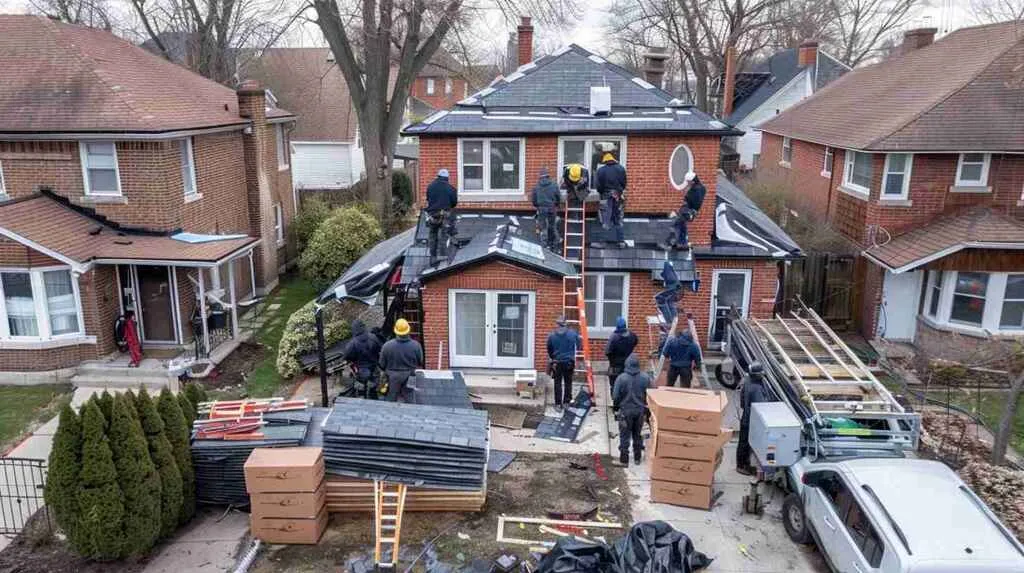
Shingle Roof to Wall Flashing Queens NY – Keep That Joint Dry | Free Quotes
Blueprint: around 80% of the “mystery leaks” I see on Queens shingle roofs trace back to bad roof-to-wall flashing, not the shingles themselves. That’s the number that surprised me in my first five years on roofs, and it’s still holding true after 19. This article is a calm, visual walk-through of how one drop of water runs its heist at the exact spot where your shingles meet a wall-and how I stop it at every door it tries to crack open.
Why Roof-to-Wall Flashing Causes 80% of Those “Mystery Leaks” in Queens
Let’s get visual: imagine a single drop of water lands on your shingle roof right where it touches the neighbor’s brick wall. If your step flashing and counterflashing were done right, that drop hits a locked door, slides down into your gutter, and you never hear from it again. But if the roofer rushed that joint or skipped the counterflashing-and I see this constantly in Queens-the drop finds a gap, slips behind the shingles, and starts its slow heist down into your wall cavity. One January morning around 6:30 a.m., I was on a two-family brick in Maspeth where the owner swore his roof was “perfect” because it was only five years old. It had rained overnight and the temperature dropped, so I watched thin sheets of ice forming exactly where his shingle roof met the side wall of the neighbor’s house. The roofer before me had just slapped step flashing into the mortar joints and skipped the counterflashing, so meltwater was traveling behind the shingles like it was on a secret slide. My opinion? A young roof with rushed flashing is more dangerous than a 20-year-old roof that was flashed correctly, because you trust it and ignore the small clues.
Now follow that drop of water one step further. On tight Queens blocks-especially in Astoria, Woodside, and Maspeth where rowhouses share walls-your roof-to-wall joint is often a long, continuous seam. Wind-driven rain off the East River and summer thunderstorms don’t hit straight down; they come sideways. Bad or missing counterflashing lets water slide behind shingles at that transition, and you won’t see it from the ground. By the time you see a ceiling stain or smell mustiness, the drop has been running the same heist route for months.
Common Myths vs. Reality: Shingle Roof Leaks in Queens
| Common Myth | The Real Story in Queens, NY |
|---|---|
| If my shingles look fine, my roof is fine | Perfect shingles mean nothing if the flashing at roof-to-wall joints is failing-water slips behind the shingles where you can’t see it |
| Leaks always show up directly below the problem | Water travels along rafters and wall studs; your ceiling stain in the bedroom might come from bad flashing at a dormer 8 feet away |
| A newer roof won’t leak | Age isn’t the issue-rushed or skipped roof-to-wall flashing on a 3-year-old roof will leak faster than a 15-year-old roof done right |
| Caulk and tar will fix any flashing gap | Sealant is temporary at best; Queens freeze-thaw and UV breaks it down fast, and then water pours through the same gap |
| All roofers know how to do roof-to-wall flashing correctly | Flashing is detail work-many crews skip counterflashing or kickout flashing to save 20 minutes, and you pay for it later in leak calls |
On a Typical Queens Block, Here’s Where That Drop of Water Actually Sneaks In
On a typical Queens block with rowhouses shoulder to shoulder, the most dangerous place on your roof is where it kisses the wall next door. In Astoria, Woodside, and Maspeth especially, you’ve got attached homes with long shared roof-to-wall seams running 20, 30, sometimes 40 feet. Wind off the East River and those summer thunderstorms that roll in sideways mean water isn’t just falling straight down-it’s being driven horizontally right into that joint. One humid August afternoon in Richmond Hill, a landlord called me because her third-floor tenant kept complaining about a musty smell in the bedroom. There was no active dripping, just a faint water stain near a side wall dormer, so three handymen told her it was “old damage.” I brought my camera gear out of retirement, set up time-lapse on the inside during a thunderstorm, and watched the exact moment water traced down from a misaligned kickout flashing that dumped water into the wall cavity instead of the gutter. That drop of water was scouting like a little burglar, finding the one unlocked door and walking right in.
Now follow that drop of water one step further. Once it gets past the shingle edge at a side wall, dormer, or parapet, it can slide down the back of your siding or brick, soaking the sheathing and studs on its way. Queens buildings built before 1980 often have minimal or no house wrap behind the siding, so that water has a free highway. When kickout or step flashing is wrong-or missing entirely-the drop just keeps traveling until it hits something it can stain: drywall, insulation, electrical boxes. Here’s an insider hint I tell every homeowner: the stain you see on your ceiling rarely lines up perfectly with where water is getting in outside. It’s like trying to find a burglar by looking at the room he robbed, not the door he used to break in.
Decision Tree: Is Your Leak from Roof-to-Wall Flashing?
→ YES: Continue below
→ NO: Your leak may be elsewhere-check valleys, vents, or middle-of-roof shingles
→ YES: Go to Q2
→ NO: Go to Q4
→ YES: High chance your shingle roof-to-wall flashing is the culprit-time to have it inspected
→ NO: Go to Q3
→ YES: High chance your shingle roof-to-wall flashing is the culprit-time to have it inspected
→ NO: Still worth inspecting flashing; water often hides behind shingles
→ YES: High chance your shingle roof-to-wall (or roof-to-chimney) flashing is the culprit-time to have it inspected
→ NO: Go to Q5
→ YES: High chance your shingle roof-to-wall flashing is the culprit-time to have it inspected
→ NO: Consider other roof penetrations, but don’t rule out wall flashing yet
→ YES: High chance your shingle roof-to-wall flashing is the culprit-time to have it inspected
→ NO: Could be a sudden shingle failure; still worth a full roof inspection
⚠️ Call Shingle Masters ASAP (within 24 hours)
- Active dripping during storms near a wall or corner-water is getting into wall cavities now
- Rapidly spreading ceiling stain after wind-driven rain-flashing failure is letting volume through
- Soft or spongy wall texture near your roofline-sheathing or studs are staying wet
- Water stains near electrical fixtures or outlets in upper floors-safety hazard from roof-to-wall leak
📋 Can Schedule an Inspection Soon (within a week)
- Faint musty odor near an exterior wall, especially in humid weather
- Small recurring stain that only shows up after heavy wind-driven rain from one direction
- Shingle granules piling up where your roof meets a wall-sign of water washing them down
- Visible gap or rust (from ground) where shingles meet siding or brick-flashing aging out
How I Track a Single Raindrop and Shut Down Its Heist Route
Step-by-step: From First Drip to Dry Wall
When I come to your house, the first thing I’ll ask is, “Where does the leak show up inside, and what’s directly above that on the outside?” I’m not being nosy-I’m mapping the heist route that single drop of water is using. One fall evening just before dark in Astoria, I was halfway done re-flashing a roof-to-wall joint on a rowhouse when Con Edison cut power to the block for some emergency work. A storm was rolling in over the East River, I had an open joint where the siding met the shingles, and the homeowner was pacing like we were in an operating room. I used the last bit of light to improvise a temporary two-stage flashing with extra ice & water membrane and aluminum coil stock, then came back the next day to install permanent step and counterflashing. Watching that joint stay bone dry through six straight hours of rain convinced the homeowner-and me-that the “boring” details are what rescue a roof. Think of it like a heist movie: that drop of water is the tiny criminal, and every piece of flashing I install is a locked door, a security camera, an alarm that shuts down another escape route.
Now follow that drop of water one step further-here’s how proper roof-to-wall flashing actually works in simple terms. Step flashing is the L-shaped metal that tucks under each shingle and laps up the wall; it’s your first line of defense. Counterflashing covers the top edge of the step flashing and gets embedded into the mortar or tucked behind siding, so water running down the wall can’t sneak behind the step flashing. Kickout flashing sits at the bottom end of a wall run and diverts water away from the wall and into your gutter-without it, every drop just pours into the gap between your siding and roof. Here’s an insider tip nobody tells you: peel-and-stick ice & water membrane under your shingles is important support, but it’s not a substitute for proper metal step and counterflashing at a roof-to-wall joint. Relying on sealant alone is asking water to win the heist six months later when that caulk cracks in Queens winter.
Vic’s 6-Step Roof-to-Wall Flashing Process
I map every stain, every musty smell, every soft spot on walls and ceilings to understand where water is ending up and work backward to the entry point.
On the roof, I follow the suspected path of a single drop of water along all roof-to-wall intersections, checking step flashing, counterflashing, and kickout details.
I run a hose in short sections-never flooding-to confirm exactly where the drop is sneaking in, while someone inside watches for new moisture.
I carefully remove shingles and old, failed flashing at the problem area, inspect sheathing for hidden rot, and prep clean surfaces for new materials.
I install new underlayment, individual step flashing pieces under each shingle course, counterflashing tucked into mortar or behind siding, and kickout flashing where needed to guide water into gutters.
I run another careful water test to prove the heist route is shut down, take photos of the finished work, and walk you through what I did and why it’ll last.
Why Queens Homeowners Call Vic for Stubborn Roof-to-Wall Leaks
What Shingle Roof-to-Wall Flashing Repairs Cost in Queens, NY
$450 to $2,400 is the range most of my Queens customers fall into for roof-to-wall flashing work, and where you land depends on access, how many feet of wall need flashing, whether I have to coordinate with a mason or siding guy, and if you need temporary emergency protection before we schedule the full rebuild. Think of it this way: you’re paying now to stop the heist instead of funding drywall replacement, mold remediation, and electrical repairs six months down the road when that drop of water has invited all its friends inside your walls.
Typical Queens Shingle Roof-to-Wall Flashing Scenarios
| Scenario | Typical Price Range (Queens, NY) | What’s Included | Approx. Time On Site |
|---|---|---|---|
| Small side-wall flashing tune-up at one short section | $450 – $850 | Remove 8-12 shingles, replace 4-8 ft of step flashing, install kickout if missing, reinstall shingles, test | 3-5 hours |
| Full re-flash of one short wall-to-roof intersection on a two-family | $900 – $1,450 | Remove shingles along 12-18 ft wall, full new step flashing and counterflashing, kickout, underlayment patch, reinstall or replace shingles | 1 day |
| Dormer side-wall flashing rebuild including kickout | $1,100 – $1,800 | Dormer requires detail work on 3 sides, full step/counter/kickout system, possible siding coordination, shingle match | 1-1.5 days |
| Long shared party-wall transition on attached rowhouses (20-35 ft) | $1,600 – $2,400 | Remove shingles along full wall run, new step and counterflashing entire length, mortar work or siding coordination, possible sheathing repair | 1.5-2 days |
| Emergency temporary flashing & tarp plus scheduled permanent repair | $350 (temp) + permanent work priced separately | Immediate stop-gap using membrane, coil stock, and tarp to protect until weather allows full repair; credit often applied to final job | 2-3 hours (temp) |
All prices are approximate and depend on access, materials needed, and findings during inspection. Free on-site quotes always provided before work begins.
Patching vs. Proper Re-Flash: What You’re Really Choosing
| Option | Pros | Cons |
|---|---|---|
| Patch & Seal Only (Caulk, tar, or surface sealant over existing flashing) |
• Quick-can be done in 30-60 minutes • Lower upfront cost ($150-$350) • May stop an active drip temporarily |
• Queens freeze-thaw cycles crack sealant fast • Doesn’t address root cause (missing or wrong flashing) • Leak usually returns within 6-18 months • You end up paying twice-patch now, real fix later |
| Full Tear-Out & Proper Re-Flash (Remove shingles, install correct step/counter/kickout flashing) |
• Fixes the root problem for 15-25+ years • Protects wall sheathing and interior from ongoing damage • Increases roof longevity and home value • One-time investment with proper warranty |
• Higher upfront cost ($450-$2,400 depending on scope) • Takes 3 hours to 2 days depending on wall length • Requires removing and reinstalling or replacing some shingles |
Vic’s take: In Queens’ wind-driven rain and heavy snowmelt, I’ve seen patch jobs fail during the very next nor’easter. If the diagnosis shows your step flashing is missing or your counterflashing is letting water behind shingles, proper re-flash is almost always worth it-you’re not just fixing a leak, you’re stopping hidden damage that costs 5x more to repair later.
Quick Checks Before You Call Me Out to Your Queens Roof
Here’s the truth nobody likes to hear: water is more patient than any contractor-if you leave it a path, it will find it. Before you call, do a few safe, ground-level checks so our conversation is more productive. You shouldn’t climb the roof, but you can note exactly where stains show up inside and whether they only happen during wind-driven rain from one direction.
✅ Before You Call: Simple Things to Note
- Note exactly where inside you see stains, bubbling paint, or smell mustiness-which room, which wall, how close to the ceiling
- Check if it only happens during wind-driven rain from a certain direction (east storms off the river hit Queens hard)
- Look from the ground for any visible gaps, rust stains, or missing metal where shingles meet siding or brick on exterior walls
- See if gutters near the wall are overflowing, pulling away, or dumping water right at the roof-to-wall joint
- Take clear photos of any interior damage-I can often start mapping the water path before I even climb your roof
- Write down how old the roof is and who installed it if you know-helps me understand what flashing approach they might have used
- Note if neighbors in attached homes have had similar leak issues-shared party walls often have shared flashing problems
Common Questions About Shingle Roof-to-Wall Flashing in Queens
How do I know if my leak is really from roof-to-wall flashing and not my shingles?
Can you fix flashing on just one section, or do I need a whole new roof?
How long does a proper flashing repair last in Queens weather?
Do you work on attached rowhouses where the neighbor’s wall is right against my roof?
What’s the difference between step flashing, counterflashing, and kickout flashing, in simple terms?
Let me come out and follow that single drop of water on your Queens roof-I’ll show you exactly where it’s sneaking in at your roof-to-wall joint and how we shut down the heist for good. Call Shingle Masters for a free on-site quote, or reach out online and I’ll get back to you same or next business day. If you suspect your shingle roof-to-wall flashing is letting water plan a break-in inside your walls, don’t wait-every storm is another chance for that drop to do more damage.