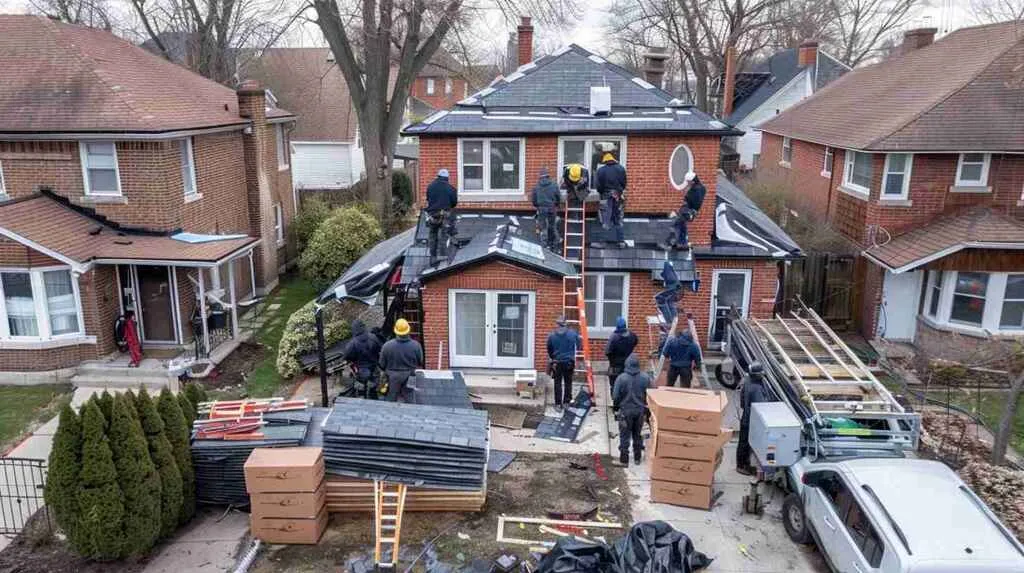
Shingle Roof Divider Queens NY – Managing Multiple Roof Planes | Call Today
Channels are what most Queens leaks really come down to, because if your shingle roof has three or four planes meeting at weird angles and the dividers aren’t built to guide water like a proper highway, you’re going to have problems that no amount of “new shingles” will fix. My name’s Eric “Levels” Mancuso, and after 19 years climbing on Queens roofs and fixing the messes left by guesswork instead of good design, I can tell you that most so-called complicated leak cases aren’t about the shingles at all-they’re about how multiple roof planes connect and how the dividers are (or aren’t) managing the actual traffic flow of rain.
Why Shingle Roof Dividers in Queens Leak So Much
On a typical two-family in Queens, you’ll see at least three roof planes before you even spot the front door. One August afternoon in Ridgewood, it was about 95 degrees and the shingles on this old two-family were so hot they were almost gummy. The owner had a messy “T” intersection where a back addition roof met the original main roof, and somebody had tried to solve it with three different kinds of metal dividers and a tube of clear caulk. I still remember stepping into that valley, looking at the janky divider, and watching a line of ants literally using it as a highway straight into the attic gap. That moment made it obvious: a shingle roof divider that doesn’t actually guide water is just sitting there like a busted traffic signal, and you end up with backups, crossflow, and insects finding all the shortcuts. The water wants to follow the path of least resistance, and if your divider isn’t pointing it in the right direction, it’s going to take a turn straight under your shingles and into your attic.
Here’s the thing about multi-plane roofs on those classic Queens two-families and row houses: when you’ve got a front-to-back pitch meeting a side addition, plus maybe a porch or dormer tying in, you’re basically creating a five-lane intersection for water every time it rains. If the dividers and valleys are guessed at instead of designed to handle the actual volume and direction of flow, you get traffic-jam conditions-standing water, backed-up ice in winter, and leaks that show up six feet away from where the actual problem is. Factor in Queens weather with sudden downpours off the Sound, wind that drives rain sideways, and an older housing stock where additions were tacked on without any thought to how the planes connect, and you’ve got a recipe for chronic divider failure.
Common Misunderstandings About Shingle Roof Dividers on Queens Homes
| Myth | Fact |
|---|---|
| If the shingles are new, any leak must be from bad materials, not the dividers. | On Queens roofs, most leaks I find are from how the planes and dividers are built, even on brand-new shingles. |
| A tall metal divider bar always keeps water out, no matter how the roof planes meet. | If the divider isn’t aligned with the water flow, it can actually trap and funnel water under the shingles. |
| You can stop divider leaks with a thick bead of caulk or sealant and be done with it. | Caulk is a temporary Band-Aid; real fixes involve proper flashing, underlayment, and water pathways. |
| Only super complex roofs with five or six valleys need a specialist; simple T-intersections are easy. | Even a single porch-to-main-roof joint can leak nonstop if the divider, step flashing, and shingle layout are wrong. |
How I Diagnose Your Shingle Roof Divider Problems
One November morning in Bayside, during a cold drizzle just before Thanksgiving, I came out to a call where the homeowner said, “My new roof is leaking, but only where the porch meets the main house.” The job had been done by someone else, and they’d put a fancy decorative divider cap right where two roof planes met at a weird offset. I traced the leak marks in the attic, followed them back to that divider, and we realized the installer never offset the shingle joints or step-flashed the wall properly. Standing there at 7 a.m. in a wool coat and slippers with the owner, I had to explain that the whole leak path was basically a slide built out of bad plane management. That Bayside neighborhood has a ton of those older porch additions with small offsets, and drizzly weather like that is perfect for showing you exactly where the water’s choosing to go-it doesn’t lie, and it doesn’t skip steps. Once you see the stain trail and match it back to the divider detail, the mistake becomes obvious.
When I come out to your place, the first thing I’m going to ask is, “Where does the water come from, and where does it want to go?” I’ll start inside, looking at where the stains or drips show up on your ceiling and walls, then I’ll head up onto the roof and walk the planes like I’m tracing lanes on a highway. I’m checking every valley, every flat-to-pitch transition, every decorative cap, and any spot where two planes meet at an odd angle. I’m looking for where the shingles are pointing the water, where the dividers are supposed to split or channel it, and where the flow is getting confused or backed up. At the end, I’ll sketch out the water path on a piece of cardboard or the back of a pizza box so you can actually see what’s happening-because once you understand that water is just following the easiest route, the whole roof makes a lot more sense and you’ll know exactly where your money needs to go next.
My Step-by-Step Shingle Roof Divider Inspection Process in Queens, NY
⚠ WARNING
Risks of Letting Divider and Valley Leaks Linger Through a Queens Winter
- Sheathing rot: Slow leaks soak the plywood deck under your shingles, turning solid structure into mush that can’t hold nails or support weight.
- Insulation damage: Once fiberglass or cellulose gets wet, it loses R-value and starts feeding mold growth in your walls and ceilings.
- Party wall stains: In row houses, a divider leak on your side can stain the neighbor’s ceiling, leading to fights and shared repair bills.
- Freeze-thaw expansion: Water trapped behind a bad divider freezes overnight, expands, and opens up the gap even more-each winter storm makes the leak worse.
Flat-to-Pitch Transitions and Tricky Valley Intersections
I still remember one Elmhurst job where a tiny change in the angle of a roof divider stopped a leak that three contractors had missed. The owner had been through multiple “fixes” and was ready to tear the whole thing off, but when I got up there it was clear the flat section was dumping straight into a steep pitch with a divider that was too narrow and too low. One late night in Jackson Heights, after a summer storm, I got an emergency call from a restaurant owner whose dining room ceiling had just caved in. Their shingle roof had a flat-to-pitch transition with a tiny divider where an upstairs tenant had built an illegal patio. Rain hit the flat section, shot toward the pitched section, and piled up right behind a low divider that was never meant to handle that kind of volume. Standing up there under a headlamp with the smell of fried garlic coming from the kitchen vent, I figured out that the divider was actually trapping water instead of splitting it-like a median barrier that forces cars into a wall instead of guiding them into the next lane. Here’s my insider tip: never let a flat section dump straight into a tiny divider. You need an intentionally wide, sloped channel-an express lane for heavy rain-so when those summer downpours hit, the water has somewhere to go at full speed instead of backing up and finding the nearest gap under your shingles.
Common Multi-Plane Problem Spots on Queens Shingle Roofs
| Roof Intersection | Typical Problem | Proper Solution |
|---|---|---|
| Flat roof to pitched shingle transition behind a parapet | Low divider backs up water and ice, forcing it under shingles. | Raised, sloped transition with wide flashing that lets water change lanes smoothly. |
| Porch or balcony roof tying into main house wall | Step flashing skipped or buried; decorative cap used instead of proper divider. | Correct step flashing up the wall with a divider that splits flow away from the joint. |
| Rear addition roof forming a T-intersection with original roof | Mixed metals and caulk used as a fake divider; water rides the seam into the attic. | Continuous valley flashing with a purpose-built divider that guides water past the T. |
| Three-way valley where two main planes meet a dormer | Valley metal too narrow; shingles point water straight at the joint instead of away. | Oversized valley metal, tightly woven shingles, and a divider angle that speeds water through the intersection. |
When to Call a Shingle Roof Divider Specialist in Queens
Think of your shingle roof like Queens Boulevard at rush hour: if the lanes (roof planes) and dividers (medians) aren’t laid out right, everything backs up and crashes. You need a specialist instead of a general roofer when you’ve got stains that only show up along walls where two planes meet, leaks concentrated at porch or addition intersections, or when multiple contractors have patched the same spot and it still drips every storm. I’ll be honest with you: if three people have patched it and it still leaks, you don’t need more patch-you need a plan that addresses how the water is actually moving across those planes and what the divider is (or isn’t) doing to guide it. Some roofers are great at straight tear-offs and re-shingles, but when it comes to tricky multi-plane geometry and designing proper water channels, you want someone who’s spent years tracing these exact problems.
Around Queens-Ridgewood, Bayside, Jackson Heights, Elmhurst, Astoria, Flushing-you’ve got older housing stock with additions built over decades, mixed-use buildings where commercial meets residential, and all kinds of weird roof configurations that nobody planned as a system. That complexity means dividers and valleys often fail because they were never designed to handle the actual traffic in the first place. Here’s the blunt truth about managing multiple roof planes: once water has backed up and chosen a path inside your house, it’s going to keep following that exact “lane” every single storm until you rebuild the divider system to give it a better route. Caulk, tar, and hope won’t change the fact that physics wants that water to go where it’s going-you have to redesign the intersection.
🚨 URGENT – Call Immediately
- Active dripping from ceiling during or right after rain
- Ceiling sag or bulge where water is pooling behind drywall
- Leak near electrical fixtures, outlets, or panel boxes
- Visible mold or black stains spreading along walls or ceilings
📅 CAN WAIT – Schedule Soon
- Minor water stains that haven’t grown in weeks or months
- One-time event during an unusual storm direction
- Attic dampness without ceiling damage visible downstairs
- Concern after inspection or neighbor’s similar problem
✅ Before You Call: What to Look At Inside Your Home
- Map the stains: Note which rooms, which walls, and whether the marks are near corners, valleys, or porch connections.
- Take photos: Snap pictures of ceiling stains, wall discoloration, and any visible drips or water trails-angles help me see what you’re seeing.
- Check the attic: If you can safely get up there, look for wet insulation, dark spots on the wood deck, or daylight coming through gaps.
- Track the timing: Write down when leaks happen-during heavy rain, light drizzle, snow melt, or wind from a certain direction.
- List prior repairs: Tell me who’s worked on it before, what they did, and how long it stayed dry afterward-that history tells me a lot.
What It Might Cost to Fix Your Shingle Roof Divider in Queens
$450 might handle a small divider reflash at a porch-to-wall intersection, but bigger multi-plane rebuilds with new valley metal, step flashing, and shingle rework can run higher depending on how many planes are involved and what’s hiding under the old setup. Exact price requires seeing your roof layout in person, but I’ll walk you through the whole “traffic plan” before any work starts so you can see exactly how each dollar is fixing a specific water path and why that’s the only way to actually stop the leak for good.
💰 Typical Queens Shingle Roof Divider & Valley Repair Scenarios
These are ballpark ranges based on 19 years of Queens jobs-not quotes. Your actual price depends on access, materials, and what I find once I’m up there.
Remove old decorative cap, install proper step flashing, new divider metal, reseal shingle courses.
Strip back shingles 3 feet each side, install continuous valley flashing, rebuild shingle weave, seal edges.
Build raised channel, install wide transition flashing, tie in new underlayment, adjust shingle courses on both planes.
Tear out narrow valley metal, install oversized flashing at correct angles, reweave shingles on all three planes, add ice-and-water shield.
Four or more planes, multiple dividers and valleys, complete traffic-flow redesign, new flashing package, shingle rework across entire footprint.
Common Questions About Shingle Roof Dividers & Multi-Plane Leaks
Q: How fast can you fix a divider leak in Queens once I call?
Most simple reflashes I can schedule within a few days and finish in half a day, weather permitting. Bigger multi-plane rebuilds might take one to two full days on-site, plus a day or two for materials if I need custom flashing bent. If it’s an emergency with active dripping, I’ll get out same-day or next-day to at least stop the immediate water and tarp it until we can do the proper fix.
Q: Can I just fix part of the divider system and save money, or does it all have to be done at once?
Depends on how the water flows. If one divider is completely isolated from the others and the leak is only in that spot, sure, we can fix just that section. But if the planes are all connected and the traffic flows from one valley into another, doing half the job usually means the water just finds a new weak point six months later. I’ll be straight with you about what can wait and what needs to be done together-I’m not trying to upsell, I’m trying to make sure you’re not calling me back next spring with the same problem.
Q: How long will a properly rebuilt shingle roof divider last in Queens?
With good materials-heavy-gauge valley metal, quality step flashing, proper underlayment-and correct installation, you’re looking at 20 to 30 years before you’d need to touch it again, assuming the shingles themselves last that long. The key is that the design has to be right from the start: if the angles guide water where it wants to go and nothing’s forcing backups or crossflow, the system will outlast most of the rest of your roof. I’ve seen dividers I installed 15 years ago still running clean with zero issues.
Q: Will you show me the water flow plan so I actually understand what you’re fixing?
Absolutely-that’s half the reason I carry cardboard scraps and a Sharpie in my truck. Before I start any divider job, I’ll sketch out your roof planes, draw arrows for where the water is going now and where it should go, and mark exactly what needs to change. Most people have never seen their roof as a system of traffic lanes, and once you do, the whole fix makes sense. You’ll know what you’re paying for and why it’s going to work this time when the others didn’t.
Once the water traffic is laid out correctly-dividers aligned with the flow, valleys sized right, step flashing in place, and every plane pointing rain where it needs to go-your shingle roof stops being a mystery leak source and starts being just a roof that does its job every storm. Call Shingle Masters here in Queens, NY, and I’ll come out, walk you through the water plan with a sketch and plain language, and get your multi-plane roof under control so you can stop worrying every time the forecast says rain.