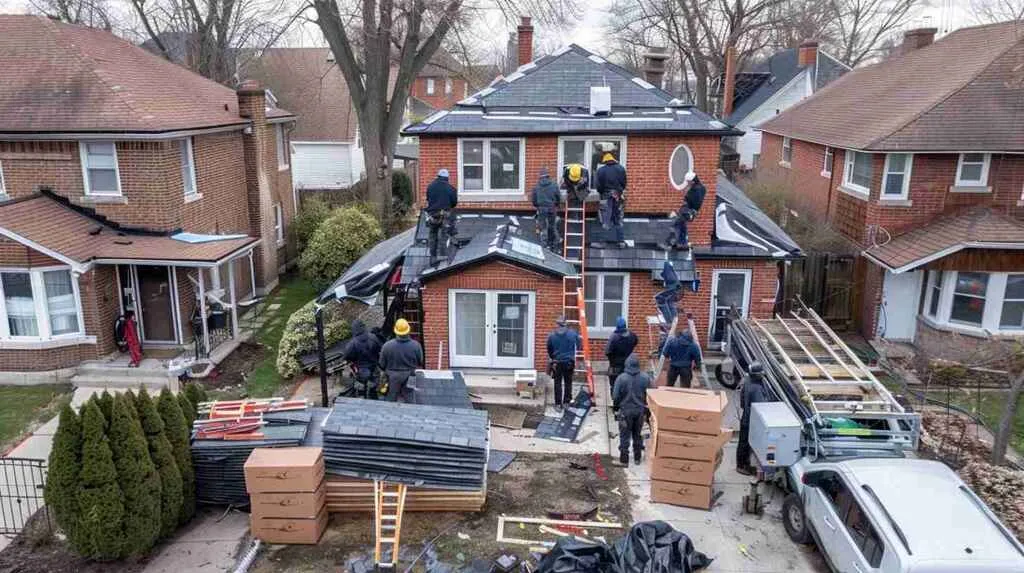
Wood Shingle Roof Replacement Queens NYC – Your Options Explained
Underneath that charming, silver-gray wood shingle roof in Queens-the one that makes your Tudor house look like it belongs in a storybook-there can be some of the worst rot, insect damage, and structural decay I’ve ever pulled back. Looks and lifespan almost never match when you’re talking about wood shingles in Queens, and I’m going to walk you through this roof like we’re examining a living organism: what’s really happening above your head, when you’re choosing planned replacement versus emergency, and what your actual options are when the time comes.
Why That “Pretty” Wood Shingle Roof in Queens Is Usually the Most Dangerous
Three blocks off Queens Boulevard, on a steep little Tudor with ivy crawling up the chimney, I showed a homeowner what I mean when I talk about roofs as living things. From the street, his cedar shingles looked perfect-that soft gray weathering that architects love, a few romantic curls along the ridgeline. But up close, those shingles were dying. Think of a tree with a hollow trunk: it still has bark, still puts out leaves in spring, looks fine until a windstorm snaps it clean through. That’s exactly what happens with old wood roofs in Queens. The outer “skin” can look charming while the structure underneath is suffocating, rotting, turning to pulp every time the humidity spikes or we get a freeze-thaw cycle. Your roof isn’t just sitting there like tiles-it’s breathing, or trying to, and Queens weather doesn’t make that easy.
One August afternoon in Forest Hills, about 3 p.m., the humidity was like soup and I was standing on a 1920s cedar shingle roof with a homeowner who swore the shingles were “fine, just quaint.” I took my moisture meter, pressed it into one gray, curled shingle, and it sank in like a thumb into a rotten peach. When I peeled it back, carpenter ants poured out and you could see daylight into the attic. That job taught me to never trust “it looks charming” when it comes to 40-year-old wood in Queens weather. The shingles had held their shape on the outside while the inside turned to cellulose powder, and the deck below was starting to sag. By the time most people notice a problem, they’re not looking at repairs-they’re looking at full wood shingle roof replacement plus structural fixes.
Here’s my blunt take: homeowners in Queens should judge their roofs the way a doctor judges a patient-not just the surface, but what’s underneath. Your shingles are skin. Your attic and venting system are lungs. You can have tanned, healthy-looking skin that hides pneumonia in the lungs, and that’s when people end up with surprise $40,000 bills instead of planned $25,000 replacements. Wood shingle roof replacement, done before the emergency hits, is almost always cheaper than riding out years of hidden rot, moisture intrusion, and the kind of insect activity that makes your attic sound like a maraca when you walk on it. Not romantic, but true.
| Myth | Fact in Queens, NY |
|---|---|
| “If the shingles still look charming from the street, the roof is fine.” | Gray, weathered shingles can be paper-thin and rotten underneath, especially after decades of Queens humidity and storms. |
| “Wood shingles last 40-50 years no matter what.” | In Queens, most cedar shingle roofs are already in the danger zone by 25-30 years due to moisture, pollution, and ice. |
| “A few curled shingles just mean it needs minor repair.” | Curling, cupping, and cracking are often signs the whole system is drying out and losing its protective ‘skin.’ |
| “If it’s not leaking inside, there’s no serious problem.” | By the time you see interior leaks, you may already have rot in decking, insulation damage, and insect activity. |
| “I can just add new shingles over the old ones.” | Layering over rotten wood is like putting a bandage over an infection-it hides the problem and traps moisture. |
Repair vs. Replacement: What Makes Sense for a Wood Shingle Roof in Queens
Here’s my honest take: if your wood shingle roof is over 25 years old in Queens, you are not choosing between “repair” and “replace”-you’re choosing between “planned” and “emergency.” There’s a real difference in how wood ages depending on where you are in Queens. Near-water neighborhoods like Bayside get salt air and more aggressive freeze-thaw cycles. Dense blocks in Jackson Heights or Astoria trap heat and humidity between buildings, cooking shingles from below when attics don’t vent right. Tree-heavy areas like Forest Hills get moss, shade, and constant moisture on north-facing slopes. All of it accelerates aging. If your roof hit 25 years and you’re still patching, you’re not buying time-you’re gambling that the next rainstorm or ice dam won’t find the weak spot before you do.
I’ll never forget a January morning in Bayside, 7:30 a.m., first snow of the year still on the cars, and I’m trying to find an ice dam source on a cedar shingle roof we hadn’t installed. The homeowner had added spray foam insulation the year before without venting, and the warm air was cooking the underside of the wood. We ended up doing a full wood shingle roof replacement plus a new venting system; I used steam from my own breath in the attic to show them exactly where the air was trapped. They told me later that visual made more sense than any technical diagram. The lesson: your roof needs to breathe like lungs, not be sealed up like a plastic bag. When you try to “fix” an old wood roof with modern insulation or cheap patch jobs, you can actually make it fail faster by trapping heat and moisture that has nowhere to go.
Should you repair or replace your wood shingle roof in Queens?
Start: Is your wood shingle roof older than 25 years?
- Yes → Do you see widespread curling, cracking, or patchy repairs?
- Yes → Plan a full wood shingle roof replacement.
- No → Has there been any leak, ice dam, or ceiling stain in the last 3 years?
- Yes → Schedule a replacement-focused inspection. Likely replacement within 1-3 years.
- No → Deep inspection & minor repairs may buy a few years, but budget for replacement soon.
- No (under 25 years) → Are problem shingles limited to one small area (like near a chimney or valley)?
- Yes → Targeted repair with moisture check of nearby shingles.
- No, issues all over → Early replacement plan to avoid deck damage.
At any point: if deck feels soft underfoot or you see interior sagging, skip repairs and go straight to a full replacement evaluation.
⚠️ Warning for Queens homeowners:
- Repeated small repairs on a 25+ year wood shingle roof can hide spreading rot in the original plank decking common in older Queens homes.
- Adding insulation or spray foam without rethinking roof ventilation can trap heat and moisture, accelerating shingle decay and voiding warranties.
- Ice dams from poor venting often show up as “mystery leaks” far from the actual problem area-by the time you notice, the damage is widespread.
Your Main Wood Shingle Roof Replacement Options in Queens (Explained Like a Care Plan)
When I walk up to a house, I look at the roof the way I used to look at stressed trees in Flushing Meadows-where is it drying out, where is it suffocating, where is it rotting from the inside? Once you know you’re doing a full replacement, you’ve got three main paths: install a new cedar shingle or wood shake system that recreates what you had, go with high-end architectural asphalt that’s designed to replace the wood look, or choose a synthetic/composite “cedar look” material that mimics the real thing. Each one is a different long-term care plan for your roof as a living organism. Real cedar needs more maintenance but weathers naturally and beautifully if you’re willing to tend it. Architectural asphalt is lower maintenance and still gives you texture and dimension from the curb. Synthetic composites resist rot and insects but don’t age the same organic way. There’s no “best” answer-just the answer that fits how you live and how long you’re staying.
There was a Saturday in late spring in Astoria, right before a kid’s birthday party, where I had three hours to fix what another contractor had started: they’d ripped half a wood shingle roof off and walked away when they realized the decking was plank, not plywood. I had to explain to the panicked parents why we couldn’t just “slap new shingles on” over the old nail holes without re-sheathing sections. We pulled tarps, stabilized the worst areas, and I spent the party explaining to guests why wood shingles need the right underlayment like plants need the right soil-otherwise you’re just decorating a problem. The base matters as much as the shingles. If your decking is old plank with gaps and decades of nail holes, or if your underlayment is torn felt from 1975, no shingle system-cedar, asphalt, or synthetic-will perform the way it should. You’re building on rotten soil.
| Option | Typical Lifespan in Queens | Looks From the Street | Breathability & Venting Needs | Best For |
|---|---|---|---|---|
| New Cedar Shingles/Shakes | 20-30 years if detailed correctly | Most authentic, natural weathering to silver-gray | High need for proper spacing, underlayment, and venting so the “roof can breathe” | Historic Tudors, landmark-style homes, owners who accept regular maintenance |
| Architectural Asphalt (Cedar-Style) | 25-35 years | Textured, dimensional look that can mimic wood from curb distance | Less sensitive than real wood but still needs venting so attic doesn’t overheat | Owners wanting lower maintenance with a classic look |
| Synthetic/Composite Cedar Look | 30-40+ years (product-dependent) | Very consistent, “fresh cedar” appearance for longer | System-specific; usually paired with modern underlayments and balanced venting | Long-term owners who want stability and resistance to rot/insects |
| Stay with Real Cedar | Switch to Asphalt or Synthetic |
|---|---|
|
Pros:
Cons:
|
Pros:
Cons:
|
What a Wood Shingle Roof Replacement in Queens Usually Costs and How It Actually Works
$18,000 to $60,000 is a realistic bracket for wood shingle roof replacements in Queens, and the actual number depends way less on just the shingles and way more on what we find when we open up the deck, how tight your lot access is, and whether we need to redesign venting or fix insulation mistakes. Think of it like deciding whether a tree just needs pruning or needs full cabling, soil amendments, and pest treatment-you don’t know the real scope until you look at the roots. A small 1.5-story Tudor in Forest Hills with moderate wear and good deck might land around $18,000 to $28,000 for architectural asphalt or basic cedar. A medium two-story detached in Bayside with ice-dam history, where we’re redesigning venting and adjusting attic insulation, could run $28,000 to $42,000. Larger homes or corner lots in Astoria where the decking is old plank and needs partial re-sheathing can hit $35,000 to $55,000. Historic-style homes near Queens Boulevard that want authentic new cedar with copper flashings and detail-heavy work can push $40,000 to $60,000 or more. These are ballpark ranges assuming we’re doing it right-not cut-corner, low-bid work that fails in five years.
Let me walk you mentally around your house, front yard to attic, so you can picture what happens during a real wood shingle roof replacement. First, we do an on-roof inspection with a moisture meter and an attic check-we’re looking for “hollow trunk” spots where the wood is rotten, measuring moisture levels, and reviewing your insulation and venting setup. Then we give you written options with photos that show exactly which areas are failing and translate shingle behavior into years of life and cost. Once you decide, we do a careful tear-off, removing old wood shingles down to the deck and protecting your landscaping and tight Queens side yards. Next comes deck repair and re-sheathing-we replace any rotten planks or upgrade sections to plywood where needed, no shortcuts. Then we install modern underlayments and design an intake/exhaust venting system so the roof can breathe like healthy lungs. Finally, we install your chosen shingle system-cedar, asphalt, or synthetic-with proper spacing, flashing, and detail work that matches your home’s architecture. The “lungs” (venting) and “skin” (shingles) have to be designed together, or you’ll be back here in ten years doing it all over again.
Typical wood shingle roof replacement scenarios in Queens, NY
| Home Type & Condition | Scope | Estimated Price Range |
|---|---|---|
| Small 1.5-story Tudor in Forest Hills with moderate wear | Full tear-off, limited deck repairs, new architectural asphalt or basic cedar | $18,000 – $28,000 |
| Medium 2-story detached in Bayside, ice-dam history | Full tear-off, venting redesign, attic insulation adjustments, new cedar or synthetic | $28,000 – $42,000 |
| Larger corner-lot home in Astoria with plank decking issues | Full tear-off, partial re-sheathing, upgraded underlayment, premium asphalt or composite | $35,000 – $55,000 |
| Historic-style home near Queens Boulevard wanting authentic cedar | Full cedar system, enhanced ventilation, copper/metal flashings, detail-heavy work | $40,000 – $60,000+ |
Note: These are ballpark ranges for Queens, NY and assume licensed, insured installation-not low-bid, cut-corner work.
Step-by-step wood shingle roof replacement process Shingle Masters follows in Queens
- On-roof inspection & attic check: Measure moisture in shingles and decking, look for “hollow trunk” spots where wood is rotten, and review insulation/venting.
- Written options & photos: Show you exactly which areas are failing, with photos that translate shingle behavior into years of life and cost.
- Careful tear-off: Remove old wood shingles down to deck, protecting landscaping and tight side yards common in Queens.
- Deck repair & re-sheathing: Replace rotten planks or upgrade sections to plywood where needed-no “slap new shingles on” shortcuts.
- Underlayment & venting system: Install modern underlayments and design intake/exhaust so the roof can breathe like healthy lungs.
- New shingle installation: Install chosen cedar, asphalt, or synthetic system with proper spacing, flashing, and detail work to match your home’s architecture.
How to Know When to Call for a Wood Shingle Roof Inspection in Queens
The first question I ask a customer standing in their driveway is simple: “How long do you plan to keep this house, and how much do you hate surprise leaks?” That tells me whether we’re looking at a long-term care plan or a short-term patch job. Even if your wood shingles still look pretty from the sidewalk, a 20-25-year-old roof in Queens deserves a professional inspection before you add insulation, paint interior ceilings, or assume you’ve got five more years-because Queens weather has a way of finding the weak spot the moment you stop paying attention.
Simple checks Queens homeowners can do before calling about wood shingle roof replacement
- ✅ Walk the sidewalk around your house and note any areas where shingles look darker, more curled, or patchy.
- ✅ Peek in the attic on a sunny day and look for pinholes of light or dark stains on the underside of the roof boards.
- ✅ After a hard rain, check ceilings and top-floor walls for new stains or musty smells.
- ✅ Gather any past roof paperwork or photos so we can see how the roof has changed over time.
Common questions Queens homeowners ask about wood shingle roof replacement
Can you replace my wood shingles in sections over a few years?
On newer roofs with isolated damage, sometimes yes. On older Queens roofs where shingles and decking are aging together, sectioning can create weak seams and mismatched layers, so we often recommend one carefully planned replacement.
Will I have to move out during a wood shingle roof replacement?
No. Most Queens homeowners stay in the house. It’s noisy for a few days, but we keep areas watertight at the end of each day and protect entryways.
Do you have to remove all the old wood shingles?
If we’re doing it right, yes. Leaving old shingles on is like leaving diseased bark on a tree-it can trap moisture, hide rot, and ruin your new system.
How long does a typical replacement take?
Most single-family Queens homes take 3-6 working days, depending on size, deck repairs, and weather.
Can you match the look of my current cedar if I switch to asphalt or synthetic?
We can get very close from the curb using specific architectural shingle lines or composites, and we’ll show you samples against your brick, stucco, or siding before you decide.
A wood shingle roof in Queens is like a living patient-it does best with planned care, not crisis surgery. If yours is past 25 years, showing signs of age, or you just want to know what you’re really dealing with before the next storm, call Shingle Masters to schedule a blunt, photo-documented inspection and a clear replacement plan that fits your house, your budget, and how long you’re staying.