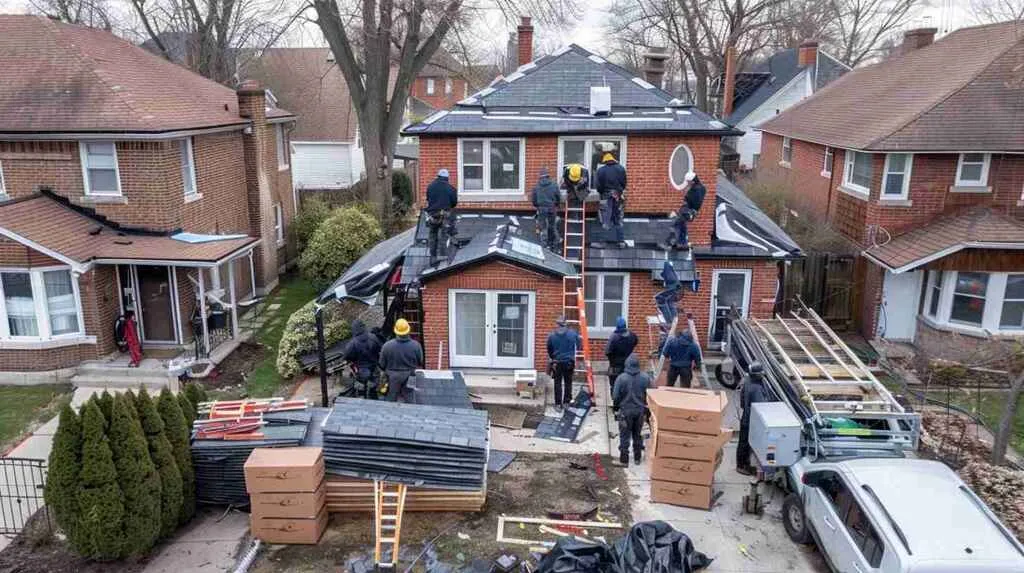
Asphalt Roof Replacement Queens NY – Quality from Start to Finish
Blueprint in plain terms: On a typical two‑family in Queens, asphalt roof replacement runs between $9,000 and $18,000, and the real driver isn’t square footage-it’s what we find when we peel back the layers. I’m talking about the condition of the decking underneath, how many old shingle layers are stacked up like subway lines nobody’s mapped, and whether we can even get a dumpster onto your narrow street without blocking half the block. Carlos Mejía here-I’ve been tearing off and replacing asphalt roofs across Queens for 17 years, and I explain everything in the same plain language I’d use if we were standing on your stoop together, pointing up at your ridge line.
What Asphalt Roof Replacement Really Costs in Queens, NY
On a typical two‑family in Queens, you’re looking at somewhere between $9,000 and $18,000 for a complete asphalt roof replacement, labor and materials included. That’s not a number I pull out of thin air-it’s based on what I actually see when I climb onto houses in Jackson Heights, Astoria, and Forest Hills. The honest truth is, the price swings depending on how many layers of old shingles we’re pulling off (think of it like peeling back multiple subway lines nobody realized were running under the first one), whether the plywood decking underneath is solid or spongy, and whether your side street can fit a dumpster without turning into a traffic disaster. A simple ranch with one layer and good bones lands on the lower end; a two‑story with three generations of shingles, rotten spots, and a steep pitch pushes toward the higher number, and sometimes beyond if we’re replacing whole sheets of decking.
One August afternoon in Jamaica, it was 96 degrees and the shingles on this two‑family house were so brittle they snapped like crackers when I touched them. The homeowner kept insisting we could “just fix the soft spots,” so I brought him up on the ladder landing, let him feel the spongy decking under his own feet, and showed him the dark pattern where water had been running under the shingles for months. That was the day I learned that sometimes the only way to explain an asphalt roof replacement is to literally put someone where the problem is and let the roof speak for itself. Here’s the thing-no contractor can give you an honest price over the phone because until we’re up there, we don’t know if you’ve got one layer or four, solid plywood or something that feels like a wet cardboard box. That’s why I always start with a real inspection, feet on the roof, photos in hand, before I quote a single dollar.
Asphalt Roof Replacement Price Calculator – Queens, NY Scenarios
These are ballpark estimates for asphalt shingle replacement in Queens, including labor and basic materials. Does not include major structural repairs, permit fees, or specialized flashing upgrades.
| House Type & Situation | Approx. Roof Size | Layers to Remove | Decking Condition | Estimated Price Range |
|---|---|---|---|---|
| Small ranch, good access | 1,200 sq. ft. | 1 layer | Solid plywood | $9,000-$11,000 |
| Two‑family, narrow driveway | 1,800 sq. ft. | 2 layers | Some soft spots | $12,000-$15,000 |
| Colonial with dormers, steep pitch | 2,200 sq. ft. | 1 layer | Good, minor repairs | $13,000-$16,000 |
| Older two‑story, shared alley access | 2,000 sq. ft. | 3 layers | Multiple rotten sheets | $15,000-$19,000 |
| Complex roof, multiple valleys & chimneys | 2,500 sq. ft. | 2 layers | Fair, patchy repairs needed | $16,000-$21,000 |
Quick Facts – Shingle Masters in Queens
| Years Roofing in Queens | 17 years, all neighborhoods from Astoria to Jamaica |
| Typical Job Completion | Same‑day tear‑off and install on most residential roofs |
| Licensing & Insurance | Licensed in NYC, fully insured, DOB‑compliant permits pulled when needed |
| Warranty Coverage | Manufacturer shingle warranty plus our labor guarantee; exact terms in every written quote |
How I Replace an Asphalt Roof From First Visit to Final Nail
Here’s my honest take: a solid asphalt roof replacement in Queens is about tight planning, fast execution, and making sure your neighbors’ driveways and gardens stay in one piece even when we’re working on a lot the width of a subway car. I’ll never forget a January job in Astoria where we opened up an old asphalt roof at 7 a.m. and found three different layers of shingles stacked like a lasagna, with newspapers from 1984 still under the first one. The forecast said clear skies, but a surprise snow squall rolled in around 11, so we had to tarp the whole thing in 15 minutes flat and work in tight rotations to keep the plywood dry. That experience made me borderline paranoid-in a good way-about weather and scheduling; now, when I tell a customer we’re stripping down to the deck and finishing the same day, it’s because I’ve lived through what happens when you don’t plan for the “what ifs.” Around neighborhoods like Astoria, Elmhurst, and Jackson Heights, where driveways barely fit one car and overhead utility wires crisscross every block, we stage materials on the street early, coordinate with neighbors, and clean up tight so nobody’s left tripping over nails or shingle scraps.
The whole process-from the moment I knock on your door to the final walkthrough where I hand you a USB stick full of before‑and‑after photos-is built around transparency and speed. You’ll see every step documented, every decision explained, and every piece of debris gone by the time the sun sets on installation day. Picture it: nail guns shutting off at dusk on a quiet Queens side street, your new roof lines clean and sharp against the evening sky, and a dumpster already scheduled for pickup in the morning. Now here’s why that matters when you’re planning your own roof timeline-you want a crew that treats your narrow lot and close neighbors with the same care they’d want on their own block, and you want it done fast enough that one surprise rainstorm doesn’t turn into a week of tarps and stress.
Exact Steps – Asphalt Roof Replacement Process in Queens
This is what happens when you hire Shingle Masters, from inspection to cleanup. Each step is written as if I’m walking you around your own house.
| Step | What Happens | Why It Matters in Queens |
|---|---|---|
| 1 | I climb onto your roof with a camera and a moisture meter, check every slope, valley, and flashing joint, and document what I find with photos and notes. | On tight Queens lots with shared walls, hidden issues like improper flashing or ventilation can cause leaks into adjoining units if not caught early. |
| 2 | I write a detailed quote listing every line item-tear-off, decking repairs, shingles, underlayment, flashing, vents, cleanup-and explain which options are must-haves versus nice-to-haves. | You know exactly what you’re paying for, and you can budget for surprises (like extra rotten plywood) without panic when we open things up. |
| 3 | We schedule a start date with a tight weather window, deliver materials the evening before, and arrange dumpster placement with your block’s parking rules in mind. | Queens streets are narrow and permit-sensitive; coordinating ahead means we’re not blocking hydrants or creating neighbor drama on install day. |
| 4 | Early morning tear-off starts: we strip old shingles down to the plywood, inspect every inch of decking, replace any soft or rotten sheets, and sweep/haul debris continuously so nothing piles up. | Same-day tear-off and install protects your home from sudden rain and keeps the disruption short-you’re not living under tarps for days. |
| 5 | We install new underlayment (ice & water shield in valleys and eaves, synthetic felt everywhere else), new drip edge, step flashing around chimneys and walls, and any needed vents or pipe boots. | Proper underlayment and flashing are what actually keep water out; skimping here is why some “cheap” roofs leak within a year. |
| 6 | Shingles go on in straight, even courses from eaves to ridge, with careful attention to alignment, nail placement, and sealing around all penetrations; ridge cap shingles finish the top line. | A clean, symmetrical shingle layout looks sharp from the street and signals quality work to future buyers or inspectors. |
| 7 | We walk the property with magnets to pick up stray nails, blow off your sidewalk and driveway, hand you a folder with warranty docs and installation photos, and haul away the dumpster within 48 hours. | On Queens blocks with kids and pets, a magnetic sweep and thorough cleanup isn’t optional-it’s basic respect for your family and neighbors. |
Why Queens Homeowners Trust Shingle Masters
| Licensed in NYC | All required city licenses, DOB permits pulled when code requires, full compliance with NYC building regs. |
| Fully Insured | General liability and workers’ comp coverage protects your property and our crew; certificates provided before work starts. |
| 17+ Years in Queens | Every neighborhood, every roof type, every curveball Queens weather and architecture can throw-I’ve seen it and handled it. |
| Photo Documentation | Before, during, and after shots delivered digitally so you (and your insurance or future buyers) know exactly what was done. |
| Bilingual & Neighbor-Focused | I communicate clearly in English and Spanish, and I plan every job around tight city lots-protecting gardens, driveways, and shared spaces like they’re my own. |
Do You Need Patches or a Full Asphalt Roof Replacement?
If we were standing on your sidewalk right now, I’d ask you this: when you look up at your roof from the street, do you see a single color and texture, or does it look like a patchwork quilt with different shades where someone kept slapping new shingles over old problems? Are the edges of the shingles lying flat, or are they curling up like potato chips left in the sun? And if you walk around to the side of your house, can you spot any sections where the roofline sags or dips instead of running straight and true? Those are the visual cues I look for before I even pull out a ladder, and here’s an insider tip: instead of climbing a shaky extension ladder yourself, use your phone’s zoom or a pair of binoculars to get a close look at the shingles-you’re checking for bald spots where the granules have worn off, dark streaks that signal algae or moisture, and any shingles that are cracked, missing, or visibly lifting at the corners. A couple of years ago in Flushing, I took over an asphalt roof replacement that another contractor had walked off from halfway through. It was a Sunday, right after church let out, and the homeowner’s parents were in the kitchen making arepas while water was literally dripping into a bucket behind the stove. When I pulled one of the “new” shingles off, I saw they had reused a rotten piece of flashing and just smeared it with cheap mastic; the water was basically being funneled into the house. That job reminded me why I take photos at every stage and show them to the owners-trust isn’t built by promises, it’s built by letting people see what’s under their own roof, because sometimes what looks like a simple patch job on the surface is actually a full replacement screaming to happen underneath.
Deciding between a patch and a full tear-off is like choosing whether to stay on Queens Boulevard or cut through the side streets-both can get you home, but one route makes sense only if the conditions are right, and the other is the smart move when you know the main drag is a mess. The decision tree below walks you through the key questions I ask every homeowner, starting with the big ones (age, leaks, visible damage) and narrowing down to whether you’re looking at “monitor and maintain,” “plan a replacement in the next year or two,” or “call me today because this roof is actively failing.”
Decision Tree – Is It Time for Full Asphalt Roof Replacement?
Answer these questions honestly, following the Yes/No branches. You’ll end up at one of three outcomes: Monitor, Schedule Replacement Soon, or Call for Urgent Replacement.
| Question / Condition | If YES → | If NO → |
|---|---|---|
| Is your roof 20+ years old? | Go to next question | Skip to “Do you have active leaks?” |
| Do you see widespread curling, cracking, or bald spots on shingles? | Outcome: Schedule Replacement in Next 1-2 Years | Go to “Do you have active leaks?” |
| Do you have active leaks inside your home (stains, drips, wet insulation)? | Go to “Multiple leaks or one isolated spot?” | Go to “Have you patched the roof multiple times in past 5 years?” |
| Multiple leaks in different areas, or one that keeps coming back? | Outcome: Call for Urgent Replacement | Isolated leak may be repairable; schedule inspection to confirm scope |
| Have you patched the roof multiple times in the past 5 years? | Outcome: Schedule Replacement in Next 1-2 Years (patches are band-aids on a failing system) | Go to “Can you see sagging or soft spots?” |
| Can you see sagging rooflines, soft spots when you walk on the roof, or visible rot around edges? | Outcome: Call for Urgent Replacement (structural issues require immediate attention) | Go to final question |
| Are shingles mostly intact, roof under 15 years old, no leaks, minimal wear? | Outcome: Monitor & Maintain (annual inspections, keep gutters clean, check after storms) | Schedule professional inspection to assess borderline condition |
🚨 Urgent: Call Shingle Masters Now
- Active leaks dripping into living spaces, bedrooms, or kitchen
- Major shingle loss after a storm (20+ shingles missing or blown off)
- Visible sagging or structural soft spots you can feel when walking the roof
- Water stains spreading rapidly on ceilings or running down interior walls
📅 Can Wait a Few Weeks
- Roof is 15-20 years old with minor curling or granule loss but no leaks yet
- Moss or algae growth (cosmetic issue, but worth addressing during next replacement)
- A few cracked or missing shingles in non-critical areas (can patch temporarily)
- Planning a home sale or refinance and want a pre-listing roof inspection
What Really Drives Asphalt Roof Cost Up or Down in Queens
The blunt truth, from someone who’s torn off hundreds of asphalt roofs, is this: the biggest cost jumps happen when we peel back the first layer and discover things nobody expected. I’m talking about two or three extra layers of shingles stacked underneath like subway lines nobody’s mapped-each one has to be stripped, hauled, and dumped, which adds labor hours and dumpster fees. Then there’s the plywood decking: if it’s spongy, dark, or cracked when we expose it, we’re not just nailing new shingles over a problem waiting to explode; we’re replacing sheets of plywood at roughly $60-$80 per sheet installed, and on a typical Queens two-family that can mean ten to twenty sheets if the previous owner let leaks run for years. Roof complexity matters too-if your house in Forest Hills or Bayside has multiple dormers, valleys, chimneys, or a steep pitch that requires extra staging and safety gear, that’s more time, more careful flashing work, and higher cost. Think of it like this: a simple gable roof is the equivalent of a straight shot down Northern Boulevard, while a complex hip roof with three chimneys and a turret is more like navigating the side streets of Jackson Heights during alternate-side parking-it gets you there, but it takes more attention, more skill, and more time.
Think of Your Roof Like Queens Boulevard at Rush Hour
Think of your roof like Queens Boulevard at rush hour: when ventilation is good and water flows cleanly off the slopes into gutters and downspouts, everything moves smoothly and your shingles last their full 25 or 30 years. But when ventilation is blocked-like traffic backing up because one lane is closed-heat and moisture get trapped in your attic, cooking the shingles from below and cutting their lifespan in half. Water behaves the same way: if your valleys and flashing aren’t installed right, water finds shortcuts, sneaking under shingles and into the decking like a delivery truck cutting through a residential side street to avoid the main drag. Those shortcuts cause rot, mold, and expensive surprise repairs that could’ve been avoided with proper installation from the start. And here’s the kicker: spending a few hundred dollars more upfront on quality underlayment, proper ventilation baffles, and code-compliant flashing will save you thousands compared to doing a cheaper “overlay” job that hides problems for two years and then forces a full emergency replacement when the whole thing fails. I’d rather you pay once for a roof done right than twice for a roof done fast and cheap.
Key Cost Factors – Asphalt Roof Replacement in Queens
| Cost Factor | Low-Impact Scenario | High-Impact Scenario | What Carlos Recommends |
|---|---|---|---|
| Layers to Remove | One layer of shingles, easy tear-off | Three layers, extra labor & dump fees, potential decking damage from weight | Always strip to bare deck-overlays hide problems and shorten new roof lifespan |
| Access & Staging | Wide driveway, street parking available, single-story | Narrow shared alley, overhead wires, two-story with steep pitch requiring scaffolding | Plan staging carefully; tight Queens lots need permits, neighbor coordination, extra safety gear |
| Roof Pitch (Slope) | Low to moderate pitch, walkable without harnesses | Steep pitch (8/12 or higher), requires toe boards, harnesses, slower install | Steep roofs look great but cost more in time and safety-budget accordingly |
| Decking Condition | Solid plywood, maybe one or two small repairs | Multiple rotten sheets, sagging, entire sections need replacement | Replace every soft or rotten sheet now-nailing shingles to bad plywood is asking for callbacks |
| Material Grade | Basic 3-tab shingles, 20-year warranty, budget choice | Architectural shingles, 30-50 year warranty, better wind/hail rating, more curb appeal | Architectural shingles are worth the $1,500-$2,500 extra for longevity and resale value on Queens homes |
Pros & Cons – Quick Patches vs Full Asphalt Roof Replacement
| Option | Pros | Cons |
|---|---|---|
| Repeated Patches / Overlay |
• Lower upfront cost ($500-$2,000 per patch) • Can extend roof life by 2-5 years if underlying structure is sound • Minimal disruption, done in a few hours |
• Hides ongoing decking rot and ventilation problems • Patchwork appearance hurts curb appeal and resale value • Eventually forces emergency replacement when hidden issues fail • Total cost of multiple patches often exceeds one proper replacement |
| Full Tear-Off & Replacement |
• Exposes and fixes all hidden decking, flashing, and ventilation issues • 20-30 year lifespan with proper materials and install • Uniform appearance, major boost to home value • Transferable warranties give buyers confidence |
• Higher upfront investment ($9,000-$21,000 typical range in Queens) • 1-2 day disruption with noise, staging, dumpster on street • Requires planning around weather and permits in some cases |
Straight Answers to Common Queens Asphalt Roof Questions
I still remember one roof in Woodside where we pulled off what looked like a perfectly fine layer of architectural shingles, only to discover an entire attic with zero ventilation and insulation so wet it squished like a sponge when you touched it-homeowner had no idea because the previous roofer just slapped new shingles over the mess. That’s why homeowners naturally have a lot of questions about what’s actually happening above their heads, how messy it’ll be, whether their neighbors will hate them for a week, and what kind of warranty they’re really getting. Skim the FAQs below for no-nonsense answers straight from someone who’s done this a few hundred times across every Queens neighborhood you can name.
FAQs – Asphalt Roof Replacement with Shingle Masters in Queens
How long does a typical asphalt roof replacement take in Queens?
For most single- or two-family homes in Queens (1,200-2,200 sq. ft.), we tear off the old roof and install the new one in a single day, weather permitting. We start early-around 7 a.m.-to beat the heat and finish before dark, usually wrapping up cleanup by 5 or 6 p.m. If we uncover significant decking damage or the forecast turns ugly mid-job, we’ll tarp overnight and finish day two, but same-day completion is the norm and the goal because nobody wants to live under tarps if a surprise storm rolls in.
How noisy and messy is an asphalt roof replacement on a Queens block?
Not gonna lie-it’s loud. Tear-off involves pry bars scraping on plywood, shingles sliding into a dumpster, and nail guns firing all day during install. If you work from home or have young kids napping, plan to be somewhere else for the day or wear noise-canceling headphones. As for mess, we contain debris with tarps around the dumpster, use magnets to sweep the yard and driveway for stray nails, and blow off your sidewalk and stoop before we leave. On narrow Queens streets where neighbors park bumper-to-bumper, we stage materials carefully and communicate with adjacent homeowners so nobody’s car gets dinged or their garden trampled. It’s disruptive for one day, but we treat your block like our own family lives on it.
How do you protect neighbors’ property on tight Queens lots?
In neighborhoods like Astoria, Elmhurst, and Jackson Heights, houses are close-sometimes just a few feet apart-and driveways, gardens, and AC units are right up against the work zone. We lay plywood walkways to protect landscaping, tarp adjacent porches and cars if they’re within the “drop zone,” and hand-carry materials when a dumpster chute would blow debris onto a neighbor’s roof. I always knock on doors the day before to introduce myself, explain the timeline, and give neighbors my cell number in case something comes up. Shared walls and tight alleys are part of Queens life; respecting that isn’t optional, it’s just how you do business here without making enemies.
Do I need permits from NYC DOB for an asphalt roof replacement?
In most cases, a straightforward asphalt shingle tear-off and replacement on a one- or two-family home in Queens does not require a DOB permit-it’s considered ordinary repair and maintenance. However, if we’re doing major structural work (replacing rafters, adding new roof framing, or significantly altering the roofline), or if your house is in a landmark district, permits may be required. I assess this during the initial inspection and let you know upfront; if a permit is needed, I handle the filing, pay the fees (which get added to your invoice), and make sure inspections are scheduled. The city takes illegal work seriously, and the last thing you want is a violation notice or trouble when you go to sell, so I do it by the book every time.
What kind of warranty do I get on my new asphalt roof?
You get two warranties: one from the shingle manufacturer (typically 25-50 years depending on the product grade you choose, covering defects in the shingles themselves) and one from Shingle Masters on the labor and installation (I stand behind my work for a minimum of 5 years, longer on some jobs). The manufacturer warranty is transferable if you sell your house, which is a selling point buyers love. My labor warranty covers things like leaks caused by improper flashing, missed nails, or installation errors-basically, if I messed up, I come back and fix it at no charge. I put all of this in writing in your contract, along with the exact shingle brand, model, and warranty registration info, so there’s zero confusion down the road. And here’s a tip: keep your warranty docs and the photos I give you in a folder labeled “Roof 2024” or whatever year we do the job-you’ll thank yourself when you go to sell or file an insurance claim five years later.
Simple Upkeep Timeline – Keep Your New Asphalt Roof in Top Shape
Once we finish your asphalt roof replacement, these basic maintenance tasks will help it reach its full 25-30 year lifespan in Queens’ climate.
| Time After Installation | Recommended Task | Why It Matters in Queens |
|---|---|---|
| First 6 Months | Walk around your house after the first big rainstorm and check attic for any signs of moisture; look at ceilings inside for stains. | Catches any rare installation issues early while labor warranty is fresh; gives you peace of mind that everything sealed properly. |
| Every Spring & Fall | Do a quick visual check from the ground (or zoom with your phone): look for lifted shingles, clogged gutters, debris in valleys. | Seasonal inspections catch small issues (a lifted corner, a clogged downspout) before they turn into leaks or ice dam problems in winter. |
| 2-3 Times Per Year | Clean gutters and downspouts, especially after fall leaves drop and spring pollen/seed season; trim any tree branches hanging within 6 feet of roof. | Clogged gutters cause water to back up under shingles and rot fascia boards; overhanging branches drop debris, hold moisture, and invite squirrels onto your roof. |
| Every 3-5 Years | Schedule a professional roof inspection (I offer these for existing clients at a discount) to check flashing, sealant around vents, and overall shingle condition. | Pro eyes catch things homeowners miss-early curling, failed caulk, or a single compromised flashing joint-and fixing them costs $200 instead of $2,000 later. |
Whether you’re seeing a few curled shingles in Bayside or you’ve got buckets catching leaks in your Flushing kitchen, Carlos and Shingle Masters can walk your specific Queens house through a clear asphalt roof replacement plan from start to finish-honest pricing, tight timelines, photos at every stage, and a final product that makes your block look twice. Call Shingle Masters for a straightforward on-roof inspection and written quote; I’ll show you exactly what’s up there, explain what needs to happen and why, and give you options that fit your budget and timeline with zero pressure and zero surprises when we open things up.