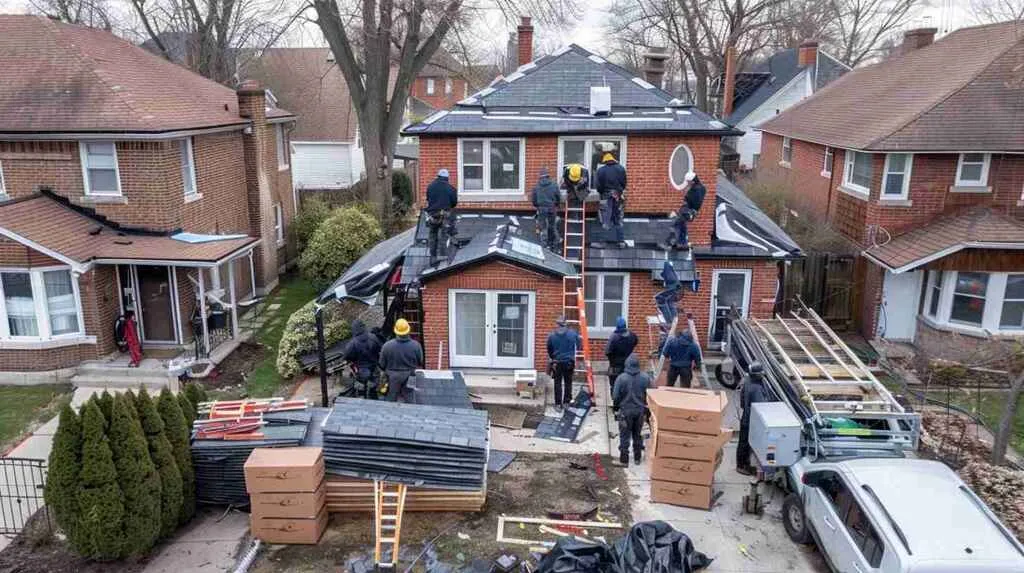
Wood Shingle Roof Lifespan Queens NY – How Long Do They Last? | Free Quotes
Layers of cedar that a salesperson swears will last three decades often start cracking, curling, and leaking somewhere around year 15 in Queens. I’ve spent nineteen years on these roofs, and I’ll tell you straight: unless you’re treating your wood shingles like a classic car-regular maintenance, perfect ventilation, careful tree management-you’re looking at about 15 to 20 years of real life, not the 30 printed on the brochure.
How Long Wood Shingle Roofs Really Last in Queens, NY
One August afternoon in 2021, I was on a steep little Tudor in Forest Hills, sweat running into my eyes, looking at cedar shingles that were only 11 years old but cracking like potato chips. The homeowner kept saying, “But the guy who sold this said 30 years!” I had to walk him shingle by shingle, showing how the south-facing slope had gone silver and fuzzy, then split from UV and lack of ventilation in the attic. We ended up rebuilding the whole south side and adding hidden intake vents-first time I watched someone go from angry to relieved just by understanding why their wood roof aged so fast. Here’s my blunt opinion: in Queens, “30-year” wood roofs are really 15-20 year roofs unless you baby them. Those manufacturer numbers don’t account for our reality-they’re testing in ideal conditions, not on a windswept two-family near the Grand Central where salt air, UV, and rapid temperature swings hit your roof like constant sun on unprotected skin.
Untreated cedar shingles in Queens? Expect 12 to 18 years before serious problems show up. Treated cedar with decent care? You’ll stretch it to 18 to 25 years. But a poorly ventilated roof, even with premium shingles, starts showing real damage by year 10. Queens wind, salt air off the water, and relentless UV work on a roof exactly like sun on your skin-speeding up wrinkles, cracks, and those dark “age spots” where algae and moss grab hold. The shingles on the sunny slope literally age twice as fast as the shaded north side, splitting and curling while the back of the house still looks fine.
| Roof Type & Care Level | Brochure / Sales Claim | Realistic Lifespan in Queens, NY | Carmen’s Notes |
|---|---|---|---|
| Premium Treated Cedar, Well Maintained | 30-40 years | 20-25 years | Only if you trim trees, clean gutters twice a year, and your attic breathes right |
| Standard Cedar, Average Care | 25-30 years | 15-20 years | What I see on most Queens houses-good years, then a slow slide into problems |
| Untreated Wood Shingles, Normal Care | 20-25 years | 12-18 years | Sun and moisture chew through these faster than people expect |
| Any Wood Shingles, Poor Ventilation | 20-30 years | 10-15 years | Trapped heat and moisture cook shingles from underneath-this kills roofs early |
Wood Shingle Lifespan Snapshot – Queens, NY
Sun, Shade, and Queens Weather: Why One Side of Your Roof Ages Faster
I’ll never forget a cold, wet Saturday morning in November 2017 in Bayside, climbing up to check what the owner swore was a “leak in the new roof.” Turned out the wood shingles were 26 years old, patched a dozen times, and the “new part” was just a few replacement bundles around a chimney. When I peeled back a course, I found moss, carpenter ants, and a layer of felt that crumbled like burnt toast. That was the day I started telling every customer that once you’ve passed that 20-year mark on wood, you either budget for replacement or you’re budgeting for surprises inside your walls. What I see in Bayside or Whitestone near the water differs from deeper inland neighborhoods like Middle Village-the salt breeze and constant humidity near the shore push wood shingles harder, and Nor’easters hit those coastal blocks first, driving water under curled edges and into gaps that might stay dry a mile inland.
Think of your wood shingle roof like a person’s skin in the sun. The south-facing slope gets a harsh “sunburn” every summer day-UV breaks down the lignin in the wood, shingles turn gray, then crack and curl like dried leather. Meanwhile, the shaded north side stays damp like skin that never fully dries after a shower, creating perfect conditions for moss, algae, and slow rot. This uneven aging is completely normal in Queens, and you can predict it by looking at how your house sits relative to the sun and nearby trees. A roof with one slope baking in afternoon sun and the other under a big oak will show a ten-year difference in wear between the two sides.
| Myth | Fact |
|---|---|
| ❌ Wood shingle roofs age evenly across all slopes | ✅ Sun-facing slopes age twice as fast as shaded sides in Queens-10+ year difference is common |
| ❌ Gray shingles are just cosmetic aging, not a problem | ✅ That gray color means the protective lignin is gone-cracks and leaks follow within 2-3 years |
| ❌ If it’s not leaking, the roof is still good | ✅ By the time you see a leak inside, there’s often hidden rot in the deck and framing |
| ❌ The manufacturer’s lifespan applies to Queens weather | ✅ Those numbers assume ideal conditions-Queens salt air, humidity, and freeze-thaw cycles cut years off |
Care vs Neglect: How Maintenance Adds (or Steals) 5-10 Years
One windy spring evening in 2014, right before sunset, I inspected a Cape in Whitestone where a meticulous retired engineer tracked every bit of maintenance in a spreadsheet. His cedar shingles were 24 years old and looked better than a lot of 12-year roofs I see-because he had the trees trimmed back every three years, cleaned the gutters religiously, and never let debris sit on the roof. We stood up there in our jackets, looking over the East River, going line by line through his “roof log” and I used his place for years as my example of how care can add 5-10 extra years to a wood shingle roof’s life. Here’s my insider tip, straight from that Whitestone job: schedule tree trimming and gutter cleaning like dentist appointments-on a fixed calendar, twice a year, no exceptions. Skipping those two tasks is what usually steals five years from a wood roof, because branches scrape off the protective surface and clogged gutters let water back up under the bottom course.
Regular simple tasks-keeping debris off, making sure shingles can “breathe,” checking flashings around chimneys-let the roof’s “skin” dry out between storms. That circulation is everything. A roof that dries fast after rain can go 24 years; the same shingles on a house with leaves piled in the valleys and moss growing in the shade might need replacement at 16. It’s the difference between a roof that breathes and one that’s suffocating under its own buildup.
📅 Wood Shingle Roof Maintenance Schedule for Queens Homeowners
| Task | Recommended Interval | Why It Matters for Lifespan |
|---|---|---|
| Gutter Cleaning | Spring & Fall (twice yearly) | Prevents water backup that soaks bottom shingle courses and rots eaves |
| Debris Removal from Roof Surface | After every major storm | Wet leaves and branches trap moisture, causing soft spots and rot |
| Professional Inspection | Every 3 years (every year after 15) | Catches curling, cracking, and hidden damage before it becomes a leak |
| Tree Trimming (Overhanging Branches) | Every 2-3 years | Eliminates constant shade and abrasion that speeds up aging and damage |
| Wood Treatment or Conditioning | Every 5-7 years (optional) | Restores natural oils, slows UV damage, can add 3-5 years to overall lifespan |
✓ Simple Habits That Extend Wood Shingle Roof Life
Is It Time to Repair or Replace Your Wood Shingle Roof?
$5,000 later, most folks tell me they wish they’d called when the shingles first started curling. Waiting until you see a leak inside usually means you’re not just replacing shingles-you’re fixing decking, framing, maybe even drywall.
When I first step onto a wood shingle roof, the first question in my head is, “How fast does this thing get wet and how fast can it dry?” I mentally “grade” a roof like a report card-A to F-based on age, visible damage, and whether I can feel soft spots when I walk across it. Most Queens wood roofs start slipping from a B to a C somewhere between 15 and 20 years: shingles are still holding on, but you can see the cracks spreading, the curls getting worse, maybe a small leak that only shows up during a hard northeast rain. That’s your warning window.
Once the roof’s “skin” is cracked, curled, or constantly damp, you’re either paying for a new roof or paying for interior damage-there’s no third option. A quick professional look can tell you which path you’re on and how much time you’ve got before the decision gets made for you by a ceiling stain or a collapsed section of deck.
🔀 Repair vs Replace for Wood Shingle Roofs in Queens
| Question / Condition | Yes → | No → |
|---|---|---|
| Is your roof 20+ years old? | ⬇️ Replace | ⬇️ Keep checking |
| Do you have active leaks or water stains inside? | ⬇️ Replace | ⬇️ Keep checking |
| Are more than 30% of shingles curled, cracked, or missing? | ⬇️ Replace | ⬇️ Consider repair |
| Can you feel soft or spongy spots when walking the roof? | ⬇️ Replace | ⬇️ Consider repair |
| Is damage isolated to one slope or section? | ⬇️ Repair may work | ⬇️ Replace |
| Are you planning to stay in the house 5+ more years? | ⬇️ Replace now | ⬇️ Patch and monitor |
What to Check Before You Call for a Wood Roof Quote in Queens
I still think about a little semi-attached in Astoria where the north side shingles told me the whole story. Take a quick “skin check” of your house from the sidewalk or attic-don’t climb up yourself-so you can talk specifics when you call Shingle Masters. Even a five-minute look from the ground helps me give you a clearer, more honest opinion over the phone about whether you need a full inspection this week or if you’ve got a season or two to plan.
✅ 5-Minute Wood Shingle Roof Pre-Call Check for Queens Homeowners
| Item | How to Check Safely |
|---|---|
| Look for Curling or Cracking | Stand across the street and look at the roof with binoculars-check if shingle edges are lifting, curling up, or if you see visible cracks |
| Check Gutters for Debris | Look in gutters from a ladder at the edge-wood chips, granules, or pieces of shingle mean the roof is shedding |
| Inspect the Attic | Go into your attic on a sunny day-look for pinholes of light coming through the roof deck, water stains, or damp insulation |
| Note Last Replacement Date | Check your home records, ask the previous owner, or look for a permit sticker in the attic-knowing the roof age helps enormously |
| Take Photos from the Ground | Use your phone to snap pictures of all four sides of the roof, any dark streaks, and close-ups of problem areas-send them when you call |
❓ Common Questions About Wood Shingle Roof Lifespan in Queens, NY
Why Queens Homeowners Call Shingle Masters for Wood Roofs
Here’s the truth nobody puts in the brochure: Queens weather chews on wood differently than it does upstate. Your wood shingle roof is aging right now-sun on one side, damp on the other, salt in the air working into every crack. Let me give your roof an honest “report card” so you know exactly where you stand: whether you’ve got five good years left, whether a repair buys you time, or whether it’s time to budget for replacement before a small problem becomes an expensive surprise inside your walls. Call Shingle Masters today or request a free quote-I’ll come take a look, talk you through what I see, and give you options that make sense for your house and your budget.