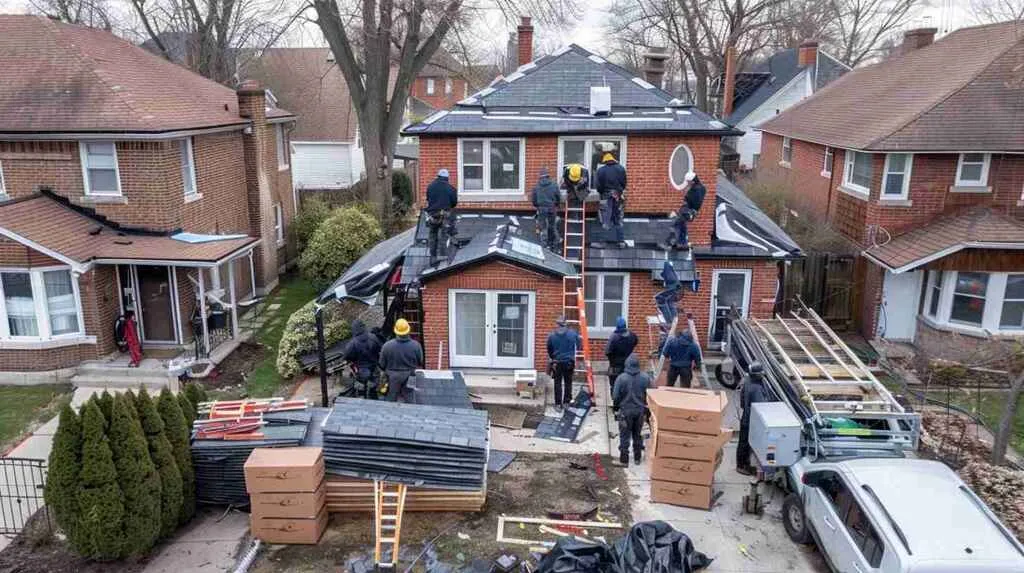
Find a Shingle Roof Leak Queens NYC – Track It Back to the Source
Spill coffee on your kitchen table and it spreads in a predictable puddle. A leak in a shingle roof doesn’t work like that-it runs uphill, sideways, along rafters and pipes, before it finally drips out somewhere that makes you look in the completely wrong spot. The brown ring staining your bedroom ceiling in Queens is just the “output” of the leak; the real “input”-that cracked vent boot or loose flashing-might be eight feet upslope and two penetrations over, invisible from the street and nowhere near where you’re pointing your flashlight.
Follow the Drip Path: Why the Leak You See Isn’t the Leak You Have
Here’s my honest opinion: most homeowners waste hours staring at the wrong part of the roof. They see a ceiling stain, they grab a ladder, they climb up and eyeball the shingles directly above, and they find nothing because the actual entry point is three penetrations upslope near a plumbing vent they never bothered to check. A leak behaves like a noisy signal path in a mix: water is the input, your roof framing and attic are the messy circuit, and that drip in your living room is the output. If you only look at the speaker cone-the ceiling stain-you’ll never find the loose cable causing the buzz at the preamp stage.
One February night around 11:30 p.m., during one of those sideways-rain Nor’easters, a lady in Jackson Heights called sobbing because water was dripping out of her ceiling light over the crib. Three companies had already “fixed” her roof in the last two years. I stood in her living room with my flashlight off, just listening to where the drips were hitting the floor, then went up in the attic and followed the sound and the smell-wet plywood has a sour, sweet odor-back to a tiny nail pop five feet upslope of where anyone had bothered to look. That was the night I realized how many leaks you can find with your ears and nose before your eyes.
Think of your roof like a subway line: water almost never takes a straight shot-it transfers, loops, and exits somewhere that looks random if you don’t know the map. So the next sections give you the step-by-step to walk the drip path yourself, from the stain inside to the attic overhead to the shingle and flashing details that are the true suspects. We’re going to trace this thing like you’d troubleshoot a broken recording chain: start at the output, map the signal path, and isolate the component that’s failing.
First 60-second check: is your shingle leak a DIY track-and-watch or a call-a-pro-now situation?
Start: Do you see water actively dripping right now?
If YES → Is water coming through a light fixture, fan, or electrical box?
– If YES → Shut power to that room and CALL A PRO NOW.
– If NO → Put a bucket/towel down, mark the drip location with tape, then go to next question.
If NO → Is the ceiling stain soft, sagging, or more than 2 feet across?
– If YES → High risk of hidden damage – CALL A PRO THIS WEEK.
– If NO → Take photos of the stain, note last storm conditions, and continue to attic inspection in Section 2.
Final check: Any musty odor or visible mold near the stain?
– If YES → Limit DIY to observation, call a leak specialist.
– If NO → Proceed with the step-by-step tracing process below.
Start Inside and in the Attic: Mapping the Leak Like a Signal Path
On a typical two-family in Queens, the first place I look for a leak is never the prettiest: the attic. Most Queens houses-Cape-style with knee walls, split two-family walk-ups, or older colonials with hatch access from a hallway closet-have some form of attic space, even if it’s cramped and full of Christmas decorations and dust. Before you ever touch a ladder outside, you’ve got to mark the ceiling stain, note its shape and size, and then mentally project upward through the insulation and framing to see where that water track really began. When I walk into a house and see a water ring on the ceiling, my first question is always, “What was the weather doing the last time this got worse?” because that tells me if I’m looking for a wind-driven issue around a chimney or a straight downpour problem at a low-slope dormer.
One blazing August afternoon, around 3 p.m., I was on a two-story in Ozone Park with a flat architectural shingle roof facing JFK’s flight path. Planes were roaring overhead every minute, and the homeowner swore the shingles were “melting” from jet fuel. Turned out the real problem was a slow leak around a satellite dish bracket someone had moved and “sealed” with duct tape. The stain on his bedroom ceiling was six feet away from the entry point, and I had to pour water from a garden jug on the exact shingle while he watched from the attic, shouting when the first drop appeared so he’d believe me. He still brings up the “water test experiment” every time he refers us. The lesson: entry point and stain point are almost always offset, and the only way to confirm is to trace the path in the attic, listening for drips and looking for wet wood, darkened rafters, nail rust streaks, or damp insulation. My insider tip is to turn off your attic light and use only a flashlight at a low angle, skimming it across the underside of the roof deck-moisture and old drip paths show up as faint shine or shadow that overhead bulbs wash out completely.
How to trace a shingle roof leak from the bedroom to the attic in Queens
-
1
Mark the ceiling output: Use painter’s tape to outline the stain and, if it’s dripping, mark the exact drop point on the floor with a towel or bowl. -
2
Note the storm profile: Write down the last time the stain grew worse-heavy Nor’easter, light drizzle, or summer downpour-plus wind direction if you remember it. -
3
Go to the attic directly above: From the access hatch, measure roughly over the taped area; bring a flashlight and a mask. -
4
Kill the overhead light: Use only a flashlight at a low angle to skim across the underside of the roof deck, looking for darkened plywood, shine, or tiny drip tracks. -
5
Check around penetrations first: Look 3-8 feet upslope from the ‘output’ for nails, vents, chimneys, satellite dish bolts, or skylights. -
6
Follow the path, not the puddle: Trace any damp rafter or pipe uphill until it disappears-that’s where the ‘input’ likely is.
What to document inside and in the attic before you call a Queens shingle leak specialist
-
✅
Clear photos of the ceiling stain from 2-3 angles. -
✅
A note of the last 1-2 storms when the stain changed, including wind direction if remembered. -
✅
At least one photo of the attic area above the stain, even if you only see insulation. -
✅
Any sounds you’ve noticed during storms: dripping, ticking, or tapping in the attic or walls. -
✅
A quick sketch or phone note of where plumbing vents, bathroom fans, or chimneys sit relative to the stain.
On the Roof: High-Suspicion Zones on Queens Shingle Homes
Blunt truth: shingles almost never ‘just start leaking’ in the middle of a field unless somebody did them dirty during install. A job that went sideways was a Sunday repair in Flushing after church, light drizzle, older couple, steep roof. I was certain I’d nailed the valley leak-re-shingled, ice-and-water shield, the works. Two weeks later, same brown ring growing bigger on the bedroom ceiling. I went back furious with myself, pulled more shingles, and discovered a hairline crack in the metal plumbing vent hidden under the collar; wind-driven rain was riding along the pipe, then running across a rafter before dropping into the drywall. That mistake is why I now tell every customer: “If there’s a pipe, chimney, or vent anywhere near that stain, I don’t care what it ‘looks’ like-it’s a suspect.” When you trace a leak to the roof itself, always check 3-8 feet upslope from where you think the problem is, and inspect every penetration-plumbing vents, exhaust fan caps, satellite mounts, chimney flashings, wall transitions-before you even glance at the open field of shingles.
⚠️Safety Warning: If your Queens home has a steep pitch, multiple stories, or any moss/ice on the shingles, stay off the roof. Limit your check to ground-level binoculars or photos from a window and call a pro with harnesses and fall protection. Never step near the edge to ‘just peek’ at a valley or vent-one slip on dusty granules is all it takes.
If there’s a pipe, chimney, or vent anywhere near that stain, it’s not innocent until proven guilty.
Myth-Busting How to Find a Leak on a Shingle Roof in Queens
Here’s my honest opinion: most homeowners waste hours staring at the wrong part of the roof. They see a brown ring on the bedroom ceiling, assume the leak is directly overhead, climb up on a sunny afternoon, eyeball a square of perfectly good shingles, and decide nothing’s wrong-or worse, they squeeze a tube of caulk around the nearest seam and call it fixed. The problem isn’t the homeowner’s effort; it’s the mental model. A roof leak isn’t a puncture wound. It’s a routing problem.
Think of your roof like a subway line: water almost never takes a straight shot-it transfers, loops, and exits somewhere that looks random if you don’t know the map. Water hits a shingle gap near a plumbing vent, rides the pipe collar down an inch, jumps onto a rafter running perpendicular to the roof slope, follows that rafter for six feet until it meets a ceiling joist, then finally drips through the drywall in your kid’s closet. If you only look at the closet ceiling, you’re troubleshooting the speaker when the real problem is a loose cable three components upstream in the chain. The myths I hear most often-‘leaks are always right above the stain,’ ‘new roofs can’t leak,’ ‘a little caulk seals anything’-all stem from ignoring the signal path and focusing only on the output.
Why call Shingle Masters for leak tracing in Queens
-
▸
19+ years tracking tricky shingle leaks across Queens neighborhoods. -
▸
Licensed & insured specifically for roofing work in NYC. -
▸
Same- or next-day response for active leak calls during storms. -
▸
Leak-first mindset: we trace the path like a signal chain before suggesting any major work.
When You’ve Done Your Homework-and When to Hand It Off
You can reasonably watch and document a small, dry stain that hasn’t changed in three storms, especially if your attic shows no wet wood and no musty smell. But if you’re seeing active dripping during every rain, if the drywall is soft or sagging, if you’ve already paid for two “repairs” that didn’t stop the problem, or if the leak is near electrical fixtures, it’s time to call someone who can walk the entire drip path with proper tools and experience. Queens roofs take a beating-Nor’easters that drive rain sideways under shingles, summer downpours that test every valley and flashing seam, freeze-thaw cycles that crack old vent boots, and an aging housing stock where original installation quality varies wildly from block to block. The goal isn’t to turn you into a roofer; it’s to help you decide whether this is a ‘mark and monitor’ situation or a ‘get a specialist up there this week’ problem.
Queens shingle leak questions
Can you really find a leak on a shingle roof when it’s not raining?
Yes. In Queens we often trace leaks on dry days by reading staining patterns, checking high-risk details around vents and chimneys, and sometimes using controlled water tests at specific shingles while someone watches from the attic.
How much does it usually cost to fix a small shingle leak in Queens?
Minor repairs around a single vent or a few shingles are often a few hundred dollars, while larger flashing or valley issues can run higher. The key is accurate tracing so you’re fixing the true input, not just the visible output.
Do you always have to replace a whole roof to stop a leak?
No. Many Queens leaks are fixed with targeted repairs: new flashing, replacing a bad boot, or reworking a small area of shingles-especially on otherwise healthy roofs.
What if my building is a two-family or attached row house?
We work on plenty of two-families and attached homes in Queens; tracing includes checking shared walls, parapets, and transition points where your shingle roof meets a neighbor’s wall or flat roof.
Tracing a shingle roof leak in Queens the right way means walking the drip path from the stain you see inside, through the attic where water changes direction, all the way to the penetration or flashing detail on the roof where it actually got in. Once you stop chasing the ceiling spot and start thinking about inputs, paths, and outputs like a troubleshooting checklist, most leaks become solvable puzzles instead of mysteries. Call Shingle Masters, ask for Los, and let’s walk the drip path together-from your living room to your attic to the exact shingle or vent that’s letting water in-so we can stop it at the true source and keep your home dry.