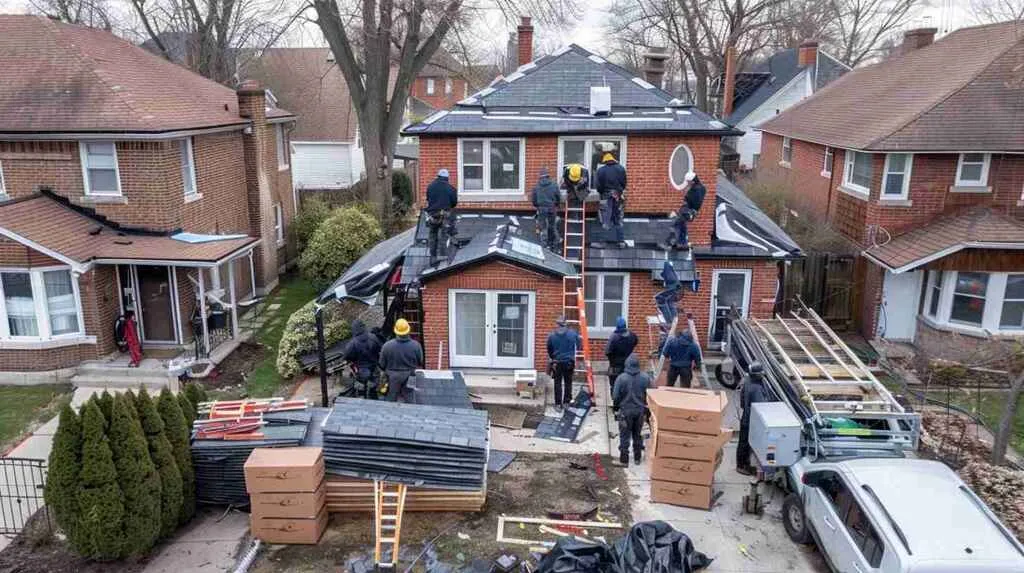
Three-Tab Shingle Roof Queens NY – Budget Option Done Properly | Call Today
Blueprint first: a properly done three-tab shingle roof in Queens should cost you about $4.25-$5.75 per square foot installed, and if someone quotes you much less than that, they’re leaving out ice-and-water shield, synthetic underlayment, or proper flashing-which is like buying a MetroCard that expires halfway through your ride. This article breaks down exactly what you’re actually buying at each price point, where installers hide shortcuts, and how to avoid turning a “budget” roof into an expensive leak three winters from now.
Real Three-Tab Shingle Pricing in Queens (and What Cheap Really Means)
When I say $4.25-$5.75 per square foot installed for a three-tab shingle roof in Queens, I’m talking about a full tear-off, proper synthetic underlayment, ice-and-water shield at every eave and valley, new flashing where needed, and basic ventilation work. Anything priced much below that range is almost certainly hiding something-usually the stuff under the shingles that keeps water out of your bedroom. Think of it like paying for the local train now versus taking a “cheap” route that dumps you into two transfers and a long walk later; the second option feels like a deal until you’re standing in the rain looking at your water-stained ceiling.
One February morning, about 6:30 a.m., I was on a flat-to-slope transition in Flushing, chipping ice off the eaves of a three-tab shingle roof another crew had installed in the summer. They’d skipped the ice-and-water shield because “Queens winters aren’t that bad.” That homeowner called me crying after a thaw because water had run backward under the shingles and into her son’s bedroom. That job taught me to never let anyone call three-tab “good enough” without proper waterproofing underneath, no matter how tight the budget is. The contractor who sold her the original job advertised it as a “budget” roof and shaved dollars by leaving out a $200 roll of shield-which cost her $3,800 in new drywall, framing repair, and a full valley redo before her next winter.
💰 Installed Three-Tab Shingle Roof Cost – Real Queens Scenarios
All ranges assume full tear-off, synthetic underlayment, ice-and-water shield at transitions, proper flashing replacement, and basic ventilation work where accessible.
⚠️ Lowball Three-Tab Quotes in Queens – What Gets Skipped
- No ice-and-water shield at eaves and valleys – Contractors skip the $180-$250 of self-sealing membrane where ice dams and wind-driven rain do the most damage, shortening roof life by 5-7 years.
- One layer of old felt instead of synthetic underlayment – Saving $300-$400 by using cheap felt (or worse, leaving the old felt in place) means your roof is sitting on paper that tears and rots, not a waterproof backup layer.
- Skipping basic ventilation work – Installers avoid adding ridge vents or soffit intake because it adds $400-$600 to the job, but poor ventilation cooks your shingles from underneath and cuts their lifespan nearly in half.
On a Typical Two-Family in Jackson Heights, Here’s Exactly What You’re Paying For
On a typical two-family in Jackson Heights, when I run the numbers, you’re looking at about 1,600-1,900 square feet of roof that often includes a chimney near the party wall, maybe a small skylight, tight side access, and a couple of valleys where the dormers meet the main slope. A full three-tab job includes: complete tear-off and disposal of the old roof, minor deck repair where plywood is soft or cracked, synthetic underlayment across the whole deck, ice-and-water shield at every eave and valley transition, replacement of rusted chimney flashing and skylight collars, and basic ventilation-either adding ridge vents or cleaning and upgrading soffit intake. I remember a hot July afternoon in Jamaica, standing on a half-finished three-tab roof for a retired MTA worker who kept every receipt in a binder. We sat on the ridge for a minute, sweating, going through line items because he didn’t believe venting could actually add years to a budget roof. When I showed him photos from a job in Woodside where poor ventilation cooked the three-tabs in eight years, he finally nodded and said, “Alright, kid, I’ll ride that train.” That’s when I realized pictures and hard numbers beat sales talk every time.
The three-tab shingle cost is only part of the bill-the “underneath work” is like the local train that quietly makes all the stops so your roof lasts 18-20 years instead of 8-10. Roughly 15-18% of your total goes to the shingles themselves, another 20-22% to synthetic underlayment and ice-and-water shield, about 12-15% to flashing work (chimneys, skylights, sidewalls), around 8-10% to ventilation adjustments, and the rest covers tear-off, disposal, labor, deck repair allowance, and cleanup. Shaving a few percentage points off the wrong line-like skipping ice-and-water or using one layer of felt-is like hopping a “cheap” route that dumps you into transfers and delays three winters later when you’re calling me to fix a leak.
✅ What’s Included in a Proper Three-Tab Install on a Queens Two-Family
- ✅Full tear-off – Complete removal of old shingles, underlayment, and damaged flashing down to the deck
- ✅Synthetic underlayment – Non-organic, tear-resistant waterproof layer covering entire roof deck
- ✅Ice-and-water shield at eaves and valleys – Self-sealing membrane where ice dams and wind-driven rain attack first
- ✅Metal flashing replacement where needed – New step, counter, and apron flashing at chimneys, skylights, and sidewalls
- ✅Basic ventilation check and adjustment – Ridge vent installation or upgrade, soffit intake cleaning or addition to balance airflow
Why Three-Tab Roofs Fail Early in Queens (and How to Avoid the Trap)
I’ll be blunt: three-tab shingles don’t fail first-the shortcuts underneath them do. The three main failure points I see on Queens roofs are lack of ice-and-water shield at eave and valley transitions (water sneaks backward under the shingles during freeze-thaw or wind-driven storms), bad valleys (woven instead of properly cut and metal-flashed, turning into gutters full of grit and moss), and cooked shingles from poor ventilation (attics hit 150°F in July and literally bake the asphalt from below). One evening just before a thunderstorm, I was racing the clouds in Middle Village, redoing a three-tab valley that had been woven instead of cut and flashed. The previous roofer thought weaving saved time and materials, but the valley had turned into a gutter full of grit and moss. I had the homeowner standing at the window while I peeled it back and showed her how the water was sneaking sideways. That night, with lightning in the distance, I promised myself I’d never install a valley on a budget roof that I wouldn’t put over my own kids’ bedrooms.
Here’s a quick insider tip you can do from the sidewalk or a second-story window: look for buckling or cupping along the shingles (sign of poor ventilation cooking them from below), heavy piles of dark granules at the gutter downspouts (the protective layer washing off), or dark streaks and stains in the valleys or under the eaves (water tracking where it shouldn’t). You don’t need to climb up there-just note what you see and mention it when you call. Ignoring these signs is like staying on a local train that’s already delayed; you’ll pay with time and money later when a small leak turns into framing rot and interior damage.
❌ Myth vs ✅ Fact – Three-Tab Shingle Roofs in Queens
| ❌ Myth | ✅ Fact |
|---|---|
| “All three-tab shingles are basically the same.” | Brand quality, thickness, and warranty vary widely; a properly installed budget three-tab outlasts a poorly installed premium one. |
| “Underlayment is optional on a budget roof.” | Synthetic underlayment is your primary waterproof layer; skipping it guarantees leaks the first time wind lifts a shingle or ice backs up. |
| “Valleys can always be woven to save time.” | Woven valleys collect debris, channel water sideways, and fail early; properly cut and metal-flashed valleys last the life of the roof. |
| “Ventilation doesn’t matter on older Queens homes.” | Poor ventilation cooks shingles from below, cutting lifespan by 40-50%; even older homes benefit from soffit intake and ridge vents. |
| “Cheaper per square foot always saves money.” | A roof priced at $3.50/sq ft that fails in 7 years costs you $0.50/year; one at $5.00/sq ft lasting 18 years costs $0.28/year. |
If you were standing on your sidewalk in Queens right now looking up at your roof, I’d ask you one question: how many winters do you actually expect that thing to survive?
Should You Stay with Three-Tab or Upgrade? Think of It Like Choosing Your Train
Here’s how I explain it when I’m sketching on a scrap of cardboard at your kitchen table: your roof is like choosing between the local and express train. Staying with a well-installed three-tab is the local-slower, cheaper ticket, more stops and maintenance visits over the next 15-18 years, but you get where you’re going and you save money upfront. Upgrading to basic architectural shingles is the express-higher fare ($1.50-$2.25 more per square foot), but fewer transfers, less hassle, and you arrive at year 20-25 without major drama. Neither choice is wrong; it depends on your budget today, how long you plan to stay in the house, and whether you’d rather pay a little more now or deal with an extra re-roof cycle later.
🛤️ Decision Tree – Repair, Re-Roof, or Upgrade?
Before You Call, Check These 5 Things from the Sidewalk
You don’t need to climb up there-just walk outside and look at your roof from the street or a second-story window across the way. Note any shingle curling or cupping, missing or broken tabs, sagging rooflines, stained siding or soffits under the eaves, and heavy piles of dark granules collecting at your downspouts. This quick check won’t replace a professional inspection, but it helps our conversation go faster and lets me zero in on exactly what you’re seeing when you call.
✅ Ground-Level Checks for Your Queens Three-Tab Roof
- ✅Look for missing or broken tabs – gaps in the shingle pattern or pieces lying in gutters
- ✅Check for curled or cupped shingles – edges lifting or centers buckling (sign of poor ventilation or age)
- ✅Scan for dark streaks or stains under eaves, along valleys, or on siding below transitions
- ✅Inspect visible flashing around chimneys and skylights for rust, separation, or missing pieces
- ✅Check downspout outlets for piles of dark granules – heavy granule loss means shingles are wearing out fast
- ✅Look at top-floor ceilings inside for water stains, discoloration, or bubbling paint near exterior walls
❓ Common Three-Tab Shingle Roof Questions from Queens Homeowners
▸ How long should a properly installed three-tab roof last in Queens?
With full synthetic underlayment, ice-and-water shield at all transitions, proper flashing, and adequate ventilation, a three-tab roof in Queens should give you 15-18 years of solid service. If ventilation is marginal or the installer skipped underlayment, expect closer to 8-12 years before you’re dealing with leaks and granule loss.
▸ Can you just layer new three-tabs over my old roof to save money?
Legally you can in some cases, but I don’t recommend it. Layering hides deck problems, traps moisture, voids most manufacturer warranties, and adds weight that older framing wasn’t designed for. A full tear-off costs more upfront but gives you a known, solid foundation and a warranty that actually means something.
▸ Do I really need ice-and-water shield if my neighbor didn’t use it?
Yes. Queens gets freeze-thaw cycles, ice dams at eaves, and wind-driven rain that pushes water uphill under shingles. Ice-and-water shield is a self-sealing membrane that stops leaks at the exact spots where they happen most-eaves, valleys, and around chimneys. Your neighbor might get lucky for a few years, or they might be the one calling me at 6:30 a.m. when their ceiling is dripping.
▸ How much more is ventilation work going to cost me?
Basic ventilation-adding a ridge vent and clearing or cutting new soffit intake-usually adds $400-$600 to a typical Queens two-family job. It sounds like extra money, but it can double the life of your shingles by keeping your attic cool in summer and dry in winter. Skipping it to save a few hundred now will cost you thousands when your roof fails at year 9 instead of year 18.
▸ How fast can Shingle Masters get to my place if the roof is already leaking?
If you call on a weekday and the roof is actively leaking, we’ll typically get someone to your Queens address within 24 hours to tarp or do an emergency patch and assess what’s needed for a permanent fix. If it’s a weekend or during a storm, we prioritize active leaks and aim for same-day or next-morning response depending on the queue.
🏆 Why Queens Homeowners Hire Shingle Masters for Budget Roofs
NYC Licensed & Insured
Fully licensed, insured, and compliant for all Queens residential roofing work
17+ Years in Queens
Astoria, Jackson Heights, Jamaica, Flushing, Middle Village, Maspeth, and beyond
24-Hour Leak Response
Active leaks get priority; typically on-site within one business day on weekdays
Written Workmanship Warranty
All three-tab installs backed by our written labor and installation warranty
A three-tab roof can still be the right “local train” when it’s installed correctly-with real underlayment, ice-and-water shield where it matters, proper flashing, and ventilation that actually works. You’ll get 15-18 solid years out of it, save money upfront, and avoid the expensive “transfers” that come from shortcuts hidden under cheap shingles. Call Shingle Masters directly for a Queens-specific quote and a walk-through of your roof options-over the phone or at your kitchen table, whichever works for you.