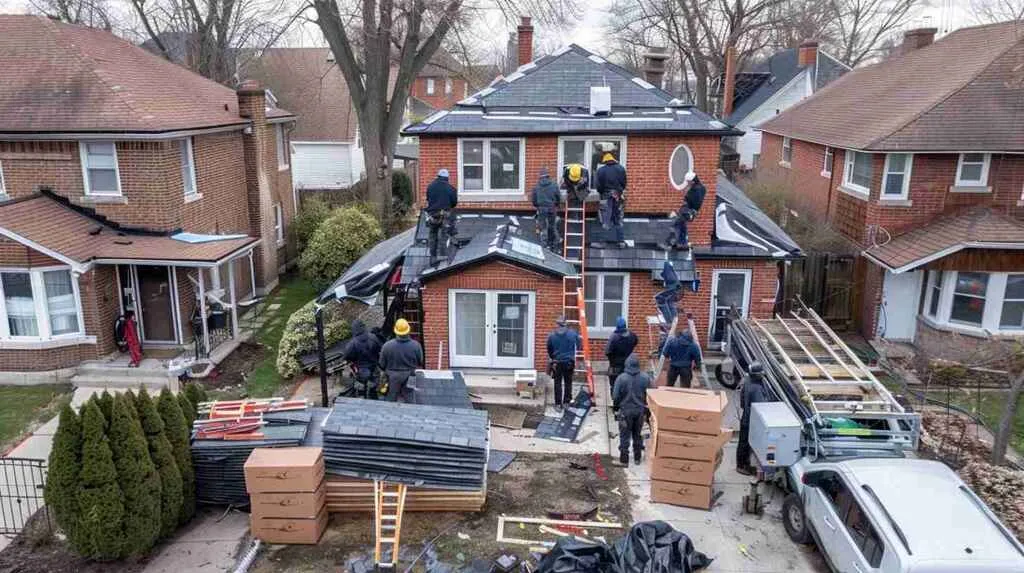
Shingle Roof Cap Installation Queens NY – Get the Peak Right | Free Quotes
Peaks hide secrets. Most mystery leaks in Queens don’t start in the flat field shingles that cover ninety percent of your roof-they start at the ridge cap, the shingles that cover the highest line where two roof planes meet. That ridge is under more wind stress, more thermal cycling, and more impact from rain and snow than any other part of the roof, but it’s also the part homeowners ignore until water drips into the hallway right along the center line.
I’m Luis Calderón, and I’ve spent nineteen years on Queens roofs, but around here people call me “the ridge line guy” because other contractors call me when their shingle roof caps keep blowing off in Rockaway or Jackson Heights. I started out studying industrial design in Bogotá before moving to Queens, and I still approach every ridge cap installation like it’s a design puzzle-how do the cap shingles, the nails, the overlap, and the wind direction all fit together so they’ll hold for twenty years instead of two. Right now, let’s talk about why your ridge cap is probably the real problem and how proper installation works when you understand Queens wind patterns.
Why Your Ridge Cap Is Probably the Real Problem
On a typical Queens block, if you stand back and look at ten roofs in a row, at least three have ridge caps that are already starting to fail and nobody’s noticed yet. You’ll see curling, small cracks, or a single cap shingle flipped back like a playing card after a storm. These roofs aren’t ancient-they’re just dealing with crosswinds that run along the streets or come off Jamaica Bay and hit the ridge from the side. That peak is where the wind splits, doubles back, and tries to peel everything loose. When a contractor doesn’t respect how the wind attacks that line, you get caps that look fine from the driveway but start leaking in under a year.
Most contractors treat the ridge cap like an afterthought-just slap some shingles over the top, nail them down fast, and move on. But here’s my honest opinion: if your contractor shrugs when you ask how they’re installing the shingle roof cap, you need a different contractor. The ridge is where lazy work hides the easiest because you can’t see the details until it’s too late. I’ve seen caps nailed too high so the sealant strip never touches, caps bent too sharply so they crack in winter cold, and caps that don’t overlap enough to block driven rain. All of it looks fine from the ground until your dining room ceiling starts turning brown along the center line.
One February morning around 6:45 a.m., before the sun was really up, I was on a ridge in Howard Beach where the winter wind was gusting straight off the water. A customer had called me because their “new” shingle caps had started flipping like playing cards after just one storm. When I pulled one cap back, I saw the installer had nailed high and skipped the sealant strip completely-just raw exposure to the wind tunnel along the ridge. We ended up tearing off the whole cap run and rebuilding it with properly staggered ridge shingles and a six-nail pattern. That job taught me to treat every Queens ridge like it’s on an oceanfront, even when it’s not. The wind off the bay or moving down the streets doesn’t care if you saved twenty minutes by nailing fast-it’ll find the weak point and rip the cap right off.
Myth vs. Fact: Common Assumptions About Ridge Caps in Queens
| Myth | Fact |
|---|---|
| Ridge caps are just decorative trim that cover the raw shingle edges. | Ridge caps are a critical weatherproofing component that must seal against wind-driven rain and block uplift forces that can exceed 100 mph gusts in exposed Queens neighborhoods. |
| You can bend regular 3-tab shingles over the ridge to save money. | Bending 3-tab shingles causes cracking in cold weather and doesn’t provide the proper overlap or sealant contact; dedicated ridge cap shingles are pre-scored and flexible enough to conform without splitting. |
| If the rest of my roof looks fine, the ridge is probably fine too. | The ridge experiences four times the wind stress of the field shingles and gets hit by sun, rain, and thermal expansion on both sides; it can fail years before the rest of your roof shows any wear. |
| Leaks near the peak must mean the whole roof needs replacement. | Most ridge leaks can be fixed by removing and rebuilding the cap shingles alone, especially if the field shingles and underlayment below are still in good shape; a focused ridge cap repair often costs $600-$1,800 instead of a full roof replacement. |
How Proper Shingle Roof Cap Installation Works on a Queens Roof
When I first step into a customer’s yard, one of the first questions I ask is, “Do you get strong crosswinds here, or is the wind mostly straight down the street?” It sounds like a weird question, but wind direction changes everything about how I install the ridge cap. I study wind paths around Queens roofs the same way you study traffic patterns on Queens Boulevard-where does the air hit, where does it split, where does it double back and create uplift? In Rockaway, you’re dealing with sustained ocean wind hitting exposed ridges almost every day. In Jackson Heights or Corona, you get crosswinds that funnel between row houses and semi-attached homes, hitting the ridge from angles most installers never think about. I adjust my nailing pattern, the overlap between cap shingles, and even which direction I start laying the caps based on how the wind will attack that line.
One August afternoon, heat index over 100, I was working on a semi-attached in Corona for an older couple who’d just installed solar panels. The solar crew had run conduit right over their ridge and sliced three cap shingles to “make it fit.” A month later, they had a mysterious ceiling stain right under the ridge. I traced the leak back to those cuts, rebuilt the caps around the conduit, and flashed it properly with aluminum coil stock and roofing sealant so water couldn’t track down the cable. Since then, whenever someone mentions solar and a leak near the peak, I already know to look at the ridge caps first, not the panels. Caps have to be integrated with penetrations-attic vents, conduit, antenna mounts-not just bent around them. If you cut a cap shingle, you’ve broken the seal and the overlap; you need to reflash and rebuild that section as if it’s a mini valley.
Luis’s Step-by-Step Shingle Roof Cap Installation Process
- Inspect the ridge deck and underlayment: Before touching a cap, I check the roof deck along the ridge line for rot, sagging, or soft spots. If the deck is compromised, I replace those boards first because nailing into rotten wood is pointless. I also verify that ice & water shield or ridge vent underlayment runs continuously along the peak-no gaps where wind can drive moisture under the cap.
- Choose and cut the cap shingles: I use manufacturer-specified ridge cap shingles, not field shingles bent over the peak. These caps are pre-scored to fold cleanly and have a deeper sealant strip. If your roof has a specific color blend, I hand-select caps that match the field shingles so the ridge doesn’t look like a different roof.
- Start at the end opposite the prevailing wind: Based on wind direction, I begin laying caps at one end so each shingle overlaps in the direction that sheds water and resists uplift. In Queens, that usually means starting at the east or south end and working west or north, but I adjust for every job.
- Nail with a six-nail pattern and correct placement: Each cap gets two nails on each side, placed one inch from the edge and about six inches apart, low enough to be covered by the next cap’s overlap but high enough to avoid the sealant strip. I hand-drive the last few nails to avoid overdriving, which can tear the shingle and create a leak path.
- Ensure proper overlap and sealant contact: Each cap overlaps the previous one by five to six inches, and I press down to make sure the factory sealant strip on the underside makes full contact with the cap below. On hot days like that Corona job, the sealant activates fast; on cold days, I sometimes use a small propane torch to warm the adhesive so it bonds immediately instead of waiting for summer sun.
- Flash around penetrations and finish with a ridge-end cap: Any vent, conduit, or antenna mount gets custom flashing integrated into the cap layer. At the final end of the ridge, I install a cut cap piece sealed with roofing cement so there’s no exposed nail or raw edge where wind can get under.
Why Queens Homeowners Trust Shingle Masters for Ridge Caps
-
✓
Fully licensed and insured in NYC: We carry general liability and workers’ comp so you’re protected if something goes wrong on your property. -
✓
19+ years on Queens roofs: Luis has worked in every neighborhood from Rockaway to Bayside and knows how local wind, weather, and building styles affect ridge cap performance. -
✓
Fast response for urgent ridge cap issues: If you call about a missing cap or active leak before a storm, we typically respond within 24 hours to do temporary sealing or full repair. -
✓
Warranty on ridge cap work: Our ridge cap installations come with a 5-year workmanship warranty covering leaks or blow-offs caused by installation errors, plus the manufacturer’s material warranty on the cap shingles themselves.
Costs and When Your Ridge Cap Can’t Wait
A typical ridge cap project in Queens runs between $450 and $2,200, depending on how long your ridge is, how steep the roof is, and whether there’s existing water damage that needs repair first. If you have a simple ranch with twenty feet of ridge and no rot, you’re looking at the low end. If you have a two-story colonial with multiple hips, valleys, and sixty feet of ridge line, plus some decking to replace where the old cap leaked, you’re closer to the high end. Access matters too-working on a steep 8/12 pitch row house with tight side yards costs more than a gentle 4/12 suburban roof with easy ladder access. And here’s the thing: delaying cap work turns small problems into emergency ones. I’ll never forget a Saturday night in late October, 9:30 p.m., when I got a panicked call from a small church in South Ozone Park. A nor’easter was rolling in, and their choir loft was already taking in water right along the center line. I climbed up with a headlamp and found that the “architectural” ridge cap was actually just 3-tab shingles bent over too sharply, already cracking in the cold. I did an emergency temporary cap with spare ridge shingles and ice & water shield I keep in the truck, then came back the next week to redo the entire ridge properly. That’s the night I decided I’d never let anyone talk me into improvising ridge caps from the wrong shingles just to “save a few bucks.”
Typical Shingle Roof Cap Installation and Repair Scenarios in Queens, NY
| Scenario | Description | Estimated Price Range |
|---|---|---|
| Small cap repair | Replace 3-6 loose or damaged cap shingles after a storm; no structural work needed. | $250-$550 |
| Full ridge cap replacement – small row house | Remove and replace all ridge caps on a typical Queens row house (20-30 linear feet of ridge). | $600-$1,100 |
| Full ridge cap replacement – larger detached home | Complete ridge cap rebuild on a two-story colonial or detached home (50-70 feet of ridge, possibly multiple hips). | $1,400-$2,200 |
| Ridge cap rebuild around solar/vents | Remove and replace caps that were cut or damaged by solar panel installation, HVAC vents, or conduit runs; includes custom flashing. | $800-$1,600 |
| Emergency temporary ridge cap service | Late night or weekend call to stop an active leak during a storm; temporary cap and tarp until full repair can be scheduled. | $450-$900 |
🚨 Urgent – Call Shingle Masters Now
- Multiple cap shingles missing or visibly flipped up before a forecast storm
- Water stains appearing on your ceiling right along the center line of the house
- Visible daylight or wet underlayment when looking up at the ridge from the attic
- Recent solar, HVAC, or antenna work near the ridge followed by a new leak within weeks
📋 Can Wait a Few Days for an Inspection
- Minor cosmetic wear or slight curling on a few cap shingles with no leaks
- Your roof is over 15 years old and you’re planning maintenance in the next few months
- You see a slight wave or sag along the ridge line but no active water intrusion
- You want to upgrade or replace caps during a planned full roof replacement later this season
DIY vs Pro Ridge Cap Work on Queens Homes
The blunt truth is that the ridge-the highest, prettiest part of the roof-is also where lazy work hides the easiest. And DIY ridge cap work is almost always a bad idea if you live in Queens and deal with real wind. I constantly frame roof cap decisions in terms of “how the wind will attack this ridge,” talking about wind direction, uplift paths, and how air moves over row houses and corners, almost like I’m describing traffic patterns on Queens Boulevard rather than a roof. When wind hits your roof, it doesn’t just press down-it splits at the ridge, doubles back underneath the eaves, and tries to peel shingles off from the edges and peak. If you don’t know how to nail at the right depth, where to place each fastener to avoid the sealant strip, and how much overlap you need based on your roof’s pitch and exposure, you’re building a cap that’ll fail the first time a 40-mph gust comes through. Add in the safety risk-working on a steep pitch twenty feet up with no fall protection-and the lack of warranty or insurance if something goes wrong, and most DIY cap jobs end up costing more when they have to be torn off and redone by a pro.
Here’s my honest opinion: if your contractor shrugs when you ask how they’re installing the shingle roof cap, you need a different contractor. But the same goes for DIY-if you can’t explain to yourself why you’re nailing in a specific spot or how the sealant strip works, you shouldn’t be up there. Now, here’s one practical insider tip you can use from the ground: after a storm, stand back and look at your ridge line from the street. Is it straight, or does it have a wave or sag? Are any cap shingles lifted at the edges, or do you see a gap where one cap meets the next? You don’t need to climb up-those visual clues from the sidewalk tell you whether the caps are holding or starting to fail. If you see lifted edges or a crooked line, that’s your signal to call someone like me for an inspection before the next storm turns a small problem into an emergency tarp-and-bucket situation.
DIY Ridge Cap Work vs. Hiring Shingle Masters in Queens, NY
| Option | Pros | Cons |
|---|---|---|
| DIY Ridge Cap Work | Lower upfront material cost if you already own basic tools; sense of personal accomplishment. | High risk of improper nailing, sealant failure, and wind blow-off; no warranty or insurance if you fall or the work fails; requires ladder safety skills and knowledge of manufacturer specs. |
| Hiring Shingle Masters | Correct nailing pattern and overlap for Queens wind conditions; 5-year workmanship warranty; full insurance coverage; faster completion with professional tools and safety gear; caps matched to your existing roof color. | Higher upfront cost than DIY materials alone (but lower than DIY plus future repair after failure); requires scheduling an appointment. |
⚠️ Warning: Risks of Improvising Ridge Caps from the Wrong Shingles
Bending regular 3-tab shingles over your ridge instead of using dedicated ridge cap shingles is one of the most common mistakes I see-and it’s the reason that South Ozone Park church ended up with a late-night emergency call. When you bend a 3-tab too sharply, especially in cold weather, the asphalt mat cracks and the granules flake off, leaving raw asphalt exposed to UV and water. You also lose the proper sealant strip contact because 3-tabs aren’t designed to fold. Skipping underlayment or ice & water shield along the ridge deck creates a direct path for wind-driven rain to soak into the wood. And overdriving nails-punching them in too deep with a pneumatic nailer-tears through the shingle and creates a hole that water will track down into your attic. All of these shortcuts might save you an hour and fifty bucks in materials, but they’ll cost you hundreds or thousands when the caps fail in the first big storm and you’re calling for emergency repair at 9:30 on a Saturday night.
Quick Checks Before You Call for Shingle Roof Cap Installation
Think of your ridge cap as the zipper on a winter coat: the rest of the fabric can be perfect, but if that zipper fails, you’re still cold and wet. Before you call me for an inspection, there are a few things you can safely check from the sidewalk or from inside your attic that’ll help me diagnose faster and give you a more accurate quote over the phone. You don’t need to climb up-good observations from the ground are worth more than risky guesses from a shaky ladder.
I still remember a little house off Northern Boulevard where a single crooked ridge cap shingle was the whole reason the dining room ceiling kept staining. The homeowner noticed the stain first, then went outside and saw that one cap near the center of the ridge was sitting at an angle, creating a tiny gap where rain was funneling straight down. When I got there, I pulled that one cap and found the nails had been driven into a knot in the deck, so they never held. We replaced that section and the two caps on either side, sealed it, and the leak stopped. The lesson: small cap issues create big interior problems, and having photos or notes ready when you call helps me understand whether this is a quick fix, a section rebuild, or a full ridge cap replacement. Don’t feel like you need to know all the technical terms-just describe what you see, and I’ll walk you through it.
Before You Call Shingle Masters: Quick Ridge Cap Checklist
- Visible missing or broken cap shingles: Stand across the street and look at the ridge line-do you see gaps, flipped-up caps, or shingles that look crooked?
- Wavy or sagging ridge line: Does your ridge look straight from end to end, or is there a dip or wave that wasn’t there before?
- Shingle granules in gutters near the ridge: After a rain, check your gutters-if you see a lot of dark granules collecting near the downspouts, your caps might be shedding.
- Interior stains along the ceiling center: Walk through your top floor and look for brown or yellow water stains running along the center of rooms, parallel to the ridge.
- Noises at the peak in high wind: If you hear flapping, tapping, or scraping sounds from the attic during storms, a loose cap might be lifting and dropping back down.
- Recent solar or HVAC work near the ridge: If contractors worked on or near your ridge in the past year and you’re now seeing leaks, the caps may have been cut or disturbed.
- Age of your existing roof: If your roof is over 15 years old and you’ve never replaced the caps, it’s worth an inspection even if nothing looks wrong yet-preventive cap work is cheaper than emergency repair.
Common Questions About Shingle Roof Cap Installation in Queens, NY
How long does a ridge cap replacement usually take?
For a typical Queens row house or small detached home, a full ridge cap replacement takes between four and eight hours, depending on ridge length, pitch, and access. Larger homes with multiple hips or complicated roof lines can take a full day. Emergency temporary cap work during a storm usually takes one to two hours.
Can you match my existing shingle color?
Yes. I bring color samples and hand-select ridge cap shingles that match your field shingles as closely as possible. If your roof is an older discontinued color, I’ll blend caps from similar shades so the ridge doesn’t stand out. Most manufacturers offer ridge caps in the same color families as their architectural shingles.
What if my roof deck under the ridge is rotted?
If I find rot or soft decking when I remove the old caps, I’ll replace those boards before installing new caps-nailing into rotten wood doesn’t hold. Deck repair adds to the cost, but it’s necessary for a secure, long-lasting ridge. I always inspect the deck first and let you know before starting cap work.
Do you work around solar panels and attic vents?
Absolutely. I’ve rebuilt ridge caps around solar conduit, ridge vents, attic fans, and even old TV antennas. Any penetration gets custom flashing integrated into the cap layer so water can’t track down the mount or cable. That Corona job taught me to treat every penetration like a mini-valley-if you cut a cap, you need to reflash it properly.
How do Queens winds and storms affect your installation method?
Queens wind patterns-whether you’re near the water in Rockaway or in a row house corridor in Jackson Heights-change how I orient caps, how many nails I use, and how much overlap I build in. I study your property’s exposure and adjust the installation so the wind sheds over the caps instead of lifting them. That’s why I treat every Queens ridge like it’s oceanfront, even when it’s not.
Whether you’re seeing brown stains along the center of your ceiling or you’ve noticed a few loose shingles at the peak after the last storm, the ridge cap is almost always the culprit-and it’s the part of your roof that needs the most wind-aware, detail-focused work. Shingle Masters can inspect your ridge line, explain exactly what’s failing and why, and rebuild your shingle roof cap with the correct materials, nailing pattern, and wind resistance for Queens weather.
Call us today or request a free quote for shingle roof cap installation in Queens, NY, and let’s get your peak right before the next storm.