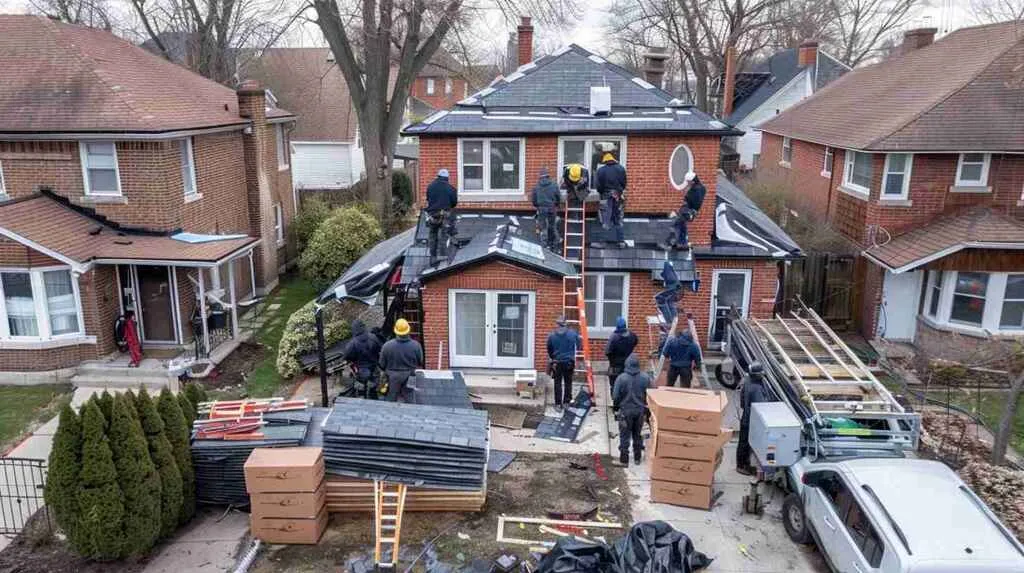
Tar Shingle Roof Queens NY – What This Term Actually Refers To | Call Today
Misnamed is the nicest word I can use here. Most Queens homeowners who call me about their “tar shingle roof” don’t actually have tar shingles at all – what they’ve got is a layered mix of asphalt shingles sitting on top of older tar-based roofing materials, old roll roofing, and sometimes a patchwork of roof cement smeared like frosting between the generations.
Understanding what’s really up there is the only way to fix leaks for good, and I’m going to break it down for you the same way I explain it on kitchen tables across Queens: layer by layer, like a sandwich.
What a “Tar Shingle Roof” in Queens NY Usually Really Is
On a typical Queens two-family house, when someone says “tar shingle roof,” what I usually find is asphalt shingles – sometimes fiberglass, sometimes organic-mat – sitting on top of at least one older layer of roll roofing or modified bitumen that contains actual tar or tar-like adhesive. In my opinion, the term “tar shingle roof” causes more confusion than anything else, because it makes homeowners think they’ve got some specialty material when really they’re looking at decades of band-aid repairs stacked on top of each other. Think about your roof like a Cubano sandwich: if you stack the wrong layers in the wrong order, or press down too hard in the wrong spots, the whole thing falls apart and drips all over the place. That’s exactly what happens when patch jobs pile up without anyone ever addressing what’s underneath.
One July afternoon in Jackson Heights, it was 94 degrees and the homeowner kept talking about his “tar shingles” melting. I climbed up and found three generations of roofing: old roll roofing with actual tar, then a fiberglass shingle layer, then a patch job smeared with roof cement like peanut butter. As I pulled back the layers, I kept telling him, “This isn’t one roof, this is a seven-layer dip,” and you could literally see how water was sneaking between each “ingredient” every time it rained. On those typical Jackson Heights two-family homes – you know the brick-and-frame combo buildings with the shared walls and narrow side yards – contractors have been re-roofing over old work for fifty, sixty years. Leaks don’t just drip straight down; they travel sideways between the layers, show up three feet away from the actual problem, and drive everyone crazy until somebody finally peels the whole thing back.
The Roof Sandwich: Layers That Matter on Queens Tar-and-Shingle Jobs
Think about your roof like a Cubano sandwich: if you stack the wrong layers in the wrong order, everything slides around, the pickles end up on the outside, and you’ve got a mess. A Queens “tar shingle roof” is the same deal. From the top down, you’ve usually got asphalt shingles (the bread), then some kind of underlayment or felt paper (the mustard layer), then old tar paper or roll roofing (the pork), and finally the wood deck (the cutting board everything sits on). In neighborhoods like Astoria, Bayside, and Jackson Heights, the typical two-family homes and small multifamily buildings have been re-roofed over and over since the ’40s and ’50s, so each decade added another “ingredient” without necessarily taking the old one off. Leaks happen when those layers don’t talk to each other – when water hits a seam between the shingles, slides under to the tar layer, finds a crack there, keeps going down to the felt, and finally drips through a nail hole in the deck three feet to the left of where you’re standing with the bucket.
On a windy November morning in Bayside, an older lady called me saying the “tar paper and tar shingles” her husband installed in the 80s were finally done. When I opened up a section, I realized he’d mixed proper asphalt shingles with leftover modified bitumen strips and brushed hot asphalt over the nails – a Frankenstein of roofing. Explaining to her what was actually up there, I laid the old samples on her kitchen table in order, like a history timeline of roofing materials, so she finally understood why some spots failed and others didn’t. That house was a classic Bayside build – brick first floor, sided second, hipped roof with dormers – and over forty years, three different contractors had each added their own “fix” without stripping anything. When you see that kind of mix, you can’t just patch the leak you see today; you’ve got to understand the whole sandwich before you decide whether to rebuild one section or tear it all down to the deck and start fresh.
⚠️ WARNING: Stacking too many roof layers on Queens homes
Many older Queens houses already have two or even three roof layers. Adding yet another tar-and-shingle layer can overload the structure, void shingle warranties, and hide rot in the deck. Before anyone adds more material on top, the existing layers need to be evaluated and, in many cases, stripped back to solid wood.
Why More Tar Usually Makes Leaks Worse, Not Better
Let me be blunt: adding more tar on top of a problem roof almost never fixes the real issue. One rainy night in Woodhaven, a landlord dragged me out at 10 p.m. because his tenant swore the “tar shingle roof” was leaking straight into their bedroom light fixture. In my headlamp beam, I saw that someone had tried to “fix” the problem by slapping cold-applied tar across the tops of architectural shingles, basically gluing them together so they couldn’t shed water right. I showed the landlord with my phone light how rain was hitting the shingle, bouncing off the hardened tar, and running sideways under the laps – like water running around a rock in a stream – so he finally stopped asking, “Can’t you just add more tar?” Here’s the insider tip that separates real roofers from bucket-and-brush hacks: when I’m hunting a leak, I don’t just seal what’s wet on top. I trace the water path under the shingle layers, lifting tabs and checking seams, because the drip you see inside could be coming from a crack two courses up and four feet over, and no amount of tar smeared on the surface will stop that.
How I diagnose a “tar shingle” leak before touching a bucket of tar
- Inspect the inside first – ceilings, walls, and attic (if accessible) to see where the water is actually showing up.
- Walk the roof carefully, looking for past tar patches, soft spots, and odd shingle patterns instead of just obvious holes.
- Lift select shingles and patches to see how many layers are below and where water could be traveling between them.
- Check key leak zones: around chimneys, vents, valleys, and transitions between flat and sloped sections.
- Plan a repair that removes bad layers and reshapes how water sheds, instead of just smearing more tar on top.
What to Expect When Shingle Masters Fixes a Queens “Tar Shingle Roof”
When you call me about a “tar shingle roof” in Queens, here’s exactly what happens. I show up – usually same or next day if you’ve got an active leak – and I start inside, not on the roof. I want to see where the water’s showing up, because that tells me which direction to trace once I’m up top. Then I climb up, walk the roof, and start lifting shingles and old patches to see the full sandwich. I take photos and short videos on my phone so you can see what I’m seeing, and when I come down, I’ll sit with you at the kitchen table and show you the layers – sometimes I even bring down sample pieces and lay them out in order, like a timeline. I’ll tell you straight whether you need a targeted repair (strip one section, rebuild it right) or a full tear-off to the deck and new roof. No upselling, no scare tactics – just a clear explanation you could repeat back to me, because if you don’t understand it, I haven’t done my job. On Queens jobs, I’m also realistic about logistics: tight driveways, shared walls with neighbors, dumpster permits, and the fact that half the time there’s no good place to stage materials except the front yard.
$500 on a quick smear of tar might make the drip stop for a month, but it won’t fix the rotted underlayment or the three hidden layers causing the problem. Real repair means addressing the sandwich, not just frosting over the top slice.
Typical cost scenarios for Queens roofs people call “tar shingle roofs”
| Scenario | What usually needs to be done | Typical price range (Queens NY) |
|---|---|---|
| Small leak around a vent with minor tar patches | Targeted shingle removal, underlayment repair, proper flashing | $450 – $950 |
| Localized failure where old roll roofing meets shingles | Strip a section to deck, rebuild layers correctly | $1,200 – $2,500 |
| Multiple tar layers on a typical two-family sloped roof | Full tear-off to wood, install new underlayment and shingles | $8,000 – $15,000+ |
| Combo of flat rear roof with shingle front, both patched with tar | Rebuild flat section with proper membrane, re-shingle front | $10,000 – $18,000+ |
| Emergency temporary dry-in during active leak storm | Short-term patching and tarping to stabilize until full repair | $350 – $850 |
Why Queens homeowners trust Shingle Masters with tricky tar-and-shingle roofs
- Licensed in NYC for roofing work across Queens
- Fully insured for residential and small multi-family projects
- 19+ years hands-on roof experience in Queens neighborhoods
- Fast response for active leaks, often same or next day
- Before-and-after photos of every repair so you can see the layers we fixed
Quick Checks Before You Call About Your Tar Shingle Roof
These checks help you talk clearly about what you’re seeing without ever climbing a ladder, and that makes diagnosing Queens roofs much faster and safer. You stay on the ground or inside, gather the clues, and when you call, I already know which tools and materials to bring – saves time, saves money, and keeps you off a wet roof in your sneakers.
Simple, safe indoor and ground-level checks for Queens homeowners
- ✅ Note where any ceiling stains or drips are (room name and distance from outside wall).
- ✅ After a storm, walk the perimeter and look for shingle pieces or dried tar chips on the ground.
- ✅ From the sidewalk or yard, see if you can spot shiny black smear patches over shingles.
- ✅ Look at roof edges to see if multiple layers of material are visible at the eaves.
- ✅ Check around chimneys and plumbing vents from inside for damp spots or musty smells.
- ✅ Take a few clear photos from the ground and of any interior damage to share when you call.
Common questions Queens homeowners ask about tar shingle roofs
Is a “tar shingle roof” automatically a problem?
No, not automatically. Many Queens roofs have some tar-based patching or older layers and still perform okay, but once you see repeated leaks or soft spots, the mix of materials usually needs a proper evaluation.
Can you just add one more layer instead of tearing everything off?
On most older Queens homes, adding another layer is a bad idea. It can overload the structure, void warranties, and bury moisture issues. I prefer to strip down to at least one solid, known-good layer – often the wood deck.
How long does a proper repair or replacement usually take?
Small, focused repairs often take a few hours. A full tear-off and replacement on a typical two-family can run 1-3 days, depending on access, weather, and how many surprise layers we find.
Will you show me what you find up there?
Yes. I take photos and, when possible, bring down sample pieces so you can see each “layer of the sandwich” laid out, and I walk you through what failed and why.
Do you work across all Queens neighborhoods?
Yes. I regularly handle roofs in Astoria, Jackson Heights, Woodhaven, Bayside, Flushing, Ridgewood, and the rest of Queens. The building styles change block to block, but the tar-and-shingle mysteries are the same.
If you’re in Queens and dealing with a confusing “tar shingle roof” or a mystery leak that nobody else can track down, call Shingle Masters for an on-roof evaluation. I’ll explain every layer in plain language, show you exactly what’s causing the problem, and give you a clear choice between targeted repair and full replacement – no guesswork, no generic patches, just honest work backed by 19 years of peeling back roofs and making sense of the sandwich. Call today.