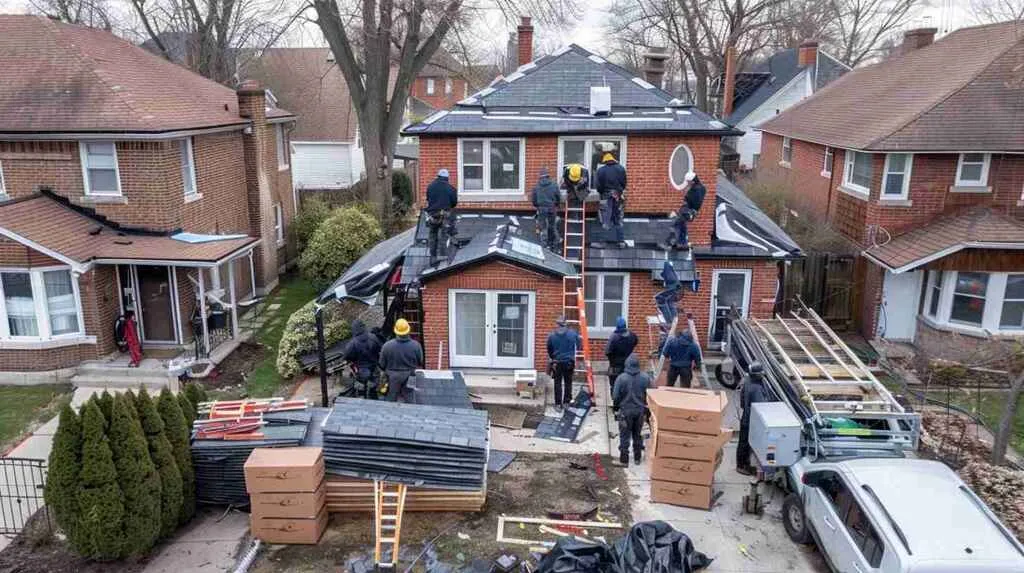
Asphalt Shingle Installation Steps Queens NY – Full Sequence | Free Quotes
Blueprint: On a typical Queens cape with a 4/12 pitch and 60 years of history under the shingles, the first thing I do is check what’s hiding underneath. Most homeowners asking “how to install a asphalt shingle roof” jump straight to choosing shingle colors and buying nail guns, but they skip the one thing that determines whether their new roof will last ten years or leak in two-the deck inspection and prep work that happens before a single shingle touches the house.
Start at the Deck: The First Critical Step on Any Queens Asphalt Shingle Roof
Think of your roof deck like I’m laying tracks for the 7 train-if the foundation isn’t solid and level, every station I build on top of it will be delayed, backed up, or outright broken. On that Astoria job where we found three layers of old shingles hiding rotted OSB, the homeowner kept asking why we couldn’t just shingle over the top layer to save money. I punched my boot through a soft spot near the eave and showed her daylight coming through from the attic. That’s the reality: your asphalt shingle roof is only as good as the wood underneath, and in Queens, where houses were framed in the 1940s with lumber that’s seen decades of ice dams and raccoon damage, you can’t skip this.
Around 7:30 on a chilly October morning in Astoria, we were tearing off an old three‑layer asphalt roof-yes, three-and underneath it we found a patch of OSB decking so rotten my boot went straight through. The homeowner was already stressed because rain was forecast for late afternoon. I walked her up to the edge, showed her the daylight shining through, and explained the sequence: cut back to solid wood, install new sheathing, ice and water shield, then shingles, all before the weather hit. We finished the last ridge cap literally as the first drops started, and that job is why I now obsess over wood condition during every estimate, not just during the tear-off. I check for bounce when I walk the roof, I look for rust stains bleeding through shingles, and I pull back corners during estimates to see what’s really there.
Proper deck prep is what sets the entire “water transit system” foundation for your roof. Once the old shingles and felt are off, I clean every nail, check every seam between plywood sheets, and make sure fasteners are hitting rafters-not just punching through thin spots. In Queens, where you get freeze-thaw cycles in winter that lift nails and coastal winds off the Atlantic that test every corner, a deck that’s nailed off correctly and flat is what keeps your shingle rows straight and your underlayment sealed. Before a single piece of new material goes down, I’m planning where drip edge will run at the eaves and rakes, because that metal is the first line of defense against water sneaking backward under the shingles.
✅ Quick Deck-Prep Checks Before Any Asphalt Shingle Install in Queens, NY
- ✅ Walk the entire deck and feel for soft spots, bounce, or sagging between rafters-common in older Queens colonials where rafters are spaced 24″ apart instead of modern 16″.
- ✅ Pull back a corner of existing shingles during your estimate to check for multiple layers, wet felt, or visible rot so you know what you’re tearing into.
- ✅ Inspect all roof-to-wall transitions and valleys for rust stains, nail pops, or daylight showing through-these are your red-flag zones on attached Queens homes.
- ✅ Confirm every sheet of sheathing is nailed to rafters every 6 inches along edges and 12 inches in the field, not just stapled or left floating at corners.
- ✅ Plan your drip edge layout before anything else goes down-eaves get metal first, then underlayment overlaps it; rakes get metal on top of underlayment to shed water correctly.
⚠️ Warning: Skipping Full Deck Inspection on Old Queens Roofs
Here’s what happens when you don’t tear off to the deck on a 60‑year‑old Queens house: you miss hidden rot around chimneys and valleys, you leave three-layer build-ups that violate NYC code and add dead weight, and you end up with a sagging roof line that looks crooked from the sidewalk. I’ve been called to “emergency leak repairs” where the real problem was plywood that had been wet for years under multiple shingle layers, and by the time the homeowner saw water in their ceiling, half the decking needed replacement. If you’re installing asphalt shingles yourself and you can’t pull up the old material to check what’s underneath, you’re gambling that the previous installer did it right-and in my 17 years in Queens, that bet loses more often than it wins.
Follow the Water: Underlayment, Ice Shield, and Drip Edge in Queens Weather
Once the deck is solid, I’m designing the express line for water-the underlayment and ice shield that create a second line of defense if wind ever lifts a shingle or a nail backs out in a freeze cycle. On a Jamaica cape or a Ridgewood two‑family, I start by rolling ice and water shield at the eaves, covering at least the first three feet upslope so any ice dam that forms in January can’t push melt backward under the shingles. Then I cover valleys with a 36‑inch-wide strip of ice shield, because that’s the transfer station where two roof planes meet and water converges at double speed. After those critical zones are sealed, I roll synthetic underlayment or approved #30 felt up the roof, overlapping each row by six inches and making sure every seam sheds water downhill-never trapping it against a nail line. Here’s the thing: in Queens you get coastal winds off the Atlantic that drive rain sideways, especially in Rockaway and Howard Beach, and you get heavy snow followed by freeze-thaw in neighborhoods like Forest Hills where mature trees dump extra moisture on roofs. That means your underlayment isn’t just a formality-it’s the backup system that keeps your bedroom dry when conditions get ugly.
Drip edge sequencing is where most DIYers mess up the order and don’t realize it until they see water staining their fascia boards. At the eaves, the metal drip edge goes on first, nailed directly to the deck, then the underlayment laps over the top of it so water running down the felt hits metal and drains into the gutter. At the rakes-the sloped sides of the roof-the underlayment goes down first, then the drip edge nails on top, so wind-driven rain can’t sneak under the edge and wick into the sheathing. I learned that sequence from my uncle on a brownstone in Ridgewood, and it’s code for a reason. In a neighborhood like Astoria, where rowhouses sit elbow-to-elbow and wind funnels between them, getting the drip edge order backward means you’re channeling water into your soffits instead of away from them.
Underlayment and Drip Edge Sequence for an Asphalt Shingle Roof in Queens, NY
Layout, Starter Course, and Straight Rows: Where Most DIY Shingle Jobs Go Crooked
Here’s my honest opinion: if you won’t spend time on layout and straight lines, you’re better off hiring someone, because crooked shingles advertise inexperience from the sidewalk. When I walk a Queens neighborhood and see shingle rows that curve or wander up a roof, I know exactly what happened-someone skipped snapping chalk lines and just eyeballed the rows, trusting their gut instead of geometry. Your roof deck is now a precise map for water flow, and layout is how you turn that map into clear routes that keep water moving straight downhill instead of pooling or backing up at random spots.
One August afternoon in Jamaica, with the sun bouncing off a white TPO roof next door like a mirror, I had a homeowner who wanted to “save time” by skipping the starter strip on the eaves and just cutting shingles. I laid out my chalk line, showed him a shingle lifted in the wind at the corner, and you could literally see the gusts sweeping down the block-his house sat right in a wind tunnel between two taller buildings. I told him about a job early in my career where we skipped proper starters and I had to come back in a January ice storm to repair the entire bottom row that had lifted and torn. Right then and there he said, “Okay, do it your way,” and we installed a factory starter course along the eaves and added extra nails near the corners. That starter strip is the first station on your water line-it seals the gaps between full shingles and gives wind nothing to grab, and on a Queens block where coastal gusts can hit 40 mph during nor’easters, it’s not optional.
Practical layout starts with measuring your shingle exposure-usually 5 inches on a standard three-tab or 5 to 6 inches on architectural shingles-and snapping horizontal chalk lines up the roof at that interval so every row stays parallel to the eave. On the 4/12 pitch capes and colonials that dominate Queens, I’ll snap a vertical reference line every 10 feet as well, creating a grid that keeps my shingle joints staggered and prevents long vertical seams where water can sneak between tabs. That stagger is critical: if you stack joints on top of each other, you’re building a highway for water to run under the shingles instead of over them. Done right, your layout turns the roof into an express route where every drop of rain hits a shingle, rolls to the next overlapping course, and shoots straight off the eave into the gutter-no detours, no backups, no leaks.
Factory Starter Strip
- Pre-cut adhesive strip along the bottom edge grabs the first course of shingles and seals against wind uplift immediately.
- Consistent width and thickness ensure your first row of shingles sits flat and level across the entire eave.
- Rated for high-wind zones common in coastal Queens neighborhoods-tested to withstand gusts that peel back DIY cut shingles.
- Fast installation means you’re not spending an hour cutting and flipping regular shingles, and you reduce the chance of misaligned starter rows.
Cut Regular Shingles as Starter
- Saves money upfront-you’re using leftover shingles instead of buying dedicated starter rolls, which appeals to tight budgets.
- Requires precision cutting and manual application of extra adhesive or caulk at the eave, adding labor time and introducing more room for error.
- No factory-sealed edge means wind can more easily catch the first course during storms, especially at corners and rakes.
- Higher risk of callbacks for lifted or torn eave shingles in Queens’ winter wind and freeze-thaw cycles-I’ve had to repair these more than once.
Valleys, Penetrations, and Ridge Caps: The High-Leak Stations on Your Roof’s Water Line
The blunt truth about asphalt shingle installation is that 80% of leaks come from 20% of the details-valleys, penetrations, and transitions where one material meets another and water changes direction. These are the transfer stations on your roof’s transit system, where water that’s been flowing smoothly down a shingle field suddenly has to navigate around a chimney, through a valley, or past a plumbing vent. One winter evening in Flushing, just after dark, a landlord called me in a panic because water was dripping through a top‑floor tenant’s ceiling right above their crib. The roof had been “redone” two years earlier by a guy who just shingled straight through a dead valley-no metal, no proper underlayment-and smeared mastic everywhere like frosting. I brought a headlamp, got up there in 25‑degree wind, and peeled back the mess to show him how water was getting trapped at the valley seam and flowing sideways into the sheathing instead of down and off the roof. That night we did an emergency temporary fix with tarps and caulk, and a week later, in daylight, I walked him through every step of re‑doing the valley properly: full ice and water shield coverage in the valley channel, metal flashing laid in the center, then shingles woven or cut to overlap the metal on both sides, with every nail placed at least six inches away from the valley centerline so fasteners don’t create puncture points where water concentrates. For step flashing at walls and chimneys, I install each piece as I go up the roof-one step flashing per shingle course, tucked under the wall siding and lapped over the shingle below it, so water hitting the vertical surface is immediately directed back onto the shingle field. Pipe boots get a bead of sealant under the base flange, then shingles overlap the lower half while the upper half of the boot sits on top of the shingles, creating a shingle-metal-shingle sandwich that sheds water at every layer.
Even perfect shingle fields will leak if these details are wrong. Ridge caps are the final terminal station where all the water routes you’ve built converge and exit the roof-install them facing the wrong direction and wind will drive rain backward under the caps and straight into your attic.
Detailed Sequence for Queens-Grade Valleys, Flashings, and Ridge Caps
🚨 Urgent: Call Shingle Masters Now
- Active leak in a valley, around a chimney, or at a pipe boot-water is already inside and spreading through insulation or ceilings
- Missing or lifted flashing after a storm, especially step flashing at walls or valley metal visibly torn or separated
- Multiple nail pops or exposed fasteners in valleys or around penetrations where water concentrates
- Sagging or soft decking visible from inside the attic near any flashing transition or valley-this means rot has already started
🔧 Can Wait a Bit or Attempt Minor DIY
- Minor sealant crack around a pipe boot that’s still dry inside-you can apply roofing caulk as a temporary fix if weather is calm
- Lifted shingle tab away from valleys or critical flashing zones-a dab of roofing cement and a careful nail can hold until a full inspection
- Cosmetic ridge cap wear with no visible gaps or uplift-monitor it through one more season and schedule a pro check before winter
- Debris in valley channels after a storm-clear leaves and branches yourself, then watch for any new staining or slow drainage that signals a bigger issue
DIY vs Hiring a Queens Pro for Asphalt Shingle Installation
When you add up every step-deck inspection and repair, underlayment and ice shield, drip edge sequencing, layout and starter strips, straight shingle rows with proper stagger, valleys with metal and correct nail placement, step flashing at every wall course, pipe boots sealed and shingled correctly, and ridge caps installed in the right wind direction-you’re looking at 40 to 80 labor hours on a typical Queens colonial, and that’s if you know what you’re doing and the weather cooperates. Follow the water one more time from eave to ridge: a single missed detail at any transfer station-rotten decking you didn’t catch, underlayment that traps moisture, a valley without metal, step flashing face-nailed, or ridge caps facing the wrong way-turns into a leak that costs more to fix than the entire install would have cost if done right the first time. That’s where Shingle Masters comes in: we handle full asphalt shingle replacements and tricky tie-ins on older Queens homes where every corner has a story and every roof pitch is a little different from the plans, and we’ve spent 17 years learning where water tries to sneak in so you don’t have to figure it out the hard way.
Typical Queens Asphalt Shingle Roof Scenarios and Ballpark Price Ranges
Note: Prices reflect typical Queens, NY labor and material costs as of 2024-2025. Actual quotes depend on roof access, permit requirements, shingle brand and grade, and specific conditions found during tear-off. All scenarios assume licensed contractor, proper insurance, NYC permits where required, and full warranty on labor and materials.
Queens Asphalt Shingle Installation Questions
How long does a typical Queens asphalt shingle roof installation take?
Most residential asphalt shingle roofs in Queens-think 2,000 to 2,500 square feet on a colonial or cape-take 2 to 4 days from tear-off to final clean-up, assuming decent weather and no major decking surprises. Smaller homes or simple gable roofs can be done in a long day or a day and a half. If we find extensive rot, need to coordinate with electricians for mast relocation, or hit a three-day rain stretch, add time accordingly. I always build in weather buffer when I schedule jobs between October and April.
Do I need a permit to replace my asphalt shingle roof in Queens?
In New York City, including Queens, you generally need a permit for a full roof replacement, especially if you’re altering the structure, adding insulation, or changing roof lines. A straight reshingle-tearing off old asphalt shingles and installing new ones on the existing deck-often falls under an “alteration” permit that your contractor should pull. Some smaller repairs don’t require permits, but if you’re hiring a licensed roofer, they’ll handle the paperwork. Don’t skip this-unpermitted work can complicate insurance claims and future home sales.
How long will my new asphalt shingle roof last in Queens weather?
A properly installed architectural asphalt shingle roof in Queens should last 20 to 30 years, depending on shingle quality, ventilation, and how well valleys and flashings were detailed. Three-tab shingles are cheaper but typically last 15 to 20 years. Queens’ coastal wind, freeze-thaw cycles, and summer heat all shorten lifespan compared to, say, a mild climate-so don’t expect 40 years from a basic shingle. Regular gutter cleaning and quick repairs when you spot lifted tabs or missing granules will push you toward the high end of that range.
Can I install a second layer of asphalt shingles over my old roof in Queens?
Technically NYC code allows up to two layers of asphalt shingles, but I rarely recommend it in Queens. Second layers hide deck problems-rot, sag, and fastener issues-that you won’t discover until they cause leaks or structural damage. They also add weight, reduce ventilation effectiveness, and make future tear-offs more expensive because you’re hauling double material. If your goal is long-term performance and resale value, tear off to the deck, inspect everything, and start fresh. The upfront cost difference is smaller than most homeowners think, and you’re buying peace of mind.
What should I do to prep my property before the roofing crew arrives?
Move cars out of the driveway and off the street directly in front of your house so we have clear access for the dumpster and material deliveries. Trim back any tree branches touching or hanging over the roof-we can do minor cuts, but large limbs are your job. Clear the attic of any valuable or fragile items stored near the roof line, because vibration from tear-off can shake things loose. If you have outdoor furniture, grills, or potted plants along the house perimeter, move them at least 10 feet away so they don’t get hit by falling debris. Let your neighbors know we’ll be working-noise, trucks, and the occasional shingle scrap in their yard are part of the process, and a heads-up keeps everyone friendly.
Why Queens Homeowners Call Shingle Masters for Asphalt Shingle Roofs
Licensed & Insured in NY
Fully licensed residential roofing contractor with worker’s comp and liability insurance-you’re protected if anything goes wrong, and we pull permits so your project is code-compliant.
17+ Years in Queens
Diego and the crew have worked on hundreds of roofs from Astoria to Rockaway, so we know the quirks of your neighborhood’s housing stock, weather patterns, and where leaks hide in older homes.
Valley & Leak Specialists
We’ve fixed more “impossible” valley leaks and tricky flashing failures than most roofers attempt-if water is sneaking in somewhere, we’ll find the transfer station that’s broken and redesign the route.
Fast Response Time
Emergency leak? We’re local and we move fast-often same-day tarps and temporary fixes, with full repairs scheduled within the week, not next month.
Clean Job Sites
Magnetic sweeps for nails in driveways and lawns, tarps to protect landscaping, and full dumpster haul-away-you won’t find shingle scraps in your bushes three months later.
Honest Estimates
Diego will walk your roof with you, show you exactly what needs repair or replacement, and explain why-no pressure, no upselling, just a clear plan and a fair price.
Every step in “how to install a asphalt shingle roof”-from deck prep and underlayment to layout, valleys, flashings, and ridge caps-is about giving water a clean express route off your Queens home, with no detours or backups that turn into leaks. Small misses compound in coastal wind, freeze-thaw, and the kind of hundred-year-old framing you find in Astoria brownstones and Jamaica capes, and that’s where knowing the system matters more than owning the tools. Call Shingle Masters at (718) 555-ROOF for a free on-roof inspection and quote-Diego will walk your roof like a subway map, trace every water route from ridge to gutter, and design the right installation sequence for your home so you’re dry for the next 25 years, not calling for emergency repairs in two.