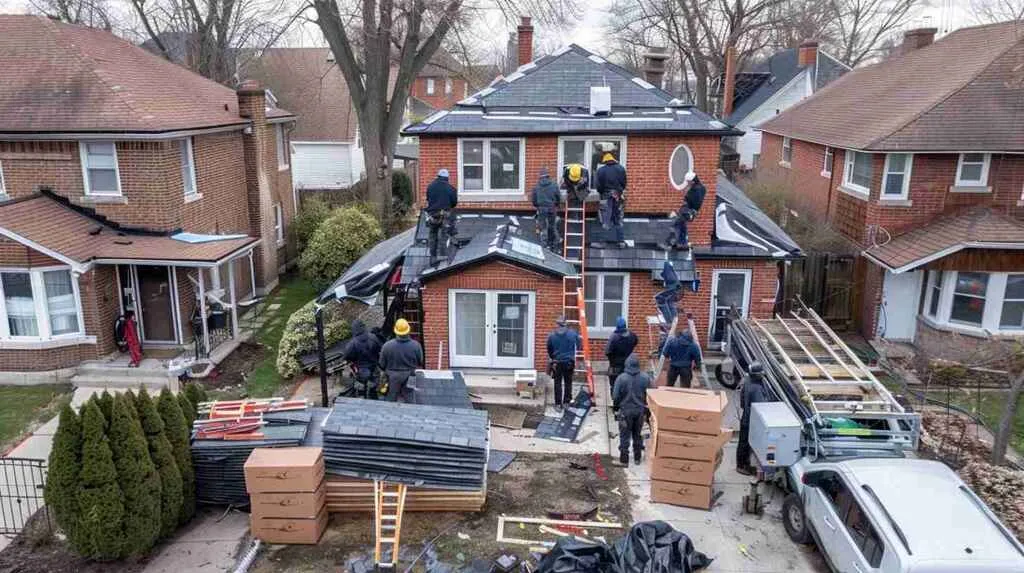
Slate vs Asphalt Shingles Cost Queens NYC – Long-Term Value Check
Ledger pages from three decades of Queens roofing jobs tell me the same story: a typical asphalt shingle roof runs $12,000-$20,000 installed while slate will set you back $40,000-$80,000 on the same house-but when you divide that by lifespan (asphalt at 18-25 years, slate at 60-100+ years), you’re looking at roughly $667 to $1,111 per year for asphalt versus $400 to $1,333 per year for slate, and suddenly the math isn’t as one-sided as the upfront price makes it feel. The real question isn’t what your roof costs today; it’s what it costs you per year of peace of mind over the next 30-40 years while you’re living under it.
Slate vs Asphalt in Queens: Sticker Price vs Cost Per Year
My blunt opinion: most Queens homeowners underestimate what they’ll actually spend on asphalt over two decades and overestimate how long they’re planning to move, which makes slate a better value than they think before they even pull out a calculator. I’ve sat at enough kitchen tables in Flushing, Forest Hills, and Astoria-notebook open, pen circling numbers-to know that the sticker shock of slate ($40k, $56k, sometimes $80k for a larger detached home) blinds people to the fact that they’re about to sign their future self up for a roof “subscription” that renews every 18-25 years with asphalt, while slate is more like a one-time lifetime membership. When I break it down to cost per month-say, $65/month for asphalt vs. $55/month for slate over realistic lifespans-the guy who thought he was saving money by going cheap suddenly realizes he’s just deferring the bill and doubling the number of times a crew will be tearing his gutters apart.
On my notepad last week in Bayside, I wrote down two numbers that made a homeowner go quiet: $18,500 and $56,000. Those were the asphalt and slate quotes for the same 1,800-square-foot ranch, and he’d been ready to sign the asphalt contract until I did the simple math right there on his dining table-$18,500 spread over 20 years is $925 per year, while $56,000 over 75 years is $747 per year, and that’s before we even talked about the emergency repairs that asphalt invites in year 12 or 15. I still remember an Astoria landlord from about eight winters back: one January morning around 7:15, I was on his three-story walk-up, fingers half frozen, counting 40-plus lifted or cracked shingles after a nor’easter, and he’d gone “cheap” on asphalt years earlier when I’d quoted him slate at what felt like triple the price. I opened my notebook and showed him that his emergency repairs plus two months of lost rent from soaked apartments had already caught up to the slate number he’d rejected, and he just stared at the page and said, “I should’ve listened to the spreadsheet roofer.”
Queens Roof Cost Per Year Snapshot
| Scenario | Roof Type | Installed Price Range | Assumed Lifespan | Cost Per Year |
|---|---|---|---|---|
| Small Rowhouse (~1,200 sq ft roof) |
Asphalt Shingles | $10,000-$15,000 | 20 years | $500-$750/year |
| Slate Roof | $35,000-$50,000 | 70 years | $500-$714/year | |
| Medium Detached Home (~1,800 sq ft roof) |
Asphalt Shingles | $15,000-$22,000 | 22 years | $682-$1,000/year |
| Slate Roof | $50,000-$70,000 | 80 years | $625-$875/year | |
| Larger Detached Home (~2,500 sq ft roof) |
Asphalt Shingles | $20,000-$28,000 | 22 years | $909-$1,273/year |
| Slate Roof | $65,000-$95,000 | 85 years | $765-$1,118/year | |
| Two-Family Building (~2,000 sq ft roof) |
Asphalt Shingles | $16,000-$24,000 | 20 years | $800-$1,200/year |
| Slate Roof | $55,000-$80,000 | 75 years | $733-$1,067/year |
Note: Prices reflect typical Queens installations as of 2024; steep pitch, complex flashing, or structural reinforcement can push slate numbers higher.
How Long You’ll Stay: The Queens Homeowner Math
Here’s my blunt view: if you’re planning to stay less than 10 years, asphalt usually wins the math, even in Queens. The raw numbers favor the lower upfront cost, and buyers-despite what agents sometimes promise-don’t always pay you back dollar-for-dollar for a fancy slate roof, especially in neighborhoods where turnover is faster and owner-occupancy rates are lower. I’ve watched this play out in Astoria, Sunnyside, and Ridgewood, where people buy a two-bedroom co-op or a small detached starter house fully intending to upgrade in 7-10 years; for them, spending an extra $40k on slate makes zero sense when asphalt will outlast their ownership and they’re not banking on recouping the premium at closing. On the flip side, the longer-term holds in Douglaston, Jamaica Estates, and parts of Bayside change the equation completely-once you hit that 15-20 year ownership horizon, the asphalt roof you installed in year one is either failing or already replaced once, and suddenly you’re looking at a second $18k-$22k check while the slate owner hasn’t thought about their roof since the installer packed up the truck.
Turn the page with me for a second: back in 2018, on a sticky August afternoon in Jamaica Estates, I replaced a 50-year-old slate roof for an older couple moving to Florida, and that original slate had outlived two boilers, three refrigerators, and one of their cars-aside from a few replaced tiles after a fallen branch in ’96, it had never given them trouble. Their son wanted to swap to cheap asphalt to “save cash for the sale,” but I sat with them at the dining table and laid out two listing scenarios: one with a 75-year slate warranty stamped on fresh inspection paperwork, and one with a 25-year asphalt roof that would need replacement again before most buyers’ mortgages were paid off. They went with slate, and they ended up getting three offers over asking; every buyer’s agent commented on the new slate roof in their feedback, and one agent literally told me it closed the deal because the buyer was planning to retire in that house and didn’t want to think about roofing ever again. Think of it like train lines: asphalt is the short local run that gets you to your next stop, slate is the express train that carries you into retirement-and even if you’re planning to get off early, in higher-end Queens markets the slate ticket still makes sense because buyers and their agents recognize the long-term value and price it into their offers.
Queens Roof Choice Express Line
Start: Do you realistically plan to own this property for more than 15 years?
↓ NO → Consider Asphalt Shingles
Lower upfront cost makes sense for shorter ownership. Verify quality installation, get a solid warranty, and budget for one potential repair cycle before you move. In co-ops and smaller multi-families, this is usually the practical choice.
↓ YES → Next Question
Is this a higher-end neighborhood (Jamaica Estates, Douglaston, Forest Hills) or a 2-3 family where buyers care about premium finishes?
↓ YES → Lean Strongly to Slate
Buyers in these markets recognize slate value and agents will use it to justify your asking price. A 75-year slate warranty can close deals and boost offers, especially with buyers planning long-term ownership or multi-generational holds.
↓ NO → Next Question
Are you comfortable with 2-3× upfront cost if your cost per year is lower and you never want to think about this roof again?
↓ YES → Choose Slate
You’re buying decades of peace of mind. Budget for the upfront number, then forget about roofing until your grandkids inherit the house. Ideal for long-term owners who value low maintenance and zero emergency calls.
↓ NO → Higher-End Asphalt (Architectural or Impact-Resistant)
Go with premium asphalt shingles rated for 30+ years. You’ll still face replacement within your ownership, but quality installation and a strong warranty will minimize headaches. Plan for one replacement cycle and factor that into your long-term home budget.
Real Queens Examples: Repairs, Disruptions, and Peace of Mind
$7,200 in five years-that’s what one Ridgewood restaurant owner ended up spending on emergency asphalt roof issues before we even talked about lost business from a closed kitchen. I’ll never forget that Saturday night call: pouring rain, close to midnight, his kitchen ceiling actively dripping onto the prep table, and we’d installed architectural asphalt shingles for him five years earlier because his landlord wouldn’t approve slate on the mixed-use building. On the phone, half-shouting over the rain, he said, “Dennis, what would it have cost me to never have this conversation?” We ended up sitting on milk crates in his dark dining room at 1 a.m., and I showed him the math: the slate roof I’d put on his personal townhouse three blocks away had never once woken him up in the middle of the night, never cost him a single closed service, never forced him to turn away Saturday reservations because a tarp crew was working overhead. Here’s my insider tip for Queens landlords and small business owners: when you’re comparing the cost of a slate roof vs. asphalt shingles, add a line in your notebook for “lost rent / closed days” every time you imagine a leak, because that disruption cost is just as real as the invoice from your roofer, and asphalt invites way more of those midnight phone calls than slate ever will.
I still remember a humid Tuesday in Corona when a client asked me, “Dennis, why would anyone in their right mind pay slate money?” and I walked him up to his roof and pointed east toward the airports, then west toward the East River, then told him to think about every nor’easter, every August scorcher, every winter freeze-thaw cycle, and every bit of salty air blowing in from Rockaway that his roof has to shrug off for the next 20, 40, 60 years. Queens weather is brutal on roofing: we get wind gusts that peel asphalt tabs like old wallpaper, summer heat that bakes cheap shingles into brittle crackers, and enough freeze-thaw action to turn minor flaws into major leaks by February. Slate just doesn’t care-it’s been handling worse weather than this for literal centuries in Europe, and a Queens nor’ester isn’t going to faze a material that used to roof castles. When I talk about cost per year of peace of mind, I mean you’re not waking up at 2 a.m. during a storm wondering if tonight’s the night your shingles give up; you’re sleeping through it because you know your roof is a 100-year train line and you’re only 10 stops in.
Numbers at a Glance: Queens Cost, Lifespan, and Maintenance
Turn the page with me one more time-this is the side-by-side summary where we lay out the core numbers so you can see exactly what you’re signing up for. These are typical Queens ranges, not Manhattan brownstone or upstate cottage numbers, and keep in mind that steepness, complex valleys, or the need for structural reinforcement can nudge slate prices up while premium architectural asphalt can push that side higher too.
Maintenance Checkpoints for Queens Roofs Over 30 Years
Queens Reality Check: By year 30, you’ve paid for and replaced an asphalt roof at least once, possibly twice depending on storm damage and quality of original install.
Queens Reality Check: By year 30, your slate roof is barely middle-aged. Most original 1920s-1940s slate roofs in Douglaston and Forest Hills are still functional today-that’s 80-100 years of zero replacement cycles.
Still Unsure? Quick Questions Queens Homeowners Ask Me
What’s the one question your future self would want you to ask about this roof decision? The following quick FAQs cover the usual sticking points for Queens homeowners comparing the cost of a slate roof vs. asphalt shingles.
When I sit at a kitchen table and ask, “How long do you realistically see yourself in this house-be honest with me,” everything about slate vs asphalt starts to clear up. If you’re thinking retirement, multi-generational ownership, or even just “this is my last move before the kids graduate high school,” then slate’s cost per year of peace of mind beats asphalt’s deceptively cheap upfront number every time-and you’re signing up for a roof that outlasts your mortgage, your appliances, and possibly your kids’ college loans. Let Dennis and the Shingle Masters team run your specific Queens roof numbers like a subway map of the next 30-40 years, and we’ll show you exactly what each option costs per year, per month, and per night of sleeping through a storm without worrying. Call Shingle Masters today to schedule a roof inspection and get your personalized cost-per-year breakdown-because your future self deserves to know what you’re really signing up for.