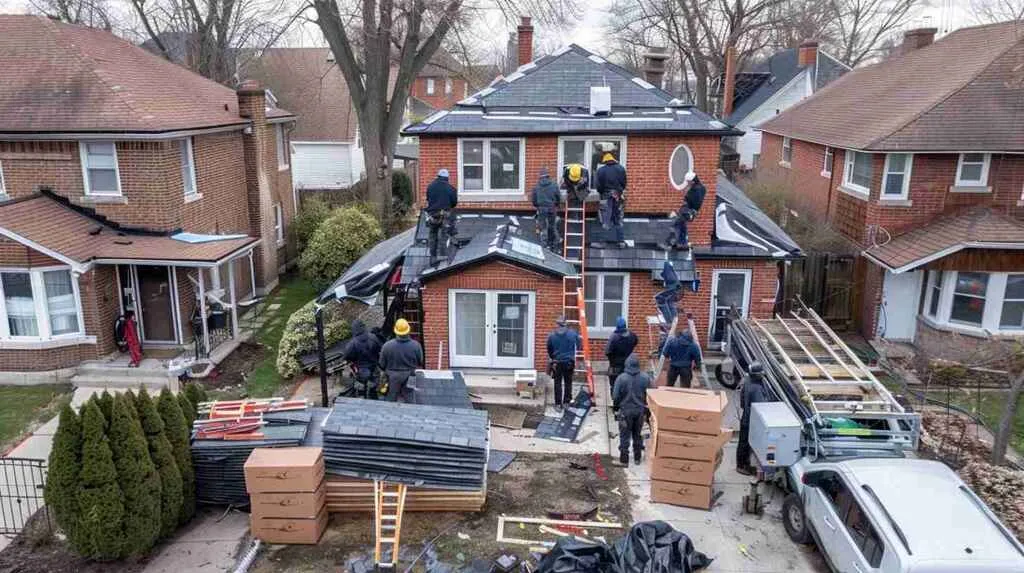
Install a Skylight on a Shingle Roof Queens NY – Full Process | Free Quotes
Blueprints tell the story before the saw touches shingles, and that’s exactly how I work every skylight install on a Queens roof: first I locate the rafters, mark the opening, and walk through where every drop of water will travel once we cut the hole. Most homeowners start by shopping for glass and brands; I start by measuring rafter spacing in the attic and making sure the opening fits between the framing without forcing structural shortcuts that turn into leak paths later.
Lay Out the Skylight Opening Around the Rafters, Not the Drywall
First thing I do when I step onto a Queens shingle roof is look for the rafters, not the view. Layout happens before you buy the skylight, before you pick a color, before you even talk to the installer. Here’s what I tell people: imagine a single drop of water landing six inches above your new skylight opening and sliding down the shingles-does it ride smoothly over the flashing and back onto the shingle courses below, or does it find a gap where we cut into a rafter or left a corner without proper backing? That water-path question decides everything. You measure rafter spacing from inside the attic, poke around in the insulation until you feel the underside of the roof deck, then you confirm on the roof by looking for the nail lines in the shingles that mark where each rafter runs. Never center a skylight only by room aesthetics-structure and water path come first, period. In Queens you’ll find everything from old 2×6 rafters spaced 16 inches on center in Maspeth bungalows to newer engineered trusses 24 inches apart in the colonials along Bayside; each one needs a layout that respects what’s actually holding the roof up.
One January morning in Astoria, it was about 23°F with that sharp wind off the river, and a client insisted we reuse his old skylight frame “to save money.” I warned him twice that the flange was warped and the weep holes were clogged, but he was set on it. Three weeks later I’m back there at 9 p.m. after a sleet storm, standing in his attic with a flashlight, watching water track along the warped flange right where I’d pointed in the first place. That job is why I tell people: on a shingle roof, a skylight is only as good as the metal you can’t see. The water didn’t leak because the shingles failed; it leaked because the warped flange gave that drop a shortcut around the intended path, straight past the underlayment and into the attic. When your layout puts the skylight flange directly over a rafter or forces you to notch framing, you’re creating those shortcuts before the shingles ever go back down.
Here’s the exact sequence I follow: mark the center of your intended skylight on the ceiling inside the room, using a tape measure from two walls so you can re-find that spot. Head into the attic and locate that ceiling mark from above-probe gently through the insulation to expose the underside of the roof deck. Find the two nearest rafters on either side of that point and measure their clear spacing; in Queens expect anything from 14 inches to 24 inches on center, especially in older stock. Compare that clear space to your skylight’s rough-opening size, and if it doesn’t fit cleanly between rafters, plan for proper headers and trimmers on both sides-not just notching the rafters and hoping. Drill a quarter-inch pilot hole straight up through the roof deck at what will be the center of the new skylight, staying between those rafters. On the roof side, find that pilot hole under the shingles, peel back just enough shingle tabs to see the wood, then snap level, square chalk lines for the final opening based on the manufacturer’s rough-opening dimensions. Double-check with a four-foot level that your layout is truly level and square before touching a saw-adjust now, not after the hole is cut.
Exact Layout Sequence Before Cutting the Skylight Hole
- In the room, mark where you want the center of the skylight on the ceiling using a tape measure from two walls so you can re-find it.
- Go into the attic and locate that ceiling mark from above; probe gently through insulation to expose the underside of the roof deck.
- Find the two nearest rafters on either side of that point and measure their spacing; in Queens expect anything from 14″ to 24″ on center, especially in older Maspeth/Astoria houses.
- Compare the clear space between rafters to your skylight rough-opening size; if it doesn’t fit cleanly, plan for proper headers and trimmers on both sides, not just notching rafters.
- Drill a 1/4″ pilot hole straight up through the roof deck at what will be the center of the new skylight, staying between rafters.
- On the roof side, find that pilot hole under the shingles, peel back just enough shingle tabs to see the wood, then snap level, square chalk lines for the final opening based on the manufacturer’s rough-opening dimensions.
- Double-check with a 4-foot level that your layout is truly level and square before touching a saw-adjust now, not after the hole is cut.
⚠️ WARNING: Never start cutting shingles and decking for a skylight just by counting shingle tabs or “eyeballing” where the rafters might be. In Queens, rafters often jog around old chimneys and dormers, so you can end up half into a rafter or over-spanning a thin section of deck. Always positively locate rafters from the attic, then lay out the opening so every edge has solid wood, or add proper framing before you install the skylight.
Integrate the Skylight With Shingles and Underlayment So Water Has No Shortcut
Here’s the ugly truth about cutting a hole in your roof for more light-water now has a favorite place to try to get in. During that big summer thunderstorm in 2021, we were mid-install on a low-slope shingle roof in Jackson Heights-a 1960s bungalow wedged between two taller buildings. The homeowner wanted a huge fixed skylight right over the stairwell. We had the opening cut and the curb framed when the sky just opened up. I had my helper holding a tarp like a sail while I scrambled to get the underlayment and emergency peel-and-stick down around the opening so they wouldn’t end up with a waterfall on the treads. That’s the day I stopped cutting skylight openings on Queens roofs after 1 p.m. if there’s even a hint of rain in the forecast. Low-slope bungalows around here shed water slower than steep colonials, so underlayment and peel-and-stick around the opening aren’t optional-they’re the only thing standing between a bright kitchen and a ruined ceiling. I temporarily redirected the water path with a 12-inch band of ice-and-water shield around the entire opening, lapping it over the existing underlayment, and that bought us time to get the skylight set and flashed properly the next morning.
Step back a second and think about your roof as a layered system: deck on the bottom, then underlayment, then step flashing interwoven with the shingles on the sides, counter-flashing or head flashing at the top, and the shingles themselves as the final weather layer. Now zoom back in to the exact nail placements around your skylight-side shingles should overlap step flashing pieces like stair treads, with each piece of step flashing tucked under the shingle above it and over the shingle below. The top course of shingles should lap over the head flashing, and you absolutely cannot place nails uphill of any flashing leg where a drop of water could find them. That’s the difference between a skylight that lasts twenty years and one that starts dripping after the first nor’easter.
✅ Ice & water shield (peel-and-stick)
wrapped at least 6″ up all sides of the opening on low-slope Queens roofs.
✅ Step flashing pieces
installed one per shingle course up both sides, each overlapping the one below.
✅ Continuous head flashing
at the top of the skylight tucked under the underlayment above.
✅ Nails placed only on the dry side
(upper corners) of the flashing legs, never in the exposed valley where water runs.
❌ Shingles butted tight to the skylight frame
without a proper factory flashing kit.
❌ Running a single “L” flashing
from bottom to top instead of true step flashing on the sides.
❌ Cutting back underlayment
so the wood deck is exposed at the corners of the opening.
❌ Relying on caulk or roof cement alone
as the primary seal around the skylight.
| Roof Slope (Queens Shingle Roof) | Underlayment & Ice/Water Recommendation | Skylight Suitability Notes |
|---|---|---|
| 3:12 – 4:12 (low-slope bungalow/rowhouse) | Full ice & water shield from eaves up past the skylight opening, plus an extra 18-24″ band around all four sides. | Use only skylights approved for low-slope; avoid oversized units and always follow manufacturer’s minimum slope. |
| 4:12 – 6:12 (typical Cape/colonial in Bayside, Maspeth, Middle Village) | Standard synthetic underlayment with ice & water shield at eaves and a minimum 12″ band all around the skylight. | Most standard skylights work well here if flashed correctly; pay attention to snow and ice dams around the unit. |
| 6:12 and steeper (taller gables, dormered attics) | Synthetic underlayment is fine; still add a perimeter band of ice & water shield around the skylight for wind-driven rain. | Best for shedding water quickly; main risk is wind-driven rain, so side and head flashing must be perfect. |
Finish the Interior Tunnel So It Doesn’t ‘Leak’ on a Sunny Day
Let me be blunt: most “leaky skylights” I see in this borough are installation mistakes, not product failures. I’ll never forget a Sunday service call in Bayside-older couple, very neat house, called about a “mysterious roof leak” above the dining room. It was one of those bright, cold March afternoons, completely dry outside. I climbed into their attic and within five minutes I could see the issue: whoever installed the skylight five years before had skipped the interior vapor barrier, so warm indoor air was condensing on the skylight frame and dripping down like a leak. I had to explain that nothing was “wrong” with the shingles; the problem was in the way the skylight tunnel was finished. That job made me start talking more about the inside of skylights, not just the shingles and flashing. Even when the shingles and flashing are perfect outside, warm indoor air condensing on a cold frame creates drips that look exactly like roof leaks. Here’s the insider tip I give every client: always treat the skylight tunnel like an exterior wall-continuous vapor barrier on the warm side, solid insulation filling the entire cavity, and airtight drywall. That’s the step most DIY installs skip, and it’s why I get called out on bright, dry days.
Zoom out for a second and think about why Queens homes-especially those with humid kitchens and bathrooms directly below the skylight-are more prone to this condensation issue. When you cook pasta or take a shower, that moisture rises, and if the skylight shaft is basically an uninsulated chimney, all that warm, wet air hits the cold glass or metal frame and turns into droplets. Now zoom back in to the specific details: tape all seams in the vapor barrier with housewrap tape so there are no gaps, foam around the skylight frame where it meets the drywall, and extend your attic insulation right up to the shaft so there’s no thermal bridge. Most people treat the shaft like interior trim work and forget it’s actually part of the building envelope. That’s the difference between a skylight that works year-round and one that “leaks” every time the temperature drops below freezing.
| Approach | Pros | Cons |
|---|---|---|
| Insulated, air-sealed light shaft with vapor barrier | Greatly reduces condensation, keeps ceiling dry; improves comfort; cuts heat loss in winter and heat gain in summer; fewer “mystery leak” calls. | Requires more time and attention to detail; may need coordination between roofer and interior finisher. |
| Bare drywall shaft with gaps and no vapor barrier | Slightly faster and cheaper at install; less material cost upfront. | High risk of condensation drips on cold days; potential for mold in the shaft; can make a good skylight look like a bad one. |
DIY vs Pro in Queens: When to Call Shingle Masters for Skylight Work
If you asked me this in your kitchen, I’d start by drawing three rectangles on a napkin: roof opening, skylight frame, and flashing. Some homeowners can absolutely handle the interior drywall and trim around a skylight once it’s already installed and weathertight, but tying a new unit into an existing shingle roof in Queens-especially near party walls, old chimneys, or on low slopes-calls for a pro who treats every cut and every piece of flashing as a water-path decision, not just a hole with a window in it. That’s where Shingle Masters comes in.
The truth is, cutting a hole is easy; making that hole behave in a Queens rainstorm is where the real work lives.
Should You DIY or Call Shingle Masters for Your Queens Skylight?
Start: Do you already have safe roof access and fall protection (harness/anchors or proper scaffolding)?
→ If NO: Call Shingle Masters for a full install or evaluation.
→ If YES: Continue ↓
Next: Is your roof slope 4:12 or steeper AND at least 5 years old?
→ If NO (low-slope or very old roof): Have Shingle Masters inspect the roof condition and design the flashing and underlayment layout.
→ If YES: Continue ↓
Next: Are you replacing an existing skylight of the same size with a factory flashing kit?
→ If NO: Let Shingle Masters handle the new opening, framing, and exterior flashing; you can still do the interior finish.
→ If YES: Continue ↓
Final: Are you 100% confident identifying rafters and following the manufacturer’s step-flashing order?
→ If NO: We’ll install and flash the skylight; you handle paint and trim.
→ If YES: You might DIY the swap, but schedule Shingle Masters for a quick check if you see any deck rot, sagging, or suspect framing when the old skylight comes out.
Why Queens Homeowners Bring Us in for Skylights
-
✓
Licensed & insured in New York City (including full liability and workers’ comp). -
✓
18+ years installing and repairing skylights on Queens roofs from Astoria to Bayside. -
✓
Typical on-site skylight evaluations within 24-48 hours for Queens ZIP codes. -
✓
Familiar with DOB permit triggers and typical co-op/HOA requirements for skylights. -
✓
Written workmanship warranty on skylight flashing and shingle tie-ins.
Common Skylight Questions From Queens Homeowners
Think of your shingle roof as a layered sandwich; a skylight is like neatly punching a square right through it without letting the fillings spill. Most questions I get boil down to cost, timing, and whether a particular Queens roof-even older ones off Northern Boulevard-can safely take a skylight without turning into a leak factory.
Can you install a skylight on an older Queens shingle roof that’s already 15-20 years old?
Yes, but only after checking the deck and shingles. If the shingles are brittle or the plywood is soft, it’s usually smarter to combine skylight installation with at least a partial re-roof so flashing can tie into fresh material. On tired roofs, I’ll walk every square foot around the planned opening before we even talk skylight sizes.
How long does a typical skylight install take on a Queens home?
For a standard-size skylight on a one- or two-family house, we usually handle the exterior work in a single day, then come back for interior finish if needed. On tight rowhouses in Astoria or Jackson Heights where access is trickier, we may plan it as a two-day project to avoid rushing critical flashing and water testing.
Will a skylight make my home hotter in the summer?
With modern Low-E glass and the shaft properly insulated, most Queens homeowners notice more light than heat. The real heat problems show up when the light shaft is uninsulated or the skylight faces south with no shades. We can recommend venting skylights or shades if your room tends to trap heat.
Do I need a permit for a skylight in Queens?
In many cases, replacing an existing skylight doesn’t require a new permit, but cutting a brand-new opening might, especially on multifamily or attached homes. We’ve worked with DOB filings across Queens and can advise whether your particular project needs drawings and permits.
What’s the risk if I just rely on caulk around the skylight instead of full flashing?
Caulk is temporary; metal flashing is permanent. In Queens weather, UV and temperature swings will crack sealant in a couple of seasons, and that’s when water finds the path of least resistance. A properly stepped and layered flashing system doesn’t depend on caulk to stay dry-it guides every drop of water safely back onto the shingles.
A skylight on a shingle roof in Queens only works long-term if every step-from layout to flashing to interior finish-respects the way water wants to move, not the way you hope it might behave. If you’re planning a brand-new opening or trying to fix a leaky existing unit, contact Shingle Masters for a free on-roof inspection and skylight quote anywhere in Queens-we’ll walk you through exactly where the rafters are, where the water will go, and how to keep your home bright and dry at the same time.