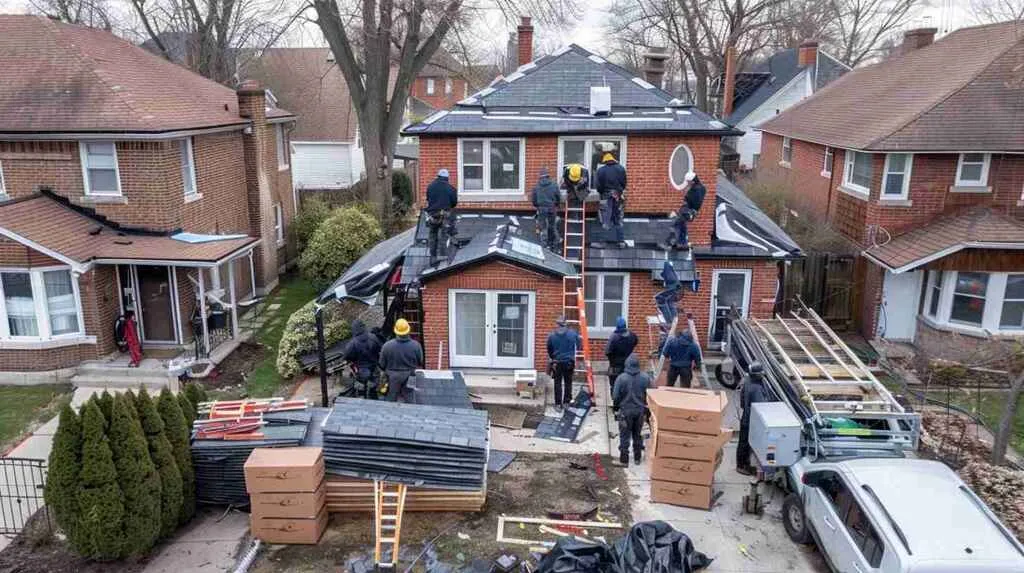
How Hard Is It to Shingle a Roof Queens NY – Honest Assessment | Call Today
Honestly, swinging a hammer on a roof is easy-keeping that roof dry through Queens nor’easters for the next 20 years is the real test. The first thing most people underestimate when they ask me how hard it is to shingle a roof isn’t the physical work; it’s the technical layout and understanding exactly where water wants to go once you’re done nailing.
How Hard Is It Really to Shingle a Roof in Queens?
On a typical two-story in Queens with a 6/12 pitch, the hard part isn’t the open field of shingles-it’s mapping how water will move across every plane of your roof, especially under the kind of wind-driven rain we get during storms that blow sideways off the Atlantic. Think of water like a sneaky jazz musician-it’s always looking for the weirdest path off the roof, not the one you expect. That means before you even touch a bundle of shingles, you need to know where your starter course goes, how each row overlaps, and where every nail line sits so water can’t track backward under the tabs.
One August afternoon around 3 p.m., sun bouncing off a white membrane roof in Woodside like a mirror, I got called to “just fix a few shingles” a homeowner had tried to install himself. He’d started in the middle of the slope instead of at the eave, no starter strip, nails way too high-looked like a shuffled deck of cards. A thunderstorm rolled in while I was up there tearing off his work, and I watched water track right under his brand-new shingles into the soffit; he could see the drip forming in his living room light fixture. That was the moment he turned to me and said, “Okay, how hard is it REALLY to shingle a roof?”
In my view, the hard part of shingling isn’t swinging a hammer-it’s predicting and controlling water in Queens storms. You’re not building a craft project; you’re building a system that has to survive freeze-thaw cycles, wind shear, and every rainstorm for two decades. If you can’t walk me through exactly where water flows from ridge to gutter on every section of your roof, including around every vent and valley, you’re not ready to DIY this job.
Perceived Difficulty vs Real Difficulty of Shingling a Roof
What Most People Think Is Hard
- Walking on the roof without slipping
- Using a nail gun or hammer correctly
- Lining up shingle tabs so they look straight
- Keeping up with the physical labor for a weekend
- Not getting sunburned while working
What’s Actually Hard in Queens, NY
- Laying out the roof correctly from the eaves up so water always flows off cleanly
- Getting starter course, edges, and nail lines right on a 6/12 or steeper pitch
- Designing around Queens nor’easters and wind-driven rain so water can’t back up
- Timing the work around sudden summer storms and freeze-thaw cycles
- Knowing how each small mistake will behave during the next 20 years of storms
WARNING: Underestimating Roof Layout and Water Flow
Starting in the middle of a slope, skipping starter strips, or nailing too high might not leak on a sunny day, but the first sideways Queens rain can drive water under those shingles and into your soffits and light fixtures. If you can’t explain exactly where water goes from ridge to gutter on every plane of your roof, it’s too early to DIY.
Safety, Pitch, and Queens Weather: Where DIY Gets Dangerous
Here’s the part nobody puts in the YouTube description: gravity doesn’t care how confident you are with a nail gun. Working on a typical two-story Queens home with a 6/12 pitch means you’re balancing on a sloped surface 20 feet in the air while managing bundles of shingles, tools, and your own footing-and that’s before you factor in ladder safety, sudden weather shifts, or the reality that most residential roofs in Queens have tight lot lines with zero margin for a fall. Around here, we’ve got two-family homes built close together, shared walls, and roofs that go from flat tar sections to steep dormers in the span of ten feet, which makes every transition a new safety challenge.
One icy morning in January, about 7:30 a.m. in Bayside, I showed up to a two-family where the owner’s nephew had “helped out” by laying shingles over an old roof in 25° weather. Nobody had a clue that cold, brittle shingles don’t seal properly. Two weeks later, a nor’easter hit, and I came back to find whole sections of shingles lifted like playing cards being shuffled by the wind, with granules piled in the gutters like sand. Standing up there, fingers numb, redoing his work, I kept thinking: the hard part about shingling a roof isn’t nailing-it’s knowing when you’re not supposed to be nailing at all. Timing matters, temperature matters, and Queens weather doesn’t wait for your learning curve.
Queens Roof Safety & Weather Risks DIYers Overlook
Replacing 1-2 shingles on a dry, flat porch roof under 8 feet high
Working alone on any roof over 15 feet with no safety harness or spotter
Inspecting your roof from a stable ladder on a calm, sunny day
Climbing onto a wet, icy, or windy roof to “just take a quick look”
Patching a small section on a low-slope addition in fair weather
Attempting full shingle removal and replacement on a steep 2-story home
Waiting for a pro assessment if you’re unsure about pitch or access
Starting work when thunderstorms are in the forecast within 4 hours
The Hidden Hard Parts: Valleys, Chimneys, and Weird Transitions
Think of water like a sneaky jazz musician-it’s always looking for the weirdest path off the roof, not the one you expect. Valleys, chimneys, sidewall transitions, and plumbing vents are where water tests every single detail of your shingle job, and in dense Queens housing where homes sit inches apart and rooflines intersect at odd angles, these junctions become critical. A Saturday just after dusk in Jackson Heights, I got called to what the owner swore was “a small leak near the chimney” after he’d tried to DIY the shingles around it. He’d watched three different online videos, mashed all the techniques together, and ended up tucking step flashing under the shingles instead of weaving it properly. By the time I arrived, his dining room wall had a perfect brown water “frame” around a family photo. As I carefully pulled up his shingles by headlamp, I remember thinking: for most people, shingling a roof is hardest where you can’t see-valleys, chimneys, transitions-not the big open spaces they film in tutorials.
I’ll be blunt: the shingles themselves are the easiest part of this whole equation. These complex areas are where most DIY jobs fail because shingle manufacturers and building codes have strict rules for flashing sequences, overlap distances, and nail-free zones that aren’t obvious if you’ve never done this before. Here’s an insider tip worth remembering: before you nail anything near a chimney or valley, trace in your head the exact path wind-driven water will take during a Queens storm, and if you can’t visualize that water rolling cleanly off the roof without sneaking under a shingle edge, step back and call a pro. That mental water test is what separates a roof that lasts 20 years from one that fails in the first nor’easter.
How a Pro in Queens Sequences Shingle and Flashing Work Around a Chimney
- Remove old shingles and inspect the chimney structure and existing flashing for rust, gaps, or movement that will compromise the new installation.
- Install new base flashing at the bottom (downslope) side of the chimney so water running down the bricks is directed out onto the shingles.
- Weave step flashing with each shingle course on the sides of the chimney so every shingle has a metal “shingle” behind it guiding water outward.
- Trim and fold counter-flashing into the brick mortar joints to cover the step flashing edges and prevent wind-driven rain from sneaking behind the metal.
- Build a cricket or saddle on the upslope side of the chimney (if it’s wide enough) to divert water around the structure instead of letting it pool.
- Seal all metal-to-brick joints with high-grade polyurethane sealant and verify the entire shingle-to-flashing sequence sheds water in every direction before moving to the next section.
DIY vs Hiring a Pro in Queens: What Makes Sense Where
When I come to your house and you ask me, “Can I do this myself?” I always ask you one question back: what’s your plan for the next storm? Limited, low-risk DIY patches on small, low-slope areas like a porch or shed might make sense if you’ve got the right materials and you’re genuinely confident about layout and water flow-but the closer you get to neighbors, chimneys, shared walls, and steeper pitches common on multi-story Queens homes, the less margin you have for mistakes. A shingle that looks fine on a sunny Saturday can turn into a ceiling stain during the first sideways rainstorm, and by then you’ve already spent the money, the time, and the risk.
Typical Queens Shingle Work Scenarios & Ballpark Ranges
*Estimates only-actual pricing depends on roof condition, access, materials, and complexity. Call for a detailed quote.
Why Queens Homeowners Call Shingle Masters
Lou and the team know Queens housing stock, weather patterns, and local building requirements inside and out.
All work is fully licensed and covered so you’re protected from liability and workmanship issues.
Lou will tell you exactly what you need and what can wait-no upselling, no scare tactics.
Written workmanship guarantees and help navigating manufacturer warranties so your investment is protected.
Quick Self-Check: Are You Really Ready to Shingle Your Own Roof?
Before you buy bundles and rent a nail gun, ask yourself one honest question: can you trace the exact path wind-driven water will take across every plane, valley, and transition on your roof during the next Queens nor’easter? If the answer is anything less than a confident yes, you’re not ready to DIY-and that’s okay.
Should You DIY or Call Shingle Masters?
START: Is your roof 1 story or less with easy, safe access?
→ NO: Call Shingle Masters. Two-story roofs and steep pitches are too dangerous for DIY.
→ YES: Continue…
Is the roof pitch 4/12 or less (gentle slope)?
→ NO: Call Shingle Masters. Steeper pitches require safety equipment and experience.
→ YES: Continue…
Can you explain exactly how water flows from ridge to gutter on every section?
→ NO: Call Shingle Masters. Water-flow mistakes cause the majority of DIY failures.
→ YES: Continue…
Are you only replacing a few shingles in an open field (no chimneys, valleys, or vents)?
→ NO: Call Shingle Masters. Complex details require proper flashing and sequencing.
→ YES: Continue…
✓ MAYBE DIY: You might be able to handle a very small, simple repair-but call Shingle Masters for a quick inspection first to confirm there aren’t hidden issues you’ll make worse.
Common Questions About Shingling a Roof in Queens, NY
How hard is it to shingle a roof yourself in Queens?
Physically nailing shingles isn’t hard-the difficulty is in layout, water-flow design, flashing details, and working safely on a pitched roof. Most DIY attempts fail at valleys, chimneys, and edges where water tests every mistake during the first Queens rainstorm.
Do I need a permit to replace shingles on my Queens home?
In most cases, yes-especially for full tear-offs or structural changes. Queens building codes require permits for roofing work, and working without one can complicate insurance claims and future home sales. Shingle Masters handles all permit applications as part of the job.
Will DIY shingle work void my roof warranty?
Often, yes. Most shingle manufacturers require installation by a certified contractor to honor material warranties, and improper DIY installation-like incorrect nailing or missing starter courses-automatically voids coverage. You could be stuck paying for premature shingle failure out of pocket.
How long does it take to shingle a typical Queens two-story home?
A professional crew like Shingle Masters can typically strip and reshingle a standard two-story Queens home in 2-4 days, depending on weather, roof complexity, and material availability. DIY attempts often stretch into weeks and frequently stall when homeowners hit unexpected challenges or bad weather.
What weather conditions make shingling impossible or unsafe in Queens?
You can’t shingle in rain, on wet or icy surfaces, in temperatures below 40°F (shingles won’t seal), or in high winds. Queens weather can shift fast-sudden summer storms and winter freeze-thaw cycles mean you need to time the work carefully and be ready to stop immediately when conditions change.
Before You Call Shingle Masters: Quick Checklist
Having this info ready helps Lou assess your situation quickly over the phone and schedule the right kind of visit.
- Age of the roof: When was it last replaced or worked on? (Check closing docs if you just bought the home.)
- Visible damage: Are shingles missing, curled, cracked, or lifted? Can you see exposed underlayment or nails?
- Interior signs: Any water stains on ceilings, walls, or around light fixtures? Musty smells in the attic?
- Recent weather events: Did damage appear after a specific storm, freeze, or wind event?
- Roof access: Is the roof steep, two-story, surrounded by tight lot lines, or hard to reach safely?
- Complexity: How many chimneys, valleys, skylights, or dormer transitions does your roof have?
- Your timeline: Is this an emergency leak requiring immediate tarping, or are you planning ahead for a replacement?
And honestly, that’s the real answer to “how hard is it to shingle a roof?” If you’re not 100% sure how water will move across every inch of your roof during the next Queens storm-across every valley, around every chimney, through every transition-it’s safer and smarter to let Shingle Masters handle the shingling. Lou and the team will inspect, repair, or replace your roof the right way, with proper layout, flashing, and warranties, so you can stop worrying about ceiling stains and start trusting your roof again. Call today to schedule an honest assessment before the next big weather hits Queens.