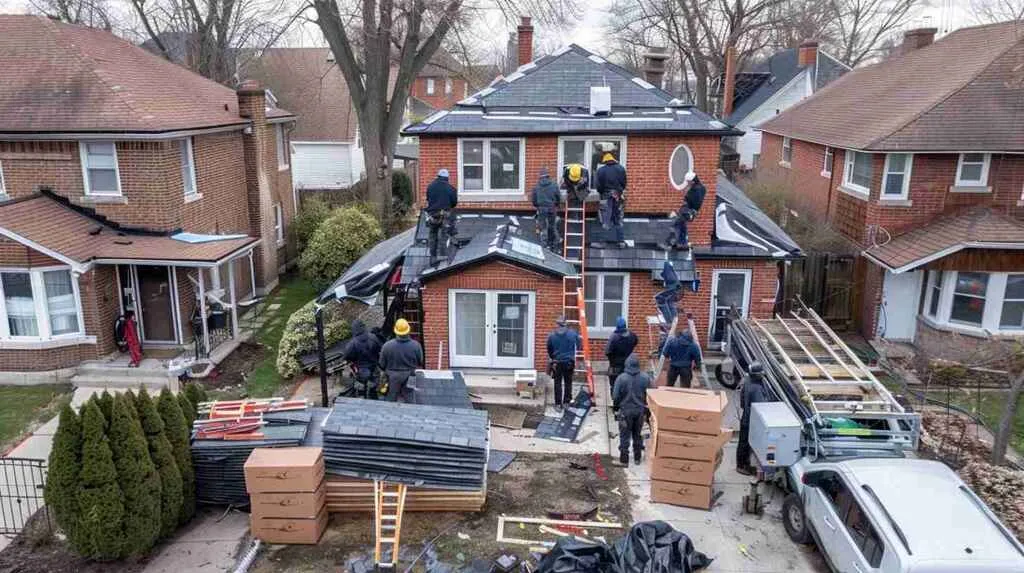
How to Shingle a Roof Queens NY – The Complete Process | Free Estimates
Blueprint: You snap a chalk line along the eave of a two-family in Woodside, peel the backing from a starter strip, and press it down perfectly straight along the edge-that single seam decides whether your Queens roof drains clean for 20 years or sneaks water under the shingles by year two. This guide walks you through exactly how to shingle a roof in Queens, step by step, and when it’s smarter to call Shingle Masters instead of gambling with a leak you’ll regret.
How a Straight Starter Strip Decides If Your Queens Roof Drains or Leaks
On a typical two-family in Astoria, the very first thing I do is look at the edges, not the middle of the roof. The starter course and drip edge form a hem-just like the bottom of a tailored pant-and that hem controls water flow for decades. If it’s crooked, lumpy, or nailed wrong, every shingle above it is compromised from day one, and you’ll see water creeping behind siding or dripping through soffits during the first hard Queens rain. Field shingles get all the attention, but edges do all the real work.
One August evening in Forest Hills, we started tearing off a roof at 6:30 a.m. because the homeowner was pregnant and couldn’t handle noise all day. Forecast said “10% chance of rain”-we all know what that means in Queens. By 3 p.m. I saw this single dark cloud over the Triborough side and told my guys, “Nail faster, something’s coming.” We got the underlayment down just in time; a 20-minute sideways rain hit. The only reason that house didn’t get soaked is because we’d staged the shingles and drip edge exactly where I knew we’d need them. That day locked in my rule: never, ever open more roof than you can dry-in by lunch. Precise starter and drip-edge layout isn’t optional in Queens-our surprise storms don’t wait for sloppy prep.
Edge Prep and Starter Course Layout on a Queens Asphalt Shingle Roof
Run aluminum drip edge along every eave and rake, overlapping corners 2-3 inches, and nail every 10-12 inches; any gap here lets wind-driven rain sneak under the shingles during nor’easters off the bay.
Install self-adhesive membrane at least 24 inches up from the eave edge (36 inches if your pitch is shallow or you face north); this is your backup seal against ice dams and sideways snow that piles up in Queens winters.
Measure up 11½ inches from the bottom of the drip edge at each end, snap a bright line across the eave, and double-check it with a level; this line controls every course above it, so crooked here means crooked everywhere.
Use full-width starter shingles or flip regular 3-tabs so tabs point toward the ridge, overhang the drip edge by ½ inch, and nail 3-4 inches up from the bottom edge so nails sit above the seal strip; this creates a perfect overlap for the first course.
Walk the entire eave and rake edge, press down any bubbles in the starter or ice & water, and confirm no nails are exposed; this 10-minute check prevents years of water intrusion along the most vulnerable seam on your Queens roof.
DIY vs. Hiring a Queens Pro: Who Should Actually Be On Your Roof?
Here’s the blunt truth-if you can’t walk your roof safely, you have no business learning how to shingle it from YouTube alone. Queens roofs come in every flavor: steep Bayside colonials where you’re gripping for dear life, flat-ish Ridgewood row houses with parapets and tight access, and Astoria two-families with multiple layers of old shingles that might be hiding rotten decking. Steepness, layers, and how you’ll even get materials up there all decide whether DIY is realistic or reckless. Add in that most homeowners don’t own pneumatic nailers, proper harnesses, or 40-foot extension ladders, and the “save money” math starts looking pretty thin once you rent gear and lose three weekends.
I’ll never forget a Sunday in January in Bayside, 29 degrees and windy, when a homeowner called me almost in tears because another roofer had left mid-job after finding rotten decking. I drove over, climbed up, and saw they’d started shingling right over soft plywood-every step felt like a drum. I stopped everything, showed her with my boot heel how the wood flexed, and walked her through a proper redeck, drawing it out on a frozen trash can lid. It turned into a two-day rebuild, but that roof is still bone-dry and flat as a billiard table ten winters later. That’s exactly where DIYers and cheap contractors get into trouble-cutting corners on structure and safety to meet a budget or timeline, then ending up with a leak two seasons later that costs triple the original savings to fix.
Structural and Safety Risks When You Shingle Over Rotten or Unknown Decking
Older Queens homes often carry two or three roof layers, and the plywood underneath can be soft, cracked, or completely rotten without any visible sign from the ground. If you walk on compromised decking or nail shingles into spongy wood, you risk falling through mid-job, voiding manufacturer warranties that require solid substrate, and creating hidden leak pathways that won’t show up until water is already dripping onto bedroom ceilings. Before you shingle, you must verify deck integrity-either by removing all old layers and inspecting every sheet, or by hiring someone who knows exactly how a Queens two-family deck should feel underfoot and can spot trouble before it becomes a hospital trip or an insurance claim.
Step-by-Step: How to Shingle a Roof in Queens So It Drains, Breathes, and Lasts
On a typical two-family in Astoria, the very first thing I do is look at the edges, not the middle of the roof. Eaves, rakes, and valleys are your critical seams-get those wrong and no amount of pretty field shingles will save you. Think of your roof like a layered winter coat in a Queens blizzard: if the base layer is wrong, that fancy outer jacket-your shingles-won’t save you. Underlayment is your lining, ice & water shield is your interfacing where stress hits hardest, and flashing is the careful hem work that keeps wind and rain from sneaking through every joint. I always compare shingle layout to custom-fitting a garment to your building-you measure twice, cut clean, overlap precisely, and treat valleys and ridges like tailored seams that can’t pucker or gap, because one wrinkle becomes a leak five years down the road.
One summer night in Ridgewood, around 8 p.m., we were finishing a small shingle job for an elderly couple before a predicted heatwave. As we were cleaning up, I heard a drip in their attic-no rain outside, just condensation from a terrible vent layout. I climbed back up in the dark with a headlamp, and by the glow of the Manhattan skyline I re-laid a whole row of shingles around a new ridge vent cut we made on the spot. That experience is why, whenever someone in Queens asks me how to shingle a roof, I always talk about attic ventilation in the same breath-because shingles alone don’t save you if the roof can’t breathe. Hot, humid Queens summers turn un-vented attics into ovens that cook shingles from underneath and warp decking; cold winters create moisture that rots wood and grows mold. Proper intake at the soffits and exhaust at the ridge must be part of every shingle job, not an afterthought.
Straight lines, correct nail placement, and clean valleys are like clean seams on a suit-no puckers, no shortcuts. This is where Queens roofs either last 20-plus years or start leaking in five. Every shingle course must align to your chalk lines, every nail sits in the nailing zone (not too high, not through the seal strip), and every valley gets either woven or metal flashing that sheds water without creating a dam. Skip these details and you’re just stapling pretty rectangles to plywood while hoping for the best.
Full Queens, NY Shingle Roof Installation Sequence
Tear Off Old Shingles & Inspect Deck
Remove all old roofing down to bare plywood, sweep clean, and walk every square foot probing for soft spots, cracks, or rot; replace any compromised sheets with ½” or ⅝” CDX plywood and secure with 8d ring-shank nails.
Install Drip Edge on Eaves
Nail aluminum drip edge along every eave, overlapping pieces 2 inches and securing every 10-12 inches; this goes on before underlayment so water can’t wick back under the deck edge.
Roll Ice & Water Shield, Then Underlayment
Apply self-adhesive ice & water membrane 24-36 inches up from eaves and in all valleys; cover the rest of the deck with #30 felt or synthetic underlayment, overlapping 6 inches and securing with cap nails or staples.
Add Drip Edge on Rakes Over Underlayment
Install drip edge along gable ends (rakes) on top of underlayment so water running down shingles flows over the edge, not under it; overlap corners and nail every foot.
Snap Chalk Lines & Lay Starter Strip
Snap a line 11½ inches up from the eave edge, install starter shingles (tabs up or dedicated starter roll), overhang drip edge ½ inch, and nail 3-4 inches up from the bottom to avoid exposing fasteners.
Install Field Shingles Course by Course
Start first full course aligned to chalk lines, offset each row by 6 inches (or per manufacturer pattern), nail 4-6 fasteners per shingle in the nailing zone (just above the tabs), and check alignment every 4-5 courses to catch drift early.
Flash Valleys, Vents, and Ridge
Weave or metal-line every valley so water flows cleanly; boot all pipe penetrations and turbine vents with proper rubber collars; cap the ridge with ridge shingles nailed alternately left and right so wind can’t peel them back.
Final Clean-Up & Inspection
Sweep gutters, magnet-sweep the ground and driveway for stray nails, check all flashing seals, confirm ridge venting is unobstructed, and walk the perimeter to verify no exposed fasteners or lifted tabs before you call it done.
Critical Shingling Do’s and Don’ts for Queens Homes
Nail in the nailing zone
Place nails just above the tabs, never through the seal strip; this lets the shingle bond properly and prevents wind blow-off during Queens storms.
Don’t over-drive your nails
If the nail head sinks and crushes the shingle surface, it creates a weak point where water pools; set your compressor pressure so nails sit flush, not buried.
Run ice & water shield up valleys
Valleys are high-stress zones-adhesive membrane here stops wind-driven rain from sneaking under shingles when snow melt and rain collide in Queens springs.
Don’t skip soffit intake vents
Ridge vents do nothing without air coming in below; blocked soffits trap heat and moisture, cooking your shingles and decking from the inside out.
Check alignment every 4-5 courses
Measure from rake to rake and from eave up; catching a 1-inch drift early is easy-fixing it after 20 courses means tearing off and re-laying half the roof.
Don’t shingle in extreme cold
Below 40°F, the seal strip won’t activate properly and shingles crack when you bend them; wait for warmer weather or use hand-sealant tabs in emergencies.
Weave or metal-line your valleys cleanly
Either weave shingles in alternating overlaps or run pre-bent metal up the center and cut shingles back 2 inches; sloppy valley work equals guaranteed leaks within three years.
Don’t leave exposed nail heads
Every fastener must sit under the next shingle’s overlap; an exposed nail is a direct water pathway, and in Queens’ freeze-thaw cycles it’ll rust and enlarge the hole fast.
What It Really Costs to Shingle a Roof in Queens, NY
$9,000 is about what a lot of full shingle replacements on smaller Queens homes land around, but that number swings hard depending on what’s hiding under your old roof. Decking condition-whether you need zero sheets replaced or twenty-moves the price more than shingle brand ever will. Layers to tear off (one versus three), pitch steepness, how many valleys and dormers need flashing, whether you’re adding proper ridge venting for the first time, and access challenges (tight Ridgewood alley? Bayside backyard with no truck access?) all shift the final bill. Paying once for proper prep-solid deck, correct underlayment, real flashing-beats paying twice when you’re calling someone back in three years to fix leaks because the first guy skipped steps to hit a low bid.
Shingle Masters at a Glance for Queens Homeowners
NYC Home Improvement license, general liability, and workers’ comp-proof provided before any work begins.
We’ve shingled everything from Astoria two-families to Bayside colonials; we know your neighborhood’s weather, roof styles, and permit rules.
Call or email, we’ll schedule a visit, measure on-site, sketch your roof on a shingle scrap, and email a detailed quote same day or next.
Most Queens single or two-family homes get fully torn off, re-decked (if needed), and shingled in one to two working days, weather permitting.
Straight Answers About Shingling a Roof in Queens, NY
I’ll be honest with you: most “how to shingle a roof” guides skip the parts that actually cause 80% of the leaks I get called to fix in Queens. The following questions cover valleys, permits, weather timing, ventilation, and what you should check before calling Shingle Masters-no fluff, just neighbor-on-the-stoop straight talk so you know exactly what to expect.
Common Queens Shingle Roofing Questions
▶ Do I need a permit to shingle my roof in Queens, NY?
Usually, yes-especially if you’re doing a full tear-off or any structural work. NYC Department of Buildings requires an “Alt-2” permit for roofing projects on most residential properties. If you’re just replacing a few damaged shingles, you might skate by, but for a complete re-roof, pulling a permit protects you: inspections catch hidden problems, and you’ll have official records if you ever sell. Shingle Masters handles all permit paperwork and coordinates inspections as part of every full roof job in Queens.
▶ What’s the best time of year to shingle a roof in Queens?
Late spring through early fall-basically May through October-gives you the most predictable weather and warm enough temps for shingles to seal properly. Avoid shingling when temps drop below 40°F; the adhesive strips won’t activate and shingles crack when you bend them. That said, if you’ve got an active leak in January, we can do emergency winter installs using hand-sealant tabs and careful staging, but plan your full re-roof for warmer months whenever possible. Queens summer heat actually helps shingles bond faster, just start early to avoid working in brutal midday sun.
▶ How do you handle valleys without creating leaks?
Valleys are high-stress zones where two roof planes meet and dump huge volumes of water, so they need extra care. I always run ice & water shield the full length of every valley first, then either weave shingles in alternating overlaps (time-consuming but clean look) or install pre-bent metal valley flashing and cut shingles back 2 inches on each side so water flows down the center channel without damming. Never, ever nail through the valley center-nails go up high on the shingle body, away from the water path. Sloppy valley work is leak #1 on Queens roofs; done right, valleys last the full life of the shingles with zero issues.
▶ Why do you always talk about attic ventilation with shingle jobs?
Because shingles alone won’t save you if your attic can’t breathe. Hot, humid Queens summers turn un-vented attics into 140°F ovens that cook shingles from underneath, voiding warranties and cutting lifespan in half. In winter, warm indoor air hits cold roof decking and condenses, rotting wood and growing mold you won’t see until it’s a disaster. Proper ventilation-continuous soffit intake and ridge exhaust-keeps attic temps closer to outside air and prevents moisture buildup. I’ve re-laid entire shingle sections at night because bad vent layout caused condensation drips that looked like roof leaks. Ventilation and shingling are a package deal, not separate projects.
▶ How long does a shingle roof actually last in Queens?
20-30 years for architectural asphalt shingles installed correctly with proper underlayment, flashing, and ventilation. Basic 3-tab shingles might give you 15-20 years. But here’s the catch-those numbers assume perfect installation. If someone cut corners on deck prep, nailed through seal strips, skipped ice & water shield, or left your attic un-vented, you might see leaks and curling in 7-10 years. Queens weather-freeze-thaw cycles, humid summers, occasional nor’easters-tests every weak point. A roof done right the first time will outlast two cheap jobs done wrong, and you’ll spend way less in total.
What to Check Before Calling Shingle Masters for a Roof Shingle Estimate
A Queens shingle roof is only as good as its edges, seams, and ventilation-skip those and you’re just stapling pretty rectangles over problems that’ll cost you double to fix in five years. Call Shingle Masters today for a free, no-pressure estimate; I’ll come out, walk your roof, sketch the whole plan on a shingle scrap right on your driveway, and explain exactly what your house needs before any hammer swings. Let’s get your roof done right, once.