Roofing a House with Shingles Queens NY – What to Expect | Free Estimates
Blueprint, not guesswork. A typical shingle re-roof in Queens takes 1 to 3 days for most single-family homes, and at 7:15 on that first morning, when my crew steps out of the trucks on your block, the first thing we’ll do is walk you through exactly what you’re about to see and hear over the next 48 to 72 hours.
What Day One of Roofing a House with Shingles in Queens Actually Looks Like
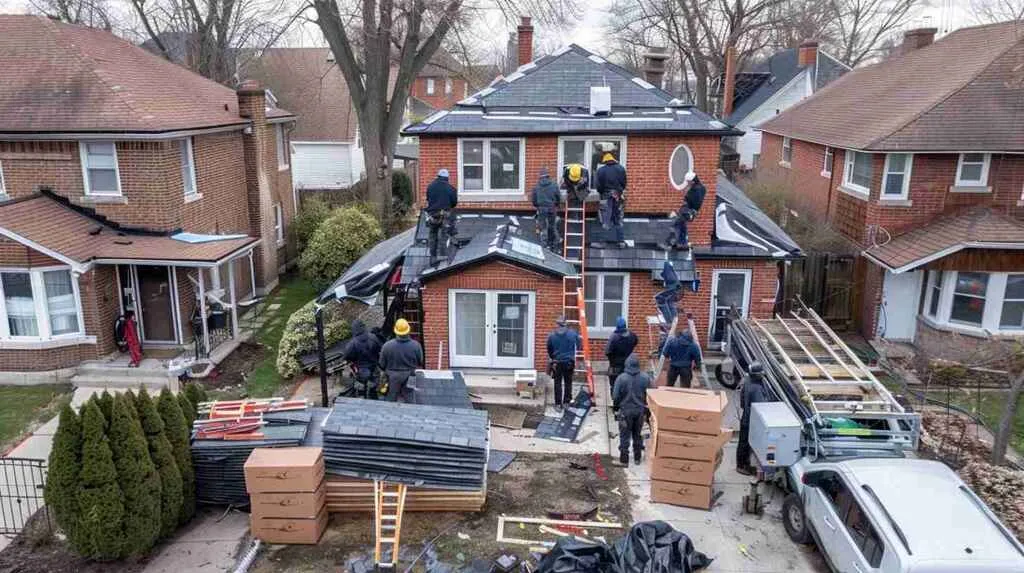
At 7:15 on the first morning, when my crew steps out of the trucks on your block in Queens, you’ll hear us rolling out plywood ground protection in your driveway, setting up metal slide chutes for debris, and wrapping your landscaping in heavy tarps before anyone touches a ladder. We’ll walk the perimeter with you-or whoever’s home-pointing out entry points, where the dumpster will land, and answering the same question we always get: “Can I still use my front door?” Then I’ll sit down at your dining table for three minutes, pull out my little notebook, and sketch the slope, layers, and problem zones I spotted during the estimate. That’s the “first revision” of your roof design, and it has to be drawn right before we tear anything off.
Tear-off on a typical Queens cape or colonial usually runs from about 8:00 a.m. to 11:30 or noon, depending on how many old layers are up there and whether we hit rotten decking. You’ll hear the rhythmic scraping, then the loud clatter as bundles of old shingles slide down the chute into the dumpster. Once the deck is clean and swept, we inspect every sheet of plywood or board sheathing, marking soft spots with chalk and replacing bad sections on the spot. This is where the “sketch” starts to matter: if the deck has dips or weak spots, the shingle lines will telegraph those flaws later, so we sister in bracing or swap out bad sheets right then.
I still remember a little brick house off Northern Boulevard where the owner called me at 5:30 one January evening, panicked because her “brand-new” shingle roof was leaking over the dining room table during a freezing drizzle. I climbed up in the dark and found that the installer had run the starter course backwards along the eave, so wind-driven rain was being channeled under the main shingles like a slide. We stripped the bottom three rows, redid the underlayment, and relaid the shingles properly. That job taught me-and now my crew-why we don’t rush the edges or the first rows on Day One. You’ll see us move deliberately around eaves, valleys, and rake edges, because those are the lines in the sketch that, if wrong, ruin the whole drawing later.
Typical 1-3 Day Queens Shingle Re-Roof Timeline
| Step | Approx. Time Window | What You See on Site | What We’re Actually Doing |
|---|---|---|---|
| 1. Setup & Protection | 7:00-7:30 a.m. Day 1 | Trucks park, tarps go down, ground protection laid, chutes positioned | Protecting your property, setting safe debris routes, staging materials where parking/traffic allows in Queens |
| 2. Tear-Off & Deck Inspection | 8:00 a.m.-12:00 p.m. Day 1 | Loud scraping, shingles sliding down chutes, crew on roof sweeping and marking plywood | Removing old layers, checking every deck sheet for rot or sag, replacing bad sections before any new material goes down |
| 3. Underlayment & Starter Course | 1:00-4:00 p.m. Day 1 | Black felt or synthetic rolls unrolling across roof, crew working eaves and valleys first | Laying waterproof underlayment uphill-lapped, installing drip edge and ice-and-water shield, setting correct starter shingle direction |
| 4. Shingle Install & Flashing | Day 2 full day (or late Day 1 if small roof) | Bundles carried up, rhythmic nailer sounds, rows climbing from eave to ridge, metal flashing around chimneys and vents | Nailing shingles per manufacturer spec, mixing bundles to avoid color banding, custom-fitting step and counter flashing at penetrations |
| 5. Ridge Cap, Cleanup & Final Walk | Late Day 2 or Morning Day 3 | Ridge vents or cap shingles installed, crew sweeping yard with magnets, dumpster hauled, final walkthrough with you | Sealing ridge, checking every nail line, magnetic sweep for dropped fasteners, documenting work and handing you warranty paperwork |
How Long Your Queens Shingle Roof Really Takes and What It Costs
A proper 1,500-square-foot re-roof in Queens takes two full days. If someone says they’ll finish your whole house in half a day, you’re watching corners get cut in real time.
Most single-family homes in Queens-think capes in Jamaica, colonials in Forest Hills, or attached row houses in Flushing-clock in between 1,200 and 2,200 square feet of actual roof area, and that translates to 1 to 3 days on-site when done properly. Total cost bands run from around $6,500 for a simple one-story ranch with good access all the way up to $18,000 or more for a steep two-story colonial with multiple valleys, chimneys, and tight parking that slows material staging. Traffic, driveway size, and whether we can park the dumpster on your street or have to hand-carry debris to a truck two blocks away all shift the schedule and labor hours in Queens, so honest contractors price those variables in rather than quoting a flat number and then adding surprise fees.
One humid August afternoon in Jamaica, I was reroofing a small Cape for an older couple who wanted to watch every step. Around 2 p.m., when the sun was blasting off the black felt like a frying pan, the homeowner pointed at the shingle bundles and asked why some looked slightly different in color. That job turned into a mini on-site seminar: I laid out three brands side by side, explained dye-lot numbers, and showed them why we always mix bundles from different pallets as we install to avoid ugly “racing stripes” running down the finished roof. Yes, stopping to rotate bundles every few courses adds maybe an hour to the schedule, but it’s the difference between a roof that looks professionally planned and one that screams “rushed installation” every time you pull into your driveway. Good planning keeps the timeline realistic and protects your curb appeal.
Estimated Cost to Roof a House with Shingles in Queens, NY
| Home Type / Scenario | Approx. Roof Size | Complexity | Typical Duration | Estimated Price Range (Queens, NY) |
|---|---|---|---|---|
| Small one-story ranch, good access | 1,200-1,400 sq ft | Low (simple gable, minimal valleys) | 1-1.5 days | $6,500-$9,200 |
| Typical Queens Cape, one chimney | 1,500-1,700 sq ft | Medium (some pitch, one penetration) | 2 days | $8,800-$12,500 |
| Two-story colonial, moderate pitch | 1,800-2,100 sq ft | Medium-High (valleys, vents, skylights) | 2.5-3 days | $11,000-$15,800 |
| Steep Victorian or complex hip roof | 2,000-2,400 sq ft | High (multiple hips, dormers, turrets) | 3+ days | $14,500-$21,000 |
| Attached row house, limited truck access | 1,000-1,300 sq ft | Medium (hand-carry debris, shared walls) | 1.5-2 days | $7,200-$10,500 |
Prices assume complete tear-off, synthetic underlayment, ice-and-water shield at eaves and valleys, architectural shingles, proper flashing, and code-compliant ventilation. Add 15-25% for upgraded storm-rated shingles or extensive deck replacement.
The Non-Negotiable Steps When Roofing a House with Shingles
Think of your roof like a layered sketch in my notebook: deck, underlayment, shingles, flashing-if any one of those layers is wrong, the whole drawing is off. When I’m sitting at your table during the estimate, I’ll literally draw these layers so you see how water moves and where it’s supposed to exit, because understanding the “sketch” makes it obvious why skipping a step or rushing a detail isn’t just cutting a corner-it’s erasing a critical line in the plan that keeps water outside. The deck is the canvas, underlayment is the base coat that seals the canvas against moisture, shingles are the visible finish layer that sheds rain and snow, and flashing is the custom detailing around edges and penetrations that cleans up any weak lines where two planes meet. Miss one, and the sketch falls apart in the first rainstorm.
Think of Your Roof as a Layered Sketch
From a purely technical standpoint, the biggest mistake I see when people are roofing a house with shingles is treating each layer like an independent task instead of understanding how they build on each other. A solid deck with no sag or rot gives the underlayment a stable surface to grip. Underlayment-whether synthetic or felt-must be lapped uphill like the shingles themselves, so water that sneaks past a shingle can’t run back under the layer below. Shingles go on in a staggered pattern that hides seams and creates multiple barriers, and flashing wraps every penetration and edge with metal that directs water onto the shingle surface, not into a seam. If you picture all four layers as a single unified drawing rather than separate to-do items, it becomes clear why an installer who skips ice-and-water shield at the eaves or nails flashing through shingle courses instead of under them is redlining your roof sketch in ways that guarantee future leaks.
What Can Go Wrong If a Step Is Skipped
I’ll never forget a windy spring morning in College Point when we were halfway through roofing a house with shingles and the forecasted 10 mph breeze suddenly turned into 30 mph gusts blowing off the East River. A neighbor came over insisting we just “nail it down harder and finish,” but I’d seen a job years back where rushed installation in high wind led to whole sections of shingles lifting within a year. We secured the exposed areas with weighted tarps, tied everything down properly, and came back the next calm day to finish. Later that season, after a nasty nor’easter rolled through, that same neighbor called me to fix the shingles that had blown off his own roof-the crew he’d hired that day ignored the wind, didn’t seal starter courses, and rushed nailing patterns. Skipping steps or working in bad conditions might save a few hours, but it erases the structural integrity from your roof sketch, and once wind or rain finds those weak lines, the damage compounds fast.
Critical Layers in a Proper Queens Shingle Roof
| ✅ | Solid Roof Deck | The structural “canvas”-plywood or board sheathing must be flat, dry, and securely fastened so nothing sags or flexes under shingle weight and foot traffic |
| ✅ | Waterproof Underlayment | Synthetic or felt rolled uphill-lapped across the entire deck, acting as a backup barrier if wind-driven rain ever gets under a shingle edge |
| ✅ | Ice-and-Water Shield | Self-adhesive membrane at eaves, valleys, and around penetrations-seals nail holes and stops ice-dam melt from sneaking backward under shingles in Queens winters |
| ✅ | Architectural Shingles | The visible weather layer, installed in offset rows from eave to ridge with proper exposure, nailed per manufacturer spec to handle Queens wind uplift ratings |
| ✅ | Metal Flashing & Drip Edge | Custom-fitted metal at chimneys, skylights, vents, and all roof edges-directs water onto shingle surfaces instead of letting it sneak behind or under, the final cleanup of weak sketch lines |
⚠
Red Flags That Your Shingle Roof Is Being Rushed or Shortcutted
- Crew starts nailing shingles in sustained winds over 25 mph or during active rain-proper installation requires calm, dry conditions so adhesive strips seal and nails set correctly.
- No underlayment visible before shingles go down, or you see shingles being laid directly onto old felt or bare wood in sections-every inch should get fresh barrier first.
- Starter course runs the wrong direction along eaves, or no dedicated starter strip at all-this is the #1 edge detail that causes early leaks if reversed or skipped.
- All shingle bundles from the same pallet number stacked in one area without mixing-leads to visible color banding (“racing stripes”) because dye lots vary slightly between manufacturing runs.
Choosing the Right Shingles and Plan for Your Queens Home
Here’s the blunt truth most ads skip: not every roof in Queens should be done with the same shingle, even if the price sheets make it look that way. I’ve reroofed colonials in Forest Hills where the homeowner plans to stay 20 years and needs maximum storm protection because they’re three blocks from open water and catch every nor’easter head-on, and I’ve done small ranches in Bayside where the owner is prepping to sell in two years and just needs code-compliant coverage that looks clean for appraisals. Both jobs get done right, but the material “sketch” is different: one gets impact-rated architectural shingles with extra ice-and-water shield and upgraded ridge venting, the other gets solid mid-grade architecturals with standard underlayment. Matching the design to your timeline, budget, and exposure makes more sense than blindly picking the cheapest per-square price and hoping it holds up, or overspending on features you’ll never use if you’re moving soon.
If I were standing in your kitchen right now, I’d probably ask you one simple thing: how long are you planning to stay in this house? That answer changes which “revision” of the roof sketch we draw. Staying 15+ years in a Queens neighborhood with mature trees and seasonal ice? We’ll spec a thicker architectural shingle with higher wind and impact ratings, double the ice-and-water shield coverage, and possibly add a ridge vent upgrade to handle Queens’ humid summers and keep attic temps reasonable. Selling in under five years? A clean, warrantied install with quality mid-tier shingles and proper flashing will pass inspection, photograph well, and meet every buyer’s lender requirement without you paying for 30-year storm performance you won’t use. Queens weather swings-freezing January sleet one week, 90-degree August sun the next-and a lot of the older housing stock has minimal attic insulation or outdated framing, so the roof design has to account for those stresses or you’ll see premature granule loss and curling within a few seasons.
Common Myths About Roofing a House with Shingles in Queens
| Myth | Fact |
|---|---|
| “All shingles are basically the same-just pick the cheapest.” | Shingles vary widely in wind rating (90 mph to 130+ mph), impact resistance, granule adhesion, and warranty terms. Cheap shingles may not survive Queens’ winter ice and summer heat cycles as long as rated products. |
| “You can roof over old shingles to save money and it’s just as good.” | Layering hides deck rot, adds weight that older Queens framing may not handle, voids most manufacturer warranties, and shortens the new shingles’ lifespan because heat can’t escape properly. |
| “A one-day roof job means the crew is super efficient.” | Extremely fast timelines usually mean corners are being cut-no deck inspection, minimal underlayment, improper flashing. Proper jobs for typical Queens homes take 1-3 days depending on size and complexity. |
| “Permits and inspections are just red tape; good roofers skip them.” | Most Queens re-roofs legally require a permit. Skipping it can void your homeowner’s insurance, hurt resale value, and leave you liable if the work doesn’t meet code-and good contractors pull permits as part of the job. |
What to Check Before You Call and Questions Queens Homeowners Ask Most
Before anyone climbs a ladder, sit down at your dining table for five minutes and run through a quick mental sketch of what you already know about your roof and what you need to find out, so when we talk you can get a sharper estimate and I can draw a more accurate plan. Think of it like cleaning up the rough draft before we ink the final design.
Quick Prep List Before You Call Shingle Masters for a Roof Estimate
| Item | What to Do / Look At |
|---|---|
| Age of Current Roof | Check closing docs or ask prior owner; knowing if it’s 10, 15, or 25 years old helps us estimate whether we’ll hit deck rot during tear-off. |
| Visible Damage or Leaks | Walk your attic and ceilings; note any stains, drips, or daylight showing through boards-tell us exactly where so we can target inspection. |
| Roof Access & Parking | Is your driveway wide enough for a dumpster? Do Queens alternate-side parking rules affect our truck staging? Knowing this speeds scheduling. |
| HOA or Landmark Rules | Some Queens neighborhoods have color or material restrictions; check any bylaws or historic district guidelines before we order shingles. |
| Insurance Claim Status | If storm damage triggered the need, have your adjuster’s report or claim number handy-we can document findings to support your claim scope. |
| Your Timeline & Budget Range | Be honest about how soon you need it done and roughly what you’re comfortable spending-helps us design the right “sketch” instead of quoting features you don’t want. |
Common Questions About Roofing a House with Shingles in Queens, NY
Do I need to be home during the entire roofing job?
No, you don’t have to stay home every hour. We walk through the plan and property access on Day One morning, then you’re free to go to work or run errands. Most homeowners check in around lunch and at day’s end to see progress. We’ll text or call if we uncover unexpected deck damage or need a quick decision, but otherwise the crew works independently and secures the site each evening so your house is weathertight overnight.
How loud is the tear-off and nailing, and will it disturb neighbors?
Tear-off is the loudest phase-think rhythmic scraping and the clatter of old shingles sliding into the dumpster. Pneumatic nailers during shingle install are sharp and repetitive but not as loud as tear-off. In Queens, most neighbors are used to construction noise during daytime hours; we work 7 a.m. to 5 p.m., which is within normal residential work windows. If you have a medically sensitive neighbor or infant next door, let us know and we can stagger the noisiest tasks or give them a heads-up.
What happens to all the old shingles and debris?
We bring a dumpster or dump trailer to your property, position tarps and plywood to protect landscaping and driveways, and use roof-mounted chutes to slide debris directly into the container. At the end of each day, we sweep and magnet-sweep the yard and driveway for nails. The dumpster gets hauled when full or at job completion, and disposal fees are included in your contract so there’s no surprise charge. Your property should look cleaner after we leave than it did before we arrived.
What kind of warranty comes with a new shingle roof in Queens?
You’ll get two warranties: a manufacturer’s material warranty (typically 25-50 years depending on shingle grade) covering defects in the shingles themselves, and our workmanship warranty (usually 5-10 years) covering installation errors like improper flashing or nail placement. Both should be in writing at contract signing. Make sure the installer is certified by the shingle manufacturer-that’s often required to activate the full material warranty and can sometimes extend coverage or add wind-damage protection.
Do I need a permit to re-roof my house in Queens, and who handles that?
Yes, most re-roofing projects in Queens require a permit from NYC Buildings, especially if you’re doing a full tear-off or any structural work. A reputable contractor will pull the permit, pay the fee (which is usually part of your quoted price), schedule the required inspections, and close out the permit when the job passes. Never let a roofer talk you into skipping the permit to “save money”-it can void your insurance, create resale headaches, and leave you personally liable if the work doesn’t meet code.
Why Queens Homeowners Hire Shingle Masters
At Shingle Masters, we handle the full process-from that first dining-table sketch through final nail check and permit closeout-across every neighborhood in Queens. If you’re ready to walk through a custom “roof sketch” for your home and get a realistic timeline and price, call us or request a free estimate today.