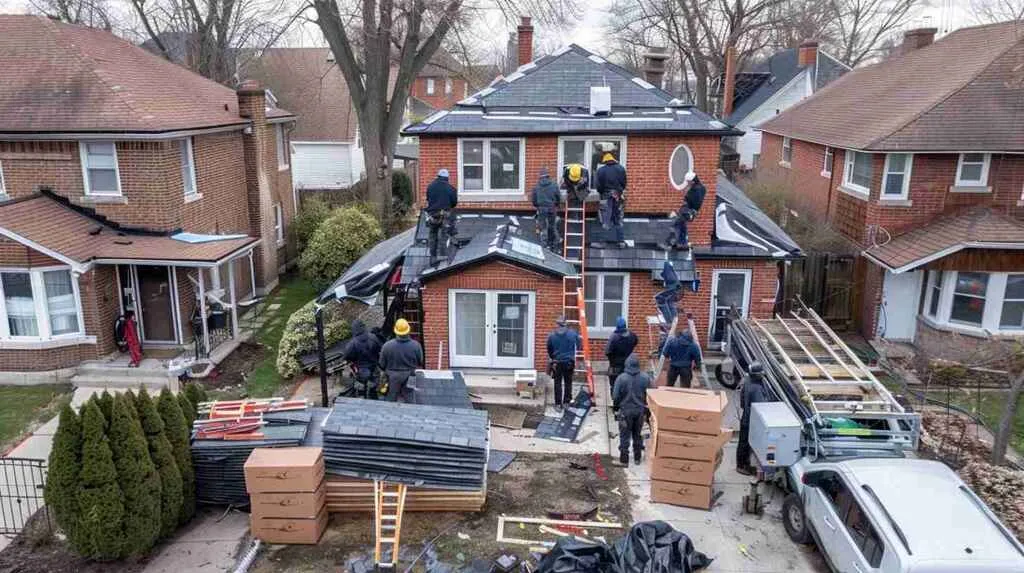
Creased Shingles Roof Queens NY – Cause and Whether to Worry | Free Quotes
Sideways wind coming off the bay can turn a $250 shingle repair into a $5,000 disaster if you ignore it for six months, and in Queens that gap between small fix and major job is exactly what I see homeowners wrestle with every single week. This article explains why some creases are an emergency, why others can wait a bit, and how to tell which one you’re looking at before you call someone like me to climb up and check.
Creased shingles in Queens: small fix now or big problem later?
On a typical two-family house in Queens with a 10-year-old roof, I see the same pattern every winter after a heavy wind event: homeowners spot a visible line running across a shingle tab from the sidewalk, worry it’s major damage, and assume they need a full replacement because some flyer in their mailbox told them so. Here’s my direct opinion after 19 years on these roofs-most creased shingle calls I get do not need full replacement right away, but ignoring them is what turns a small bill into a huge one. One January afternoon in Woodhaven, with that brutal sideways wind coming off the bay, I was on a two-story colonial checking what the owner thought was hail damage; the shingles looked “cracked” from the ground, but when I got up there, every line of damage was in the same direction-clean creases from wind flipping the tabs and snapping the asphalt mat. The guy had three different storm-chaser flyers in his mailbox telling him he needed a full replacement; I showed him how only the north-facing slope was affected and we did a surgical repair instead. He told me later I’d saved him more than ten grand and a lot of sleepless nights. If we were looking at this like a band falling apart, your shingles are the drummer missing beats, not the whole group quitting-one bad note doesn’t mean you fire everyone and start over.
A creased shingle isn’t just a wrinkle you can smooth out with your hand. It’s a line where the asphalt mat underneath the granule surface has actually folded or cracked, usually because wind got under the tab and bent it backward, or because someone stepped on a brittle, aged shingle in cold weather. In Queens, our wind patterns-especially along corridors near the water in Far Rockaway or Broad Channel, and in areas where the prevailing northwest gusts funnel between buildings-create lift on the edges and corners of shingles. A cosmetic surface scratch won’t let water through, but a true crease weakens the waterproofing seal and can start allowing moisture into the underlayment within weeks if the crease runs all the way through the mat. You can’t fix a structural crease by pressing it flat; the mat is broken, and that section needs replacement or sealing by a professional who knows how to blend in new material without creating more leak paths.
Typical Costs for Creased Shingle Roof Issues in Queens, NY
| Scenario | What’s Going On | Typical Cost Range (Queens, NY) |
|---|---|---|
| Single creased tab caught early | One shingle bent from wind, no interior leak yet, diagnosed within a week of damage | $150-$400 |
| Multiple creases on one slope | Wind lifted 4-8 tabs along ridge or eave, intact underlayment, no active water intrusion | $600-$1,200 |
| Creases ignored for 6+ months | Water seeped under tabs, underlayment rotted in spots, minor deck damage visible from attic | $1,800-$3,500 |
| Widespread crease pattern | Improper install (high nails, no starter), tabs creasing across entire roof, shingles past rated life | $5,000-$9,500 |
| Delayed response with interior damage | Creases turned to leaks, ceiling stains, insulation wet, mold remediation and drywall repair needed | $8,000-$15,000+ |
Prices reflect Queens, NY labor and material costs as of 2025 and assume standard residential roof pitch and access. Emergency service or complex structural work may cost more.
How to tell if your creased shingles are urgent or can wait a bit
Let me be blunt: if you can see a crease from the sidewalk, it’s worth a phone call within a few days, because that means the damage is significant enough to be visible from ground level-and if you’re seeing it, water can probably find it too. In Queens, I see this most often on two-family homes in Elmhurst and Jackson Heights where the prevailing northwest wind hits the back slope hard in winter, and on walk-up buildings where maintenance has been deferred for years. One summer evening in Jackson Heights, just as the sun was dropping behind the 7 train tracks, I inspected a roof over a busy family daycare; the owner was panicked because a home inspector had flagged “significant shingle damage” and the sale of the building was on the line. Turned out most of the so-called “damage” were creases from an old improper install-no starter strip, so wind was getting under the bottom row and bending them. I documented each row with photos and a letter explaining the cause and risk; the buyer accepted a credit for a partial repair instead of demanding a full tear-off, and the sale went through. The difference between urgent and watch-and-wait often comes down to whether that crease is isolated or part of a bigger pattern, and whether you’ve already got a leak or just the potential for one.
Here’s an insider tip about safe, ground-level checks rather than climbing up yourself: use your phone camera with maximum zoom on a clear day, especially after a windy night, and snap photos of the same spot a week apart to see if more tabs are lifting or new creases appear. Worth doing this from multiple angles-front yard, side alley if you’ve got one, and the back if you can access it safely. Don’t skip checking right after a storm, because that’s when fresh wind damage shows up most clearly. But once you see a tab that’s bent at an angle, curling up at the edge, or folded over on itself, that’s the signal to call a pro who’s insured and experienced with Queens roofs, not to grab a ladder and poke at it yourself. A roofer like me will walk every section, check the underlayment integrity from above, and tell you whether you need immediate action or you’ve got time to budget for it in the next month or two.
Call in 24-48 hours
- Crease runs full width of the shingle tab and you can see dark underlayment through the gap
- Multiple tabs on the same slope are bent or lifted, especially near roof edges or valleys
- You have a water stain on your ceiling directly below the creased area
- The creased shingle feels soft or spongy when you gently press it from below with a broom handle
Can wait a few weeks
- Single shingle has a surface crease but tabs are still sealed flat and no tabs are lifting
- Crease appeared during mild weather and roof is less than 12 years old with no prior leak history
- No visible underlayment showing, no granule loss around the crease, and attic is dry
- You’re in a sheltered area of Queens with minimal wind exposure and the next inspection is already scheduled
⚠
Why You Shouldn’t Trust Every ‘Storm Damage’ Flyer After Wind in Queens
- Storm-chaser outfits often label every crease as “hail damage” or “insurance-covered wind loss” even when the real cause is an old improper install or normal aging, pushing you toward a full replacement claim that may get denied.
- Local roofers with years in Queens can distinguish between fresh storm damage, chronic installation issues, and wear patterns specific to your neighborhood’s wind corridors-and we document it with photos that hold up under scrutiny.
- Insurance adjusters look for consistency: if your roof has random creases from multiple causes over time, a claim for “sudden storm damage” won’t fly, but a properly documented recent wind event with matching crease direction and fresh granule scatter will.
- Getting a second opinion from someone licensed in NYC who isn’t chasing your insurance claim as a commission protects your wallet, your coverage record, and your relationship with your insurer for the next real emergency.
What actually causes creased shingles on Queens roofs
Here’s the part most people don’t realize about creased shingles in Queens: it’s almost never just one thing that breaks a tab, it’s a combination of how the shingle was installed, how old it is, and what the local wind does to your specific house. I’ll never forget a humid August morning in Far Rockaway, right before a storm, on a small bungalow three blocks from the water; the homeowner had tried to power-wash moss off the roof and ended up weakening the granules so badly that a medium gust started creasing whole shingle tabs along the ridge. When I stepped on one area, I could feel the shingle “hinge” like a floppy playing card-that’s how far it had separated internally. I used that job for months as a warning story: sometimes it’s not the storm that ruins the shingles, it’s what you did to them before the storm ever showed up. Coastal wind in Far Rockaway or Broad Channel will find any weak spot-a high nail that didn’t catch the tab below it, a seal strip that never bonded because the installer worked in cold weather, or a ridge cap that’s starting to curl-and once wind gets under even a half-inch gap, it can flip that tab backward hard enough to snap the asphalt mat in a single gust.
Do not go up there and try to bend that creased tab back down yourself.
The main causes I see every season break down like this: wind lift getting under improperly sealed tabs, especially on north and west-facing slopes where prevailing gusts hit hardest; weak or failed seal strips that didn’t bond because the roof was installed in freezing weather or the installer didn’t press the tabs down; improper installation where nails were driven too high (missing the self-seal zone) or no starter strip was used at the eaves, leaving the first row vulnerable to updraft; and aging shingles that have lost flexibility, so when they bend even slightly they crack instead of flexing back, like an old guitar string that snaps when you try to tune it instead of holding the note. I remember one roof in Elmhurst where the wind had a “favorite corner” it attacked every winter, lifting the same three tabs over and over until the owner finally called me; turned out the rake edge flashing was installed backward, creating a little ramp that funneled wind right under those specific shingles. Once we resealed and added a proper drip edge, the problem stopped-it wasn’t the whole band quitting, just one section playing out of time because the stage setup was wrong.
Common Myths About Creased Shingles vs Reality in Queens, NY
| Myth | Fact |
|---|---|
| “A creased shingle always means I need a full roof replacement.” | Most isolated or small-cluster creases in Queens can be repaired surgically for a few hundred dollars if the underlayment is intact and the roof is under 15 years old. |
| “Insurance will automatically cover any wind-damaged crease.” | Insurance pays for sudden, recent storm damage with clear documentation; creases from age, improper install, or gradual wear are considered maintenance and typically denied. |
| “Creases are always caused by hail or falling branches.” | In Queens, wind lift from improper sealing or high nails causes more creases than hail; actual hail leaves round bruises, not long fold lines, and we rarely see severe hail here. |
| “I can fix a creased shingle by gluing or taping it down myself.” | Once the asphalt mat cracks, the shingle has lost structural integrity; DIY patches trap moisture, void warranties, and usually fail within weeks, creating bigger leaks. |
| “If I don’t see a leak inside, the crease isn’t urgent.” | Water can seep through a crease and saturate underlayment or deck sheathing for months before you see a ceiling stain; by then, repair costs have multiplied and mold may be growing. |
What I do when I inspect a creased shingles roof in Queens
When I’m standing on your roof and I bend a shingle tab gently like I’m testing a guitar string, I’m checking for two things: does it have any flex left, or does it crack further when I apply the slightest pressure? That tells me whether the asphalt mat is still somewhat intact or completely broken through. I start at the area you pointed out from the ground, but I never stop there-I walk the entire roof in a grid pattern, looking for other tabs that show early signs of the same problem, because one visible crease often means three or four more are starting nearby. I check the nail placement by lifting the tab above each creased shingle to see if the installer put the fasteners in the self-seal zone or drove them too high, and I look at the seal strip itself to see if it ever bonded or if there’s daylight showing between the layers. I also pull out my phone and document everything with close-up photos and a quick video narrating what I’m seeing, so you’ve got a record that’s useful whether you’re filing an insurance claim, negotiating a home sale, or just deciding whether to budget for this repair now or next season.
Now, here’s where it ties together: that on-roof diagnostic separates the “change one shingle and you’re good” repairs from the “we need to address a slope or section” jobs, and it keeps you from paying for work you don’t need. If I find that your crease is isolated and the surrounding shingles are solid, I’ll quote you a small repair-maybe $250 to $400 depending on access and how many tabs need replacing. If the pattern shows me that wind is getting under a whole row because there’s no starter strip or the flashing is wrong, I’ll explain that fixing just the visible crease won’t stop the next one from forming, and we’ll talk about a targeted section repair or a slope replacement that actually solves the root cause. And if the roof is 18 years old with creases popping up in multiple areas because the shingles are past their rated life and the mat is brittle, I’ll tell you straight that a full replacement is the smarter move, because otherwise you’ll be calling me back every few months for new leaks. It’s like a band: if the drummer is off, you retrain the drummer; if the whole rhythm section is falling apart, you need a new lineup, not just a drum-kit tune-up.
Step-by-Step: How a Creased Shingle Inspection Works with Shingle Masters
Why Queens Homeowners Call Luis at Shingle Masters
-
✓
Fully licensed and insured in NYC with 19+ years of hands-on roofing experience across every Queens neighborhood from Astoria to the Rockaways -
✓
Same-day or next-day response for most creased shingle inspection calls, because we know water damage doesn’t wait for your schedule -
✓
Photo-documented reports that hold up for insurance claims, home sales, and real estate transactions, written in plain language you and your adjuster can both understand -
✓
Straight talk, no upselling-if you need a $300 repair, I won’t push you toward a $10,000 replacement, and if you do need major work, I’ll explain exactly why
Quick answers about creased shingles and repairs in Queens, NY
Not every creased shingle question needs a full conversation, so here are the five things Queens homeowners ask me most often-think of it like tuning one string instead of rewriting the whole song.
Q
Can a single creased shingle be repaired, or must it be replaced?
Q
Will my homeowners insurance pay for creased shingles from wind?
Q
How fast can a small crease turn into a leak?
Q
Is it safe for me to walk up and check the crease myself?
Q
Do you serve my part of Queens? What neighborhoods do you cover?
What to Note Before You Call Shingle Masters About a Crease
Having these details ready when you call speeds up the inspection and helps us bring the right tools and materials on the first trip:
-
1.
Location on the roof: Which slope (front, back, side), how many stories, and roughly how far from the edge or ridge the crease is visible -
2.
Direction that slope faces: North, south, east, or west-wind patterns in Queens make certain exposures more vulnerable, and this helps us predict what else we’ll find -
3.
Age of the roof: When it was last replaced or if you’ve never replaced it since you bought the house, because that tells us whether we’re dealing with wear or installation issues -
4.
Recent weather events: Any big wind storms, heavy snow, or ice dams in the past few weeks that might have triggered the damage -
5.
Interior signs: Whether you’ve seen water stains, drips, or damp insulation in the attic directly below the creased area, or if everything inside still looks dry
If you’ve spotted a creased shingle on your Queens roof and you’re not sure whether it’s a quick fix or a sign of something bigger, call Shingle Masters for a documented inspection that’ll give you clarity and a clear written quote before any work starts. Luis will climb up, document everything with photos, and explain exactly what’s going on in plain language-no pressure, no surprises, just honest roofing advice from someone who’s been doing this in Queens for 19 years. Reach out today for your free assessment and find out whether that one off note means tuning a string or rebuilding the whole band.