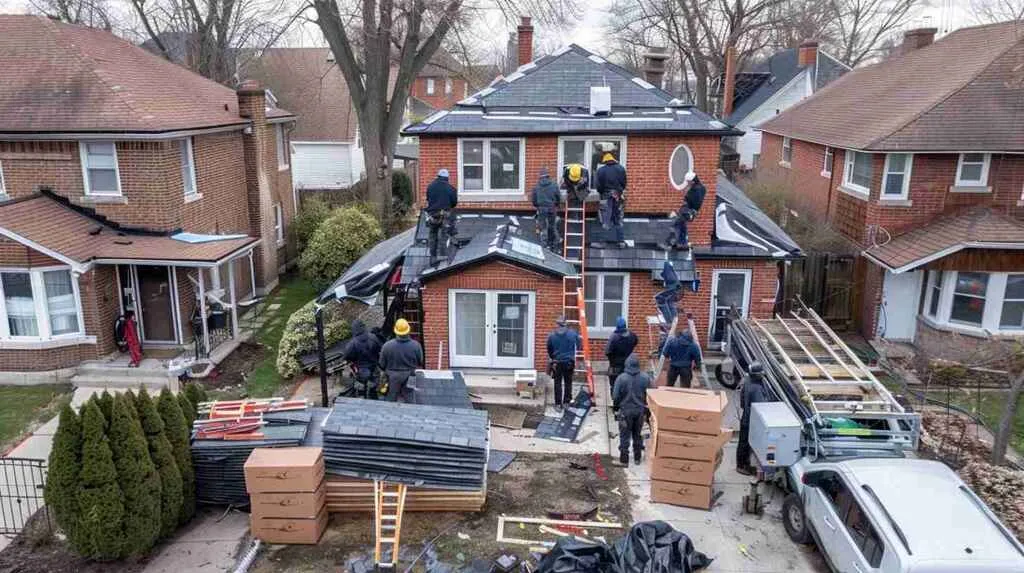
Are Rubber Roof Shingles Good Queens NY? Honest Pros and Cons | Free Quotes
Sideways conversations are where I tell people the truth they don’t always want to hear: rubber roof shingles can be either one of the smartest moves you make on your Queens home or an expensive mistake you’ll regret for fifteen years. I’m Los, and after 11 years installing and fixing shingle systems across Jackson Heights, Astoria, Forest Hills, and Bayside, I’ve learned that rubber shingles are less about the brand name on the box and more about what’s underneath them-your roof deck, your attic ventilation, and honestly, the crew doing the work.
Are Rubber Roof Shingles Good in Queens, NY or Just Hype?
Here’s my honest take: in Queens, rubber roof shingles are good in some very specific situations-and mediocre or overkill in others. Our climate does this weird thing where we get hammered by summer heat that bakes a roof into submission, then freeze-thaw cycles all winter that crack sealants and lift edges. Add in the constant roar from LaGuardia, traffic on the Grand Central, and branches whipping around from Norway maples, and you’ve got a mix of challenges that rubber shingles can either handle beautifully or fail at spectacularly. The difference comes down to prep, installation, and whether your roof structure can support what rubber brings to the table.
Think of your roof like a sound system: rubber shingles are like a high-end subwoofer-amazing in the right setup, pointless if the rest of the system is junk. Rubber turns up the “volume” on impact resistance, noise dampening, and flexibility in freeze-thaw, but it also cranks up the cost, adds weight to your deck, and demands near-perfect installation with the right accessories. If your goal is to quiet down airplane noise in a Bayside bungalow or handle falling branches in a tree-heavy Forest Hills block, rubber can be a strong play. If you’re just replacing worn-out asphalt on a budget and your roof deck is already marginal, rubber’s going to amplify every problem underneath and cost you 30-60% more for the privilege.
| Where Rubber Shingles Shine in Queens | Where Rubber Shingles Disappoint in Queens |
|---|---|
| Noise reduction: Cuts down hollow rattling from planes and traffic better than asphalt, great near LaGuardia or busy corridors | Higher upfront cost: Typically $7-$11/sq. ft. installed vs. $4.50-$7 for quality architectural asphalt-hard to justify on tight budgets |
| Impact resistance: Handles branches, hail, and debris without cracking; ideal for tree-covered blocks in Forest Hills or Douglaston | Magnifies deck problems: Flexible material shows every wave, dip, and weak spot in sheathing-won’t hide a bad deck like rigid asphalt can |
| Freeze-thaw flexibility: Expands and contracts without cracking in Queens’ temperature swings, especially on low-slope sections | Installer-sensitive: Wrong fastener length, bad sealants, or skipping ventilation fixes will cause early failures rubber can’t forgive |
| Longevity potential: Can outlast asphalt by 10-15 years if installed correctly on a solid, well-ventilated deck | Heat absorption: Dark rubber can run hotter than comparable asphalt on summer afternoons, increasing attic temps if ventilation isn’t upgraded |
Real-World Pros and Cons on Queens Roofs
On a block like 37th Avenue in Jackson Heights, where every roofline is different, rubber shingles behave very differently from house to house. You’ve got narrow row houses with steep slopes where rubber’s flexibility helps it tuck into tight valleys, you’ve got squat post-war bungalows with nearly flat rear extensions where rubber’s water-shedding matters more than looks, and you’ve got semi-detached colonials with mixed slopes and dormers where one bad deck board can telegraph through rubber and ruin the whole aesthetic. The same rubber product that performs beautifully on a newly sheathed, well-vented Bayside Cape can fail miserably on a Forest Hills Tudor where someone laid it over lumpy old asphalt to save a few thousand bucks. Deck condition and ventilation aren’t just “nice to have”-they’re the difference between a 40-year roof and a warranty claim at year six.
On a cold March morning in Bayside, I inspected a small bungalow where the owner had chosen rubber shingles specifically to cut down on airplane noise from LaGuardia. It was 7 AM, planes roaring overhead, and she leaned out the window to ask, “Did it work?” We stepped inside together and honestly, the difference was real-less hollow rattling, more of a dull thud from the overhead noise. But in the attic, I showed her some early signs of discoloration where someone had used the wrong sealant around a vent, reacting with the rubber. That job became my go-to example of how rubber shingles can shine in noise reduction but are unforgiving if you cheap out on the accessories. Queens throws a lot at a roof-summer heat that can hit 95°F on a black rubber surface, winter freezes that crack cheap caulk, and constant low-frequency rumble from planes and traffic. Rubber handles the temperature swings and impact like a champ, but if your installer uses standard asphalt pipe boots, generic flashing cement, or doesn’t account for rubber’s extra weight when planning fastener patterns, you’re tuning your system wrong and the whole thing falls flat.
| Factor | Rubber Shingles | Architectural Asphalt Shingles |
|---|---|---|
| Average Installed Cost per Sq. Ft. in Queens | $7-$11/sq. ft. (higher for complex roofs) | $4.50-$7/sq. ft. (quality brands) |
| Typical Lifespan in Queens Climate | 30-50 years if installed right | 20-30 years (top-tier products) |
| Noise Reduction (planes/traffic) | Significantly better-dampens hollow echo | Good but more resonant |
| Heat Gain on Summer Afternoons | Higher (dark colors run very hot) | Moderate (lighter shades available) |
| Tolerance for Imperfect Roof Deck | Poor-shows every flaw | Better-hides minor waves/dips |
When Rubber Shingles Fail in Queens (and It’s Not the Product)
I still remember the first time I saw a rubber shingle roof peel at the corners after just four summers, and it had nothing to do with the brand. One July afternoon in Forest Hills, it was about 93 degrees and the rubber shingles were so hot I could feel the heat through my knee pads. A couple had put rubber shingles over their old three-tab asphalt to “save money and go green.” Three years later, the edges were curling and trapping water because the old roof underneath was lumpy as a washboard. I had to explain, sweating on their porch, that the shingles weren’t the only problem-the whole system was wrong from the start, and rubber got the blame it didn’t fully deserve. Installing rubber over existing shingles is like putting studio monitors on a wobbly desk-you’re not hearing what the speakers can actually do, you’re hearing the desk rattle. The trapped heat between layers, the uneven nailing surface, and the lack of airflow underneath turned a premium product into a liability, and the homeowner spent more tearing it all off and starting over than they would’ve spent doing it right the first time.
Blunt truth: if your roof deck is wavy, your ventilation is lousy, and your gutters are a mess, rubber shingles won’t save you-they’ll just fail more expensively. Rubber’s flexibility is a feature when the deck is flat and solid, but it becomes a bug when you’ve got 1950s sheathing with dips and sags. Every low spot shows through as a visible valley, every high spot creates a hump, and water doesn’t shed cleanly-it pools in the dips and works its way under the shingles at the edges. Add in an attic with no ridge vent and bathroom fans exhausting straight into the roof cavity, and you’re cooking moisture into the underside of those rubber shingles all winter. The material itself can handle Queens weather for decades, but it can’t fix structural problems it’s sitting on top of. Before you approve rubber, insist your contractor pull a sample section of sheathing to check for rot, verify you’ve got proper soffit-to-ridge ventilation (not just those little turtle vents), confirm gutters are clear and sloped right, and show you in writing what rubber-compatible accessories they’re using-pipe boots, flashing cement, even the fasteners need to match the system or you’ll see early failures that void your warranty.
Rubber Shingle Failure Traps in Queens
- Installing over old shingles to “save money”: Traps heat, creates uneven nailing, voids most warranties, and guarantees early edge curling and water infiltration
- Skipping deck repairs on wavy sheathing: Rubber telegraphs every dip and hump-what looks “okay” under asphalt looks terrible and sheds water poorly under flexible rubber
- Ignoring attic ventilation and bathroom fan exhausts: Moisture gets trapped under rubber and can’t escape; leads to mold, wood rot, and shingle delamination from below
- Using generic asphalt sealants and standard pipe boots: Many react chemically with rubber, causing discoloration, early cracking, and voided manufacturer warranties
- Letting gutters back up on low-slope edges: Rubber’s flexibility means standing water can work backward under shingles faster than rigid asphalt would allow
✅ Key Questions to Ask Your Roofer Before Choosing Rubber Shingles
“How will you inspect my roof deck and attic ventilation before quoting rubber, and what specific repairs are you including in the price?”
“What’s your ventilation plan-are you adding ridge vents, upgrading soffit vents, or leaving it as-is-and why?”
“What fastener length and pattern will you use for rubber, and is that different from what you’d use for asphalt shingles?”
“Will you fully remove my existing shingles and underlayment, or are you planning to layer over them to cut costs?”
“What accessories-pipe boots, ridge caps, flashing cement, sealants-are you using, and are they rated as rubber-compatible by the manufacturer?”
Should YOU Use Rubber Shingles on Your Queens Roof?
When I sit at a kitchen table in Queens and someone asks, “Are rubber roof shingles good, or is this just a sales pitch?” I fire back with three questions of my own: What’s driving you crazy about your current roof-is it noise, leaks, or just age? What’s the condition of your roof deck and attic when you actually look inside? And how much are you willing to spend to turn up certain “channels” while accepting trade-offs in others? Those answers tell me whether rubber makes sense or whether I’m about to watch someone spend $18,000 on a system that won’t deliver what they actually need. Roofing isn’t one-size-fits-all, especially in Queens where a bungalow in Bayside has different challenges than a row house in Elmhurst. Rubber lets you tune specific things-crank up impact resistance and noise dampening, extend lifespan if the install is perfect-but you’re turning down budget flexibility and tolerance for imperfect prep work. The decision tree below walks you through the logic I use when I’m standing in someone’s living room, looking at their ceiling and listening to what matters most to them.
Decision Tree: Are Rubber Shingles Right for Your Queens Home?
💰 Typical Queens Rubber Shingle Project Scenarios & Price Ranges
| Scenario | Estimated Range | What Drives Cost |
|---|---|---|
| Small 2-family row house, simple slope, full tear-off | $15,000-$22,000 | Square footage ~1,400-1,800; waste factor on tight lot; dumpster/permit in dense neighborhood |
| Detached Bayside bungalow near LaGuardia, noise-focused upgrade | $18,000-$26,000 | Premium rubber for max noise reduction; attic ventilation upgrades; specialized underlayment |
| Astoria semi-detached with tricky dormers and new ventilation | $21,000-$30,000 | Dormer flashing complexity; adding ridge vents; deck repairs on older sheathing; multiple roof planes |
| Low-slope rear extension needing hybrid rubber + shingle solution | $12,000-$19,000 | Smaller area but requires modified-bitumen or EPDM tie-in; ice-and-water shield; careful drainage planning |
| Full roof plus new gutters and attic ventilation upgrades | $25,000-$38,000 | Larger home (2,500+ sq. ft.); 6″ seamless gutters; soffit work; baffles and insulation coordination |
Prices reflect 2024 Queens material and labor costs; your quote will vary based on access, permits, deck condition, and product selection.
In Queens, the honest truth is that the logo on the shingle matters less than the hands and eyes that put it on your roof.
What to Expect If You Call Shingle Masters for Rubber Shingles
When you call, I’ll walk your roof and your attic, point out what I’m seeing with my phone camera so you can look over my shoulder, and explain the findings like I’m tuning a stereo-here’s your bass (deck and structure), here’s your mids (ventilation and drainage), here’s your treble (accessories and details). Then I’ll give you an honest thumbs-up or thumbs-down on whether rubber makes sense for your specific house, your budget, and what you’re trying to fix.
I’ll never forget a November night in Astoria, around 9:30 PM, when a windstorm started ripping at a rubber shingle roof we’d just finished that summer. The homeowner called in a panic because he thought the flapping underlayment noise meant the shingles were tearing off. I drove over in the rain, headlamp on, climbed up, and found the rubber shingles were actually fine-it was a loose section of ridge vent we hadn’t fastened into the extra-thick rubber layer properly. One hour, a handful of longer screws, and it was quiet again-but that taught me how critical fastening patterns are on these materials. That level of follow-through and detail is what you’ll get when Shingle Masters handles your rubber shingle project-we don’t just nail it down and disappear. The process is straightforward: you call, we schedule an inspection usually same-day or next-day in Queens, I’ll lay out your options in plain English with real numbers (rubber vs. upgraded asphalt vs. hybrid approaches), you’ll get a written quote with photos of any trouble spots, and if you say yes, we’ll schedule the work with a clear timeline and daily updates so you’re never wondering what’s happening on your roof.
How a Rubber Shingle Quote Works with Shingle Masters in Queens
Tell us when your roof was last done, what problems you’re noticing (leaks, noise, visible damage), and what you’re hoping to accomplish-takes about 10 minutes and we’ll usually schedule an inspection same or next day.
Los climbs up, checks shingles/flashing/deck from above and ventilation/moisture from below, takes photos you can review together, and explains what he’s seeing in plain language-not trying to upsell, just showing you the truth.
We’ll show you rubber vs. upgraded asphalt vs. hybrid approaches side-by-side, with honest pros/cons and real costs for your specific roof-you decide what matters most (longevity, noise, budget, curb appeal) and we tune the system to match.
You’ll get a detailed written estimate breaking down materials, labor, disposal, permits, and timeline; once you approve, we lock in dates, coordinate dumpster delivery, and keep you updated daily as we tear off, prep the deck, install rubber shingles with proper accessories, and clean up so your yard looks untouched.
Common Questions Queens Homeowners Ask About Rubber Shingles
Do rubber roof shingles handle Queens wind and storms better than asphalt?
Rubber shingles are more flexible, which helps them resist cracking in high winds, but wind performance comes down to proper fastening and edge details more than the shingle material. In Queens, where we get occasional nor’easters and summer microbursts, rubber won’t blow off any easier than quality architectural asphalt-but if your installer skimps on fastener count or uses the wrong pattern for the extra weight and flexibility of rubber, you’ll see lifted edges and failures. I’ve seen rubber roofs sail through 60 mph gusts and I’ve seen them fail in moderate wind because someone nailed it like regular asphalt. Ask your contractor to show you the manufacturer’s fastening spec for rubber and confirm they’re following it.
Are rubber shingles actually quieter under rain and airplane noise?
Yes, noticeably-rubber dampens the hollow drumming sound you get with thin asphalt, especially in homes near LaGuardia or under the flight path into JFK. That Bayside bungalow I mentioned earlier went from rattling every time a plane passed to a much duller thud, and the homeowner said it made a real difference in her upstairs bedrooms. Rain noise is also softer and less sharp. But don’t expect total silence-you’ll still hear heavy rain and low-flying aircraft, just at a lower volume and with less high-frequency ping. If noise is your main driver for rubber, make sure your attic insulation and ventilation are also upgraded, because sound travels through gaps and thin insulation just as much as through the roof itself.
Can you put rubber shingles over my existing roof to save money?
Technically some manufacturers allow one layer of overlay, but I don’t recommend it in Queens and won’t do it on my jobs. Layering rubber over old asphalt traps heat between the layers, creates an uneven nailing surface that shows through the flexible rubber, voids most warranties, and almost guarantees edge curling and early failure. That Forest Hills disaster I described-curling edges, trapped water-happened because someone tried to save $3,000 by skipping tear-off, and the homeowner ended up spending $8,000 more to fix it three years later. If your budget is tight, stick with quality asphalt and do it right; if you want rubber, budget for full tear-off, deck inspection, and proper prep or you’re wasting your money.
How long should a rubber shingle roof last in Queens if it’s installed right?
You should see 30-50 years with proper installation on a solid deck and good ventilation-that’s 10-20 years longer than mid-grade asphalt and comparable to high-end architectural shingles. But those numbers assume you’ve done everything right: full tear-off, deck repairs where needed, manufacturer-approved accessories, correct fastening, and annual gutter cleanings to prevent edge backup. I’ve inspected 20-year-old rubber roofs in Bayside that still look great because the original installer did it by the book, and I’ve seen 6-year-old rubber roofs in Elmhurst that are already failing because someone cut corners on prep. The material can deliver on the longevity promise, but only if the system around it is tuned correctly from day one.
Why Queens Homeowners Trust Shingle Masters for Specialty Shingle Systems
-
✓
17+ years roofing in NYC, 11 focused on shingles in Queens-we know how these systems behave in your specific climate and housing stock -
✓
Licensed & insured in New York with workers’ comp and liability coverage you can verify before we start -
✓
Fast response in Queens neighborhoods-often same or next day for inspections in Jackson Heights, Astoria, Bayside, Forest Hills, Elmhurst, and surrounding areas -
✓
Special experience with rubber, synthetic slate, and hybrid systems that other roofers avoid or botch because they don’t understand the fastening and accessory requirements -
✓
Clear written quotes and photos of problem areas before work starts-no surprises, no upsells, just honest assessments and fair pricing
You don’t have to figure this out alone or trust a salesperson who’s never climbed onto a Queens roof in February. Call Shingle Masters today for a free, no-pressure inspection and quote on rubber shingles versus other options for your home-Los will walk you through the “tuning” of your roof system in plain English, show you exactly what you’re working with, and help you make the call that actually makes sense for your house, your budget, and your goals.