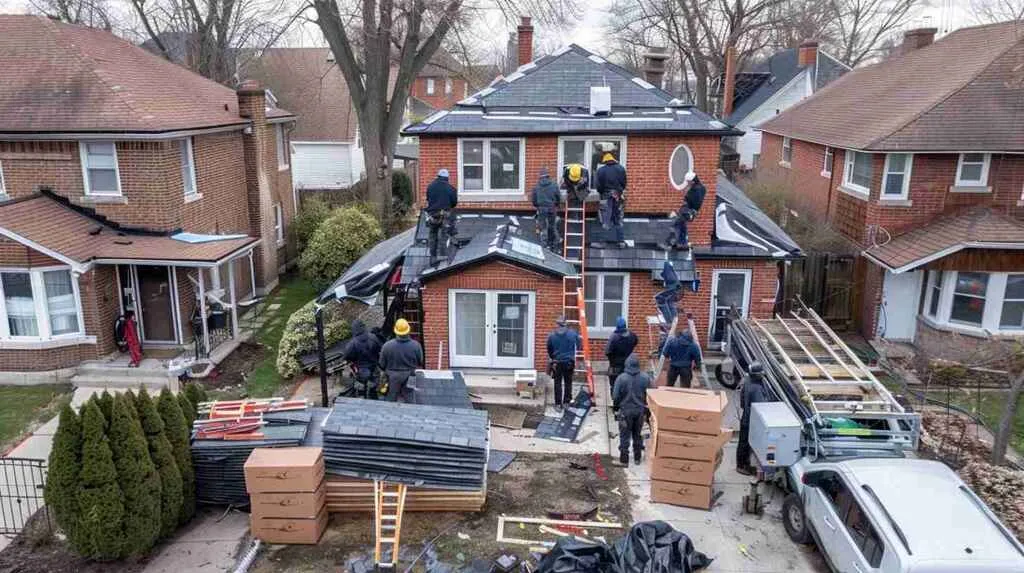
Can Roofing Shingles Be Reused Queens NY? Rarely – Here’s Why | Free Quotes
Honestly, in Queens, NY, trying to reuse shingles usually backfires and costs homeowners an extra $1,500-$3,000 in leak repairs and interior damage within a few years. I’m going to walk you through the real-world, physics-based reasons why reusing old shingles is almost always a false economy-and when I say “physics-based,” I mean it: after 19 years on Queens roofs and a decade before that teaching science at John Bowne High, I frame every roofing decision as an experiment with one simple question: where will the water and weight actually go if you try this shortcut?
Can Roofing Shingles Be Reused in Queens, NY – Or Will It Just Cost You More?
The blunt answer is almost never, and here’s the cause-effect experiment we see play out over and over: someone attempts to reuse shingles to save, say, $800 on a tear-off, then within 18-24 months water finds the old nail holes, the worn seal strips fail to stick, and the homeowner ends up paying for ceiling repairs, failed inspections, and ultimately a full tear-off anyway. In Queens, where we deal with summer heat that bakes south-facing slopes and winter freeze-thaw cycles that expand every crack, reused shingles behave like a science experiment gone wrong: you’re taking materials that have already been stressed, punctured, and aged, then expecting them to perform as if they were new.
One August afternoon in Woodside, it was pushing 94 degrees and the shingles on this 25-year-old roof were so brittle I could crush them with two fingers. The homeowner asked if we could “just reuse the good ones in the back” to save money. I literally laid one of those “good” shingles on the driveway, tapped it with the butt of my hammer, and it cracked like a potato chip. That was the day I started bringing a little notebook to jot down “shingle autopsies” so I could show people how heat, age, and past repairs kill any chance of reusing them safely. On that Woodside block, the building inspector had already red-tagged two other reused-shingle jobs that summer, and I knew if we tried it we’d be back in three months chasing leaks and writing off our labor as a guaranteed callback.
💰 Cost Impact: Trying to Reuse vs Doing It Right in Queens, NY
| Scenario | What Actually Happens | Typical Extra Cost in Queens, NY |
|---|---|---|
| Reuse “good-looking” shingles from a 15+ year old roof | Brittle asphalt snaps during installation; seal strips won’t stick; granule loss accelerates | $1,200-$2,000 in leak-related ceiling and insulation repairs within 2 years |
| Reuse shingles pulled off carelessly (nails ripped through tabs) | Each torn tab becomes a water entry point; new nails often overlap old holes | $1,500-$2,500 for emergency repairs plus re-roof after first nor’easter |
| Mix reused shingles with new on same roof plane | Mismatched thickness and seal performance; inspector flags it; bank appraiser marks it down | $800-$1,200 to fix plus delayed closing or financing on home sale |
| Contractor stockpiles your old shingles “for later use” | They curl, warp, and degrade further in storage; attempt to use them creates more waste | $500-$900 in extra tear-off and disposal when the experiment fails |
| Proper tear-off and new shingles with code-compliant underlayment | Clean deck inspection; new seal strips bond in first warm week; manufacturer warranty valid; passes NYC DOB inspection | $0 in surprise repairs; roof performs for 20-25 years |
Risk of Failed Inspections and Hidden Leaks When Reusing Shingles in Queens
Most reused-shingle jobs in Queens trigger NYC Department of Buildings inspection issues, especially when a permit is pulled or when a bank appraiser walks the roof before closing. The inspector sees mismatched colors, visible old nail holes, and worn granules, and you’ll get a correction notice. Even worse, manufacturer warranties are automatically voided the moment you reuse shingles-they’re engineered for a single installation cycle. And here’s the hidden danger: old nail holes create straight leak paths that only show up one or two storms later, often staining a ceiling or soaking insulation long before you see the drip. I’ve walked homeowners through these “surprise” leaks in Astoria, Forest Hills, and Woodhaven, and the pattern is always the same: water followed the old puncture right down to the deck.
Why Old Shingles Fail the “Physics Test” When You Try to Reuse Them
Brittle asphalt, dead seal strips, and old nail holes
If you were my old physics student, I’d ask you this question the same way: where do you think the water will go when you put a nail through a shingle that already has three or four nail holes in it from the last installation? The answer is obvious once you see it on a roof, but people forget that asphalt shingles are petroleum-based materials that age like any other hydrocarbon exposed to UV, heat, and freeze-thaw cycles. In Queens, especially on south-facing slopes in neighborhoods like Jackson Heights and Corona, summer sun can push surface temperatures above 160°F, which cooks the volatile oils out of the asphalt and leaves it brittle and chalky. Granule loss accelerates that aging-once those ceramic-coated rock chips start washing into your gutters, the asphalt underneath is exposed and deteriorates even faster. And those self-seal strips along the bottom of each shingle? They’re designed to bond once, using a temperature-activated adhesive. After 10 or 15 years, dust, pollen, and oxidation contaminate that strip, so even if you carefully peel a shingle off and try to reuse it, it won’t re-bond reliably.
During a cold March drizzle in Flushing, I had a landlord who’d stockpiled old three-tab shingles in his basement, stacked like records from the 90s. He wanted us to reuse them on a small rear extension. We tried to bend one in that 40-degree weather and it snapped clean at the nail slot. When we checked the back, the old nail holes lined up almost exactly where the new nails would have to go, which is just begging for leaks. That job turned into a lesson on why reusing shingles can be a false economy and how water always finds the old weak points. The cause-effect here is straightforward: you drive a nail through or near an old hole, the deck gets a new puncture right next to the old one, and now you have an easy channel for wind-driven rain to migrate under the shingle, across the underlayment (if there even is any left), and down to the plywood.
🔍 Myth vs. Fact: Common Beliefs About Reusing Roofing Shingles in Queens, NY
Real Queens Example: How Reused Shingles Turned a Nursery into a Leak Lab
One Saturday at 7 AM in Astoria, I got called to fix a leak over a baby’s nursery after a “budget contractor” reused shingles from a previous tear-off. When I pulled up the reused shingles, I saw three different brands, two different colors, and nail holes like Swiss cheese. The granules were half gone, the seal strips had dust stuck to them, and there was no way they were ever going to reseal properly. I ended up showing the parents each layer like a crime scene, explaining how every shortcut with reused shingles added another path for water to reach their kid’s ceiling-and that every one of those reused shingles was essentially a failed experiment waiting to drip. Here’s my insider tip for any homeowner: if a contractor suggests reusing shingles, ask them to bend one in front of you and show you exactly where the old nail holes will be under the new nailing pattern. If they can’t-or won’t-do that demo, walk away.
❌ Reused-Shingle “Budget” Job
- Materials: Salvaged shingles, multiple brands/colors, worn seal strips, old nail holes
- Labor steps: Minimal deck inspection, no new underlayment, nail over old holes or adjacent to them
- Short-term cost: Saves $600-$900 on materials and disposal
- 5-year outcome: Leaks appear within 18-24 months; $1,500-$2,500 in ceiling repairs; full re-roof required anyway; no warranty coverage
✅ Proper Tear-Off and New Shingles
- Materials: New architectural or three-tab shingles, one manufacturer, matching color, fresh seal strips
- Labor steps: Complete tear-off to deck, inspect and repair any soft spots, new synthetic underlayment, code-compliant nailing
- Short-term cost: Full material and labor investment, but transparent and predictable
- 5-year outcome: Zero leak-related repairs; manufacturer warranty in force; passes inspection; adds to home value
How to Decide: Is Your Roof a Candidate for Spot Repair or Full Replacement?
Follow the water and the weight, not just what “looks okay”
On a typical Queens block with those attached brick houses, water doesn’t just travel straight down-it runs across shared party walls, into valleys, and along flashings, which means a “small” problem on one slope can telegraph damage to an adjacent roof or interior wall. When I frame this as a physics experiment, the question is always the same: where will the water and weight go if you mix new shingles in a small area with the old, aged ones around them? The answer is that water follows the path of least resistance, which is usually the oldest, most punctured, most degraded shingles. A true spot repair means installing NEW shingles-never reusing old ones-in a well-defined, small area where storm damage or a tree branch took out maybe five to ten shingles and the surrounding roof is young enough (under eight to ten years) and sound enough to handle the transition. Even then, you’re counting on matching shingle lots, proper flashing integration, and a deck that’s still solid under the repair zone.
Here’s the blunt part people don’t love to hear, but always nod at once I show them the evidence: in 19 years of doing roofs across Queens-from Ridgewood to Far Rockaway-I’d say maybe 1 to 2 percent of roofs even look like candidates for reusing shingles, and I still advise against it every single time because the risk-reward math just doesn’t work. The tiny upfront savings disappear the moment you’re cutting a check for drywall, paint, and mold remediation after the first nor’easter. When I sit at someone’s kitchen table and we walk through the options, my recommendation is straightforward: if your roof is old enough that someone’s proposing reuse to save money, it’s old enough that a full tear-off and replacement is the smarter, safer, and ultimately cheaper play. If damage is localized and the roof is relatively new, a small repair with NEW shingles-not salvaged ones-can buy you a few more years, but you’re still setting expectations that the clock is ticking on the whole system.
🌳 Should You Even Be Thinking About Reusing Shingles?
| START: Do you have missing or damaged shingles? | |
| → YES – Continue to next question | → NO – Stop here; monitor roof annually but no action needed now |
| NEXT: Is the roof under 10 years old? | |
| → YES – Continue to next question | → NO – STOP: Do NOT reuse. Plan a full replacement. Shingles over 10 years are too degraded. |
| NEXT: Is damage confined to a small, well-defined area (5-10 shingles)? | |
| → YES – Continue to next question | → NO – STOP: Do NOT reuse. Full replacement needed. Widespread damage means system failure. |
| FINAL: Have shingles already been removed from that area? | |
| → YES, and someone wants to reuse them – STOP: Do NOT reuse. Order NEW shingles for small area repair. | → NO, damage is visible but shingles intact – Small-area NEW-shingle repair might be okay; still no reuse. |
| OUTCOME: Reusing shingles in Queens, NY is almost never the right call. Plan for new materials. | |
What to Do Before You Call – and What to Ask About Shingle Reuse
A 5-minute check from your attic ladder or driveway can easily save you $2,000 in bad repairs and help you ask the right questions when you call. Use the checklist below so when you talk to me-or any experienced Queens roofer-the conversation is focused and based on what you actually see, not just guesses or what a neighbor said.
✓
Before You Call: Homeowner Checklist for Shingle Roofs in Queens
- Check gutters and downspouts for granule buildup – Heavy granule shedding (looks like coarse sand) means shingles are past their effective life.
- Look for missing, curled, or cracked shingles from the ground – Use binoculars if needed; note how many and where (front slope, back, valleys).
- Walk your attic with a flashlight on a rainy day – Look for water stains, damp insulation, or light coming through nail holes in the deck.
- Ask yourself: how old is this roof? – If it’s 15+ years, reusing shingles isn’t even on the table; plan for replacement.
- If a contractor mentions reuse, ask to see a sample bent and inspected – Look for brittleness, old nail holes, and worn seal strips in your hands, not just from the ground.
- Get the roof’s history if you bought recently – Check disclosure or ask previous owner when it was last done and whether any repairs were “budget” shortcuts.
🏆 Why Queens Homeowners Call Denise at Shingle Masters for Shingle Roofs
Fully compliant with NYC Department of Buildings requirements; every job permitted and inspected when required.
Deep experience across every neighborhood from Astoria to Far Rockaway, and every roof style from flat to steep pitch.
When available, we prioritize active leaks to minimize interior damage; always responsive within 24 hours.
Familiar with Queens inspectors and bank appraisers; we know what they look for and how to get jobs approved the first time.
The bottom line is that reusing shingles in Queens, NY is a false economy that almost always leads to leaks, failed inspections, voided warranties, and extra costs that dwarf any upfront savings. After nearly two decades walking roofs from Woodside to Whitestone, I can count on one hand the number of times reuse even looked plausible-and I still talked the homeowner out of it because the physics just don’t support it: aged asphalt, contaminated seal strips, and old nail holes are a recipe for water infiltration no matter how carefully you try to reinstall. If you’re dealing with missing or damaged shingles, or if a contractor has suggested reusing materials to “save you money,” call Shingle Masters and let me come out to inspect your roof, explain the options at your kitchen table, and give you a free, no-pressure quote for a code-compliant, leak-resistant solution that’ll actually protect your home for the next 20 years.