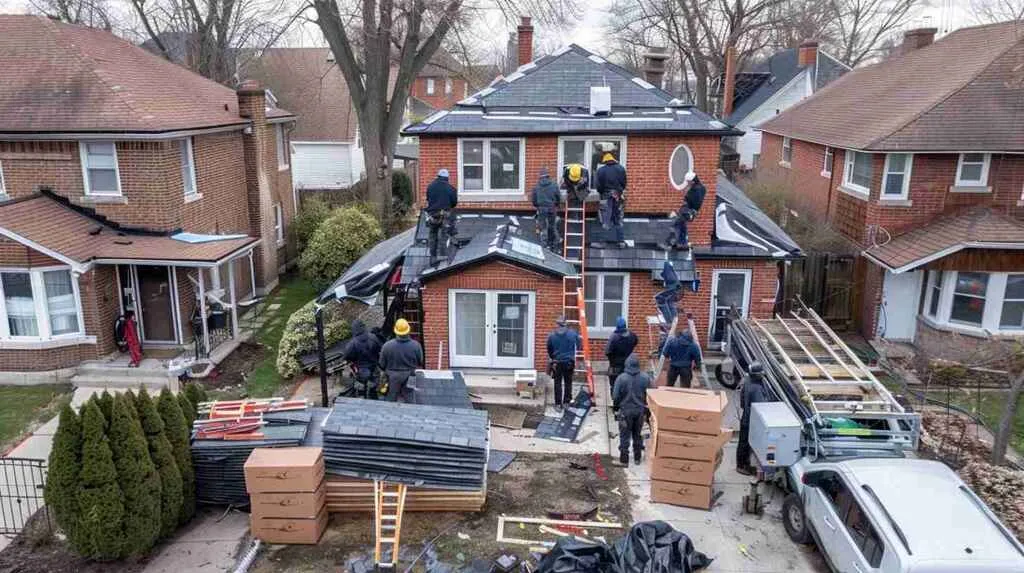
Synthetic Shingle Roof Replacement Queens NY – Get a Free Quote
Blueprint for what you’re about to read: right now in Queens, a typical synthetic shingle roof replacement runs between $14,000 and $26,000-and the rest of this article will break down exactly why some homes land closer to $14k and others closer to $26k, using plain language and real on-roof examples from around our borough.
What a $14,000-$26,000 Synthetic Shingle Roof Really Buys You in Queens
When I quote a synthetic shingle roof replacement in Queens, that $14,000-$26,000 range isn’t about which brand you pick or what color matches your shutters-it’s about what’s happening under those shingles. Think of a roof like the 7 train: the rails, the ties, and the power system (in our case, deck, underlayment, and flashing) matter way more than how shiny the train cars look. I care much more about how water moves off your house than how pretty the shingles look from the street, and honestly, I’d rather argue with you than install a beautiful roof that fails in two years because we skimped on the “local track” details.
At the corner of 37th Avenue and 84th Street, I replaced a 25-year-old asphalt roof with synthetic, and here’s what changed the price more than anything else: we planned a simple overlay to keep costs down, but during tear-off we found rotted decking where an old dormer had leaked for years. I grabbed a scrap synthetic shingle, bent it over one of the gaps, and showed the homeowner exactly how water would ride that space straight into his living room. That five-minute demo turned a $15,200 overlay into a $21,800 full rebuild-but the homeowner saw the water path and made the call himself. The system’s been tight ever since.
Synthetic Shingle Roof Replacement Cost Scenarios – Queens, NY
Ballpark ranges for Queens homes, assuming synthetic shingles, full professional replacement, and typical access.
| Scenario | Roof Description | What’s Included | Approx. Price Range |
|---|---|---|---|
| Small attached home | 800-1,000 sq ft, simple gable, clean deck | Tear-off, synthetic underlayment, new flashing, standard synthetic shingles | $14,000-$17,500 |
| Typical 2-family rowhouse | 1,400-1,700 sq ft, one layer tear-off, minor deck repair | Full tear-off, limited decking repair, ice & water shield, quality synthetic shingles | $18,000-$22,000 |
| Single-family with dormers | 1,800 sq ft, multiple dormers, steep pitch, 2 layers | Double tear-off, deck repair around dormers, full flashing package, premium synthetic shingles | $22,000-$26,000 |
| Low-slope commercial building | 2,000 sq ft, low pitch, narrow access, heavy debris disposal | Tear-off, reinforced deck sections, enhanced underlayment, low-slope synthetic system | $20,000-$25,000 |
| Historic home restoration | 1,500 sq ft, complex valleys, skylight, chimney, hidden rot | Full structural repairs, custom flashing, ice & water in all valleys, architectural-grade synthetic shingles | $23,000-$28,000 |
What Changes Your Price More Than the Shingle Brand
At the corner of 37th Avenue and 84th Street, I replaced a 25-year-old asphalt roof with synthetic, and here’s what changed the price more than anything else: not the shingle color, not the manufacturer logo on the wrapper, but the narrow driveway where we had to hand-carry every bundle, the attached neighbor’s fence that limited staging space, and the three layers of old shingles we found under the first one. Around Jackson Heights, Corona, and similar Queens neighborhoods, those tight lots, shared driveways, and zero-setback party walls turn debris handling and material staging into a serious labor cost. Your deck condition, roof pitch, how many layers we tear off, and whether we can actually set up scaffolding or need to hand-haul everything-those details move the needle way more than glossy brochure photos.
Back in late October 2019, right before that early nor’easter rolled through, I got a frantic call from a restaurant owner in Flushing whose brand-new synthetic shingle roof was literally lifting in strips. I didn’t install it-some out-of-town crew did-and when I climbed up at 7 a.m. in that cold drizzle, I saw they’d used smooth roofing nails meant for underlayment instead of ring-shank nails and skipped half the starter strip details. I spent the next 13 hours re-fastening critical sections, explaining to the owner between gusts of wind that the shingles themselves weren’t the problem-the installation was. That day convinced me to start every synthetic shingle consultation by showing customers the exact nail specs on the manufacturer’s data sheet, because proper fasteners and following the install manual add maybe $400 in material and time but save you from watching your roof peel off in the next storm.
Key Cost Drivers for Synthetic Shingle Roof Replacement in Queens
| Cost Factor | Example in a Queens Home | Impact on Price |
|---|---|---|
| Deck condition | Finding rotted plywood around an old dormer after tear-off | High |
| Number of old layers | Discovering three old roofs under the top one (common in pre-war homes) | High |
| Roof pitch/steepness | Steep pitch on a Tudor-style home requiring extra safety harnesses | Medium |
| Site access/staging | Narrow driveway shared with neighbor, no room for dumpster close to house | Medium |
| Flashing complexity | Skylights, chimneys, multiple valleys, party walls | Medium |
| Shingle brand/grade | Choosing premium architectural synthetic vs. standard 3-tab synthetic | Low |
⚠️ Cheapest-Quote Pitfalls with Synthetic Shingles
- No tear-off listed: If the quote doesn’t mention removing old layers, you’re probably getting an overlay that will fail early and void the manufacturer warranty.
- Vague “repairs as needed” language: Without a deck repair allowance or inspection clause, you’ll face surprise charges when we find rot.
- Generic “underlayment” with no brand or spec: Quality synthetic underlayment costs more than felt paper; if they won’t name it, assume the cheap stuff.
- Zero mention of nail type or fastener schedule: Wrong nails (smooth instead of ring-shank) or improper spacing is the #1 reason synthetic roofs fail in wind-and it’s almost invisible until it’s too late.
$2,000 saved on paper is nothing if the first nor’easter rips half your synthetic shingles off the roof.
How a Synthetic Shingle Replacement Actually Works, Step by Step
I still remember a Tuesday in March, standing on a Bayside roof with my moisture meter in one hand and a homeowner’s “cheapest quote” in the other-a one-page estimate that just said “new synthetic roof” with a price. Once you break the work into actual steps-tear-off, deck inspection and repair, underlayment install, flashing details, shingle application, ventilation check, final cleanup-the price starts to make sense, and you can see exactly where corners are getting cut. Here’s my insider tip: insist on photo documentation of the bare deck after tear-off and before new underlayment goes down. That’s the only moment you can actually verify what’s happening under your roof, and any contractor who won’t text you those photos is hiding something.
One winter evening in 2023 in Forest Hills, I was finishing up a synthetic shingle replacement for a young couple who both worked nights at a hospital. It was already dark at 5 p.m., light snowflakes were starting, and we fired up the portable job-site lights to finish the ridge and clean up. During the final walkthrough, we found one area near a skylight where ice from an old leak had rotted the sheathing in a weird, triangular pattern I’d never seen before-water had been traveling sideways under the old shingles like a passenger transferring between subway lines. I laid one of the new synthetic ridge caps over the repair and explained how the new underlayment and flashing would turn that old “ice funnel” into a dead end for water, kind of like how a triage station redirects patient flow so the whole system doesn’t jam up. They told me no one had ever explained a roof to them in a way that matched how they think about their work, and honestly, that’s the whole point: your roof is a transit system for water, and every detail either helps it flow off cleanly or creates a backup.
Carlos’s Synthetic Shingle Roof Replacement Process in Queens
✅ Key System Components That Make a Synthetic Roof Last
- ✅ Deck repair: Solid plywood or OSB base so shingles have something firm to grip-think of it as the foundation under the subway tracks.
- ✅ Ice & water shield: Self-sealing membrane in valleys, eaves, and around chimneys where ice dams and wind-driven rain try to push water backward.
- ✅ Synthetic underlayment: Waterproof secondary barrier that sheds moisture even if a shingle fails-way better than old felt paper.
- ✅ Flashing: Metal “gutters” around every roof feature (chimneys, walls, skylights, vents) that redirect water like turnstiles, keeping it on the right path.
- ✅ Ventilation: Ridge and soffit vents that let hot, moist air escape from your attic, preventing premature shingle aging and ice dams in winter.
Do You Really Need Replacement Now or Can It Wait?
Truth is, your roof doesn’t care how busy you are-it will leak at 3 a.m. on a work night if you ignore the warning signs. If you’re seeing active drips inside, ceiling stains that grow after rain, or shingles flapping in moderate wind, you’re past the “can it wait” stage and into urgent territory. On the other hand, if you’re just noticing some granule loss in the gutters or a couple curled edges on the sunny side, you’ve probably got a season or two to plan the job right and get multiple quotes. Think of it like a subway station with a slow leak versus one actively flooding-you shut down the flooded one immediately, but the slow drip gets scheduled maintenance before it becomes a crisis.
🚨 Urgent – Call Shingle Masters Now
- Active leaks or interior ceiling stains
- Large sections of missing or blown-off shingles
- Sagging or soft spots visible from the ground
- Water running down interior walls after rain
⏳ Can Wait a Few Weeks – But Don’t Ignore
- Noticeable granule loss in gutters (roof aging)
- Curling or minor lifting at shingle edges
- Roof is 20+ years old with no leaks yet
- Dark streaks or moss growth (cosmetic, but plan replacement)
Should You Repair or Fully Replace with Synthetic Shingles?
Start here: Are you seeing active leaks or interior stains?
- Yes → Is your roof under 10 years old?
- Yes → Likely a spot repair (flashing failure, isolated damage).
- No → Probably time for full synthetic replacement.
- No leaks, but roof looks worn → Is it over 20 years old or showing widespread curling/granule loss?
- Yes → Plan for full synthetic replacement within 6-12 months.
- No → Consider a partial section replacement if damage is isolated to one area (storm damage, tree fall).
Queens-Specific FAQs About Synthetic Shingle Roof Replacement
Think of your synthetic shingle roof like the 7 train: the rails, the ties, and the power system matter more than how shiny the train cars look. Every question below comes from real conversations I’ve had on Queens roofs, and each answer focuses on where the water wants to travel on a typical Queens home-whether it’s a rowhouse, multi-family, or small single-family with tight lot lines.
How long do synthetic shingles last compared to asphalt in Queens weather?
Quality synthetic shingles typically last 30-50 years in Queens conditions (freeze-thaw cycles, nor’easters, summer heat), compared to 15-25 years for traditional asphalt. The key difference is that synthetics don’t absorb moisture and don’t become brittle in cold the way petroleum-based asphalt does. I’ve seen 12-year-old synthetic roofs in Bayside that still look nearly new, while the asphalt roof next door is already curling. That said, installation quality and proper underlayment matter just as much as the shingle material-a badly installed synthetic roof will still fail early.
Are synthetic shingles too heavy for older Queens home frames?
Actually, most synthetic shingles are lighter than traditional asphalt-they weigh about 200-250 pounds per square versus 250-350 for standard asphalt shingles. That makes them a great fit for older Queens homes (1920s-1950s construction) where roof framing might not handle the extra weight of heavy architectural asphalt or slate-look products. I always check the attic framing on pre-war homes, but I’ve never had to reinforce a structure for standard synthetic shingles. If anything, going synthetic when you replace an old slate or tile roof can actually reduce the load on the frame.
How noisy is a synthetic shingle roof installation in an attached Queens home?
Not gonna lie: tear-off day is loud-you’ll hear the scraping, the debris sliding into the dumpster, and the nail guns. But it’s the same noise level as any roof replacement, whether synthetic or asphalt. The good news is that most Queens rowhouse and attached-home jobs are done in 2-3 days total, so your neighbors aren’t dealing with weeks of racket. We schedule around noise ordinances (no work before 7 a.m. or after 6 p.m. on weekdays, and we coordinate with neighbors if someone works nights). If you’re in a semi-detached or true rowhouse, I always knock on the neighbor’s door before we start, explain the timeline, and give them my cell number.
Can you install synthetic shingles on the low-slope areas common in Queens homes?
Yes, but it requires extra care. A lot of Queens homes-especially older two-families and commercial buildings-have sections with 3:12 or 4:12 pitch, which is on the edge of what standard shingle manufacturers recommend. For those areas, we use a low-slope synthetic shingle system with modified installation: full ice & water shield underlayment coverage instead of strips, wider overlap on the shingles, and sometimes a double starter course. I won’t install any shingle (synthetic or asphalt) on a true flat or near-flat section under 2:12 pitch-that’s TPO or modified bitumen territory, and mixing systems is asking for trouble.
How long does a typical Shingle Masters synthetic roof replacement take on a 2-family Queens home?
For a typical 1,400-1,700 square foot two-family in decent shape, we’re usually done in 2-3 working days: day one is full tear-off and deck inspection/repair, day two is underlayment and most of the shingle install, and day three is finishing details, flashing, cleanup, and final walkthrough. If we hit surprise rot or multiple old layers, add another half day. Weather can stretch things-we won’t shingle in active rain or high wind-but I give you a realistic timeline up front and text updates if anything changes. The actual disruption to your day-to-day life is minimal; you can stay in the house, and we tarp everything if we have to stop mid-job.
Why Queens Homeowners Trust Shingle Masters with Synthetic Shingles
- ✓ Licensed and insured in New York State – full liability and workers’ comp coverage on every job
- ✓ 19+ years of hands-on roofing experience in Queens – I’ve worked on everything from Astoria pre-wars to new construction in Bayside
- ✓ Familiarity with manufacturer installation specs for all major synthetic shingle brands – I actually read the technical bulletins, not just the marketing
- ✓ Typical 24-48 hour response time for on-roof inspections – I’ll come out, walk your roof, and give you an honest assessment same-day or next-day
- ✓ Photo documentation of deck and flashing on every job – you’ll see exactly what’s under your shingles before we cover it back up
Here’s the thing: synthetic shingles only perform as well as the system and the installer behind them-beautiful materials on top of shoddy underlayment, wrong fasteners, or rotted decking is just expensive failure waiting to happen. If you want a free, photo-documented synthetic shingle roof replacement quote in Queens, NY, or you just want someone to climb up and tell you honestly whether your roof can wait another year, call Shingle Masters at (718) 555-ROOF or schedule a quick on-roof inspection through our contact form-I’ll bring my moisture meter, my camera, and a straightforward answer.