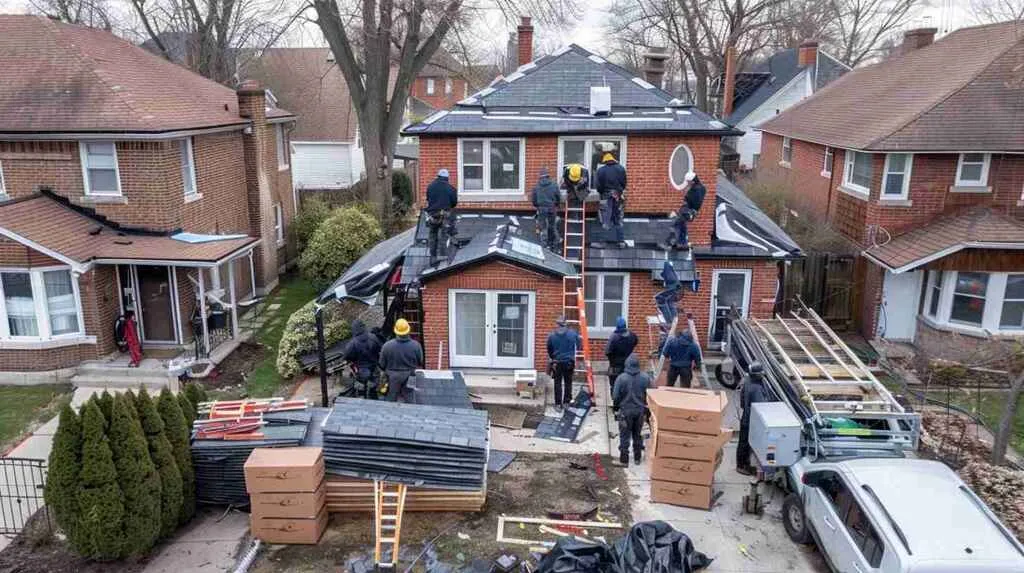
Residential Shingle Roof Replacement Queens NY – Free Estimate | Call Today
Blueprint first: On a typical detached house in Queens-think 20 by 40 footprint-you’re usually looking at somewhere between $12,500 and $18,000 for a full residential shingle roof replacement, assuming we tear off the old stuff, replace any bad decking, install proper underlayment, and get everything ventilated right. The rest of this page breaks down exactly why some roofs land on the low end and some push toward the high end, using real Queens house examples and the kind of surprises I’ve pulled off roofs across Maspeth, Astoria, Jamaica Estates, and everywhere in between.
What a Residential Shingle Roof Replacement in Queens Really Costs
On a typical detached house in Queens-think 20 by 40 footprint-you’re usually looking at somewhere between $12,500 and $18,000 for a complete tear-off and replacement with architectural shingles. I know that’s a wide range, and I’m not gonna sugarcoat it: the reason it varies so much is because I can’t tell what your decking looks like until I peel back those shingles, and I can’t see how many layers some guy nailed up in 1987 until we’re already committed. What I can tell you is what the water is trying to do on your roof-it wants to find the lowest spot, slide down, and get off your house as fast as possible. When decking is rotted or the underlayment is shot, the water starts doing things you don’t want, like soaking into framing or dripping into your ceiling. That’s why I tell people the real numbers up front: patching forever is usually the most expensive way to own a roof, because you’re just delaying the job and letting the hidden damage get worse.
One January morning around 6:45 a.m., I was on a Rego Park two-family where the owner swore he just needed “a few shingles patched.” By the time I peeled back the first row, I could push a screwdriver straight through the decking like it was wet cardboard. We ended up tearing off the whole south slope in 28-degree weather with the wind howling down Queens Boulevard, racing the sunset so his tenants didn’t wake up to snowflakes in their bedrooms. That job taught me to never sugarcoat when I tell people, “Patchwork isn’t going to save this roof.” The quote jumped from around $3,200 for a patch to just under $16,000 for the full replacement once we accounted for new decking, but the alternative was letting his tenants deal with interior water damage that would’ve cost twice that in mold remediation and drywall work.
Typical Residential Shingle Roof Replacement Scenarios in Queens, NY
All prices include full tear-off, architectural shingles, underlayment, basic ventilation adjustments, and disposal. Materials, access challenges, and hidden damage can push costs up or down.
Fast Facts: Residential Shingle Roof Replacement with Shingle Masters
Free on-roof estimate within 48 hours of your call, usually same or next day in Queens
Most Queens residential roofs complete in 2-4 days, weather depending
10-year labor warranty, plus manufacturer warranty on shingles (typically 25-50 years)
Fully licensed in NYC, insured for liability and workers’ comp, local crew only
How Roof Condition, Layers, and Surprises Change Your Price
I’ll be honest: if your shingles are curling, cracked, and patched in three different colors, we’re past the “wait and see” phase. I still remember a late August roof replacement in Jamaica Estates for a retired school principal who’d kept a binder of every home repair since 1979. Halfway through the tear-off, we uncovered three different layers of shingles and an old, abandoned chimney chase nobody had mentioned on the listing. Her first reaction was panic about cost and time, so I sat on her front steps, drew out every layer we found, line by line, and walked her through the options-tear everything off and do it once, or keep gambling and hope the decking holds another winter. That was the job where I realized most people don’t fear roofs-they fear surprises. The older capes and colonials in Jamaica Estates, Bayside, and Maspeth often hide multiple layers because someone in the ’80s or ’90s decided nailing over was cheaper than tearing off. Each extra layer adds weight, traps heat, and makes it harder to spot the real problems underneath. More layers mean more dump fees, more labor tearing everything down to the deck, and more chances we find soft spots once we get there.
Decking damage is the big wildcard. On most Queens houses built before 1985, you’re dealing with plywood or board sheathing that’s been up there for decades, and if it’s taken on water from a slow leak or poor flashing, it goes soft in patches you can’t predict from the ground. Bad past patch jobs are another headache-somebody slaps tar and a random shingle over a problem spot, and underneath it the wood is rotting away quietly until we pull it up. Old chimneys and abandoned vent pipes are common on brick colonials and two-families; if the flashing around them was done wrong or just deteriorated, you’ll see staining on the decking that tells me water’s been sneaking in for years. The real fear isn’t roofs-it’s walking into a job thinking it’s straightforward and discovering halfway through that you need 12 more sheets of decking and a chimney cricket nobody budgeted for. That’s why I always tell people: budget a little cushion for surprises, because Queens houses have secrets.
⚠️ Warning: Why Nailing Over Existing Shingles Is a Bad Bet on Older Queens Homes
Some contractors will offer to just nail a new layer of shingles right over your old roof to save you a few thousand dollars upfront. Here’s why that’s usually a mistake:
- Added weight on older framing: Queens homes from the ’50s through ’80s weren’t designed to carry the combined load of multiple shingle layers, especially when wet.
- Traps heat and moisture: The old shingles underneath act like an insulating blanket that holds heat in your attic and prevents the roof from breathing, quietly cooking your new shingles from below.
- Hides deck rot: If there’s soft decking or water damage under the old layer, you won’t know until the new shingles start sagging or a ceiling stain appears.
- Voids manufacturer warranties: Most major shingle manufacturers require a clean deck for their warranties to be valid-nail over an old roof and you’re on your own if something fails early.
My take: The cheapest roof is rarely the best roof. Tear it off, see what you’re really dealing with, fix it right, and sleep easy.
Ventilation, Ice Dams, and Why Queens Roofs Need to Breathe
When I step into a Queens attic, the first thing I ask myself is, “Where is this roof trying to breathe, and who blocked it?” Picture your roof like the lid on a steaming pot of pasta-if the steam can’t get out, it’s going to cause problems you can’t see yet. Hot air rises from your living space into the attic, and if there’s no clear path for it to escape through ridge vents or gable vents, it just sits there, baking your shingles from underneath and turning your attic into a sauna in summer and a condensation factory in winter. Poor ventilation quietly kills shingles early, especially on those attached brick homes in Jackson Heights or Elmhurst where the original builders just slapped on a couple of lousy gable vents and called it a day. What happens is the heat buildup makes the shingles age faster-granules fall off, the asphalt gets brittle, and you start seeing curling and cracking years before you should. In winter, warm attic air melts snow on the roof deck, and that melt refreezes at the eaves where it’s colder, creating ice dams that back water up under your shingles and into your house. Here’s an insider tip: on a cold day, go up to your attic and touch the underside of your roof deck-if it feels warm or you smell something musty, your ventilation is probably shot and your shingles are working overtime to compensate.
One of my roughest days was a Saturday in April, right after a nor’easter, doing a residential shingle roof replacement on a narrow block in Astoria. The neighbor’s car was parked exactly where our dumpster had to go, and he refused to move it because he “didn’t believe it was going to rain again.” Around 3 p.m. the sky turned black, I threw tarp over half-stripped decking in record time, and we spent the storm holding down the edges while water sheeted off the blue plastic. When the neighbor saw his car safe and his own roof leaking, he booked us the next week. That’s when I started telling customers: weather doesn’t care about your schedule-only your preparation. That job also reminded me why proper ventilation and underlayment aren’t negotiable on replacements-the house underneath that tarp had zero ridge vent, just two tiny gable openings, and you could see the moisture stains on the rafters from years of trapped humidity. We ended up cutting in a full ridge vent during the replacement, and the homeowner told me six months later his heating bills dropped and the upstairs bedrooms finally felt comfortable in summer. Ventilation isn’t sexy, but it’s the difference between a roof that lasts 25 years and one that starts failing at 12.
Signs Your Queens Roof Isn’t Breathing Right
-
✓
Attic feels hot and stuffy in summer, even early in the morning or late evening when outside temps have dropped -
✓
Frost or moisture on the underside of the roof deck in winter, especially near the eaves or in corners -
✓
Musty smell or visible mold on attic rafters, insulation, or stored boxes -
✓
Ice dams forming along the eaves after snow, with icicles hanging down and water stains appearing on exterior walls or soffits -
✓
Shingles aging unevenly, with the upper slopes looking fine but lower sections or areas over unvented spaces curling and cracking early -
✓
Upstairs rooms uncomfortably hot in summer or cold in winter, even with good insulation, because attic temps aren’t being regulated
Step-by-Step: How Our Queens Shingle Roof Replacements Work
Here’s how it actually goes when you call us for a residential shingle roof replacement in Queens: First, I come out to your house, get on the roof with my ladder, and do a real inspection-I’m looking at shingle condition, flashing, valleys, ventilation, and any visible soft spots or staining. I’ll sketch out a little diagram in my notebook, usually with arrows and goofy labels like “where water currently hates you,” and we’ll talk through what needs to happen and what the realistic budget is. Once you’re ready to move forward, we schedule the tear-off, order materials, and pull any permits the city requires. On job day one, the crew shows up early, sets up tarps and dumpsters, and strips everything down to the bare deck-old shingles, underlayment, flashing, the works. Day two (or same day on smaller roofs) we replace any rotted or soft decking, install new underlayment and drip edge, and start laying shingles from the eaves up, overlapping each course properly and nailing to manufacturer specs. We cut in ridge vents if needed, flash all the chimneys and vent pipes with new metal, and make sure every valley is sealed tight. Final day is cleanup-magnets for nails, haul away all debris, and a walkthrough with you so I can show you exactly what we did and answer any last questions before you sign off.
Our Residential Shingle Roof Replacement Process in Queens
Free On-Roof Inspection & Estimate
I personally come out, climb up, check every slope, valley, and flashing point. We discuss what I found, sketch the problems, and give you a written estimate within 24 hours-no pushy sales pitch, just facts.
Material Selection & Permit Handling
We help you pick the right shingle grade, color, and warranty tier for your budget and house style. If your job requires a NYC DOB permit, we pull it and handle the paperwork so you don’t have to.
Complete Tear-Off to Bare Deck
Crew arrives early, sets protection tarps, and tears off every old shingle, underlayment, and failed flashing down to the plywood or board deck. All debris goes straight into our dumpster-your yard stays clean.
Deck Inspection & Repairs
With everything stripped, we inspect every square foot of decking. Soft, rotted, or sagging sections get replaced with new plywood, and any structural concerns are flagged and discussed with you immediately before we continue.
Underlayment, Drip Edge, and Flashing Install
We roll out high-quality synthetic underlayment, secure drip edge along all eaves and rakes, and custom-flash every chimney, vent pipe, valley, and dormer junction. This layer is what keeps water out when shingles eventually wear.
Shingle Installation & Ventilation Upgrades
Shingles go on in straight, overlapping courses from bottom to top, nailed per manufacturer specs. We cut and install ridge vent if planned, add or improve soffit vents, and make sure air can flow from eave to peak.
Final Cleanup & Walkthrough
Magnetic sweep of the entire property for stray nails, haul away all materials, and a detailed walkthrough where I show you the finished work, explain your warranty, and answer any remaining questions before you sign off.
Why Queens Homeowners Hire Shingle Masters
-
✦
22+ years serving Queens neighborhoods-Maspeth, Astoria, Bayside, Jamaica Estates, Rego Park, Elmhurst, Flushing, and beyond. We know the housing stock, the weather patterns, and the quirks. -
✦
Fully licensed and insured in NYC-proper DOB licensing, liability coverage, and workers’ comp so you’re protected if anything goes sideways on the job. -
✦
Local crew, no storm chasers-same guys you meet at the estimate are the ones on your roof. No out-of-town subcontractors who vanish when the warranty claim comes in. -
✦
10-year labor warranty plus manufacturer coverage-our workmanship is guaranteed for a decade, and shingles carry their own 25- to 50-year material warranty depending on the product you choose. -
✦
Fast response and realistic scheduling-free estimate within 48 hours, usually same or next day. Once you’re ready, most jobs start within 2-3 weeks depending on weather and material lead times.
Is It Time to Replace Your Shingle Roof or Can It Wait?
$600 caught early versus $18,000 ignored. That’s the math on a lot of Queens roofs I see-someone notices a few missing shingles or a small ceiling stain, figures it’s not urgent, and two winters later they’re dealing with rotted decking, trashed insulation, and mold in the drywall. Be honest about what you’re seeing: if you’ve got curling shingles, granules washing down the downspouts, daylight visible through the attic deck, or water stains spreading on your ceiling, you’re not in “wait and see” territory anymore. Catching things before the decking goes soft is the cheapest way out, because once water starts soaking into the plywood and framing, every month you delay adds to the final bill. Use the tools below to figure out where you stand-and if you’re on the fence, just call me and I’ll come take a look for free so you can make the decision with actual facts instead of guesses.
Do You Need a Full Residential Shingle Roof Replacement in Queens Right Now?
START: What are you seeing on your roof or inside your home?
- Active leak, water dripping, or large ceiling stain that’s spreading → Call for emergency visit within 24 hours
- Many shingles missing, curled, or cracked; roof is 18+ years old; heavy granule loss in gutters → Schedule replacement estimate this season (spring or fall ideal)
- A few damaged shingles, minor granule loss, roof under 15 years old, no interior signs → Monitor with yearly inspection; budget for replacement in 3-5 years
If you’re seeing anything in category one or two, don’t wait for the next storm to make the decision for you. The longer water has access, the more expensive the fix becomes.
When Queens Homeowners Should Call Shingle Masters About Their Roof
🔴 Call Urgently (Same Week)
- Water actively dripping from ceiling or running down interior walls after rain
- Large section of shingles blown off or visibly hanging loose
- Sagging roofline or soft, spongy feeling when you walk on the roof
- Daylight visible through attic deck or rafters
- Storm damage with exposed decking or torn underlayment
🟡 Schedule Soon (This Season)
- Roof is 18-25 years old and showing widespread curling or cracking
- Heavy granule accumulation in gutters and downspouts
- Old water stains on ceiling that haven’t grown but haven’t been fixed
- You’re planning to sell in the next 1-2 years and want to avoid buyer inspection issues
- Multiple small leaks or past patch jobs that keep failing
Common Questions About Residential Shingle Roof Replacement in Queens, NY
How long does a typical residential shingle roof replacement take on a Queens house?
Most single-family homes in Queens take 2-4 days from tear-off to final cleanup, depending on size, roof complexity, and weather. A simple cape might be done in two days; a larger colonial with dormers and multiple valleys can stretch to four. We don’t rush-quality matters more than speed.
Can we stay in the house while you’re replacing the roof?
Absolutely. The work is all exterior, and we tarp at night if we can’t finish in one day. It’ll be noisy during tear-off and nailing, so if you work from home you might want headphones, but you don’t need to move out or make special arrangements. Pets should stay inside for safety.
Do I need a permit for a roof replacement in Queens, and who handles that?
In New York City, most full roof replacements require an after-the-fact or advance permit from the Department of Buildings, especially if you’re changing materials or doing structural work. We handle the permit paperwork, filing, and inspections as part of the job-it’s included in our estimates so you don’t have to deal with the DOB yourself.
Can you install a new shingle roof in winter, or do we have to wait until spring?
We can and do work in winter as long as temps are above freezing and there’s no active snow or ice on the roof. Shingle sealant activates with heat, so winter installs sometimes take a few warm days in spring to fully seal, but the roof is watertight the day we finish. If it’s an emergency leak, we’re not waiting for May.
How far in advance should I book a roof replacement in Queens?
Spring and fall are our busiest seasons, so if you want a specific week during those times, call 3-4 weeks ahead. In summer or winter we usually have more flexibility and can often start within 1-2 weeks. Emergency jobs get priority and we’ll move things around to fit you in fast if your roof is actively leaking.
The cheapest time to replace a residential shingle roof is before the decking and framing are damaged-once water gets past the shingles and starts rotting the structure underneath, you’re not just paying for roofing anymore, you’re paying for carpentry, mold remediation, and interior repairs that could’ve been avoided. If you’re anywhere in Queens, NY and you want a straight answer about what your roof actually needs, call Shingle Masters for a free, on-roof estimate. I’ll come out, take a look, sketch what I’m seeing, and give you a realistic price with no pressure and no gimmicks. Call today to get on the schedule-the sooner you know what you’re dealing with, the sooner you can stop worrying about the next rainstorm.