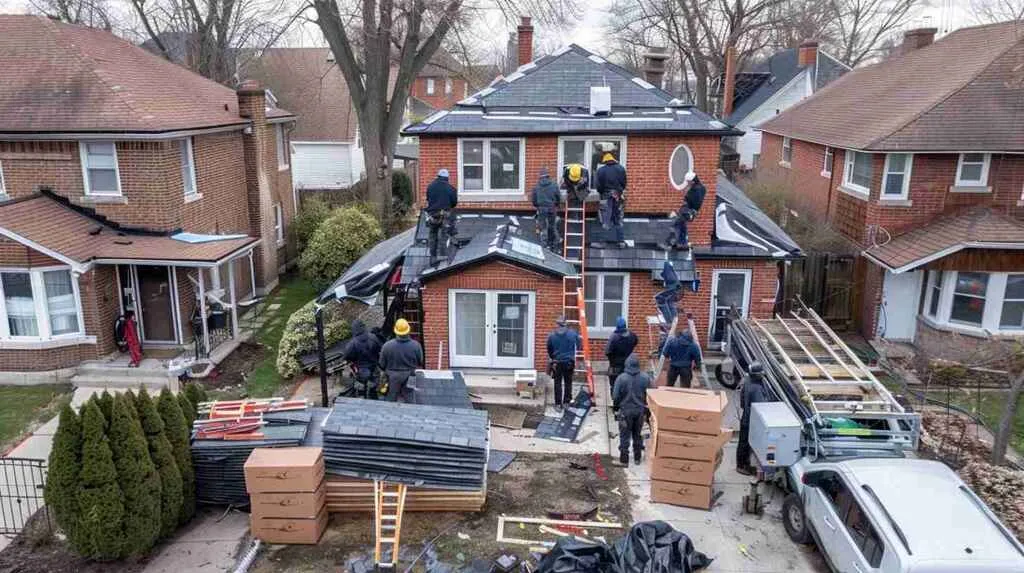
Are Shingle Roofs Asphalt Queens NY? Not Always – Here’s What Else
Layers. That’s what most “asphalt shingle roofs” in Queens really are-not a single slab of black goo and rock, but a cross-section of fiberglass mat, ceramic-coated granules, and polymer binders that sometimes contain barely a drop of actual asphalt. If you’re picturing the tar-and-gravel roof from 1985, you’re already shopping with the wrong mental image.
What You’re Really Buying When You Say “Asphalt Shingle Roof” in Queens
On a typical block in Woodhaven, you’ll see at least four different “asphalt” roofs that actually aren’t the same material at all. Most modern “asphalt” shingles are layered systems built on a fiberglass mat base, coated with asphalt or polymer compounds, and finished with mineral granules that do the real work against UV, fire, and weather. Some of today’s premium shingles use so little asphalt in their formulation that calling them “asphalt shingles” is like calling your smartphone a telephone-technically true, but missing the point. If you ask me, people obsess over shingle color and brand while ignoring what’s actually under those granules, and that’s where performance lives or dies. Think of asphalt as the dependable supporting actor in a play: it holds the structure together, but the fiberglass mat is the backbone and the underlayment is the stage crew keeping the whole production from collapsing.
I still remember that August afternoon in Jackson Heights when it hit 96 degrees and the shingles on my customer’s roof felt like gum melting on a griddle. The homeowner kept saying, “But they’re just asphalt, right?” while I stood there holding a composite shingle sample made of fiberglass mat, ceramic-coated granules, and a polymer binder. I laid three different shingles on his picnic table-one basic asphalt, one fiberglass asphalt, one synthetic-and by the time we were done in that brutal sun, he could tell which was which by touch alone. That job convinced me most people aren’t cheap; they’re just misinformed about what “asphalt” even means, especially in Queens where heat and UV exposure make the difference between a 15-year roof and a 25-year one. The material matters more than the label.
So are shingle roofs actually asphalt? Older organic felt shingles from the ’80s and ’90s were soaked in asphalt with a paper or rag felt core-those curled, cracked, and failed early, which is why most Queens roofs that age are already replaced. Modern fiberglass asphalt shingles use a non-flammable fiberglass mat coated with a thin asphalt or modified asphalt blend, making them lighter, stronger, and more fire-resistant. Then there are the non-asphalt synthetics-composite rubber, recycled plastics, engineered polymers-that mimic slate or wood and skip asphalt entirely. What you have on your roof right now might be completely different from what you think, and that’s Scene One of this play: defining the cast before we can talk about performance.
| Myth | Fact |
|---|---|
| All shingle roofs in Queens are just layers of asphalt | Modern shingles are fiberglass-mat systems with asphalt or polymer coatings and ceramic granules; some premium brands use minimal asphalt |
| “Asphalt shingles” means cheap, short-lived roof | Architectural fiberglass asphalt shingles can last 25-30 years in Queens with proper underlayment and ventilation |
| You can’t mix asphalt shingles with other materials | Mixing asphalt on main slopes with metal accents or synthetic slate features is common and structurally sound when done correctly |
| All “asphalt” shingles fail the same way in Queens weather | Organic felt asphalt (pre-2000s) and fiberglass asphalt (modern) age completely differently under freeze-thaw cycles and summer heat |
Meet the Main Shingle Characters on Queens Roofs Today
Let me be direct: if you think every shingle roof in Queens is just black goo and rock, you’re already shopping with blinders on. The key shingle “characters” you’ll actually find on roofs around here are fiberglass asphalt shingles in two flavors-three-tab flat strips and thicker architectural dimensional styles-plus the occasional organic asphalt relic from the ’90s that’s hanging on by pure stubbornness. Then there are the synthetic and composite shingles designed to look like slate or wood shake, engineered from rubber, polymers, or recycled materials, which perform like the experimental understudy trying to prove they’re tougher than the veteran. And don’t forget metal panel accents paired with asphalt on porches, dormers, or low-slope sections, playing the flashy lead role where asphalt would fail. In Bayside, I see a lot of architectural asphalt on Tudor-style homes; in Jackson Heights, you get a mix of older three-tab and newer architectural upgrades; in Woodhaven and Astoria, I find plenty of organic felt holdouts next to fresh synthetic slate composites on renovated houses. Asphalt is still the reliable supporting actor on most Queens stages, but synthetics are the experimental understudy, and metal is the flashy lead stealing scenes where the slope or sun exposure demands it.
There was this stormy March morning in Bayside when I got called to a “failed asphalt roof” that was supposedly only three years old. I climbed up in the drizzle and realized half the roof wasn’t asphalt at all-it was a thin, imitation slate composite mixed in after a mid-project material change the owner never knew about. The asphalt side showed normal wear, a few lifted tabs from wind, nothing dramatic. The composite side had cracked seams and curling edges because whoever installed it didn’t account for thermal expansion differences between the two materials. The contrast in how the two materials aged under the exact same Queens weather-freeze-thaw cycles, summer baking, wind-driven rain-became one of my go-to lessons for customers about why you must know exactly which character is on which slope before you judge all “asphalt roofs” as good or bad. They’re not one thing; they’re a cast, and every actor ages differently.
| Shingle Type | Core Material | Typical Lifespan in Queens (yrs) | Relative Cost | Best For |
|---|---|---|---|---|
| Three-tab asphalt | Fiberglass mat + asphalt coating | 15-20 | $ | Budget replacements, rental properties, garages |
| Architectural asphalt | Fiberglass mat + multi-layer asphalt | 25-30 | $$ | Most pitched roofs in Queens, long-term homes |
| Organic felt asphalt (legacy) | Paper/rag felt saturated in asphalt | 12-18 (mostly replaced) | $ (no longer installed) | Pre-2000 roofs; found during tear-offs |
| Synthetic composite | Rubber, recycled plastics, engineered polymers | 30-50 | $$$ | Slate-look upgrades, historic aesthetics, low maintenance |
| Metal panel accent | Galvanized steel or aluminum | 40-60 | $$$ | Porch overhangs, low-slope sections, high-UV areas |
| Pros | Cons |
|---|---|
| Excellent fire resistance (Class A rating standard) | Wind can lift tabs on poorly nailed or aged installations |
| Wide color and style variety to match Queens home styles | Granule loss accelerates in high UV exposure without quality underlayment |
| Proven 25-30 year track record in freeze-thaw cycles | Cheaper three-tab versions wear faster than architectural styles |
| Cost-effective for most pitched roof applications | Not suitable for very low-slope (under 2:12 pitch) without special treatments |
So no, not every shingle roof in Queens is asphalt-but every one has a cast you need to know by name.
Scene Change: What’s Under the Shingles Matters as Much as the Asphalt
In the next scene, we stop staring at the actors and look at the stage crew. Underlayment (synthetic or felt), roof ventilation (ridge vents, soffit intake), and flashing (metal valleys, step flashing at walls, drip edge) are the backstage crew that keeps any shingle type-whether asphalt, synthetic, or metal-from failing early in Queens’ brutal freeze-thaw cycles and summer heat waves. Here’s the insider tip I give every homeowner: always ask your roofer for the exact underlayment product name, the ventilation plan in writing, and the type and gauge of flashing metal on the proposal, not just the brand and color of the shingle. If they can’t or won’t tell you, that’s a red flag the size of a Broadway marquee.
Key “Backstage” Components Under a Queens Shingle Roof
- ✓ Underlayment: Synthetic or #30 felt barrier between deck and shingles; stops water if shingles fail
- ✓ Ice-and-water shield: Self-sealing membrane at eaves and valleys; critical for Queens winters
- ✓ Ridge and soffit ventilation: Exhausts heat and moisture to prevent deck rot and shingle baking
- ✓ Metal flashing: Galvanized or aluminum at valleys, walls, chimneys; directs water off roof
- ✓ Drip edge: Metal strip at eaves and rakes; protects fascia and directs runoff into gutters
!
Warning: Don’t Assume All Underlayments and Flashings Are the Same
Budget underlayment, skipped ice-and-water shield at eaves, or reusing old rusty flashing can sabotage even premium shingles, especially with Queens wind-driven rain and snow. A $200 underlayment upgrade can add 10 years to your roof’s life, but you’ll never see it from the sidewalk-so ask for it in writing on the contract.
How I Mix Materials on Real Queens Roofs (Not Just Asphalt Everywhere)
When a homeowner asks me, “So are shingle roofs asphalt?” I answer with another question: “Which kind of shingle are we talking about-today’s or 30 years ago’s?” Organic felt asphalt from the ’80s and ’90s was paper or rag saturated in asphalt, prone to curling and cracking. Modern fiberglass asphalt uses a non-flammable fiberglass mat with a thin asphalt or polymer coating, making it lighter and more durable. Synthetic composites skip asphalt entirely, using rubber or polymers to mimic slate or wood. I often use asphalt as the dependable base material for pitched roofs, but add accents or upgrades where they perform best-metal panels on low-slope porch overhangs, synthetic slate features on highly visible front gables, or upgraded ice-and-water shield in valleys where Queens snow and ice sit longest. One December evening in Astoria, just as the sun was dropping behind the Triborough Bridge, I met an older couple convinced they needed “anything but asphalt” because their last “asphalt roof” had curled to pieces. I pulled a shingle piece off their old roof and showed them it was actually an organic felt shingle from the early ’90s, not the fiberglass-based asphalt we use today. We ended up mixing architectural asphalt shingles on the main slopes with a metal panel accent over their porch, and that hybrid project turned into my favorite way to show people that “asphalt” is just one actor in a much bigger cast of roof materials.
Here’s the practical breakdown of how a Queens homeowner should think about casting their roof. Asphalt shingles-specifically modern architectural fiberglass asphalt-make sense for most pitched roofs (4:12 slope or steeper), where they deliver solid 25-30 year performance at a reasonable cost and come in every color to match your siding. Non-asphalt options might be the lead actor on a porch accent, flat or very low-slope section under 3:12 pitch, or in heavy shade where algae resistance matters more than UV durability. Metal panels work beautifully on dormers, bay window roofs, and anywhere standing water or ice dams are a chronic issue. The right “casting” depends on sun exposure (south-facing slopes bake harder), slope (steeper sheds snow and water faster), and budget (synthetic slate costs triple what asphalt does), not just a gut dislike of the word asphalt. And honestly, if you’re choosing materials based on what they’re called instead of how they perform on your specific roof, you’re already set up to overspend or under-protect.
Choose the Right “Cast” for Your Queens Roof
→ YES: Architectural fiberglass asphalt is your lead actor (main slopes) + consider metal or synthetic accents for porches, dormers, or high-visibility areas
→ NO (low slope under 3:12): Move to modified bitumen, TPO, or metal panel systems; skip asphalt shingles entirely
→ YES: Three-tab asphalt across the board; upgrade underlayment and flashing instead of shingle thickness
→ NO: Architectural asphalt base + allocate budget to metal accents or synthetic upgrades where visible
→ YES: Synthetic composite shingles (non-asphalt) on front-facing slopes; use asphalt on less-visible rear slopes to control cost
→ NO: Stick with architectural asphalt; focus budget on premium color and warranty length
Queens-Specific Roof Casting Facts
| Typical asphalt shingle lifespan in Queens | 20-28 years for architectural, 15-20 for three-tab, depending on sun exposure and ventilation |
| Mixed-material roof frequency | About 1 in 5 Queens re-roofs now mix asphalt with metal accents or synthetic features |
| Common slope challenges | Many older Queens homes have shallow porch roofs (2:12 to 3:12) where asphalt struggles; metal or modified bitumen performs better |
| Sun exposure impact | South-facing slopes can age 30% faster due to UV; north-facing slopes may grow algae in shade-material choice should vary by slope |
Before You Call a Roofer in Queens About Your “Asphalt” Roof
Here’s the unglamorous truth: the word “asphalt” sells and scares people in equal measure, and both reactions are usually based on half-information. Before you pick up the phone to call any roofer, walk out to the sidewalk and look at your roof like you’re casting a play. Note whether the shingles are flat three-tab strips or thicker layered architectural styles. Spot any metal panels on porches, dormers, or valleys. Try to remember when the roof was last replaced and what the installer told you it was made of. Look for visible trouble spots-curling edges, missing granules that expose black felt underneath, lifted corners, or dark streaks from algae. If you’ve ever watched a play from the cheap seats, you know you can’t tell who’s who on stage until the spotlight hits them-roofing materials work the same way under Queens weather. You need to identify the cast: who’s the lead (main shingle type), who’s the backup (underlayment and flashing), and where the understudy (patched or mismatched area) is standing in for a missing original piece.
Here’s my personal opinion: the best money a Queens homeowner spends is on a roofer who can correctly identify the entire cast and explain it in plain English before selling anything. I can often spot where an “asphalt” roof will fail within a few shingles from the sidewalk-wind damage shows at the edges first, thermal cracking runs in diagonal lines across south-facing slopes, and underlayment failure telegraphs through sagging or waviness you can see in side lighting. That kind of diagnosis saves you money versus jumping straight to a full replacement when a targeted repair or partial re-roof would buy you another five years. Don’t hire someone who just gives you a price per square and a shingle brand; hire someone who can walk your roof like a director at rehearsal and tell you exactly which characters are on that stage, how they’re aging, and what the next scene looks like if you do nothing.
Before You Call Shingle Masters: Your Roof Observation Checklist
- Shingle style: Flat three-tab or thicker dimensional/architectural?
- Visible color and texture: Note any fading, dark streaks (algae), or shiny spots (granule loss)
- Metal or mixed materials: Do you see metal panels, synthetic slate sections, or all one shingle type?
- Age and install date: When was it last replaced, and do you have paperwork with the product name?
- Curling or lifting: Look for edges peeling up, especially at ridge and eaves
- Missing shingles or tabs: Any bare spots or broken pieces on the ground after storms?
- Valleys and flashing condition: Can you see rust, gaps, or cracked caulk at chimneys, walls, or valleys?
Common “Asphalt” Shingle Questions from Queens Homeowners
How long do asphalt shingles actually last in Queens?
Architectural fiberglass asphalt shingles typically last 25-30 years in Queens if installed with proper underlayment and ventilation. Three-tab versions run 15-20 years. South-facing slopes and homes without attic ventilation age faster; expect to lose 5-8 years in those conditions.
How can I tell if my shingles are asphalt or synthetic composite?
Asphalt shingles (fiberglass type) are lighter, have a slight petroleum smell when fresh, and show granule loss over time. Synthetic composites are heavier, have a rubber or plastic texture on the underside, and maintain color better. If you can lift a corner, asphalt will have a black felt-like backing; synthetics show layered polymers or recycled materials.
Is it safe to mix asphalt shingles with metal or synthetic materials on the same roof?
Yes, as long as transitions are properly flashed and each material is installed to its own spec. I mix them regularly-asphalt on main slopes, metal on porch roofs or low-pitch areas, synthetics on visible gables. The key is matching expansion rates and using step flashing or custom trim at borders.
Do I have to remove old organic asphalt shingles completely before installing new fiberglass asphalt?
In most cases, yes. Old organic felt shingles are thick, brittle, and trap moisture, so leaving them under a new layer invites deck rot and shortened shingle life. Queens building code generally allows one layer over existing, but I recommend full tear-off for organic shingles older than 1995.
How does Queens weather affect which shingle material I should choose?
Freeze-thaw cycles, summer heat (90°F+ roof surface temps), wind-driven rain from nor’easters, and occasional heavy snow all stress shingles. Fiberglass asphalt handles freeze-thaw well but needs upgraded underlayment at eaves for ice dams. Synthetics resist algae in shade and stay flexible in cold. Metal sheds snow and ice fastest but costs more upfront.
Why Call Shingle Masters for Your Queens Shingle Roof
| Licensed & Insured in NY | Fully licensed, insured, and bonded for all roofing work in Queens; compliance with NYC building codes |
| 19+ Years Local Experience | Ricardo has installed and diagnosed shingle roofs across Queens since 2005; knows every neighborhood’s quirks |
| Clear Material Explanations | We explain exactly what’s on your roof now and what we’re proposing, in plain language-no jargon, no pressure |
| Detailed Written Proposals | Every quote includes shingle brand, underlayment product, flashing materials, ventilation plan, and warranty terms in writing |
If you’ve ever watched a play from the cheap seats, you know you can’t tell who’s who on stage until the spotlight hits them-roofing materials work the same way under Queens weather. If your roof is starring the wrong material in the wrong role, it will fail early, no matter how much you paid or what the label said. Call Shingle Masters so Ricardo can walk your roof like a director at rehearsal, identify every character on that roof-asphalt, fiberglass, synthetic, metal, underlayment, flashing-and give you a clear, written plan before a single shingle is touched. You’ll know exactly what you’re buying, why it makes sense for your house and your budget, and how long the production is going to run.