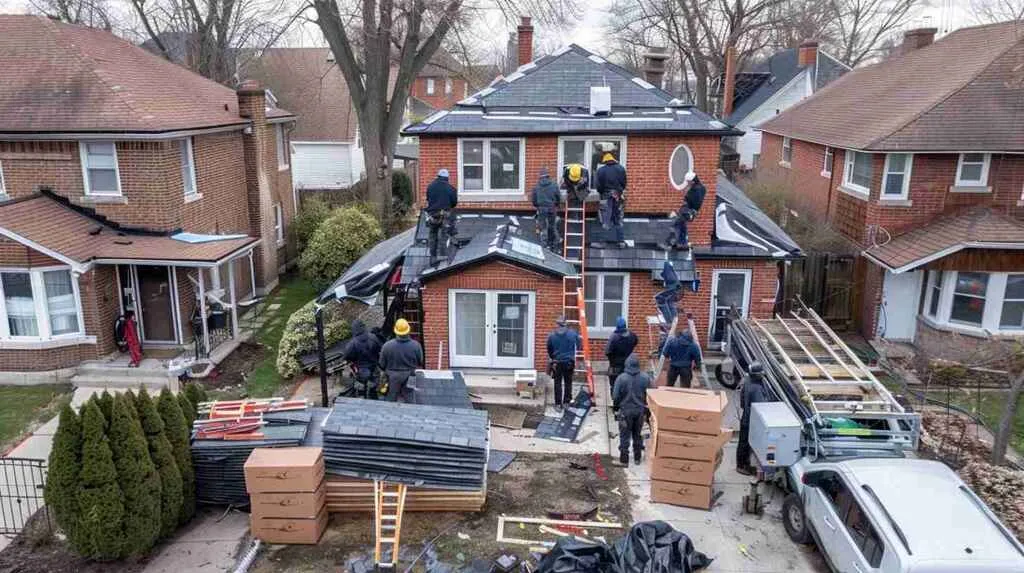
Figure Roof Shingle Coverage Queens NY – The Math Roofers Use | Free Quotes
Numbers don’t lie, and your roof won’t either-once you know the exact formula Queens roofers like me use to turn your house measurements into real shingle bundle counts. Here’s the thing: underestimating coverage in Queens can leave you short a few bundles and a few hundred dollars when the delivery truck shows up mid-job, so let’s break this down the way I do it every single day, using simple math and zero fluff.
The Exact Shingle Math Queens Roofers Use (Pizza-Slice Simple)
Three times out of five, when I step onto a Queens roof, the homeowner has under-guessed the size by at least 20%. The core formula is clean and straightforward: measure the length times width for each flat roof section, add them all up, then divide by 100 to get “roofing squares.” Each square covers 100 square feet-think of it like a family-size pizza cut into a hundred little bites. Then multiply your square total by 3, because shingles ship in bundles and you need three bundles to cover one roofing square. Not gonna lie, if a roofer can’t explain your bundle count in plain English and simple math, he shouldn’t be ordering your materials.
I still remember that August afternoon in Ridgewood, sweating through my shirt at 3 p.m., when a homeowner swore his “1,000 square foot roof” meant 10 bundles because “Google said so.” I pulled out my tape measure and notebook, showed him the back addition he’d forgotten, and walked him through the 4/12 pitch that actually pushed his roof area higher. We sat at his picnic table using pizza-slice diagrams-each slice representing coverage-and ended up saving him from being short by 7 bundles when the truck arrived. That’s why I always start with the real measurements, not what someone thinks their floor plan says.
| Roof Footprint (Length × Width) | Total Area (sq ft) | Approx. Bundles (no pitch/waste) |
|---|---|---|
| 20′ × 40′ (single plane) | 800 sq ft | 24 bundles (8 squares) |
| Two planes: 25′ × 30′ each | 1,500 sq ft | 45 bundles (15 squares) |
| 30′ × 35′ main + 12′ × 20′ addition | 1,290 sq ft | 39 bundles (13 squares) |
| Two-story: Four planes at 18′ × 28′ each | 2,016 sq ft | 60 bundles (20 squares) |
How Pitch and Old Queens Layouts Quietly Add Bundles
I still remember standing on a South Ozone Park bungalow at 7 a.m., looking at my tape measure, and realizing the “square” roof was lying to us. Here’s the reality: every time your roof tilts, the actual surface area grows bigger than the footprint you measured from the ground, and you adjust for that by applying a pitch multiplier. For a gentle 3/12 pitch, multiply your area by 1.03. For the common 4/12 pitch you see all over Bayside, Ridgewood, and Jackson Heights, use 1.06. A steeper 6/12 pitch? That’s 1.12. And if you’re looking at an 8/12, you’re at 1.20. Think of it like this: imagine laying a flat lasagna pan on your counter, then tilting it up-suddenly the surface you need to cover is bigger, even though the pan’s footprint stayed the same.
During a foggy October morning in Bayside, we started tearing off what looked like a simple gable, and halfway through we uncovered an old, hidden valley where someone had framed over a porch 30 years ago. My original coverage math was off because that valley changed the waste factor dramatically-I had to recalc on the fly, under a blue tarp, using a damp notepad and my phone’s calculator while the homeowner watched nervously from the kitchen window. That was the day I started automatically adding extra waste for any roof on a house older than 1950 in Queens. These older neighborhoods-Astoria, Woodhaven, parts of Forest Hills-hide surprises under layers of old shingles and weird framing, and ignoring them will cost you bundles.
Common Roof Pitches in Queens and Their Multipliers
-
✅
3/12 pitch (gentle slope): × 1.03 – looks almost flat, common on ranches and single-story homes -
✅
4/12 pitch (moderate slope): × 1.06 – the most common pitch in Queens capes and bungalows -
✅
6/12 pitch (steep slope): × 1.12 – typical on colonials and two-story homes with attics -
✅
8/12 pitch (very steep): × 1.20 – older Victorians and some Tudors in Kew Gardens and Forest Hills
⚠
Warning: Underestimating Pitch and Hidden Features on Older Queens Homes
Ignoring pitch and hidden valleys on pre-1950 houses in Queens can leave you short several bundles mid-job. If you’re working on a home older than 1950 in neighborhoods with lots of additions-Bayside, Astoria, Woodhaven, parts of Flushing-add a minimum 5% extra waste automatically. These roofs have been modified, patched, and extended over decades, and what looks simple from the street often hides valleys, framing transitions, and odd angles that eat up material fast.
Waste, Hips, Valleys, and Dormers: Where the Extra 10-15% Actually Goes
If I asked you right now, “Where does the extra 10-15% of shingle waste go on your roof?” could you point to the spots? Think of your roof like a family-size lasagna pan-flat, simple-then imagine cutting it up to fit into ten weird little baking dishes; that’s what hips, valleys, and dormers do to your shingle coverage. Every time a roof plane meets another at an angle, you’re making angled cuts, and those offcuts pile up fast. Clean rectangles with straight gable ends? Start with 10% waste. But whenever I see multiple hips and valleys-common in Forest Hills and Kew Gardens Tudors-I automatically bump waste to at least 15%, sometimes 18%, because of all the angled cuts and the starter courses you need along every hip and valley line.
One winter evening in Jackson Heights, just after sunset, I met an older couple who only spoke Spanish and were terrified they’d be ripped off on shingle quantities. We sat around their dining table while sleet tapped the windows, and I drew their roof from memory after walking it once, breaking every plane into rectangles and triangles. When the supplier’s quote came in lower than my calculated coverage, they thought I’d done something wrong-until I showed them, line by line, that the salesman had forgotten the detached garage roof entirely. That garage added another 240 square feet, plus all the waste from cutting around its hips. By breaking the roof into simple shapes and accounting for every single plane, I built their trust and made sure the shingle delivery matched reality, not wishful thinking.
Step-by-Step: Dialing In Your Waste Factor
Put It All Together: A Queens Shingle Coverage Walkthrough
From an engineer’s point of view, your roof is just a bunch of rectangles and triangles pretending to be complicated. So let’s walk through a real example: picture a mid-size Queens cape with two main roof planes, each measuring 30 feet by 20 feet. That’s 600 square feet per side, 1,200 total. Add a small back addition that’s 10 feet by 10 feet-another 100 square feet. Now you’re at 1,300 square feet of flat footprint. But this roof has a common 4/12 pitch, so multiply 1,300 by 1.06, and you’re actually covering 1,378 square feet of sloped surface. Divide by 100 to get 13.78 roofing squares, then multiply by 3 bundles per square-that’s 41.34 bundles before waste. Now add 12% waste (because this roof has a few hips and one small valley), and you’re at 46.3 bundles. Round up to 47.
Think of it like feeding a big family pizza night: better to have a slice or two left over than send someone home hungry, right? Same logic applies to shingles-under-ordering means delays, extra delivery fees, and a crew standing around waiting. And honestly, if you’ve done the math and still want a second opinion, that’s smart. Having someone who does this every day double-check your numbers and handle the install makes all the difference.
Want the exact bundle count without guessing? The following examples do the math for you, showing how real Queens roofs turn area into bundles with pitch and waste already baked in.
Example Queens Roof Scenarios: From Area to Bundles
Real coverage numbers with pitch and waste already included
| Scenario | Approx. Roof Squares (after pitch) | Bundles Needed (with waste) | Queens Example |
|---|---|---|---|
| Small flat-ish 3/12 ranch, ~900 sq ft footprint | 9.5 squares | 32 bundles (10% waste) | Starter homes in Maspeth or South Ozone Park |
| Typical 4/12 cape, ~1,200 sq ft footprint | 13.5 squares | 46 bundles (12% waste) | Common in Ridgewood, Bayside, Glendale |
| Cut-up 6/12 hip roof, ~1,600 sq ft footprint | 18.9 squares | 66 bundles (15% waste) | Colonials in Forest Hills, Kew Gardens |
| Older 2-story with multiple valleys, ~2,000 sq ft footprint | 24 squares | 85 bundles (18% waste) | Pre-1950 homes in Astoria, Jackson Heights |
Before You Call Shingle Masters: Info to Jot Down
Having these details ready makes your quote faster and more accurate:
- ✓ Rough length and width of each main roof section (even a tape measure guess helps)
- ✓ Number of stories on your home (single-story, cape, or full two-story)
- ✓ Best guess of your roof pitch-use simple terms like “gentle slope,” “medium angle,” or “pretty steep”
- ✓ Whether your home was built before 1950 (older homes almost always have hidden surprises)
- ✓ Any extras like porches, garages, additions, or shed dormers that also need shingles
Queens-Specific Questions About Shingle Coverage, Answered
Here’s the blunt truth: if you don’t respect the math, the math will punish your wallet. Queens homeowners ask me the same handful of questions every week, usually mixing up floor space with roof space or underestimating how much a detached garage adds to their order. Let’s clear up the common myths and worries right now, so you can order smart and avoid mid-job panic.
Can I just use my floor square footage to order shingles?
No, and this is the most common mistake I see. Your floor is flat-your roof isn’t. Roofs have pitch (slope), which increases the actual surface area, plus overhangs that extend past your walls. A 1,000 square foot floor might turn into a 1,300 square foot roof once you account for pitch and eaves. Always measure the roof itself, not the blueprint.
How many bundles do I need for a 1,000 sq ft roof in Queens?
If it’s a dead-flat 1,000 square feet with zero pitch (which doesn’t exist in Queens), you’d need 30 bundles. But let’s be realistic: assume a typical 4/12 pitch, and that 1,000 becomes 1,060 square feet. That’s 10.6 squares, times 3 bundles per square = 31.8 bundles. Add 12% waste for a simple gable roof, and you’re at about 36 bundles. If the roof has hips, valleys, or dormers, bump it to 38-40 bundles to be safe.
Does a detached garage really add that much to my shingle order?
Yes, and forgetting it is exactly how that Jackson Heights couple almost got burned. A typical one-car detached garage in Queens is roughly 12′ × 20′, which is 240 square feet per side, or 480 total if it’s a simple gable. With pitch and waste, that’s another 5-6 roofing squares, or 15-18 bundles. Skipping it means you’re short almost a full pallet of shingles, and delivery fees for a second trip can run $150-$300 depending on your supplier.
Is it cheaper to under-order and add later if I need more?
Almost never. Sure, bundles are cheaper than a full delivery fee, but most suppliers charge $100-$300 for a second drop-off, plus you lose a day of work waiting for it. Not to mention, if you’re buying from big-box stores in separate trips, color lots can vary slightly between batches, and your roof ends up looking patchy. Order the right amount the first time-it’s always cheaper and faster.
Will you come out just to double-check my math and give a quote?
Absolutely. Shingle Masters offers free on-site measurements and written shingle coverage breakdowns before you order a single bundle. I’ll walk your roof, measure every plane, account for pitch and waste, and hand you a quote that shows exactly how we got to that bundle count. No pressure, no guessing-just the math, explained in plain English so you know what you’re paying for.
Why Queens Homeowners Trust Shingle Masters
Every neighborhood, every roof style, every hidden surprise-we’ve seen it.
All proper permits, liability coverage, and workers’ comp-zero shortcuts.
The weird cuts, the tight angles-that’s where our experience pays off.
You get the math on paper before you order materials-no guessing.
Even with solid math in hand, having a Queens roofer who’s walked a thousand roofs double-check your coverage and handle the install makes all the difference between a smooth job and a mid-project scramble. Call Shingle Masters today for a free on-site measurement, a precise shingle coverage breakdown that shows exactly how we got to that bundle count, and a written quote you can trust-because your roof math should be as solid as the shingles we’re nailing down.