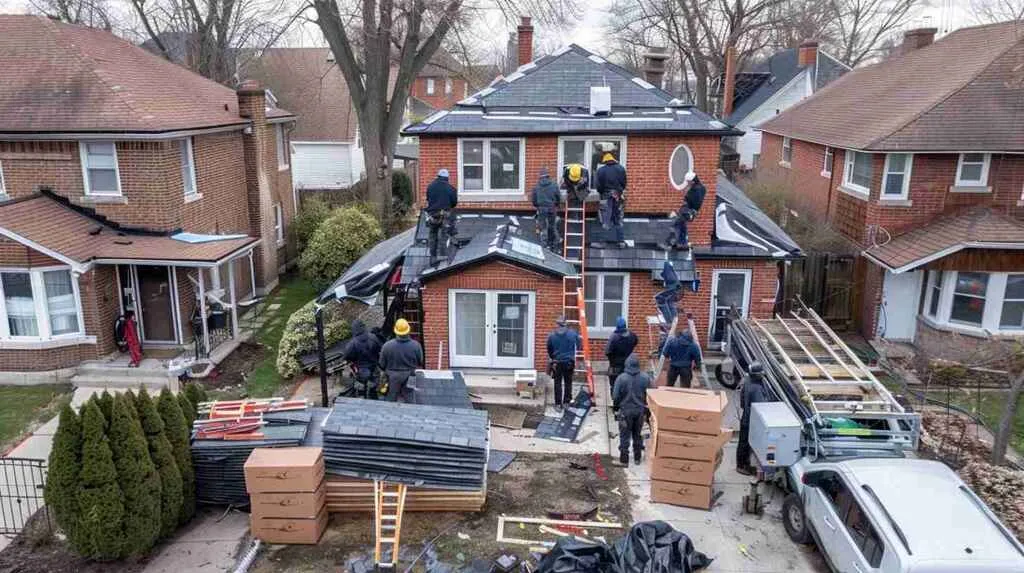
Manufactured Home Shingle Roof Repair Queens NY – Specialists | Free Quotes
Blueprint: a realistic manufactured home shingle roof repair in Queens runs between $650 and $1,200 for a small localized patch job, and between $1,200 and $2,400 when you’re dealing with a full section that needs proper flashing, decking reinforcement, and careful nailing on that flexible structure. Here’s the thing-when someone quotes you half that number, they’re usually skipping the quiet, hidden work that actually keeps water out: the underlayment refresh, the ice-and-water shield at vents, the extra attention to how these homes flex and vibrate under wind like a cheap recording mix that hides problems instead of fixing them.
Real Queens Pricing for Manufactured Home Shingle Roof Repair
I’ve been pricing these jobs honestly for 19 years across Howard Beach, Jamaica, Queens Village, and South Ozone Park, and what I see again and again is people comparing quotes like they’re shopping for the same product-but on manufactured homes, the rock-bottom number almost always means shortcuts. These roofs flex. They vibrate. The decking isn’t as thick as a site-built home, and if someone nails shingles too high or skips proper flashing around vents and edges where the structure moves most, you’ll hear it whistle in the next storm, and you’ll see water dripping through your kitchen ceiling before winter’s over. When a repair is done right, the whole roof comes back in tune-quiet, dry, and safe.
On a 14×70 manufactured home in South Ozone Park last summer, I saw a cost-conscious owner wrestle with two quotes: one at $1,350 for full flashing work and proper decking repairs, and another at $675 that promised “same-day shingle patch.” She chose the first, and I took before-and-after photos from the same exact spot on her driveway showing how we rebuilt the section where her old metal roof had been pushing water sideways under three-tab shingles. Six months later, through a rough February with bay winds and sleet, her living room stayed bone-dry and whisper-quiet, and she told me it was the best money she’d ever spent because she could finally sleep through a storm without listening for that slow drip rhythm.
Typical Manufactured Home Shingle Roof Repair Costs in Queens, NY
| Scenario | Description | Estimated Price Range (Queens, NY) | Typical Turnaround |
|---|---|---|---|
| Small Localized Patch | Minor shingle replacement, few tabs missing, no decking issues | $650 – $950 | Same or next day |
| Vent/Flashing Repair | Re-flashing vent stack or chimney with ice-and-water shield, shingle replacement around penetration | $900 – $1,350 | 1-2 days |
| Section Rebuild (Decking + Shingles) | Soft or damaged decking, tear-off, reinforcement, new underlayment and architectural shingles | $1,200 – $2,400 | 2-4 days |
| Ridge/Hip Repair | Ridge cap replacement, wind-uplift correction, sealing along the peak where flex is highest | $850 – $1,500 | 1-2 days |
| Skylight/Edge Full Rebuild | Complete skylight curb rebuild, custom flashing, edge drip correction on wind-facing side | $1,400 – $2,600 | 3-5 days |
All prices reflect Queens labor and material costs for manufactured homes with lighter framing and flexible structures, not site-built houses.
⚠
Dangers of the Cheapest Quote on Manufactured Home Shingle Roofs
- Skipping underlayment or ice-and-water shield – these homes flex, and without proper moisture barrier under the shingles, water finds a path through nail holes and gaps within a single storm.
- Nailing shingles too high on flexible decking – when the roof moves under wind or traffic vibration, high nails tear through shingles instead of holding them, creating a “flapping” sound and instant leak points.
- Ignoring original metal roof layers – most manufactured homes had metal roofs first; if the shingles are laid over them without flashing the seams or vents properly, moisture gets trapped between layers and runs sideways for feet before appearing inside.
- Not addressing vents, edges, and penetrations where homes flex most – the ridge, eaves, and vent stacks take the most movement; if flashing and sealant aren’t rated for that constant micro-shifting, you’ll hear wind whistle and see drips within weeks.
How Manufactured Home Roofs in Queens Flex, Leak, and Fail
I still remember the first time I stepped onto a manufactured home roof and felt it flex under my boots like a stage floor-not unsafe, but alive, responding to every step, every gust off Jamaica Bay, every truck rumbling past on Rockaway Boulevard. These roofs behave completely differently than site-built homes. The framing is lighter, the trusses are spaced wider, and the whole structure vibrates under wind coming off the bay in Howard Beach or those sudden gusts near JFK when planes bank low over residential streets. That movement matters for shingle nail patterns, for how you lay flashing, and for why a “good enough” job on a regular house becomes a whistling, leaking mess on a manufactured home within a single winter.
Now, here’s the part most people don’t realize-and this is where my old sound engineer brain kicks in. Blunt truth: most leaks on manufactured home shingle roofs in Queens don’t start where the stain shows up-they start ten, sometimes twenty, feet away. Water hits a bad vent flashing or a lifted shingle edge on the windward side, travels under the old metal roof or along the underlayment seam like a rhythm section carrying sound across a stage, and then drops through a nail hole or seam joint near a light fixture in your hallway. I’ve traced drips from dining room ceilings back to ridge vents facing the Rockaways, following the moisture path like I used to track feedback loops in a mix, finding where the “bad bass line” of wind uplift and hidden gaps was pushing water sideways before gravity finally pulled it down into your insulation.
Common Myths About Manufactured Home Shingle Roofs in Queens
| Myth | Fact |
|---|---|
| “Any roofer can fix a manufactured home-it’s just shingles.” | These roofs flex and vibrate under wind off Jamaica Bay and traffic rumble. If you don’t adjust nail placement, flashing, and underlayment for that movement, the repair fails within months. |
| “If the leak only happens in certain storms, it’s not urgent.” | Wind direction in Queens changes where water enters-a leak that shows up only when the wind blows from the bay means water is already running under layers; it just hasn’t found the shortest path to your ceiling yet. |
| “You can just patch the spot where the stain appeared.” | On manufactured homes, the entry point is often ten to twenty feet upslope or upwind from where the drip shows up. Patching the stain area without tracing the path wastes money and sets you up for repeat failures. |
| “Older manufactured home parks mean the roofs aren’t worth fixing.” | Many of these homes are structurally sound for decades-proper shingle roof repairs extend their life, protect equity, and keep insurance valid. Ignoring a small leak turns a $1,200 fix into a $5,000+ interior rebuild. |
| “Metal roofs under shingles don’t affect repairs.” | Original metal roofs create hidden water channels and trap moisture between layers. If you don’t address seams, vents, and edges where metal meets shingle, you’re setting up a long-term leak path that’s hard to trace later. |
What a Proper Shingle Roof Repair Looks Like on a Manufactured Home
Here’s my honest take: if your manufactured home roof in Queens is already leaking, you’re not in “wait and see” territory-you’re in “fix it before it spreads” territory. Water doesn’t negotiate. It doesn’t slow down for good intentions. Once it’s found a path through your shingles, underlayment, and decking, it’s going to keep following that path every single storm until you stop it at the source. A correct repair on these homes isn’t just slapping new shingles over the stain-it’s finding the real entry point, checking for multiple roof layers (most have old metal under the shingles), reinforcing decking at soft spots where moisture has been sitting, and tuning the shingle layout to the home’s flex points so the roof can breathe and move without tearing itself apart. Think of it like bringing a drum kit back in tune after someone over-tightened the heads and cracked the shell-you can’t just replace one drumhead and call it fixed; you’ve got to address the whole setup so the bad bass line of wind uplift and hidden leaks goes away for good.
If you think about your roof like a drumhead stretched tight over a frame, the seams, vents, and edges are the spots where the sound-and the water-tries to escape. On manufactured homes in Queens, those priority zones are the ridge line, the eaves facing prevailing winds from the bay or open lots, vent stacks, skylights, and any place where an addition or awning was attached years ago and someone cut corners on flashing. I rebuilt a skylight area in Queens Village last spring where the previous repair guy had clearly tried to save material by cutting corners-literally-around the curb, leaving mismatched, oddly spaced shingles that curled up and funneled water right under the flashing within the first strong rain. We tore it all out, re-flashed the skylight properly, and laid architectural shingles in a pattern that matched the roof’s natural flex rhythm. When I sat with the homeowner at her kitchen table afterward, showing her before-and-after photos on my tablet, I explained how every cut had to line up like notes on a staff-otherwise the water would go off-beat and end up in her hallway again, which is exactly what had been happening for two winters straight.
Shingle Masters’ Manufactured Home Shingle Roof Repair Process in Queens
You call or text with photos of the stain inside and the roof outside. We discuss when it leaks, which direction the wind was blowing, and any sounds you’ve heard-flapping, whistling, ticking during storms.
I walk the roof, note flex zones, check decking for soft spots, photograph the shingle condition, and trace likely water entry points based on wind direction and stain location inside.
Using moisture meters and visual inspection, I trace the water path backward from the stain to the real entry point, checking for old metal roofs, failed underlayment, and hidden seams where water travels sideways.
We remove only the damaged section, inspect and reinforce any soft or water-damaged decking, and prepare a clean, dry surface for proper underlayment and flashing installation.
Ice-and-water shield at critical zones (vents, edges, valleys), proper drip edge, and flashing that accommodates the home’s flex. Architectural shingles installed with nail patterns adjusted for movement and wind uplift.
I take after photos from the same exact spots as the before shots, so you can see the difference. We walk through what was fixed, why it failed originally, and what to watch for going forward.
Why Queens Homeowners Hire Shingle Masters for Manufactured Homes
Full liability and workers’ comp coverage, with all permits pulled and inspections coordinated when required in Queens.
I’ve been the “manufactured home whisperer” across Queens for nearly two decades, understanding how these lighter structures flex and require different techniques than site-built homes.
When water is dripping through a light fixture or pooling near electrical, I prioritize emergency calls and typically arrive same-day or next-day, even evenings and weekends.
Howard Beach, Jamaica, Queens Village, South Ozone Park, Far Rockaway, Richmond Hill, and every manufactured home park and residential street in between.
Spotting Trouble Early: Leaks, Stains, and Wind ‘Noise’ on Your Roof
When I walk into a manufactured home and sit at the kitchen table, my first question is always: “Where did you see the very first stain or drip?” Because that tiny ceiling spot, that little bubble in the paint, that faint ticking sound during a rainstorm-those are like the first off-beat notes in a song that warn you a roof section is failing before the whole arrangement falls apart. Most people wait until water is actively dripping onto their dining table or soaking into a bedroom closet, but by then the moisture has been traveling for weeks, sometimes months, through insulation and along joists. I handled a January emergency in Jamaica where a family noticed water through a light fixture over their table around 9 p.m., sleet coming down sideways. When I climbed up there with a headlamp in the freezing wind, I found the old shingle roof had been layered over the original metal roof with no proper flashing at the vent stack, and the water was making a two-layer maze before it showed up at that light-starting nearly fifteen feet upslope where the vent collar had rusted through.
Now, here’s the part most people don’t realize: wind direction off Jamaica Bay or over those wide open lots near JFK can completely change where leaks show up in your home. A roof that stays dry when the wind blows from the north might pour water into your hallway when a storm comes from the southwest, because the entry point is on a specific edge or vent facing that direction. I encourage people to notice patterns-which wall gets the stain, which kind of storm causes it, what sounds you hear before or during the leak. Listen for tapping, whistling, or flapping on the windward side during the next big blow. That “sound map” helps me trace leaks faster than any moisture meter, because I can hear where the roof is trying to tell you it’s out of tune, where the rhythm of wind and water is finding a gap it shouldn’t.
What to Note Before Calling About a Manufactured Home Roof Leak
- Where the first stain appeared – room, ceiling or wall, distance from nearest vent or roof edge.
- Which storms cause it – every rain, only heavy wind, only when wind blows from a certain direction (bay, north, etc.).
- Any noises from the roof – flapping, whistling, tapping, or ticking sounds, especially during high winds or gusts.
- Photos of inside and outside – stain close-up, overall ceiling shot, exterior roof photo showing the area above the stain if possible.
- Age of the shingle layer – when the shingles were installed, and if you know whether they went over an old metal roof.
- Whether there’s an older metal roof under the shingles – many manufactured homes have original metal that was covered; if you’re not sure, mention it.
- Park or street access details for Queens – narrow driveways, tree coverage, parking restrictions, or if the home is in a gated manufactured home park with entrance procedures.
$300 today can save you $3,000 later when water reaches your walls and subfloor. Once moisture gets into the interior structure of a manufactured home, repair costs multiply fast-drywall, insulation, flooring, and electrical all come into play.
Queens-Focused Answers: Manufactured Home Shingle Roof FAQs
These are questions I hear constantly from manufactured home owners across Howard Beach, Jamaica, Queens Village, South Ozone Park, and every park and street in between. The answers reflect real jobs I’ve done bringing noisy, leaky roofs back into tune.
Can you shingle over an old metal roof on a manufactured home?
Technically yes, and it’s been done on thousands of manufactured homes in Queens-but only if the metal is still flat, rust-free, and properly prepped with underlayment and ice-and-water shield at every seam, vent, and edge. If the metal has rust bubbles, loose panels, or failed flashing, you’re setting up hidden moisture traps that will leak within a year. I typically recommend a targeted tear-off at problem zones (vents, skylights, edges) and then shingling over the rest if the metal is sound, because full metal removal on these homes can get expensive and isn’t always necessary if you address the weak points correctly.
How long should a proper shingle roof repair last in Queens weather?
A correctly done repair using architectural shingles, proper flashing, and underlayment rated for freeze-thaw cycles and wind uplift should last 12-20 years on a manufactured home in Queens, depending on sun exposure, tree coverage, and how hard the bay winds hit your particular street. The key is addressing the flex and movement of the home during installation-if nails are placed correctly and the flashing is sealed for micro-shifting, the repair will outlast shortcuts by a decade or more.
Is a small leak near a light fixture an emergency?
Yes. Water and electricity don’t mix, and moisture near a light fixture means water is already pooling above the ceiling, which can short circuits, damage wiring, or create shock hazards. I prioritize these calls and typically arrive same-day or next-day to at minimum stop the active drip with a temporary patch, then schedule the full repair within days. Don’t wait on this one-turn off the light, put a bucket under it, and call immediately.
How fast can Shingle Masters come out for an active leak?
For active leaks-water dripping, ceiling sagging, or moisture near electrical-I aim for same-day response if you call before 2 p.m., or first thing the next morning if it’s later in the day or evening. I keep emergency supplies in the truck (tarps, ice-and-water shield, sealants) specifically for manufactured homes, so I can usually stop the immediate problem within hours and then schedule the proper repair within a few days once the weather clears or the roof dries enough to work safely.
Are partial repairs okay on older manufactured homes, or do I need a full roof?
Partial repairs are absolutely viable if the rest of the roof is still structurally sound and the shingles have life left. I’ve done hundreds of targeted section rebuilds-just the problem area, vent zone, or wind-facing edge-on homes from the 1980s and 1990s that are still solid underneath. The key is honest assessment: if more than 40% of the roof is failing, or if the decking is soft in multiple spots, a full re-roof starts to make more financial sense. But if it’s one leak area, one bad flashing, or one section where a previous repair failed, fixing just that zone and doing it right can buy you another 10-15 years without the cost of a complete tear-off.
Ongoing Care for Manufactured Home Shingle Roofs in Queens
| Timeframe | Task | Why It Matters for Manufactured Homes |
|---|---|---|
| Twice yearly (spring/fall) | Visual check from ground or ladder-look for lifted shingles, granule loss, flashing gaps, debris buildup in valleys | These homes flex and vibrate, so shingles can work loose faster than on site-built homes; catching a few lifted tabs early prevents full section failures. |
| After major wind events | Walk around home, check for missing shingles, listen for new whistling or flapping sounds, inspect inside ceilings for fresh stains | Bay winds and gusts off open Queens lots can rip tabs or lift ridge caps; post-storm checks help you catch damage before the next rain turns it into a leak. |
| Every 5-7 years | Re-seal critical flashings-vents, skylights, chimney bases, edges where wind hits hardest | Sealants break down under Queens freeze-thaw cycles and UV exposure; refreshing them prevents moisture from sneaking under flashing and traveling along hidden seams. |
| Every 3 years | Full professional roof tune-up/inspection-walk the entire roof, check decking flex, assess shingle condition, photograph problem zones | Manufactured homes age differently than site-built; a trained eye can spot soft decking, hidden moisture paths, and early flashing failures before they become expensive interior repairs. |
Shingle Masters focuses specifically on getting manufactured home shingle roofs in Queens back in tune-quiet, dry, and safe, with repairs that respect how these structures flex, vibrate, and live under bay winds and urban weather. If you’ve got a leak, a stain, or a roof that’s making sounds it shouldn’t, call for a free quote. A few photos and a quick conversation about your roof’s “rhythm”-when it leaks, which way the wind was blowing, what sounds you’re hearing-can usually get you a clear repair plan and timeline within 24 hours.