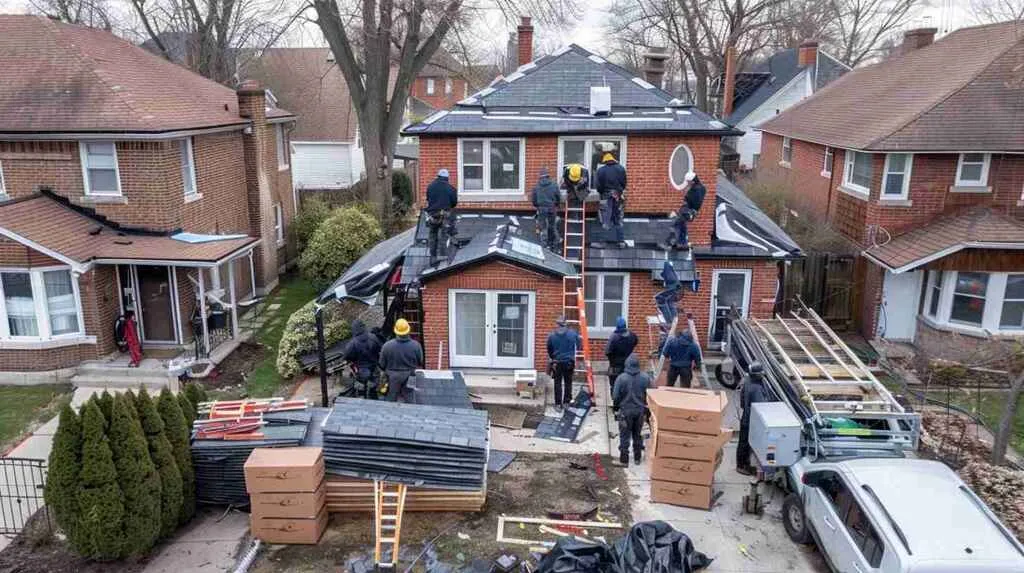
Get Shingle Bundles Up on a Roof Queens NY – Safe Staging | Free Estimates
Stacked pallets in your driveway look organized until you realize every single bundle has to travel from that concrete up to your ridge, and the way that happens-one stupid shortcut or one smart staged move-decides whether you’re nailing shingles next week or explaining ceiling cracks to an insurance adjuster. On a typical Queens driveway at 7 a.m., the first thing I’m looking at is where the weight is going to sit before it ever touches your roof. I’m thinking about the path that bundle takes: driveway to ladder base, up each rung, over the edge, across whatever decking is under your feet, and finally down through rafters into walls. Break that path anywhere-overload a soft spot, skip a safety step, stack too many bundles in one place-and the whole job turns into a repair project before you’ve installed a single row.
The core idea isn’t complicated: treat your roof like a bookshelf, not a loading dock. You wouldn’t stack fifty heavy books on one inch of shelf and expect the wood to hold, so don’t dump an entire pallet’s worth of shingles on eight feet of 30-year-old garage framing and hope for the best. One August afternoon in Jamaica, 94 degrees and the humidity like soup, I watched a delivery driver try to boom three full pallets of shingles onto a 20-year-old garage roof because “it’ll save trips.” I stopped him mid-lift, made him set them down in the driveway, and we hand-staged 6 bundles at a time instead. Halfway through the job I noticed the garage rafters had hairline cracks-if we’d put that full load up there, that roof would’ve bowed or worse. The homeowner only understood when I pulled a bundle halfway off the edge and showed him how little margin he had between “fine” and “sagging.” That’s the blunt truth about moving shingles: the idea of saving trips is false economy if the trip you’re actually saving is the one to the emergency room or the structural engineer.
Stacked Loads, Not Hero Lifts: The Safest Way to Get Shingles Up on a Roof in Queens
Most guys who’ve never staged materials for a living think the challenge is strength-can I carry this 80-pound bundle up the ladder without my arms giving out? Wrong question. The real question is: when you’re standing on that fourth rung with all that weight pulling your center of gravity backward, what happens if your boot slips or a gust hits you from the side? In Queens, where houses sit close, wind funnels down alleys in weird ways, and a wet morning after rain can leave north-facing sections slick until noon. Typical rowhouses and small colonials around here weren’t built with modern trusses; a lot of them have rafters that were sized for snow and the original roofing, not an extra few hundred pounds of staged bundles sitting in one spot for days. The safest sequence isn’t about being tough-it’s about controlling where the weight sits at every single moment from the time the truck leaves until the last shingle is nailed down.
When Shingle Masters shows up to a Queens job, we’re not racing to get bundles onto the roof. We’re setting up the ground first: marking flat zones on the driveway or yard, splitting delivery stacks into smaller piles of four to six bundles max, and making sure the ladder angle is locked at 4-to-1 before anyone climbs. Then it’s one bundle per trip, period. No exceptions, no shortcuts. Once bundles reach the roof edge, we slide them up to pre-marked zones-never more than three bundles stacked in one spot-and we spread those zones along the ridge so the load distributes across multiple rafters instead of hammering one section. Think of your roof as a long dinner table: you wouldn’t pile all the dishes on one corner and expect the legs to hold. Same principle. After the first row of bundles is up, I walk through the house and look at ceiling lines, door frames, anything that might show stress, because a roof will tell you it’s overloaded if you’re paying attention. And if you see new cracks or a door suddenly sticking, you stop adding weight and redistribute what’s already up there.
5-Step Safe Sequence: Driveway to Roof Without Overloading
Pick flat spots on your driveway or yard close to the ladder base, clear of cars, doors, and foot traffic. These are your mini-staging areas where you’ll break down the main delivery stack.
Take the full delivery and divide it into smaller groups of 4-6 bundles per ground zone. This keeps you from carrying bundles across the yard fifty times and limits how much weight sits in any one roof spot later.
Ladder feet one foot out for every four feet up. Secure the top so it can’t shift. Hard rule: one bundle per climb, held close to your body, with three points of contact whenever possible.
Don’t throw and don’t stack at the edge. Hand each bundle over the gutter line and slide it up to a pre-marked zone on the deck. Never stack more than 3 bundles per spot-spread them along the ridge.
After the first row of bundles is staged, go inside and look for new cracks in ceilings, doors going out of square, or any visible sag. If you see stress, redistribute the bundles before adding more weight.
Don’t Turn Your Roof Into a Shingle Pallet
- Never let a boom truck set full pallets on a 15-30-year-old garage or porch roof. Those structures weren’t designed to hold concentrated loads, and by the time you see visible sag, the damage is already done.
- Avoid stacking more than 3 bundles in one spot on older framing. Spread them along the ridge instead so the weight distributes across multiple rafters, not one overloaded section.
- Stop immediately if you see new ceiling cracks, doors going out of square, or any visible roof sag. These are your early warnings that the structure is stressed-redistribute or remove bundles before you continue.
- If you’re unsure what your roof can handle, call Shingle Masters for a free on-site staging plan before the delivery arrives. We’ll walk the attic, check the framing, and mark out exactly where and how many bundles can safely sit.
Ladders, Jacks, and Slick Decks: Controlling the Weight Path Under Your Feet
I don’t care how strong someone thinks they are-if they’re fireman-carrying 80-pound bundles up a ladder, they’re one bad step away from a hospital visit. One November morning in Astoria, it had just rained and then dropped to 34 degrees, which is the perfect recipe for invisible slick spots. A helper tried to “save time” by tossing bundles up and having another guy catch and drag them-old-school style. I shut that down, had everyone come down, and we reset with roof jacks, toe boards, and a short ladder to bridge the pitch. On the second trip up, we found a soft spot in the decking exactly where that catching guy would’ve been standing; if he’d taken that load there the first time, I’m sure his foot would’ve punched right through. The real danger isn’t just the ladder-it’s what happens after you’re on the roof. Queens weather means shaded north sides stay damp longer, morning frost lingers in tight alleys between attached homes, and a roof pitch that looks mild from the street feels a lot steeper when you’re standing on it with a bundle in your arms.
Here’s the part most people miss: when you’re standing on a roof to catch or drag a bundle, your weight plus the bundle weight plus any soft decking under your boots all stack together in that one spot. If you’re on questionable framing or patched plywood, that’s the moment things go wrong. The tossing method-where one guy throws bundles up and another catches them at the edge-puts all that combined load exactly where the deck is weakest, right at the overhang. We don’t do that anymore, ever. Instead, Shingle Masters uses short extension ladders and roof jacks to move the weight path away from edges and onto stronger sections of the deck, usually closer to the ridge where rafters are better supported. On typical Queens rowhouse roofs-4/12 to 6/12 pitch, often with shared side walls and parapet weight-we’ll set jacks and toe boards before we stage more than a couple of bundles, because the pitch combined with the older framing means there’s not much room for error. Every time you move, you’re asking that deck to hold you, the shingles, and the momentum of both. Control that path, or it controls you.
Safe vs Unsafe: How Bundles Should (and Shouldn’t) Move Up to Your Roof
One bundle at a time, carried close to the body with three ladder contact points whenever possible-two feet and one hand, or two hands and one foot if you’re using a hoist strap.
Using a ladder hoist or power lift when available to keep hands free and movements smooth, especially on steeper pitches or longer carries.
Installing roof jacks and toe boards before staging more than a couple of bundles on any slope steeper than 4/12-they give you safe footing and a physical barrier against sliding.
Throwing bundles up and having someone catch them on the roof edge-this puts all the weight exactly where the deck is weakest and the catcher has the least stable footing.
Climbing with two bundles or carrying them on your shoulder on a wet or frosty morning-your center of gravity shifts backward and one slip ends badly.
Stacking bundles on visibly soft, spongy, or patched sections of decking-if it feels weak under your weight alone, it’s definitely not safe under three stacked bundles.
| Roof Type | Typical Pitch | Max Bundles Per 8 ft Section | Notes on Load Path |
|---|---|---|---|
| Old 1-story garage (20-30+ years) | 3/12-4/12 | 4-6 bundles | Keep bundles near outside walls, not mid-span; check rafters for cracks from inside if possible. |
| Attached brick rowhouse main roof | 4/12-6/12 | 6-8 bundles | Stage along ridge, split into 2-3 piles; avoid stacking near parapet walls that already carry masonry weight. |
| Cape or small colonial with dormer | 5/12-7/12 | 6 bundles | Distribute equally on both sides of ridge; don’t dump all bundles on the dormer side. |
| 2-story detached with newer trusses | 4/12-6/12 | 8-10 bundles | Even with stronger trusses, keep stacks low and spread-treat the roof like a long bookshelf, not a single post. |
Small Piles, Big Difference: How We Stage Shingles Without Stressing Your Structure
There’s a job in Woodhaven burned into my brain where the only thing that saved a guy was the fact we’d limited bundle count per section of roof. I’ll never forget a small job in Flushing for an older couple who only needed half their roof done because of a leak around the valley. It was late afternoon, sun going down behind the houses, and the husband insisted we stack all the bundles on the “good” half that wasn’t being replaced, “to keep the other side free.” I took a long piece of chalk, sketched out across their driveway where the rafters probably ran based on the house age and style, and showed them how that one side was already carrying more weight because of a dormer. We ended up staging three small piles spaced along the ridge instead of one big mound, and when we opened the deck we found old, undersized rafters right under where he’d wanted the whole stack. That’s the reality of older Queens homes: what you see from the driveway doesn’t tell you what’s hidden under the shingles, and a roof that looks solid can be held together by hope and thirty-year-old nails.
If you can’t point to where the weight goes next, you have no business adding another bundle.
Shingle Masters plans every job now with three or more small piles across the ridge rather than one big mound, because that’s what protects old framing. Think of your roof as a bookshelf again: if you stack all the heavy books on one end, that bracket bends and eventually pulls out of the wall. Spread the same books evenly and the shelf holds fine. Same principle with rafters. When I walk a job, I literally draw load paths for homeowners-here’s where a bundle sits, here’s the rafter under it, here’s the wall that rafter bears on, and here’s what happens if you add five more bundles in that same spot. Most people get it once they see the diagram. The weight doesn’t magically disappear into the attic; it travels down through wood that might be cracked, undersized, or already carrying dormer and chimney loads you can’t see from outside.
| Myth | Fact |
|---|---|
| “If the roof isn’t visibly sagging, it can hold any bundle stack.” | Sag shows up late-by the time you see it, the framing is already stressed. |
| “Putting all the bundles on the ‘good’ side protects the bad side.” | You might be overloading the side that’s already carrying dormers, chimneys, or extra framing quirks. |
| “More bundles on the roof before starting means the job goes faster.” | Past a small, staged amount, extra bundles just add walking and tripping hazards. |
| “Delivery drivers know exactly how your roof is built.” | They know how to operate booms, not how your 1950s rafters were sized or modified over the years. |
Should You DIY Shingle Staging or Call a Queens Roofing Crew?
Here’s the blunt truth: most problems with getting shingles onto a roof come from impatience, not from lack of tools. A careful homeowner who follows strict limits-one bundle per climb, maximum three bundles per roof section, checking inside for stress after the first row-can absolutely stage materials safely on a low-slope, single-story roof with good access. But the moment you’re not sure about your attic framing, you see soft spots you can’t explain, or the ladder setup makes you nervous because of tight side yards or overhead wires, it’s time to bring in someone who thinks like a stagehand: always asking where the weight goes next, never assuming the structure can handle it just because it looks fine from below.
| Pros of DIY Shingle Staging | Cons of DIY Shingle Staging |
|---|---|
|
|
🚨 Call Now (Urgent)
- You see previous sag or patchwork in the garage or porch roof where shingles will be staged
- Roof pitch is steeper than 5/12 or access is over a narrow side yard or alley
- You’re in a tight Queens block with cars, power lines, or sidewalks directly under the ladder setup
- Recent storms or leaks make you suspect soft decking but you’re not sure where
✓ Can Wait or DIY Carefully
- Single-story, low-slope roof with easy, clear ladder access
- You’re only moving a few bundles for a small repair
- You can inspect from the attic and see strong, uncracked rafters
- You strictly limit bundles per section following the guidelines above
Quick Queens Checklist Before You Lift a Single Bundle
If you’ve ever stacked books on a bending shelf, that’s exactly how I want you to think about your roof when you start talking about shingle bundles. The shelf doesn’t fail because of one book-it fails because you kept adding weight without noticing the bend starting. Queens roofs add extra layers to that thinking: narrow driveways where the ladder base sits two feet from a parked car, attached homes where your staging affects the shared wall’s load, and older framing that was built before modern snow-load codes. A pre-lift checklist keeps that shelf from bending.
✓ Before You Move or Schedule Shingle Bundles in Queens, NY
Common Questions About Getting Shingles Onto a Roof in Queens
How many shingle bundles can my Queens roof safely hold?
There’s no single number that works for every house-it depends on framing age, rafter span, roof type, and what else is already up there (chimneys, dormers, HVAC units). Use the table above as a starting guide, but if your house was built before 1970, has visible patching, or you’re not sure what’s in the attic, call Shingle Masters for a free on-site estimate. We’ll walk the attic, check the framing, and give you precise staging limits based on what’s actually holding your roof up.
Is it okay to leave bundles on the roof overnight?
Yes, as long as they’re staged within safe limits and the weather is dry with no extreme wind forecast. Keep bundles low on the deck and away from edges. If rain, snow, or high wind is expected, either cover the bundles with tarps weighted down or move them back to the ground. Wet bundles are heavier and slicker, and wind can shift even a well-placed stack.
Can delivery drivers place bundles exactly where I want them?
Often yes, within the limits of what their boom truck can safely reach. But you need to direct them based on a pre-made staging plan, not just convenience. If your roof is old, narrow, or has questionable decking, don’t let them set full pallets anywhere-have them place smaller stacks on the ground and you control the move to the roof in smaller, safer loads.
Do I need a permit just to move shingles onto my roof?
Typically not for staging alone, but full roof replacements may require permits or DOB notifications depending on your Queens neighborhood and the scope of work. If you’re hiring a contractor, they should handle permit guidance. Shingle Masters includes all necessary permit coordination in our full roofing jobs, so you don’t have to chase paperwork.
Why Queens Homeowners Trust Shingle Masters
Licensed and insured in New York for residential roofing-you’re covered if anything goes wrong
17+ years hands-on shingle work across Queens neighborhoods, from Jamaica to Astoria to Flushing
Same-day or next-day free estimates on staging plans and full roof replacements
Jobsite setups planned like a theater stage-load paths, safety lines, and neighbor protection thought through before the first bundle moves
When I walk a customer around their house, I’ll usually ask, “If this roof were a dinner table, where do you think you could put the turkey without it tipping?” Most people laugh, then they get it. Your roof is a table held up by legs-some strong, some not-and every bundle you add is another dish on that table. In Queens, where roofs carry decades of patches, modifications, and weather cycles, treating that table with respect isn’t just good practice-it’s the difference between a smooth job and a structural repair bill. Shingle Masters plans every shingle move like stage rigging: we know where the weight goes, how much the structure can handle, and exactly when to stop adding more. If you’re staring at a driveway full of bundles and wondering how they get up there without breaking something, call us for a free estimate and a custom staging plan. We’ll walk the attic, mark the safe zones, and make sure your roof stays a table, not a broken shelf.