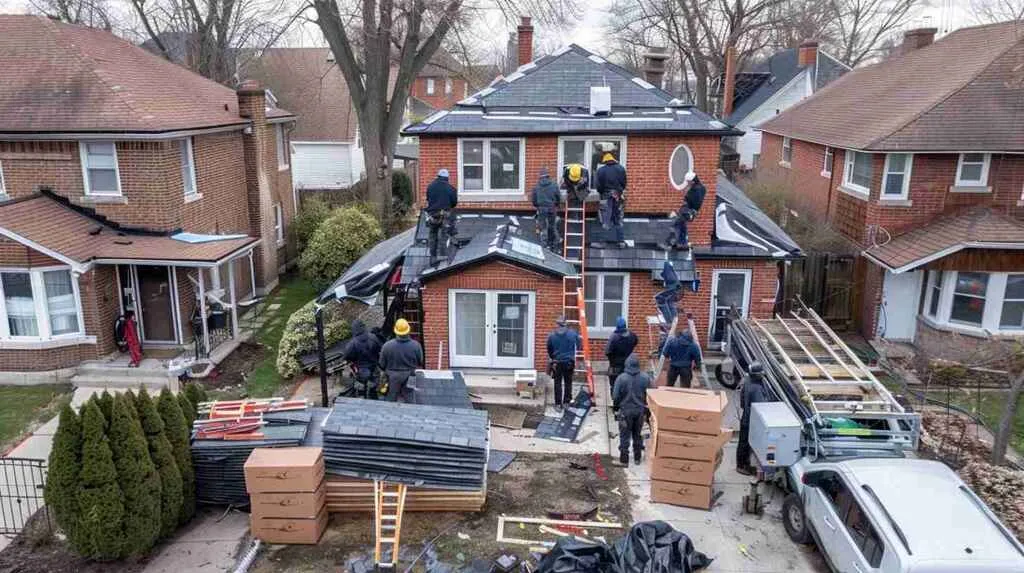
Geodesic Dome Shingle Roof Queens NY – Unusual Job Explained | Free Quotes
Sideways rain hits a dome from every angle at once, and if you’ve done it right – overbuilt the intersections, staggered the seams, treated it like a specialized system instead of a normal roof – water just slides off like it’s auditioning for a water park. But the second a contractor treats your geodesic dome shingle roof in Queens like it’s a flat walk-up or a basic gable, you’re looking at leaks by year two, not year twenty, because the geometry doesn’t forgive lazy roofing.
Think of a dome as a stage in the round: rain, wind, sun, and humidity are the audience, sitting all the way around you 360 degrees, and your job is to block the scene so that audience never, ever gets backstage into your living room. Most shingle habits that work fine on a straight roof – running seams in neat rows, trusting gravity alone, skipping extra membrane at joints – turn into disaster patterns on a dome where three or more planes meet and water finds clever detours you didn’t plan for.
Why a Geodesic Dome Shingle Roof in Queens Is Tougher-Or Leakier-Than a Normal Roof
On the corner of 108th Street last winter, I was standing under a dome that proved one thing clearly: geometry doesn’t forgive lazy roofing. The owner had hired a crew who knew pitched roofs but didn’t understand that a dome is basically dozens of tiny roofs all trying to hand off water to each other, and if one seam is misaligned or one underlayment triangle is skipped, water finds that gap like it has GPS. I traced three separate leak paths that all started at triangle intersections where the crew had run shingles in straight, parallel lines instead of staggering them – it looked tidy from the ground, but up close it was a zipper waiting to open. A dome can actually shed water faster and more completely than a flat Queens roof because gravity pulls from so many angles at once, but only if you treat every intersection as its own mini-roof with its own flashing, its own overlaps, and its own margin for error.
Let me be blunt: a geodesic dome shingle roof is either overbuilt on purpose, or it’s underperforming the first time Queens wind slaps it sideways. I’ve been doing this for 19 years, all of them in Queens, and I can tell you that a roofer who only knows flat roofs or basic gables will miss the critical details – the way shingles need to flex and conform when warmed, the importance of cutting and layering underlayment in overlapping triangles, the fact that wind-driven rain in Bayside or Flushing doesn’t care about your perfect CAD drawings if the real-world install skips the membrane at the hardest joints. Around here, people call me “the weird roof lady” because I take jobs other contractors politely decline, and domes are exactly that kind of job: they demand more planning, more patience, and more respect for how water actually behaves in three dimensions instead of two.
Common Misunderstandings About Geodesic Dome Shingle Roofs in Queens
Why Trust Carmen and Shingle Masters for Geodesic Dome Shingle Roofs in Queens, NY
-
✓
Licensed & Insured in NYC for residential and specialty roofing -
✓
19+ Years shingle roofing experience exclusively in Queens neighborhoods -
✓
Specialty: Geodesic and non-standard roof shapes other contractors avoid -
✓
Response Time: Typically within 24 hours for dome inspections in Queens
How We Actually Shingle a Geodesic Dome in Queens (Step by Step)
One February morning, just after sunrise, I was standing on a frosted geodesic dome in Bayside, holding a chalk line in one hand and a hair dryer in the other. The owner was an engineer who’d calculated every triangle on paper, but the shingles wouldn’t bend the way his equations said they would in 22-degree weather – they wanted to crack instead of flex, and the adhesive strips were basically inert in the cold. I ended up using the hair dryer to gently warm each shingle edge so we could form clean overlaps along the dome’s steepest faces without splitting them, working in small sections and checking that the sealant would actually bond once the temperature came up. That’s the reality of a Queens winter dome job: coastal wind off the bay, morning frost that doesn’t burn off until noon, and the fact that architectural shingles behave completely differently at 22 degrees than they do at 65. You can’t just follow a blueprint – you have to adapt the install to what the material is telling you in real time.
Picture a disco ball, but every mirror is a tiny roof plane trying to throw off water instead of light. That’s how I think about laying out a dome: each triangle is its own scene, and we have to choreograph how they hand off water to each other so there’s never a moment where the audience – rain, wind, driven snow – can sneak behind the curtain. I start by mapping the dome’s “blocking,” figuring out which faces get the worst wind and where water is going to try to pool or back up, then I overbuild those spots with extra underlayment and cut triangular pieces of ice-and-water shield that overlap at every joint where three or more planes meet. At vents, skylights, or any penetration, we treat that as a miniature roof of its own, flashing and sealing it like it’s the only thing that matters, because on a dome one weak point can unravel half your work when a nor’easter rolls in.
Carmen’s Geodesic Dome Shingle Roof Process in Queens
-
1
On-site Inspection & Triangle Mapping
I walk the dome (or use harness and binoculars) to map each triangle, check existing shingle layout, and mark where water is currently running. -
2
Underlayment & Ice Shield Plan
We design a layered membrane pattern that overbuilds intersections where three or more planes meet, especially on windward sides facing the East River or Jamaica Bay. -
3
Shingle Layout & Cut Strategy
I sketch how we’ll stagger seams so there’s never a straight ladder of joints up the dome, and decide where gentle heat or extra adhesive will be needed. -
4
Weather-Timed Installation
We pick a window of mild, dry weather so shingles can flex without cracking and adhesives can cure properly. -
5
Detailing Joints, Ridges, and Penetrations
Every vent, skylight, and triangle peak gets flashed and sealed like a miniature roof of its own. -
6
Final Water Path Check
Before we leave, I trace imaginary water routes across the dome, checking that every path exits cleanly at the eaves, never into your living room.
Quick Facts: Typical Queens Geodesic Dome Shingle Roof
2-4 days for a full dome re-shingle, weather permitting
3-5 roofers trained on steep and unusual roof shapes
Architectural asphalt shingles rated for high wind
Astoria, Bayside, Flushing, Jackson Heights, Forest Hills, and surrounding Queens neighborhoods
What Makes Domes in Queens Fail Early-and How We Overbuild Against It
From a roofer’s point of view, the most dangerous part of a geodesic dome isn’t the steep pitch – it’s the intersection where three or more planes meet. There was a late-summer job in Jackson Heights, an elderly couple with a tiny geodesic dome addition they used as a prayer room, and a storm rolled in at 3 p.m., faster than the radar said it would. The old shingles were half stripped, and water started sneaking in through one exposed triangle – you could see a little line of it working down the plaster like it was hunting low spots, following gravity and finding every gap in the old underlayment. I grabbed a roll of ice-and-water shield from the truck, cut triangles on the fly with a utility knife, and we created a temporary patchwork quilt over the bare panels in about 20 minutes, overlapping every edge and pressing hard to get a seal even in the humidity. The couple made me strong coffee while the rain pounded outside and kept saying, “We didn’t know a weird roof needed a weird roofer,” and honestly that’s the whole point: a dome isn’t just a novelty, it’s a structural puzzle where one missing piece turns the whole thing into a leak factory.
One sloppy seam on a dome can do more damage than ten missing shingles on a flat Queens roof.
Around year ten on these domes, I start seeing the same three failure points, like a play where the actors never hit their marks. The worst one was in Flushing – a DIY job done by someone who’d watched YouTube videos but didn’t understand that domes demand staggered seams, not neat parallel rows. It was a humid July afternoon, the kind where your shirt sticks to you by 9 a.m., and I noticed their previous installer had lined up shingle seams from one triangle to the next like a straight ladder up the dome, creating a perfect zipper path for water to follow when wind pushed it sideways. I told the owner flat-out: this is a zipper waiting to open in the first nor’easter. We re-shingled it with a staggered pattern and doubled up on ice-and-water shield at every joint, and two months later a big storm hit – he called me the next day and said the neighbors’ flat roofs were leaking, but his odd little dome stayed bone dry. That’s the insider tip I give every Queens dome owner: before nor’easter season, walk around your house and look at the windward faces, the ones that catch wind off the bay or the river, and check for lifted shingle edges, exposed nails, or those telltale seam ladders – if you see them, call before the leaks start, because catching it early is always cheaper than emergency patching in a downpour.
Critical Mistakes That Turn a Queens Geodesic Dome Into a Leak Factory
Watch for these red flags on your dome:
- Shingle seams forming straight lines from one triangle to the next instead of staggered offsets.
- No visible ice-and-water shield or membrane at triangle intersections or around skylights.
- Cracked, curled, or overly stiff shingles on the steepest faces-often from cold-weather installs.
- Flat or nearly flat “valley” spots where multiple planes meet with no extra flashing.
Costs, Red Flags, and When to Call for a Dome Roof Inspection in Queens
Around year ten on these domes, I start seeing the same three failure points, like a play where the actors never hit their marks: shingles lifting along the steepest faces where the adhesive strips have given up, sealant cracking at triangle intersections where thermal expansion works the joints loose, and minor leaks at vents or skylights that nobody noticed until the ceiling stain appeared. The good news is that catching any of these early – before water gets into the sheathing or insulation – means you’re looking at targeted repairs in the hundreds or low thousands instead of a full tear-off and re-shingle in the five figures. I’ve had Queens homeowners call me after ignoring a small damp spot for two winters, and by the time I get up there the decking is soft, the insulation is soaked, and we’re basically rebuilding a whole section of the dome instead of just patching a joint.
The question I always ask Queens homeowners with domes is simple: do you want this to be a conversation piece, or a problem you’re always talking about? If your dome is aging, showing wear, or you’re just not sure whether the previous owner’s “friend who does roofs” actually knew what he was doing, the right move is to call someone who treats geodesic roofs as a specialty, not a side job. We’ll map the triangles, check the underlayment at joints, look for seam ladders and weak flashing, and give you a written quote that explains what needs fixing now versus what can wait a season. The roof is the one part of the show where the audience – rain, wind, snow, UV – is always watching, and on a dome that audience has front-row seats from every angle, so the blocking and props better be perfect or the whole performance falls apart.
Typical Price Ranges for Geodesic Dome Shingle Work in Queens, NY
| Scenario | What’s Included | Typical Price Range* |
|---|---|---|
| Basic Dome Inspection | On-site walk-through, photo documentation, written report with repair options. | $250 – $450 |
| Targeted Leak Repair at One Intersection | Localized shingle replacement, new membrane at joint, sealant and flashing tune-up. | $650 – $1,200 |
| Half-Dome Re-Shingle | Strip old shingles, new underlayment and shingles on sun or wind-exposed half. | $4,500 – $8,000 |
| Full Dome Re-Shingle | Complete tear-off, upgraded underlayment, full re-shingle, joints and penetrations detailed. | $9,000 – $18,000 |
| Emergency Storm Tarp & Temporary Triangle Patching | Quick response, membrane triangles over exposed panels, short-term leak control. | $500 – $1,000 |
*Actual pricing depends on dome size, access, existing damage, and material choices. Free written quotes provided after inspection.
Call ASAP
-
⚠
Active dripping or staining under any dome panel. -
⚠
Missing or visibly shifted shingles after a storm. -
⚠
Soft spots, sagging areas, or rotten decking smells. -
⚠
DIY patches that aren’t holding or keep reopening.
Can Wait a Few Weeks
-
✓
Shingles look aged but no interior signs of water yet. -
✓
You’re planning solar, skylight changes, or other upgrades. -
✓
You just bought a dome and want a baseline health check. -
✓
Minor granule loss or cosmetic wear on the sunniest faces.
Common Queens Geodesic Dome Shingle Roof Questions
Can you re-shingle my dome in winter?
Yes, but I’m picky about winter work. On that February Bayside dome, we used gentle heat to keep shingles flexible and avoided days when adhesives wouldn’t cure. In deep cold or wet conditions, I’ll usually recommend temporary membrane protection and schedule permanent work for a better weather window.
Will a shingle roof ruin the look of my geodesic dome?
No-done right, shingles follow the geometry instead of fighting it. We pay attention to color, layout, and joint detailing so the roof reads as a clean, faceted surface rather than a patch job. Think of it like lighting design on a stage: the structure stays the star.
How long should a geodesic dome shingle roof last in Queens?
With quality architectural shingles and overbuilt intersections, you should expect 20-25 years, assuming normal Queens weather and basic maintenance. Around year ten, it’s smart to schedule a checkup so we can fix small issues before they become leaks.
Do you work on partial domes and dome additions?
Yes. I’ve handled tiny prayer-room domes in Jackson Heights and full live-in domes in Bayside and Flushing. Whether it’s a small addition or your whole home, we treat each curved section as its own mini-stage to control water and wind.
If your geodesic dome in Queens is leaking, aging, or just giving you that nagging feeling that the last roofer didn’t really understand what they were working on, you’re not stuck with it. Shingle Masters specializes in exactly these kinds of unusual roofs – the ones that make most contractors uncomfortable – and we’ll map your dome, explain what’s failing and why, and give you a free written quote that breaks down repair versus re-shingle costs with no pressure and no shortcuts. Call or contact us today to schedule an inspection, and let’s make sure your dome is a conversation piece for the right reasons, not a problem that keeps you up when the forecast calls for rain.