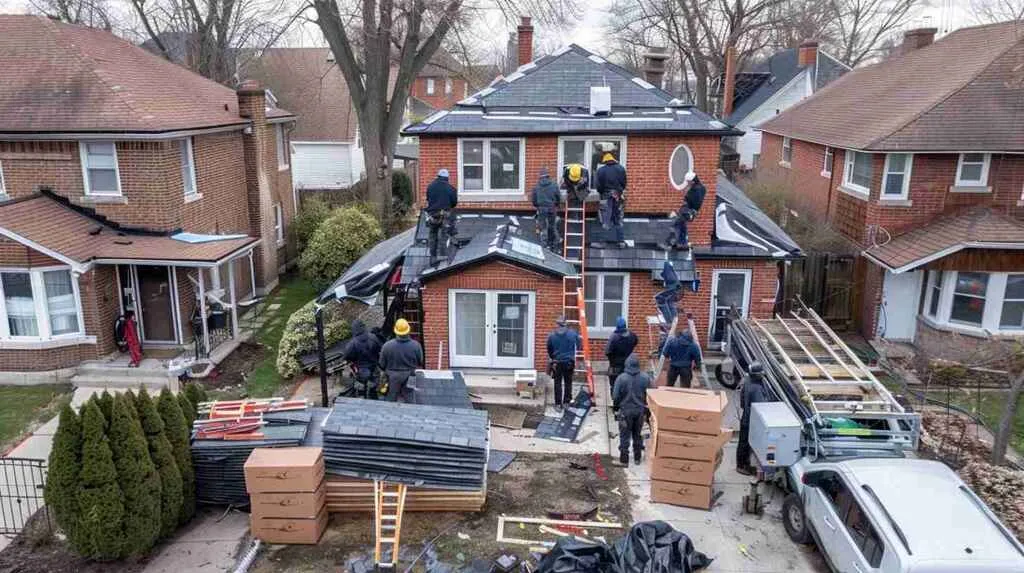
Shingle Gable Roof Queens NY – Most Common Style Done Right | Free Quotes
Sideways rain, ice dams on your eaves, and a shingle gable roof that’s leaking into your attic-that’s usually how homeowners in Queens figure out the “deal” they got wasn’t actually a deal. A proper shingle gable roof in Queens, on a typical two-story house with standard pitch, runs $8,000 to $16,000 for a full tear-off and replacement, and chasing the lowest bid is the fastest way to pay twice: once for the roof and once for the fix. I’m not saying you need to blow the budget, but your roof is your house’s winter jacket for Queens weather, and handing that job to the guy who’s 40% cheaper than everyone else is like dressing your house in a hoodie for a February storm.
Real Queens Pricing for a Shingle Gable Roof (and Why the Cheapest Bid Hurts Later)
On 43rd Avenue last winter, I watched a “budget” gable roof peel back like a sardine can in 40-mph wind because the crew used four nails per shingle instead of six, skipped the ice shield at the eaves, and ran cheap 15-pound felt over rotten deck boards they never replaced. The homeowner told me the installer charged $6,200 for the whole job and promised “the same shingles as the big guys.” Sure-same brand, wrong everything else. The shingle itself is maybe 30% of the story; the other 70% is underlayment, fastening pattern, deck condition, flashing details, and whether the crew knows how wind uplift works when a nor’easter blows parallel to your gable ridge. That avenue sits near the water, catches crosswinds hard, and needed a build spec that could handle it-not a price built to win on the phone.
Here’s the part nobody wants to hear: a beautiful shingle pattern on a gable means nothing if the underlayment, flashing, and nailing look like a toddler did them. I’ve torn off roofs in Astoria and Jamaica that looked fine from the street but had gaps at the valley liners, step flashing installed upside down at dormers, and starter courses that weren’t even starter courses-just regular shingles flipped backward. Every single one of those roofs was installed by the low bidder who promised the homeowner they’d “save thousands.” They did save thousands-on labor, materials, time, and care-and then spent it all back fixing leaks and mold damage two winters later.
A solid shingle gable roof, built to last 20-plus years in Queens conditions, costs more up front because it prevents the repairs that end up costing far more. Think of it like buying winter boots: you can grab the $40 pair that falls apart by March, or you spend $150 once and walk through slush for a decade. Your roof works the same way, and in Queens-with freeze-thaw cycles, humid summers, and wind that funnels down every block-cheap boots don’t cut it.
Typical Shingle Gable Roof Scenarios in Queens, NY
These are ballpark ranges for full replacement-labor, materials, tear-off, disposal-assuming standard architectural shingles and code-compliant ventilation. Your actual quote depends on roof pitch, access, deck condition, and how many chimneys or dormers interrupt the gable planes.
| Scenario | Roof Description | What’s Included | Estimated Price Range |
|---|---|---|---|
| Small Detached (1,000 sq ft) | Simple front/back gable, no dormers, easy truck access | Tear-off, ice & water shield, synthetic underlayment, ridge vent, drip edge, shingles | $6,800 – $9,200 |
| Two-Story Colonial (1,800 sq ft) | Cross gable with front dormer, one chimney, moderate pitch | Full tear-off, deck repairs (2-4 sheets), valley metal, chimney reflash, new vents | $11,500 – $15,800 |
| Tight-Lot Attached Row (1,400 sq ft) | Gable parallel to street, shared sidewall, rear yard access only | Tear-off, hand-carry debris, step flashing at party wall, new ridge & soffit vents | $10,200 – $13,600 |
| Large Cape with Dormers (2,400 sq ft) | Main gable plus two shed dormers, multiple valleys, steeper pitch | Full replacement, extra flashing labor at dormer cheeks, possible deck sheathing upgrade, premium ice barrier | $15,000 – $20,500 |
| Historic Detached with Complex Gables (2,000 sq ft) | Multiple intersecting gables, decorative trim, limited staging room | Careful tear-off to preserve trim, custom flashing, hand-nailing at ornamental edges, dumpster permit | $13,800 – $18,200 |
⚠️ Too-Good-To-Be-True Gable Roof Quotes in Queens
- Bids that are 25-40% below everyone else: If three contractors quote $12k-$14k and one comes in at $7,800 for the exact same roof, they’re either cutting materials, skipping permits, or planning to upsell you once they’re on the job.
- Quotes that don’t mention underlayment, ice shield, or flashing: Any estimate that only lists “shingles and labor” is hiding the fact that they’re using the cheapest felt, no waterproofing membrane, and builder-grade drip edge that’ll rust in three years.
- Installers who insist permits or ventilation “aren’t needed”: Even on a small gable roof in Queens, proper ridge and soffit ventilation prevents heat buildup and ice dams, and skipping the permit means zero accountability when something goes wrong.
Why Most Gable Roofs Leak in Queens (It’s the Shortcuts, Not the Shingles)
Let me be blunt: most gable roofs in Queens don’t leak because of old shingles; they leak because someone got cute with shortcuts. One January morning around 6:45 a.m., I was standing on a frozen driveway in Bayside with coffee in one hand and an ice scraper in the other, explaining to a retired NYPD couple why their gable roof kept dumping icicles onto their front steps. The original roofer had run the shingles dead flat over a shallow gable with barely any overhang, so meltwater had nowhere to go. I still remember the husband pointing at the sagging eave, cigarette in his mouth, and saying, “So you’re telling me they dressed this roof in a T-shirt for a snowstorm?” We rebuilt the gable edges, extended the drip line, and he calls me every winter just to say, “No more ice bullets, Cruz.” That job sits maybe three blocks from Northern Boulevard, catches wind off the water hard, and every winter the freeze-thaw cycle punishes any roof that’s built lazy-poor overhangs, thin felt, no ice barrier, flashing that’s more hope than engineering.
The three biggest failure points on Queens shingle gable roofs are the eaves and overhangs (where ice and water back up if there’s no protection), the sidewall and dormer intersections (where step flashing either exists or doesn’t), and the valleys (where two roof planes meet and water concentrates). From the sidewalk, you can spot trouble: look for shingles that curl up at the edges near the gutters, dark streaks running down from chimneys or dormer walls, or missing chunks of metal drip edge hanging loose. If you see any of that, the leak’s already started-you just don’t know it yet because it’s still running down inside the wall or pooling on top of your ceiling drywall, waiting for one more storm to break through.
Top Shortcut Mistakes on Queens Shingle Gable Roofs
Compare what you SHOULD see on a proper install versus what shortcut crews actually do. If your roof looks like the ❌ column, it’s living on borrowed time.
- ✅ Ice & water shield running two full courses up from the eaves, wrapping valleys, and protecting every penetration
- ❌ Cheap 15-pound felt slapped over bare wood with no waterproof membrane anywhere on the roof
- ✅ Metal drip edge installed under the underlayment at rakes and over it at eaves, sealed tight so water can’t wick backward
- ❌ No drip edge at all, or plastic “drip” that’s really just trim with zero function
- ✅ Step flashing woven into each shingle course where the gable meets a wall or dormer, with counter-flashing over the top
- ❌ One long piece of bent aluminum caulked to the siding and called “flashing,” guaranteed to leak within two years
| Leak Location | Typical Shortcut That Causes Leaks | How It Should Be Done on a Proper Gable Roof |
|---|---|---|
| Eaves and Overhangs | No ice barrier, felt that stops short of the gutter, shingles that overhang too far or not at all | Ice & water shield from edge up 24-36 inches past the interior warm wall, drip edge under underlayment, proper shingle overhang (⅜”-¾”) |
| Gable Sidewall / Dormer Cheeks | Caulk instead of step flashing, or step flashing installed in one continuous strip instead of individual pieces | Individual step flashing pieces woven into each shingle course, kicked out 1″, covered by siding or counter-flashing, sealed at top edge |
| Valleys (Where Two Gable Planes Meet) | Woven shingles with no valley liner, or cheap roll valley painted to match and called “finished” | Ice & water shield in valley channel, metal valley liner (or California-cut shingles if open valley), shingles cut back cleanly so water flows free |
| Ridge (Top of the Gable) | Standard shingles bent over the ridge with no vent, or a “ridge vent” that’s really just plastic screen with no baffling | Continuous ridge vent with external baffles to block wind-driven rain, nailed through into solid decking, capped with ridge shingles that overlap properly |
Ventilation, Heat, and Ice: Tuning Your Gable Roof Like It Lives in Queens (Because It Does)
Attic Heat: What a Proper Ridge and Soffit Setup Looks Like
At 2 p.m. on a humid August day, when you step into your attic and it feels like a pizza oven, your gable design and ventilation are telling on you. One August afternoon, during that blackout a few years back, I was mid-tear-off on a detached gable in Woodhaven when all the power in the neighborhood cut out. The homeowner, a school principal, came out worried about her attic fans failing and the house cooking. Her old shingle gable roof had barely any ridge venting, so I actually used that blackout as proof: I climbed down, sat with her on the stoop in the heat, and sketched how a proper ventilated gable ridge would dump hot air even with zero power. We re-decked some rotten plywood, added continuous ridge and soffit vents, and the next heatwave she texted me a photo of her thermostat like it was a report card: “Down four degrees. A+.” Think of your attic like a dress shirt: if the collar’s too tight at the ridge and the bottom’s buttoned up at the soffits, the whole thing traps heat and moisture. A balanced gable roof setup lets cool air enter low through soffit vents and hot air escape high through the ridge-passive, silent, works 24/7, and costs nothing to run.
Ice Dams and Icicles Over Your Front Door
The first thing I ask a homeowner with a gable roof is, “Do you ever see icicles hanging right over your front door?” because that tells me the roof’s radiating heat from below, melting snow up at the ridge, and then that water’s running down to the cold eaves and freezing solid. On a shallow gable over a finished attic in Woodside or Rego Park, it’s even worse-the heat from the living space below goes straight through thin insulation, bakes the underside of the roof deck, and turns your shingles into a snow-melting griddle. Normal icicles, the little ones that form at the edge after a melt day, are fine; the problem is when you’ve got foot-long ice daggers, gutters sagging with frozen chunks, and water stains on your bedroom ceiling. That’s your roof showing its bare ankles at the eaves-no ice barrier, poor insulation, maybe even blocked soffit vents that prevent cold air from washing under the deck.
How We Re-Balance a Queens Shingle Gable Roof for Better Ventilation
-
1
Inspect Existing Intake and Exhaust: We check soffit vents for blockage (paint, insulation, wasp nests) and measure net free area at ridge to confirm it’s at least equal to intake-most old gables fail here.
-
2
Deck Inspection and Repair: We pull a few shingles and check for rot, sag, or improper fastening of sheathing-rotten deck can’t hold nails and makes ventilation upgrades pointless.
-
3
Cut Continuous Ridge Slot: We snap a line 1½” off center on each side of the ridge and cut a continuous slot for the vent product, leaving hips and ridge ends intact for structural support.
-
4
Install Rafter Baffles at Soffits: We slip foam or cardboard baffles between each rafter bay so insulation can’t block airflow from soffit to ridge-this step is where most DIY and budget crews fail.
-
5
Install Ridge Vent with External Baffles: We nail a high-quality ridge vent that has weather baffles to prevent wind-driven rain and snow infiltration, running it the full length of each gable ridge.
| Myth | Fact |
|---|---|
| “Ridge vents let rain into my attic.” | A properly installed ridge vent with external baffles sheds water better than a bare ridge capped with shingles. I’ve never seen a quality ridge vent leak unless it was nailed wrong or the shingles weren’t lapped correctly. |
| “I need a powered attic fan to cool my gable roof.” | Powered fans can actually create negative pressure and suck conditioned air out of your living space. Passive ridge/soffit ventilation works 24/7, costs nothing to operate, and won’t break or need maintenance. |
| “Icicles on my gable are normal in Queens winters.” | Small icicles after a sunny melt day are normal. Constant, heavy ice buildup or ice dams that block gutters means your roof is losing heat through poor insulation or ventilation-it’s a symptom, not a feature. |
| “More vents are always better.” | Balance matters more than quantity. Mixing ridge vents, gable vents, and turbines can create short-circuit airflow where some vents suck air from others instead of from the soffits, making the whole system less effective. |
How We Install (or Fix) a Shingle Gable Roof in Queens, Step by Step
Picture your gable roof as a paper airplane-if the edges are bent wrong or the middle is too heavy, it’s going to nosedive, and roofs behave the same way. Installing a shingle gable roof the right way is like dressing your house for a Queens winter: base layer (ice shield and underlayment), insulation (proper deck and ventilation), jacket (the shingles themselves), zippers (flashing at every seam and penetration), and collar (ridge vent that lets the whole system breathe). That’s exactly how Shingle Masters handles gable projects from Astoria to Jamaica, and it’s the same sequence whether we’re doing a simple ranch or a complex Victorian with three dormers. One job that haunts me was a Saturday evening emergency call in Ozone Park during one of those sideways rainstorms-a young couple with newborn twins had water literally pouring out of a can light in their nursery, and I showed up in a poncho with a headlamp like some kind of roofing firefighter. Their gable roof had been re-shingled three years earlier, but the installer skipped step flashing where the roof met the sidewall of a gable dormer. We tarped it that night and came back to properly weave the step flashing and new shingles into the gable-now every time I see a newborn in a house, I double-check every gable wall intersection like it’s my own kid sleeping under that ceiling.
Our Queens Shingle Gable Roof Installation Checklist
- Tear-Off and Disposal: Strip old shingles, felt, and flashing down to bare deck; inspect for soft spots, rot, or improper fastening; haul debris same day so your yard isn’t a construction zone for a week.
- Deck Repair and Re-Nailing: Replace any rotted or delaminated plywood/OSB sheathing; re-nail loose boards; ensure deck is flat, dry, and structurally sound before a single shingle goes down.
- Ice & Water Shield at Critical Areas: Run self-adhering membrane at eaves (two courses minimum), valleys, sidewalls, chimneys, and any low-slope or complex intersections where water concentrates.
- Synthetic Underlayment: Install high-quality synthetic felt over the entire roof deck, lapping each course properly and fastening with cap nails or staples per manufacturer spec-this is your secondary weather barrier.
- Drip Edge and Starter Course: Install metal drip edge at eaves (under underlayment) and rakes (over underlayment); run factory starter shingles or cut strips with sealant facing down to prevent wind uplift at edges.
- Shingle Installation with Proper Nailing: Lay architectural shingles in straight courses, six nails per shingle (four on low slopes), hitting the nailing zone and penetrating deck by ¾”; check alignment every few rows so the gable doesn’t look drunk from the street.
- Flashing at Walls, Chimneys, and Penetrations: Weave step flashing into each shingle course at sidewalls; install counter-flashing and caulk only at top edge; custom-fit chimney cricket and apron if stack is wider than 30″; boot or collar every vent pipe.
- Ridge Vent and Cap Shingles: Cut ridge slot if not already open; install continuous ridge vent with baffles; cap with ridge shingles nailed into solid deck on both sides, overlapping toward prevailing wind direction to shed water properly.
🛡️ Why Queens Homeowners Hand Us Their Gable Roofs
- Fully Licensed & Insured in NYC: We carry general liability and workers’ comp so you’re never on the hook if something goes wrong on your property.
- 19+ Years Shingle Experience in Queens: We’ve worked every neighborhood from Flushing to the Rockaways and know how wind, snow, and coastal humidity affect gable roof performance.
- Photo Documentation Before/After: We take timestamped photos of deck condition, flashing details, and finished work so you have a permanent record of what’s under those shingles.
- Written Workmanship Warranty: Our labor warranty is in writing, not a handshake, and covers installation defects separate from the shingle manufacturer’s material warranty.
- Local References by Neighborhood: Ask us for three recent gable jobs within two miles of your house, and we’ll give you phone numbers-real people, real roofs, real feedback.
Still Not Sure If You Need a New Shingle Gable Roof or Just Repairs?
Whether you’re seeing leaks, curling shingles, or just worried after a storm, you don’t have to guess alone. I spend half my week walking blocks in Queens, looking at roofs like they’re lined-up winter coats on a rack, spotting the ones that are holding up and the ones that are about to fall apart. Some need a patch and a flashing fix; others need the whole thing stripped and rebuilt before the next nor’easter turns your attic into a swimming pool.
Stop trying to diagnose your roof from half a story you heard from a cousin in Brooklyn.
Do You Need a Repair or Full Replacement on Your Queens Shingle Gable Roof?
Start here: Do you see water stains on your ceiling or walls inside the house?
- → YES → Is your roof older than 15 years?
- → YES → Likely needs FULL REPLACEMENT – old shingles + active leaks = repair won’t hold long.
- → NO → Check for missing shingles or damaged flashing in one spot?
- → YES → Likely REPAIR – isolated damage can be patched if the rest of the roof is solid.
- → NO → INSPECTION NEEDED – leak source may be hidden (valley, chimney, vent boot).
- → NO (no water stains) → Are your shingles curling, cracked, or losing granules?
- → YES + roof is 20+ years old → Plan for REPLACEMENT soon – you’re on borrowed time even without leaks.
- → NO but roof is 25+ years old → GET INSPECTION – deck and underlayment may be failing invisibly.
Queens Shingle Gable Roof Questions I Answer Every Week
How long does it take to replace a typical shingle gable roof in Queens?
Most residential gable roofs-1,200 to 2,000 square feet-take two to four days depending on weather, access, deck repairs, and complexity. We tear off and dry-in day one if possible, finish shingles and flashing day two or three, and clean up same day. If you’ve got a tight lot with no driveway and we’re hand-carrying everything, add a day.
Is it loud? Do I need to leave the house during the work?
It’s loud-think hammers, air compressors, and the sound of shingles sliding off into a dumpster. You don’t need to leave, but if you work from home or have young kids napping, plan for noise between 8 a.m. and 5 p.m. We’ll give you a heads-up before the loudest parts (tear-off and deck repair).
Can you install a shingle gable roof in winter in Queens?
Yes, as long as temps are above freezing and the deck is dry. Shingles seal better in moderate heat, but we use hand-sealing techniques and cold-weather adhesives when we install November through March. We won’t work in active snow, ice, or when it’s below 25°F because shingles get brittle and underlayment won’t stick.
How long will my new shingle gable roof actually last in Queens?
A properly installed architectural shingle roof in Queens should give you 22 to 28 years with regular maintenance-cleaning gutters, trimming overhanging branches, and fixing minor flashing issues as they pop up. The manufacturer’s warranty is usually 25-30 years on the shingles themselves, but that’s prorated and doesn’t cover installation mistakes, which is why workmanship matters more than the brand name on the wrapper.
What’s the difference between 3-tab and architectural shingles for my gable roof?
Three-tab shingles are flat, single-layer, and lighter-they’re cheaper up front but thinner, less wind-resistant, and have a shorter lifespan (15-20 years). Architectural shingles are thicker, laminated, look dimensional from the street, and handle Queens wind and weather better. For gable roofs that catch crosswinds, I always recommend architectural unless budget is absolutely locked, and even then I’ll suggest waiting a season to save up rather than going cheap and regretting it in five years.
If you’re tired of watching icicles grow, sweating in your attic, or wondering whether that dark spot on your ceiling is just a shadow or the start of a leak, call Shingle Masters for a no-pressure inspection and written quote on your Queens shingle gable roof. I’ll walk the roof, take photos, and explain your options right there on the hood of my truck so you can see exactly what your house needs before you spend a dollar. You’ll know what’s broken, what’s holding, and what a proper fix actually costs-no sales pitch, no pressure, just straight answers from someone who’s been doing this since before smartphones existed.