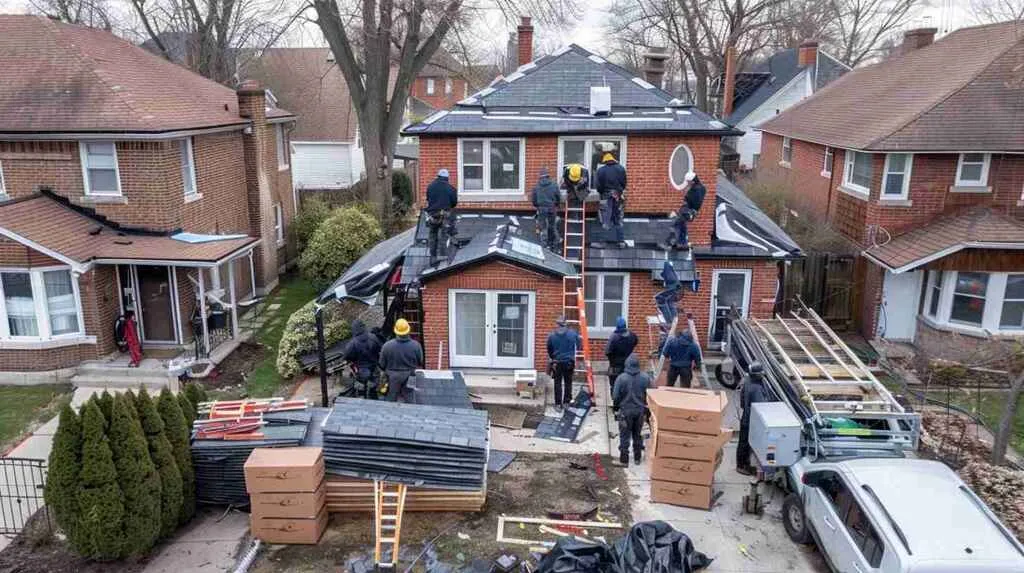
Fiberglass Asphalt Roof Shingles Queens NY – The Industry Standard
Physics doesn’t care what color your shingles are. If you ride the 7 train through Queens and actually look up at the rooflines, you’ll notice 80-90% are fiberglass asphalt shingles-and that’s not because they’re the cheapest option but because they hit a specific engineering balance of weight, wind resistance, and lifespan that works with our weather instead of fighting it.
I’ve spent 17 years on Queens roofs after walking away from a civil engineering PhD to do real-world math on ladders, and the simple truth is that fiberglass asphalt roof shingles are the standard here because they’re solving multiple problems at once: light enough not to stress old framing, tough enough to handle coastal winds in Rockaway, and affordable enough that you’re not mortgaging your house to replace 1,200 square feet of coverage.
Why Fiberglass Asphalt Roof Shingles Dominate Queens Rooflines
On a typical Jackson Heights block, if you look down the row of roofs, you’re seeing the result of a decades-long engineering experiment. Fiberglass asphalt shingles won because they weigh about half what organic felt shingles do-around 200-250 pounds per square versus 400-plus-which matters enormously when you’re working on attached brick rowhouses built in the 1920s with framing that was never designed for modern layered tear-offs. The fiberglass mat at the core acts like rebar in concrete, giving the shingle dimensional stability without adding mass, and the asphalt coating bonds the ceramic granules that reflect UV and resist wind scour. You’re not just picking a color up there-you’re choosing physics that either works with Queens weather or fights it.
One July afternoon, it was 96 degrees and the shingles on a brick rowhouse in Flushing were practically soft to the touch. The owner kept insisting his 20-year-old organic shingles “looked fine” from the sidewalk. I took a small infrared thermometer out of my pouch, showed him the surface temperature-167°F-and then showed him the fiberglass asphalt sample reading 20 degrees cooler on the same roof. That visual difference is what finally convinced him to switch, and three months later he called back just to say his upstairs didn’t feel like an attic anymore. That’s the heat management advantage nobody talks about until you measure it, and it’s especially critical on attached houses where the top floor bedrooms sit right under dark shingles with minimal attic ventilation.
Fiberglass Asphalt Shingle Snapshot for Queens, NY
From an Engineering Standpoint: How Fiberglass Shingles Handle Queens Weather
Weight, Wind Uplift, and Heat: The Physics in Plain English
From a purely engineering standpoint, fiberglass asphalt roof shingles are the standard in Queens because they solve three simultaneous problems without requiring you to rebuild your house. First, weight: old attached houses with 2×6 rafters spaced 24 inches on center can’t handle unlimited loads, and when you’re tearing off two or three previous layers, every pound matters-fiberglass shingles let you re-roof without a structural upgrade. Second, wind uplift: Queens sits between open water (Rockaway faces the Atlantic, College Point faces the Sound) and urban wind tunnels (the Queensboro and Throgs Neck create localized gusts), so your shingles need a sealant strip that actually bonds and a nailing pattern that resists peeling-fiberglass shingles hit 110-130 mph ratings when detailed correctly. Third, heat: south-facing slopes in Flushing or Woodside get hammered by summer sun, and fiberglass shingles with reflective granules stay 15-25 degrees cooler than dark organic felt, which directly translates to lower attic temps and less strain on your AC. The microclimate differences across Queens-coastal salt air in Rockaway, dense brick rows in Jackson Heights, tree shade in Forest Hills-mean the same shingle performs differently depending on your block, and that’s where local install knowledge trumps manufacturer spec sheets.
At 6:15 in the morning in Rockaway, right before sunrise, I was up on a coastal home redoing a job that another contractor had botched. They’d used cheap fiberglass shingles but nailed them too high and skipped ice and water shield in the valley. A nor’easter had peeled up a whole section like a page in a book. I still remember that first strong gust of wind while I was re-nailing the starter course; I could literally see which shingles were getting proper seal and which weren’t. That day I decided I’d never leave a coastal Queens roof without over-nailing the windward edges, even if the manufacturer only calls for four nails. The engineering here isn’t rocket science-it’s understanding that a 40-mph sustained wind with 60-mph gusts creates uplift pressure on every tab, and if your nails are placed too high or your sealant strip isn’t flush, you’re relying on hope instead of physics.
| Roofing Type | Typical Weight per Square (lbs) | Common Wind Rating (mph) | Heat Performance in Queens Summers | Realistic Lifespan in Queens (Years) |
|---|---|---|---|---|
| Fiberglass Asphalt (Architectural) | 240-270 | 110-130 | Good (reflective granules, cooler surface) | 22-28 |
| Organic Asphalt (Felt Mat) | 380-450 | 60-80 | Poor (absorbs heat, higher surface temp) | 15-20 |
| Three-Tab Fiberglass (Basic) | 200-220 | 60-90 | Fair (thinner, less thermal mass) | 18-22 |
How I Diagnose and Install Fiberglass Shingle Roofs in Queens
When I first step onto a roof, the question I’m answering in my head is not “Is it pretty?” but “How does this system move water and heat?” Most older attached houses in Queens have had three generations of patch jobs-tar over flashing, random shingles slapped over bald spots, gutters that dump water onto sidewalls-so my checklist starts with failure points, not aesthetics. I look at valleys first because that’s where water volume concentrates; then sidewalls where brick meets shingle and old mortar has crumbled; then chimneys and vent pipes where amateurs always skip the cricket or use roofing cement instead of proper counter-flashing. Here’s the insider tip nobody wants to hear: if you see a ceiling stain in your upstairs bedroom, the actual leak is almost never directly above it-water travels downslope along rafters or sheathing, sometimes 4-6 feet, before it drips. On attached houses, check the shared sidewall flashing and look one or two shingle courses upslope from the stain. I’ve found more leaks at parapet walls and where addition roofs tie into the main structure than I ever have in the field of shingles themselves.
I once had a retired electrician in Astoria who was convinced fiberglass asphalt shingles were “just plastic with grit.” It was a cold November afternoon and we were racing sunset. I actually cut a spare shingle open on his stoop, peeled back the layers, and showed him the fiberglass mat, the asphalt coating, the granules, and how the sealant strip works like a gasket. As soon as I related it to how insulation jackets work on electrical cables-core, jacket, protection-he nodded, went back inside, and came out with coffee and a signed contract. That’s the communication approach I use on every job: I explain the “why” in terms you already understand, whether that’s comparing shingle layering to a winter coat or sketching a water flow diagram on a pizza box. People trust you more when you stop talking like a salesman and start talking like someone who actually has to make the thing work in a rainstorm.
Shingle Masters Fiberglass Roof Process in Queens
We map every valley, sidewall, chimney, and vent; photograph problem areas from the roof and attic; check for multiple layers and old patch jobs that need full tear-off instead of overlay.
Why it matters: Prevents surprise costs and identifies whether your leak is a $300 flashing fix or a $8,000 full replacement.
Strip to bare plywood, inspect sheathing for rot or soft spots (common around chimneys and edges), replace damaged sections, and install drip edge before any shingle goes down.
Why it matters: Queens attached houses often hide water damage under old layers; catching it now prevents catastrophic failure later.
Full coverage in valleys, eaves (minimum 3 feet up from edge), sidewalls, and around all penetrations-even if code only requires eaves, because Queens wind-driven rain doesn’t care about minimum code.
Why it matters: Coastal wind pushes water upslope under shingles; ice shield is your second line of defense when the first line fails.
High-wind starter strip, six nails per shingle on windward slopes (vs. standard four), correct nail depth (flush, not overdriven), and hand-sealing tabs in coastal exposure zones.
Why it matters: Improper nailing is the #1 cause of premature shingle blow-off in Queens; we treat every roof like it’ll face a nor’easter next month.
Walk every slope to verify sealant engagement, check flashing laps, run a magnetic roller across yard and driveway to pull every nail, and photograph the completed work for your records.
Why it matters: You’re living here long after we leave; we don’t want a nail in your kid’s bike tire or a missed flashing gap that leaks in two years.
Key Installation Details I Refuse to Skip on Queens Roofs
Kick-out flashing where roof meets sidewall (prevents water from running into brick)
Step flashing embedded into mortar joints on shared walls, not surface-mounted
Cricket (saddle) behind every chimney over 24 inches wide to divert water
Proper drip edge over fascia (not under) so water drops clear instead of wicking back
Hand-sealing exposed shingle tabs in coastal zones and on slopes facing prevailing wind
Is It Time to Replace Your Fiberglass Asphalt Roof in Queens?
Here’s the blunt part most salespeople won’t say out loud: your shingles don’t fail randomly; they fail for reasons we can predict. In Queens, the three big failure modes are heat aging (south-facing slopes in Flushing bake in summer sun and the asphalt oxidizes, shingles curl and lose granules), wind damage (coastal properties in Rockaway or Broad Channel face sustained uplift pressure that peels improperly nailed tabs), and flashing failures (sidewalls on attached houses leak where step flashing wasn’t embedded in mortar or where valley metal corroded through). These aren’t acts of God-they’re engineering trade-offs playing out over 20 years. A fiberglass shingle is designed to sacrifice its top granule layer to protect the asphalt below; once you see bald spots the size of your palm, the waterproofing is compromised and you’re on borrowed time. Same with curling: if the edges lift more than a quarter inch, wind can get underneath and the sealant bond is broken. That’s a predictable failure, not bad luck.
Before you call anyone, do yourself a favor and use the decision tree below to figure out whether you’re looking at a $400 repair or a $12,000 replacement. Then check the attic and exterior items on the checklist so when we talk, I’m not starting from zero-you’ll save time and get a faster, more accurate answer.
Do You Need a Fiberglass Shingle Repair or Full Replacement?
Quick Roof Check Before You Call Shingle Masters
Check gutters for granule buildup (looks like coarse sand)
Look for missing, cracked, or lifted shingles from the ground
Inspect attic for daylight through roof deck or water stains on rafters
Note any ceiling stains and measure distance from exterior walls
Check chimney, vent pipes, and sidewalls for gaps or rust streaks
Know your roof age and if you’ve had prior repairs (helps diagnosis)
Costs, Maintenance, and Working With a Local Fiberglass Shingle Specialist
Think of your fiberglass shingle roof the way you’d think of a good winter coat-outer shell, insulation, seams, and zippers all have a job. The upfront cost trades off against predictable failure points: you can pay less now and tear off three layers in 15 years, or you can pay a bit more for proper ice shield and flashing and get 25+ years with minimal leaks. In Queens, a typical attached rowhouse (1,000-1,400 square feet of roof) runs $7,000-$12,000 for a full tear-off and fiberglass shingle install, but that number swings based on how many old layers need to come off (each layer adds disposal cost and labor), whether you’re coastal (Rockaway jobs cost 10-15% more because of wind-rated materials and extra sealing), and how complicated your roof geometry is-lots of valleys, dormers, and chimneys mean more custom flashing and slower work. A repair-say, replacing storm-damaged shingles on one slope and re-flashing a chimney-might run $800-$2,500 depending on access and materials. The real engineering trade-off is this: cheap out on the install crew and you’ll pay double when you have to fix botched flashing and re-nail loose shingles in three years.
Maintenance for fiberglass asphalt roofs is simple if you treat it like scheduled engineering checks instead of waiting for surprises. Clean gutters twice a year so water doesn’t back up under the shingles. Check attic ventilation in summer-if it’s over 130°F up there, you’re cooking your shingles from below. After any big storm, do a visual walk-around from the ground; if you see lifted tabs or displaced flashing, call before the next rain. That’s it. If you want a no-pressure inspection or a quote tailored to your specific Queens block-whether you’re in a coastal zone, a brick rowhouse with shared walls, or a detached house in Forest Hills-call Shingle Masters and I’ll walk your roof with a tape measure and a straight answer.
| Scenario | Roof Description | Typical Price Range | What Affects the Price Most |
|---|---|---|---|
| Small Attached Rowhouse | 1,000-1,200 sq ft, simple gable, one layer tear-off | $7,000-$9,500 | Sidewall flashing complexity, access for dumpster |
| Larger Detached House | 1,800-2,200 sq ft, hip roof, valleys, two layers removed | $11,000-$16,000 | Number of valleys, chimney crickets, old layer disposal |
| Coastal Premium (Rockaway, Broad Channel) | 1,400 sq ft, requires high-wind shingles and extra sealing | $10,500-$14,000 | Wind-rated materials, hand-sealed tabs, salt-air prep |
| Repair: Storm Damage One Slope | Replace 8-12 shingles, re-flash chimney, patch valley | $800-$2,200 | Matching existing shingles, flashing material, access difficulty |
| Full Replacement with Dormers/Complex Geometry | 1,600 sq ft with multiple dormers, skylights, multiple sidewalls | $13,000-$19,000 | Custom flashing fabrication, detail work around penetrations, labor hours |
Simple Fiberglass Shingle Roof Maintenance Schedule for Queens Homes
Every 6 Months
Clean gutters and downspouts, check for granule buildup; visually inspect from ground for missing or lifted shingles; trim back tree branches touching roof.
Why: Clogged gutters cause water backup under shingles; overhanging branches abrade granules and hold moisture.
Every 5 Years
Hire a local roofer to walk the roof, check all flashing (chimneys, vents, sidewalls), test sealant bond, inspect attic ventilation, photograph condition for records.
Why: Small flashing failures caught early cost $300 to fix; ignored, they turn into $3,000 rot repairs.
Mid-Life Check
Re-seal any lifted tabs with roofing cement, replace cracked pipe boots, check for any valley metal corrosion, verify attic insulation hasn’t blocked soffit vents.
Why: At 10 years, shingles are past initial warranty but have 10-15 years left if you address minor issues now.
As Needed
Walk the perimeter and look for displaced shingles, check gutters for sudden granule surge, inspect attic for new leaks or daylight, call for inspection if you see damage.
Why: Wind damage accelerates fast-one lifted tab becomes ten in the next storm; coastal Queens properties need extra vigilance.
Why Queens Homeowners Hire Shingle Masters for Fiberglass Asphalt Roofs
Queens Fiberglass Asphalt Roof Shingle FAQs
Warranties cover manufacturing defects, not install errors or wind damage-and most exclude “Acts of God” like nor’easters. The real warranty is hiring a roofer who over-nails windward edges and uses ice shield in valleys. Your 30-year shingle warranty is worth less than proper flashing.
Realistically, 20-28 years if installed correctly with good attic ventilation. South-facing slopes age faster (heat), coastal properties see more wind wear, and houses with poor ventilation cook shingles from below. The “30-year” label is a lab rating, not a Queens-weather guarantee.
Tear-off is loud-think construction noise for 1-2 days-but shingle install is quieter. We schedule around tenant work hours when possible, tarp and stage materials to minimize disruption, and do magnetic sweeps so nails don’t end up in the driveway. It’s manageable, but warn your tenants ahead of time.
You can install in winter as long as temps stay above 40°F for 48 hours after install so the sealant strips bond properly. We hand-seal tabs in cold weather and avoid installing if snow or ice is forecast within 24 hours. Late fall and early spring are ideal; mid-winter is case-by-case.
Architectural shingles are thicker (two laminated layers), heavier, better wind-rated, and last 5-8 years longer-worth it if you’re staying in the house. Three-tab are lighter, cheaper, and fine for rentals or if you’re planning to sell soon. For most owner-occupied Queens homes, architectural is the better engineering trade-off.
A fiberglass asphalt roof in Queens lives or dies by the details-not the shingle brand you pick, but whether the valleys got ice shield, whether the sidewall step flashing was embedded in mortar instead of surface-mounted, and whether the installer understood that a 50-mph gust off the Sound will find every improperly sealed tab. That’s the engineering, and it’s what I check on every inspection.
If your roof is leaking, aging out, or you just want someone to walk it and tell you the truth about what’s left, call Shingle Masters for a leak-hunting inspection or a fiberglass shingle replacement quote built around your specific Queens block. I’ll bring a tape measure, an infrared thermometer, and a straight answer-no pressure, just physics.