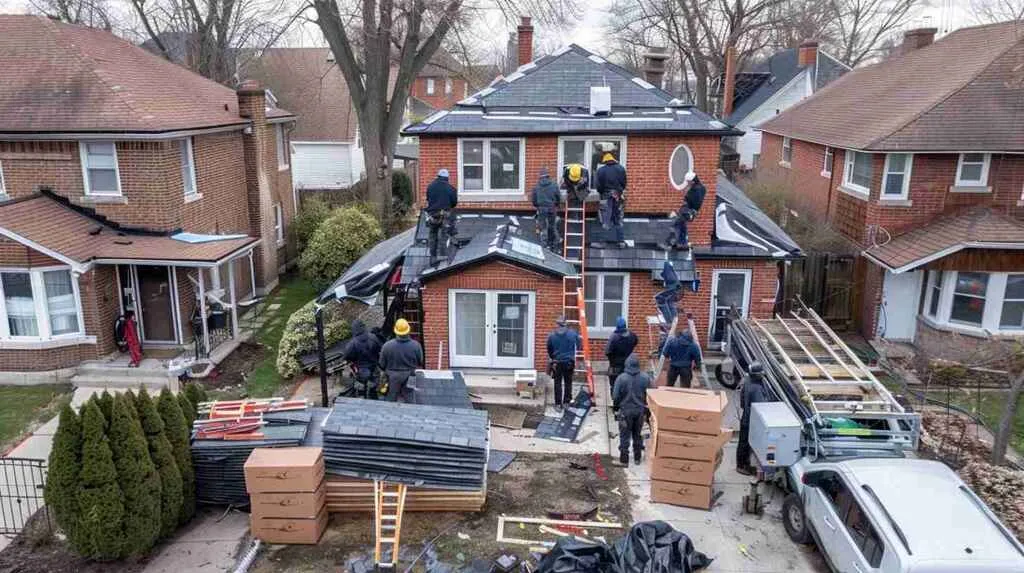
Corrugated Asphalt Shingle Roof Panel Queens NY – What to Know | Call Today
Crossroads is where most Queens homeowners end up: either they get corrugated asphalt shingle roof panels that outlast their old roof by a decade, or they get a pretty wavy pattern that starts leaking in three winters because nobody installed it for our wind. My name’s Carlos Menendez, and I’ve been running shingle jobs across Queens for 17 years after starting out as an MTA electrician. I look at roofs the same way I look at breaker panels-each decision on fasteners, underlayment, and venting is a circuit, and if one’s overloaded or poorly connected, your whole system’s gonna fail when the load hits.
Why Corrugated Asphalt Shingle Roof Panels Fail Fast in Queens
Crossroads might sound dramatic, but it’s exactly right when you see what happens to corrugated asphalt shingle roof panels installed for “curb appeal” instead of Queens weather. Not gonna lie, I’ve torn off corrugated roofs that were barely eight winters old while standing next to cheap flat three-tabs that hung on for twenty. The difference? Those fancy corrugated panels were treated like decoration-someone chased a pretty brochure photo and ignored the system underneath, so when our wind tunnels and freeze-thaw cycles hit, the whole setup failed like a weak connection in an overloaded circuit. I’ll be blunt: if your installer can’t explain why they’re fastening where they’re fastening and how the underlayment overlaps handle lateral rain, you’re not getting a roof-you’re getting a time bomb with pretty ridges.
One August afternoon in 2021, I was on a corrugated asphalt shingle panel job in Corona, sun bouncing off the white membrane next door so hard it felt like an oven. The homeowner kept telling me there was “just a little drip” over the kitchen, but when I pulled back one corrugated section, I found an entire line of rotten sheathing where someone had skipped the proper underlayment overlap. I still remember the smell of that wet, punky wood and the look on her face when I showed her how a tiny shortcut eight years earlier turned into a $3,000 repair instead of a $300 fix. That’s the thing-when you treat underlayment laps and fasteners like decoration instead of the wiring that keeps water on the right side of your deck, you’re basically running a 30-amp appliance on 14-gauge wire. It’ll work fine until the first heavy load, then everything smokes.
Here’s what actually fails on corrugated shingle asphalt roof panels in Queens: three main circuits that people either ignore or wire wrong. First circuit is fastener placement-screws in the wrong spot (ridges instead of flats) or spaced for lab weather instead of Queens nor’easters. Second circuit is underlayment overlaps-if they run with the prevailing wind or don’t overlap enough, water just follows the easy path straight through. Third circuit is ventilation-you seal the attic deck with no breathing room, and the whole system cooks itself from the inside out. Each one of those needs to be sized for actual Queens wind and temperature swings, not whatever pretty diagram the manufacturer drew for a test facility in Florida.
Common Myths vs Real Answers for Queens, NY
| Common Myth | Real Answer for Queens, NY |
|---|---|
| “Corrugated asphalt always lasts longer than flat shingles.” | It lasts longer only if the fastening pattern, underlayment, and ventilation are sized for Queens wind and temperature swings. |
| “If it’s not leaking now, the panels were installed fine.” | Hidden issues like bad overlaps and fasteners in the wrong spot can cook or rot the deck for years before the first drip shows. |
| “The manufacturer pattern on the brochure is all you need to follow.” | Brochure patterns are lab-based; Queens row-house wind tunnels and salt air require extra fasteners and tighter overlaps. |
| “Corrugated means you don’t have to worry about underlayment as much.” | The corrugation moves water fast; one bad underlayment seam just gives water a more efficient path into your kitchen ceiling. |
How Queens Wind Changes Your Corrugated Shingle Asphalt Roof Panel Design
On a cold, clear morning over in Maspeth, I watched a whole row of corrugated panels flutter like playing cards because the guy who installed them last year didn’t account for the wind channeling effect you get between row houses. That’s local knowledge: Jackson Heights and Elmhurst have mid-rise blocks that funnel gusts down the avenues like wind tunnels, Maspeth and Ridgewood have cross-winds off the truck routes, and Bayside has steady bay breezes loaded with salt. Each one changes the uplift on your corrugated panels the same way amperage changes when you switch from a small appliance to a big motor. If you’re fastening for calm air and treating edge zones the same as the center field, your panels are gonna act like loose wires the first time a real load hits-they’ll flutter, lift, and let water slip underneath before you even know there’s a problem.
One November night, right before Thanksgiving, I got an emergency call from a landlord in Flushing around 9:30 p.m. Heavy wind-driven rain was coming in sideways, and his top-floor tenant had water dripping right onto their daughter’s crib. When I got up there with my headlamp, I found that the corrugated asphalt panels had been fastened in a perfect visual pattern… but all the screws were in the high ridges instead of the flats, so wind was prying them up like little levers. I threw on a temporary patch in the rain, then came back two days later and re-fastened the whole field properly-that’s when I really started telling people, “Pretty patterns don’t keep you dry, proper fastening does.” In Queens, you need fasteners in the flats where they can compress the washer and hold the panel down against uplift, not perched on ridges where every gust turns them into pivot points. A pro designing a fastening “circuit” for real-world wind adds extra screws at eaves, edges, and corners, uses corrosion-resistant hardware near the water, and spaces everything tighter on windward exposures-not because it looks better, but because that’s how you balance the load.
Queens Neighborhood Wind Exposure vs Corrugated Panel Considerations
| Queens Area | Typical Exposure | Roof Risk for Corrugated Panels | What I Adjust |
|---|---|---|---|
| Jackson Heights / Elmhurst | Mid-rise blocks, wind channeled down avenues | Gusts that lift poorly fastened ridges and edges | Add fasteners near eaves and edges, upgrade to stronger fastener pattern in flats. |
| Maspeth / Ridgewood | Mixed row houses and open truck routes | Cross-wind that flutters loose panels like cards | Tighten spacing on panel laps, increase overlap on windward sides. |
| Bayside / Whitestone | More detached homes, exposure to bay breezes | Salt air and steady wind working on weak fasteners | Use corrosion-resistant fasteners and sealants, double-check perimeter fastening. |
| Flushing / Corona | Dense blocks, weird rooftop turbulence | Lifted panels where screws are in ridges, not flats | Re-fastening in flats, adding extra screws where gusts hit hardest. |
WARNING: Fastener Placement on Corrugated Asphalt Shingle Roof Panels
On corrugated asphalt shingle roof panels in Queens, NY, screws or nails driven into the high ridges are like loose connections in an overloaded circuit-wind pries them up and water follows the gap. Fasteners should be in the flats, with washers properly compressed, and patterns tightened at edges and corners where uplift is strongest.
Treating Your Roof Like a System: Underlayment, Venting, and Load
Think of your roof like an electrical panel: corrugated asphalt shingles are just the breakers-if the wiring underneath is wrong, it doesn’t matter what brand you bought. A couple years back, on one of those freak warm February days, I was on a small single-family in Woodhaven where the owner had tried to DIY a corrugated shingle asphalt roof panel over his old three-tab shingles. He’d called me because his attic smelled like asphalt every time the sun hit. I peeled back a section at the ridge and saw he’d trapped moisture with no venting, so the panels were literally cooking the roof underneath like a sealed frying pan. We re-did the whole thing with proper venting and spacing; I still use that job as the “overloaded circuit” story-everything technically connected, but the system couldn’t breathe, so it overheated. That’s what happens when you stack layers without thinking about airflow: you turn your roof deck into a slow cooker, and by the time you smell the problem, the sheathing’s already compromised.
I break every corrugated asphalt shingle roof panel into three main circuits, same way I’d diagram a service panel. First circuit: structure-that’s your deck and sheathing, and if it’s soft or rotten, nothing you put on top matters. Second circuit: weather skin-that’s your panels and underlayment working together, with overlaps running away from prevailing wind and fasteners holding the load where uplift’s strongest. Third circuit: breathing-ridge vents, soffit vents, or a combination that lets hot, moist air escape instead of condensing on the underside of your panels. In Queens, we get humidity in summer, freeze-thaw in winter, and salt air year-round, so every decision on a corrugated roof adds load to one of those circuits. A pro balances them: if your deck’s weak, we fix it before panels go down; if your underlayment’s cheap or your overlaps are lazy, we upgrade it; if your attic can’t breathe, we cut vents even if it costs a bit more. That’s system thinking, not just slapping down whatever’s on sale.
Key System Pieces on a Corrugated Asphalt Shingle Roof Panel Setup
-
✅
Solid, dry sheathing with no soft spots before panels go down -
✅
Underlayment with overlaps running away from prevailing Queens wind -
✅
Corrugated panels fastened in the flats on a consistent pattern -
✅
Continuous ridge and/or soffit vents so the roof “circuit” can breathe -
✅
Flashing at chimneys, skylights, and walls tied under the panels, not just caulked on top
What I Check When I Walk Your Queens Roof
Here’s my honest take: if your roofer can’t explain where every fastener goes on a windy day, they shouldn’t be touching corrugated panels at all. When I walk a roof for an inspection or estimate, I do it once, slow, tapping key spots with the back of my knife and listening to how the sheathing sounds under the panels. Solid deck sounds clean and tight; soft deck sounds dull and dead. I’m checking fastener placement-are they in the flats or perched on ridges?-and fastener spacing-did someone just follow a brochure, or did they add extras where wind hits hardest? I’m looking at lap direction to see if water can run sideways under an overlap, and I’m checking edge and ridge treatments to see if they’re actually tied down or just relying on sealant that’ll crack in three winters. That whole walk tells me how the roof was wired: like a pro who balanced the circuits, or like someone who just wanted it to look wavy and pretty from the street.
The blunt truth is, half the “mysterious leaks” I get called for on corrugated shingle asphalt roof panels aren’t mysterious at all-they’re just water following the path we accidentally gave it. I check each circuit one at a time: structure first (any soft decking or sagging rafters?), then weather skin (underlayment seams, panel overlaps, fastener integrity), then breathing (ridge vents clear? soffit vents open or blocked by insulation?). Around Queens, you’ve also got common trouble spots like parapet walls on row houses, shared chimneys between units, and old skylights that someone flashed with caulk instead of metal. I look for stains, trapped moisture smells in the attic, and piles of granules in the gutters-each one’s a clue about which circuit’s overloaded. Homeowners can do a quick sanity check from the ground before they even call: stand across the street, look for bowing or uneven panels, check the gutters for debris, and if there’s a weird smell in the attic on a warm afternoon, that’s your roof telling you it can’t breathe.
Quick Ground-Level Check Before You Call About Your Corrugated Asphalt Shingle Roof Panel
-
✓
Stand back across the street and look for panels that bow, flutter, or sit unevenly along the edges. -
✓
Check gutters and the ground for lots of asphalt granules or broken panel fragments after rain or wind. -
✓
Look under the eaves for signs of sagging wood or dark stains that could mean hidden leaks. -
✓
In the attic, sniff for a strong asphalt or moldy smell on warm afternoons-a sign the system isn’t breathing. -
✓
Note any recent wind events (nor’easters, strong thunderstorms) that might have stressed ridge and edge fasteners.
Carlos’s On-Site Roof “Circuit” Inspection in Queens, NY
-
1
Walk the roof once, tapping key areas with the back of my knife to hear soft vs solid panels. -
2
Check fastener placement and spacing in the flats, especially at edges, corners, and along ridges. -
3
Lift or spot-check panel laps to confirm underlayment direction, overlap, and nail pattern underneath. -
4
Inspect ridge and soffit areas for adequate venting and signs of trapped heat or moisture. -
5
Trace any stains or reported drips back to their source, checking flashing and seams like I’d trace a short in a circuit.
What It Might Cost to Fix or Replace in Queens
$300 can fix a problem early-a few re-fastened panels, a sealed lap, maybe a small flashing adjustment-but wait three winters and that same ignored issue turns into $3,000 worth of rotten deck, ruined insulation, and emergency tarps, just like that Corona job where a skipped underlayment overlap became a full sheathing replacement. Exact prices depend on your roof size, how easy it is to get up there, and how far the damage has spread through the system, but here’s what I see around Queens: a basic inspection and written report runs $150 to $350, minor fastening corrections (re-screwing loose panels at edges and ridges) cost $350 to $850, localized leak repairs where I open up panels and fix underlayment and deck in a small area run $750 to $1,800, ventilation and moisture fixes (adding or adjusting ridge and soffit vents) range $900 to $2,200, and a full corrugated asphalt panel replacement on an average Queens home-stripping everything, repairing the deck, new underlayment, new panels, updated venting-starts around $7,500 and can hit $16,000 or more depending on pitch, access, and how many chimneys and dormers we’re flashing. The lesson: treat your roof like a circuit you inspect and maintain, not a decoration you ignore until it sparks.
Typical Queens, NY Corrugated Asphalt Shingle Roof Panel Service Ranges
| Scenario | What’s Involved | Typical Price Range (Queens, NY) |
|---|---|---|
| Basic inspection & report | On-roof walk, fastener and lap check, written summary of remaining “winters” | $150 – $350 |
| Minor fastening correction | Re-fastening loose panels at edges/ridge, sealing disturbed fasteners | $350 – $850 |
| Localized leak repair | Open up panels, fix underlayment and sheathing in a small area, correct fastening pattern | $750 – $1,800 |
| Ventilation and moisture fix | Add/adjust ridge and/or soffit vents, address trapped heat and condensation under panels | $900 – $2,200 |
| Full corrugated asphalt panel replacement | Strip, repair deck, new underlayment, new panels, updated venting on an average Queens home | $7,500 – $16,000+ |
Deciding If You Need Shingle Masters Out There Tonight or Next Week
Call ASAP (Same Day if Possible)
- Active dripping inside, especially near electrical fixtures or a baby’s crib.
- Panels visibly lifted or flapping after a wind event.
- Strong moldy or asphalt smell in the attic after rain.
- Pieces of corrugated panels found on the ground.
Can Usually Wait a Few Days
- Minor staining that hasn’t changed after a couple of storms.
- A few loose granules in the gutters with no leaks yet.
- Old panels approaching end of life but still watertight.
- General checkup before selling or refinancing your Queens home.
Common Questions from Queens Homeowners
Now, that’s one circuit; let’s flip over to the questions I hear the most in Queens. Treat your roof like you’d treat an electrical panel-don’t be shy about asking “why” on every step, because a good roofer can explain fastener patterns, lap direction, and venting in plain English, not just brochure jargon.
Queens Corrugated Asphalt Shingle Roof Panel FAQs
▸
How long should corrugated asphalt shingle roof panels last in Queens?
Installed right, with the fastening pattern, underlayment, and venting sized for Queens wind and weather, I tell most homeowners to expect 20-30 years. Installed like a pretty brochure photo with screws in the ridges and lazy overlaps, I’ve seen them fail in under 10 winters.
▸
Can you install corrugated panels over my old shingles?
Technically you can, but in Queens I almost never recommend it. It’s like stacking a new breaker panel over bad wiring-you trap moisture, miss rotten spots, and overload the system. Stripping lets me fix the deck, underlayment, and venting circuits properly.
▸
Are corrugated asphalt panels too heavy for my older Queens house?
Most of the time, no-the weight is comparable to layered shingle systems you already see around Queens. I still check the sheathing and framing, especially on older wood-frame homes, to be sure the structure circuit can handle the load.
▸
What’s the biggest mistake you see other installers make?
Fasteners in the wrong place and not enough of them at edges and corners. That’s like running a big appliance on a tiny wire-looks fine until you put a load on it, then everything fails fast when the first nor’easter hits.
▸
How soon can Shingle Masters get to my Queens roof?
For active leaks or storm damage, we usually get there the same or next day in Queens. For inspections and planned corrugated roof replacements, we schedule within a few days, walk you through the whole system, and show you exactly which circuits we’re improving.
Your corrugated asphalt shingle roof panel is a loaded system, not just a pretty pattern-one weak circuit, whether it’s fasteners in the wrong spot, underlayment running the wrong direction, or vents that can’t breathe, can turn into thousands of dollars of hidden damage long before the first drip hits your kitchen ceiling. Call Shingle Masters in Queens, NY today so I can walk your roof, tap a few key spots, and lay out a clear, no-nonsense plan before the next big wind test rolls through.