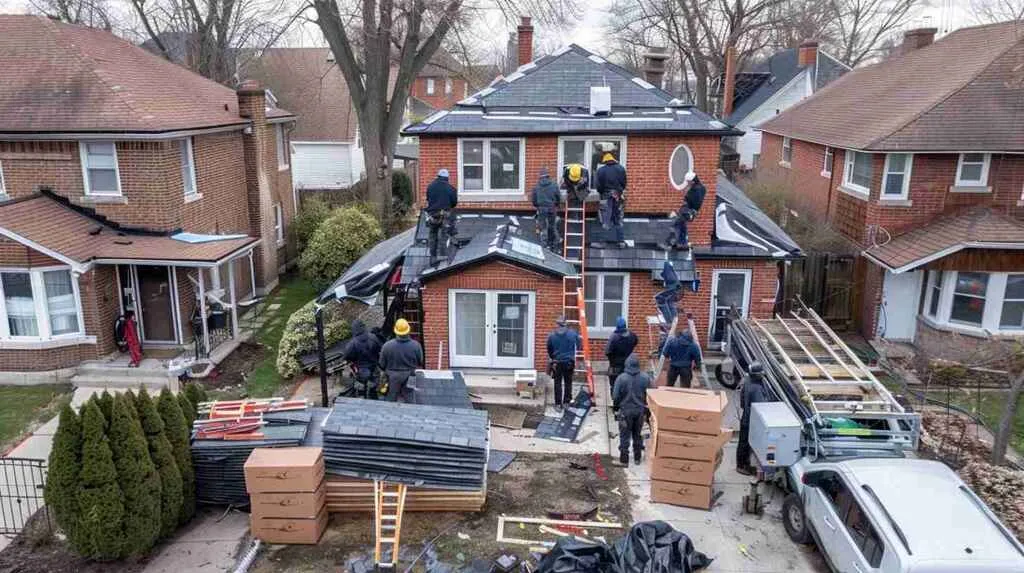
Cool Shingle Roof Queens NY – What It Is and Worth the Cost? | Free Quotes
Thermostat adjustments usually cost about $12 and take five minutes. On 43rd Avenue last July, I watched a family’s ConEd bill drop by $86 the month after we switched them to a cool shingle roof – essentially the same five-minute adjustment, except on the giant thermostat you didn’t realize you owned: your roof. In Queens, a cool shingle roof runs $7.50 to $11.50 per square foot installed, and if you’re sitting on a top floor that’s borderline unlivable every August, that number changes from “expensive” to “finally, someone did the math.”
Cool Shingle Roof Cost in Queens and What It Does to Your ConEd Bill
On 43rd Avenue last July, I watched a family’s ConEd bill drop by $86 the month after we switched them to a cool shingle roof – and honestly, that’s not even the record. A cool shingle roof in Queens typically runs $7.50 to $11.50 per square foot installed, tear-off through cleanup, and that includes proper underlayment, cool-rated shingles with reflective granules, new flashing, and the ventilation tweaks that make the whole system actually work. My blunt take: if you’re planning to pay a ConEd bill every July and August for the next seven years, you’re essentially pre-paying for a cool roof upgrade anyway, just in $80-monthly installments instead of one check. The roof is a giant thermostat you didn’t realize you owned, and choosing cool shingles is the only time you get to turn it down without touching the AC remote.
Here’s what really happens: a cool shingle roof doesn’t just reflect sunlight and look slightly lighter on a sunny day. It changes your attic from a slow cooker into something closer to an insulated box, dropping attic temperatures by 20 to 40°F on a blazing afternoon, and that temperature shift punches straight through your top-floor ceiling. For a typical Queens house – say 1,200 to 1,800 square feet of roof – you’re looking at a total project cost between $9,000 and $20,700, depending on roof complexity, number of penetrations, pitch, and whether we’re dealing with a simple gable or a cut-up hip roof with three chimneys and a dormer that makes no architectural sense.
Installed Cool Shingle Roof Pricing – Queens, NY
| Scenario | Approx. Roof Area (sq ft) | Roof Type / Complexity | Estimated Price Range (Installed) | Expected Summer Bill Change |
|---|---|---|---|---|
| Small attached Astoria | 1,000 | Simple gable, low pitch, shared walls | $7,500 – $9,500 | -$55 to -$75 / month |
| Typical Woodside two-family | 1,400 | Gable with one dormer, moderate pitch | $10,500 – $13,000 | -$75 to -$95 / month |
| Bayside detached colonial | 1,600 | Hip roof, steeper pitch, two chimneys | $12,000 – $16,000 | -$85 to -$105 / month |
| Howard Beach split-level | 1,800 | Multi-level hip/gable combo, skylights | $13,500 – $18,500 | -$90 to -$115 / month |
| Large Forest Hills custom | 2,200+ | Complex cut-up roof, turrets, steep pitch | $16,500 – $25,300 | -$100 to -$140 / month |
All ranges include tear-off, disposal, cool-rated shingles, underlayment, new flashing, and basic ventilation adjustments. Bill savings based on typical Queens two- or three-bedroom units running central AC 8+ hours daily in July/August.
Fast Numbers on Cool Shingle Roofs in Queens
Is a Shingle Cool Roof Worth It for Your Queens House?
Here’s my honest take: if you’re planning to move in three years, a cool shingle roof in Queens probably isn’t for you. The math is simple – you’ll spend an extra $1,500 to $3,000 over standard shingles (the premium for cool-rated product plus any extra ventilation work), and at $80 to $100 per month in summer bill savings, you need at least five summers to break even. But if you’re staying put, or if your top floor turns into a sauna every July and your window units run 24/7 just to keep it tolerable, the equation flips hard. Different Queens neighborhoods play differently here: an Astoria brick attached home with shared walls and a small roof footprint might see modest gains, while a detached Bayside colonial with 1,600 square feet of dark shingles baking in full sun all day can pull $110 off the electric bill in a single brutal August. The real question isn’t “does it work?” – it does – but “do I care enough about what happens in year six to write the check in year one?”
Bottom line: if you’re keeping the house more than five years and your summer ConEd bill makes you wince, cool shingles pay for themselves.
Beyond the payback math, there are measurable comfort benefits that show up the first heat wave. Your AC doesn’t cycle as often because the house isn’t fighting a 160°F roof deck all afternoon. Top floors – the ones that used to be unusable from 2 to 8 pm – become actual living space again. And here’s a bonus most people don’t think about: because the shingles themselves run 30 to 50 degrees cooler on a summer day, the asphalt stays more flexible and the granules don’t bake as hard, which can add a year or two to the shingle lifespan. Not gonna lie, it won’t turn your house into an igloo, and if your attic insulation is a joke or your ductwork leaks like a sieve, you’ll still have problems. But paired with decent insulation and proper ventilation, a cool shingle roof is the single biggest thing you can do to stop your house from cooking itself every summer.
Should You Invest in a Cool Shingle Roof Right Now?
Do cool shingles
If top floor is unbearable in summer
How Cool Shingle Roofs Actually Work (Without Making Winter Colder)
Most folks think “white equals cooler” and stop right there, but that’s not actually how modern cool shingles work. The magic isn’t the color you see with your eyes – it’s the infrared reflectance baked into the granules. A medium-brown or even charcoal cool shingle can bounce back 25 to 35% of the sun’s total energy (including the infrared wavelengths you can’t see), while a standard dark shingle of the exact same visual color absorbs 90% or more. Manufacturers coat the ceramic granules with special pigments that reflect near-infrared light, so the shingle looks normal but behaves completely differently under a blazing sun. Here’s the insider tip no one mentions in the brochure: the shingle alone is maybe 40% of the equation. The real magic happens when you treat the roof, attic ventilation, and ceiling insulation as one integrated system – a cool shingle on a poorly vented attic with six inches of patchy insulation will still let you down, because you’ve turned down the thermostat on top but left all the doors open underneath.
One winter morning in Bayside taught me more about heat loss than any textbook I half-read in college. It was January 2021, about 7:45 am, maybe 22°F out, and I was standing on this roof staring at a frost line that stopped dead where the attic insulation ended. The homeowner had called me in August convinced that cool shingles would “make the house cold in winter,” and six months later that frost line was my entire rebuttal drawn in ice. The roof surface temperature in winter has almost nothing to do with shingle color and everything to do with how much heat is leaking *out* through your ceiling – if your attic is warm enough to melt frost off the shingles, congratulations, you’re heating the sky. We did the cool shingle install *and* proper air sealing at the ceiling plane, and the following August he sent me a ConEd bill with a big circle around it and one word scrawled in Sharpie: “Lower.” The lesson: your roof is a giant thermostat you didn’t realize you owned, but it mainly controls summer heat *gain*, not winter heat *loss*. Winter comfort is about stopping warm air from escaping up through gaps and insufficient insulation, and a cool shingle doesn’t make that problem worse – it just stops punishing you for it every July.
✓ What Actually Makes a Roof Run Cooler
Infrared-reflective granules drop peak roof surface temp by 30-50°F in direct sun
Balanced intake + exhaust vents flush hot air before it soaks into the ceiling
R-38 to R-49 creates a thermal break so attic heat doesn’t punch through to living space
Sealed can lights, plumbing stacks, and hatch edges stop convective loops that bypass insulation
Real Queens Results: Temperature Readings From the Roof
Picture your roof like the hood of a black car stuck on the BQE at 4 pm in August – you wouldn’t touch it with your bare hand, and neither should your house have to. One August afternoon in 2019 in Woodside, it was 94°F outside and the top-floor hallway of this brick six-family felt hotter than the sidewalk. I put my infrared thermometer on their dark brown shingles at 2:17 pm and it flashed 167°F. Same thermometer, same roof pitch, but on a small test section I’d re-done with a cool shingle sample board earlier that summer, it read 119°F. That 48-degree surface temperature drop wasn’t a sales pitch – it was a $40 laser thermometer anyone can buy on Amazon, and it was the first time I watched a landlord’s jaw actually drop from a temperature gun reading, not from the invoice. The renters on the top floor had been running two window units flat-out just to keep the apartment at 78°F; after we did the full cool shingle install that fall, the same units kept it at 72°F cycling on and off, and the August electric bill dropped $92 compared to the previous year.
Sometimes your roof runs *so* cool it surprises equipment that was counting on the old heat. Back in 2013 in Howard Beach, I had a job where the cool roof went wrong for a hilarious reason: the homeowner insisted on super light, high-reflective shingles – beautiful choice, great specs – but forgot he’d told his cousin to install solar pool heaters on the same roof the previous spring. The first hot weekend after we finished, the pool heater loops kept tripping their thermal sensors because the roof surface wasn’t getting hot enough to give them the temperature boost they were designed to ride on. We ended up slightly re-configuring the collector layout and adjusting the flow rate, and I got a funny but valuable lesson: sometimes your roof is *too good* at rejecting heat for the older gadgets built to depend on it. The moral isn’t “don’t do cool shingles” – the moral is if you’ve got rooftop equipment that relies on surface heat (old-school solar thermal, certain HVAC condensers, pool heaters), mention it up front so we can plan around it.
| Location & Year | Roof Type | Peak Sun Roof Temp Before | Peak Sun Roof Temp After | Attic Temp Change | Top-Floor Comfort Change |
|---|---|---|---|---|---|
| Woodside 2019 | Dark brown standard shingles → cool rated medium gray | 167°F | 119°F | -34°F (measured 138°F → 104°F) | Renters went from 78°F with AC maxed to 72°F with normal cycling |
| Bayside 2020 | Black architectural shingles → cool charcoal | 171°F | 128°F | -38°F (measured 145°F → 107°F) | Master bedroom went from “unbearable 3-7 pm” to comfortable all day |
| Astoria 2021 | Standard gray shingles → cool tan/beige | 160°F | 125°F | -27°F (measured 132°F → 105°F) | Top-floor tenant reported $68 lower July electric bill vs prior year |
All readings taken between 2:00-3:30 pm on clear days with ambient air temps 90-96°F, using Fluke 62 MAX infrared thermometer.
⚠️ Coordination with Rooftop Equipment
If you have or plan to install rooftop solar pool heaters, older thermal collectors, or certain roof-mounted HVAC equipment, drastically cooler roof surface temperatures can change how those systems behave. Some solar thermal systems are designed to pull extra heat from a hot roof deck, and a cool shingle can reduce that free boost. Always mention existing or planned rooftop gear during your quote visit so layout, specs, and system compatibility can be reviewed before install day.
What Happens When You Call Shingle Masters for a Cool Shingle Roof in Queens
The first thing I ask when someone calls about a “shingle cool roof” is simple: “What’s your summer electric bill right now?” That number tells me whether we’re solving a $200/month problem or a $90/month annoyance, and it sets the entire conversation. From there, every step is about collecting numbers – roof size, shade patterns, current attic conditions, your realistic budget, and how long you’re planning to stay in the house – because a cool shingle roof is just turning down the giant thermostat you didn’t realize you owned, and like any thermostat decision, it only makes sense if the math lines up with your timeline.
Step-by-Step Cool Shingle Roof Visit & Quote Process
We start by discussing your current summer electric bill, top-floor comfort issues, when the roof was last replaced, and whether you’re planning to stay put long enough for the upgrade to pay back.
I measure the roof, check pitch and complexity, inspect existing shingles and flashing, then go into the attic to evaluate insulation depth, ventilation balance, and any moisture or airflow problems.
On warm days I’ll take infrared surface temps on the existing roof and in the attic to establish a baseline; if there’s any suspicion of moisture intrusion or vent blockage, I document it with photos and readings.
You get a detailed, itemized quote showing both a standard shingle option and a cool shingle option, with the cost difference clearly listed and an estimated range of summer energy savings based on your roof size and current bill.
Once you approve the quote, we schedule the tear-off and install, walk through the daily timeline (typically 1-3 days depending on size), explain dumpster placement and noise expectations, and confirm our cleanup and magnet-sweep process at the end.
Why Queens Homeowners Hire Shingle Masters for Cool Roofs
Licensed & Insured in NYC
Full liability and workers’ comp coverage on every job, with NYC permits pulled when required
31+ Years on Queens Roofs
Three decades of experience with Queens building types, weather patterns, and ConEd billing cycles
Specialized Cool Shingle & Ventilation Experience
I treat roof-attic-insulation as one system, not just nail shingles and walk away
Local Familiarity – Astoria, Woodside, Bayside, Howard Beach & Beyond
I know which neighborhoods have attached brick homes vs detached colonials and how that changes the cool-roof payback
Free Written Quotes with Itemized Materials & Labor
No mystery pricing – you see exactly what you’re paying for, with side-by-side standard vs cool options
Cool Shingle Roof Questions Queens Homeowners Actually Ask
A: Yes, but the payback takes longer because you have less roof area and shared walls reduce total cooling load. If your summer bill is under $120/month and you’re moving in three years, standard shingles probably make more sense. If you’re staying five-plus years and the top floor is miserable in summer, cool shingles still pencil out.
A: Same or slightly longer – most cool shingles carry the same 25- to 30-year warranties as standard architectural shingles, and because they run 30-50°F cooler in summer, the asphalt experiences less thermal stress, which can add a year or two of real-world life.
A: Technically possible in some cases, but not recommended. Layering traps heat and moisture between the old and new shingles, which defeats the whole point of going cool. Plus, NYC code limits you to two layers max, and most insurance companies and manufacturers won’t honor warranties on overlay installs. Do a proper tear-off.
A: As of late 2024, there’s no direct citywide rebate for residential cool shingles, but some utility programs and federal energy-efficiency tax credits may apply if you bundle the roof with insulation or HVAC upgrades. I’ll flag anything relevant during the quote, but don’t count on rebates to make the decision – the energy savings are the real rebate.
A: Depends on your existing insulation and AC setup, but most Queens homeowners report 4 to 8°F cooler indoor temps on peak-sun afternoons, with the biggest difference being that the AC actually cycles off instead of running continuously. If your top floor was 82°F before with the AC maxed, expect it to settle around 74-76°F with normal thermostat settings after a cool shingle install.
Your roof is the biggest thermostat on your house – it’s just sitting there either soaking up heat and forcing your AC to fight it all summer, or bouncing that heat away before it ever gets inside. A cool shingle roof in Queens costs $7.50 to $11.50 per square foot installed and, if you’re staying put, starts paying you back in lower ConEd bills the very first July. Shingle Masters can measure your current setup, quote both standard and cool shingle options side by side with real numbers attached, and install a system that treats your roof, attic, and ventilation as one integrated machine, not just a pile of shingles nailed to some plywood. Call for a free, no-pressure quote, and let’s figure out whether turning down that hidden thermostat makes sense for your house and your timeline.