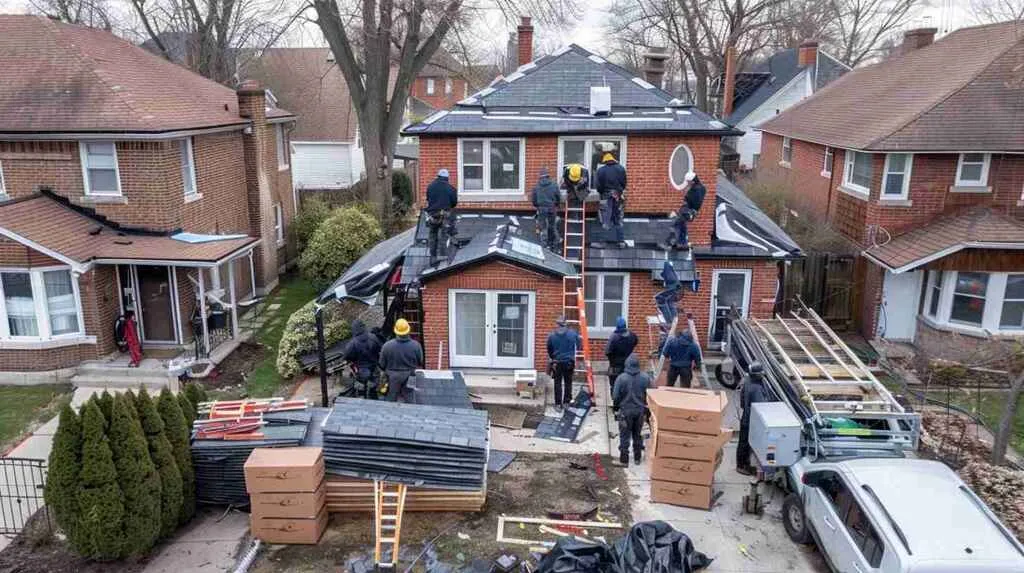
Asphalt Roofing Services Queens NY – Install, Repair, Replace | Free Quotes
Blueprint for wasting $8,000-$15,000 on an asphalt roof in Queens: obsess over shingle brand names and ignore the three details that actually keep water out. I’m Victor Rosario, and for 19 years I’ve been treating Queens roofs like systems of leaks waiting to happen – walking homeowners through the edges, the nails, and the flashing step by step, like we’re figuring it out at the same kitchen table.
The Three Details That Actually Keep Water Out on a Queens Asphalt Roof
On a typical two-family in Queens, the first thing I look at isn’t the shingles – it’s the edges. The drip edge, the starter course, how far those shingles hang over the gutter line on a row house in Ridgewood or a corner property in Forest Hills. Because here’s the reality: most roof leaks I see aren’t from bad shingle brands, they’re from bad edges, bad fastening, or bad flashing. Your roof is a network of transitions where water wants to sneak in, and my job is to close every single one of those paths before the first raindrop hits.
I explain it to customers like this: imagine water as something that’s actively looking for a crack, a gap, a place where two surfaces meet. Edges are where shingles end and metal begins – if that transition isn’t tight, water crawls under. Nailing is where the shingle grabs the deck – if the pattern’s wrong or the nails are overdriven, wind lifts them like kites. Flashing is where your roof hits a wall, a chimney, a vent pipe – and honestly, most “failed” asphalt roofs I tear off in Queens didn’t fail because the shingles wore out; they failed because someone skipped the flashing or nailed through it wrong and water found the invitation.
✅ The Three Leak-Stopping Details Victor Checks Before He Even Talks Shingle Brands
Metal edge installed correctly at every perimeter, starter course positioned so shingles shed water into the gutter, and overhang distance checked on typical Queens two- and three-families where gutter lines can be tight.
Correct nail placement zone (not too high, not too low) so wind can’t lift shingles, proper number of fasteners per shingle, and synthetic or ice & water shield underlayment in problem areas like valleys, eaves, and around penetrations.
Step flashing at sidewalls and party walls, counterflashing at chimneys, proper boot seals around vent pipes, and every joint layered so water drains away from the opening instead of pooling against it.
Why Homeowners in Queens Trust Victor with Asphalt Roofing
Licensed & Insured in NYC
Fully licensed and insured for roofing work in Queens, NY
19+ Years Queens Only
Installing and repairing asphalt shingle roofs only in Queens neighborhoods
Fast Response
We usually get on-site for non-emergencies within 24-48 hours
System-First Approach
Every estimate includes a written checklist of edges, nailing, ventilation, and flashing conditions
| What Many Homeowners Focus On | What Actually Keeps Water Out | What Victor Checks First in Queens |
|---|---|---|
| Shingle brand name and marketing | Proper drip edge and starter courses at all edges | Perimeter metal, overhangs, and gutter lines on row houses |
| Color names and style buzzwords | Correct nailing pattern and fastener depth | Nails, shingle alignment, and any soft decking |
| Warranty years printed on the bundle | Continuous underlayment and ice & water in weak spots | Underlayment coverage at valleys and low slopes |
| Online photos of “designer” roofs | Correct step flashing and counterflashing at walls and chimneys | Every transition: party walls, skylights, vents, and pipe boots |
Asphalt Roofing Costs in Queens, NY: What You Really Get for Your Money
A basic “shingles-only” job on a typical two-family in Jackson Heights might run $9,000, but a full-system job with proper underlayment, flashing work, and ventilation upgrades pushes closer to $13,000 or $14,000 – and that gap is the difference between dry ceilings and repeat leak calls. Size matters, obviously, but so do layers to remove (one layer versus two old roofs stacked up), access (tight side yards in Astoria versus wide driveways in Jamaica), and flashing complexity (a simple ranch versus a multi-hip Victorian in Forest Hills). I itemize every part of the system on your quote – edges, underlayment, vents, flashing time – so you know exactly what you’re paying for and what’s keeping the water out.
An extra $500 spent on proper edges, underlayment, and flashing today can easily save you a $5,000 interior repair bill down the road.
Typical Queens Asphalt Shingle Roofing Scenarios and Price Ranges
| Scenario | Roof Description | What’s Included | Estimated Price Range |
|---|---|---|---|
| Small repair – leak around vent or pipe boot | One trouble spot on an otherwise solid roof, 1-2 penetrations | Diagnosis, new boot or flashing, matching shingles, sealant, photos before/after | $350 – $850 |
| Targeted repair – small section of wavy or blown-off shingles | Up to 3 bundles of shingles replaced, local decking repair if needed | Remove damaged shingles, inspect wood, install new underlayment and shingles, re-nail nearby area correctly | $900 – $2,000 |
| Full replacement – narrow row house (single family) | Single layer tear-off, simple layout, easy access in streets like in Ridgewood | Full tear-off, underlayment, drip edge, new shingles, basic ventilation check, new pipe boots | $7,500 – $10,000 |
| Full replacement – typical two-family with 2 slopes | Two layers removed, moderate pitch, common layout seen in Jackson Heights | Full tear-off, ice & water in valleys, underlayment, drip edge, new shingles, ridge vent, flashing touch-ups | $9,000 – $14,000 |
| Full replacement – larger corner property with multiple hips/valleys | Complex shape, several valleys and chimneys like you see in parts of Forest Hills | Full tear-off, full underlayment upgrade, extensive flashing work, ridge and intake ventilation improvements, detailed cleanup | $13,000 – $18,000+ |
| Myth | Fact |
|---|---|
| “All asphalt roofs in Queens cost about the same per square foot.” | Tear-off layers, access, hidden decking damage, and flashing complexity make Queens roofs vary widely in real cost. |
| “If I pick the cheapest quote, I’m saving money because shingles are all equal.” | Cheap quotes usually strip out underlayment, flashing time, and ventilation work-the stuff that actually stops leaks. |
| “A higher shingle warranty automatically means a better installation.” | Warranties cover materials on paper; nails, flashing, and ventilation are what keep your roof dry in real storms. |
| “Repairs are a waste of money; you should always just replace.” | On a lot of solid Queens roofs, a smart, targeted asphalt repair buys you years of dry time before you need a full job. |
Install, Repair, or Replace? How I Decide What Your Asphalt Roof in Queens Really Needs
How I diagnose leaks and “mystery” moisture problems
When I come to your house, the first question I’m going to ask you is simple: where do you see water and when did it start? Then I’m heading straight to the attic with a headlamp, because half the “roof leaks” I see in Queens aren’t roof leaks at all. One winter morning, just after sunrise, I was on a narrow row house in Jackson Heights where the owner swore he needed a new roof because of “mystery leaks.” I spent an hour in his attic with a headlamp, tracing stains, and realized the actual culprit was an ancient bathroom vent dumping warm moist air straight into the attic, soaking the underside of the asphalt deck and making it look like a roof failure. Instead of selling him a full replacement, I repaired a few worn shingles, installed a proper vent through the roof, and added a ridge vent, and the “leak” disappeared. That job reminded me how often asphalt roofing issues in Queens are really ventilation and condensation problems wearing a disguise – especially in older housing stock where bathroom fans, kitchen vents, and dryer exhausts were never properly routed outside.
Quick decision guide: repair vs replacement
Think of your asphalt roof like a chain of umbrellas overlapping each other; if one is turned the wrong way, you’re getting wet. When I’m deciding whether you need a repair or a full replacement, I’m not thinking about the age of the shingles – I’m thinking about where the water wants to go and whether your system is still closing those paths. If your leaks are in just one or two obvious spots (a valley, a vent boot, a chimney), and the rest of the roof is lying flat with shingles that still flex when you press them, a targeted repair is usually smarter and buys you years. But if I see widespread curling, bald spots where granules are gone, or soft decking that bounces under my feet, that’s a system failing across the board, not just a detail problem. And honestly, I’ve got to be blunt: if your decking is soft or rotted in spots, I’m not just slapping new shingles over it and calling it done – we fix the structure first, or you’re just hiding a leak waiting to happen.
Do You Need an Asphalt Roof Repair or Full Replacement in Queens?
Start here: Are leaks in just one or two small, obvious areas (like around a vent, chimney, or one valley)?
→ If YES: Is most of the roof surface lying flat, with shingles still flexible and granules mostly intact?
→ If YES: ✓ Targeted repair is usually smarter-fix flashing/penetrations and keep your existing roof working.
→ If NO: Continue below ↓
→ If NO at first question: Do you see widespread curling, bald spots, or soft spots in the deck when walked?
→ If YES: ⚠ Full replacement recommended-system is failing, not just a detail.
Special case: If moisture only shows in winter and near bathrooms/kitchens → Ventilation and condensation fix first-may not need a full roof right now.
Victor’s 5-Step Leak and Moisture Diagnosis on Queens Asphalt Roofs
- Map the stain or drip location and when it appears – I ask whether it’s every rain, just heavy storms, or only in winter, because that tells me if it’s a roof problem or a condensation/ventilation issue.
- Trace the water path from attic to roof – Using a headlamp in the attic, I follow moisture stains up to the underside of the deck to see if water’s coming from a roof penetration, a valley, or a vent dumping inside.
- Inspect the suspect area on the roof surface – I check shingle condition, flashing joints, nail lines, and whether anything’s lifted or cracked right above where the leak shows up inside.
- Check all transitions and penetrations within 10 feet – Water travels sideways under shingles, so I expand the search to nearby vents, chimneys, sidewalls, and valleys to find where it’s actually sneaking in.
- Assess the overall system: edges, ventilation, and deck condition – Even if the leak is local, I walk the whole roof to see if other problems are brewing, and I make a call on whether a repair will hold or if the whole system needs replacement soon.
How We Install and Repair Asphalt Shingle Roofs to Survive Queens Weather
Here’s my honest opinion: most asphalt roofs that “fail early” in this borough were installed too fast, not too cheap. One August afternoon, about 3 PM, I was on a two-family in Ozone Park when a surprise thunderstorm hit just as we’d stripped half the asphalt shingles. I remember yelling to my guys over the wind while we tossed tarps like parachutes and the homeowner was watching out the third-floor window, panicked about their new nursery. We got everything covered in under eight minutes, not a drop in the house, but that day drilled into me that in Queens, if you’re installing asphalt roofing and you ignore the forecast-even a 20% chance-you’re asking for trouble. Since then, I build weather buffers into every schedule and explain to customers exactly how we’ll protect open areas if the sky turns on us. We stage tarps at the truck, we don’t strip more than we can close in a day, and if there’s a real storm coming, we delay the tear-off – because leaving your house open to a Queens downpour isn’t “efficient,” it’s reckless.
I still remember a cold Tuesday in January when I learned the hard way how badly Queens wind can lift a poorly nailed shingle. I was doing a small repair job in Astoria, and I pulled up a section that had blown off in a storm – every single shingle in that area was nailed too high, above the seal strip, so the wind just peeled them back like Post-It notes. That’s the moment I became obsessive about the nailing zone: every shingle gets fasteners in the correct spot, the right depth (flush, not overdriven), and the right number (usually four to six depending on slope and exposure). Starter courses at the edges get extra attention because that’s where wind wants to start lifting. And honestly, the whole job is just predicting where the water and wind want to go – edges want to lift, valleys want to funnel water fast, penetrations want to channel it inside – and every step we take is about closing each of those “leaks waiting to happen” before the first storm tests the system.
⚠️ Why Rushing an Asphalt Roof Installation in Queens is Risky
- Stripping too much roof with storms in the forecast can expose open decking to sudden Queens downpours, soaking insulation and ceilings before you even get the underlayment down.
- Speed-focused crews often skip proper nail placement and underlayment lapping, which only shows up as leaks months later when wind drives rain sideways under the shingles.
- “Patch over” fixes in valleys and around chimneys without redoing flashing almost guarantee repeat leaks – you’re just hiding the problem, not closing the water’s path.
✅ Key Steps Victor Follows on Every Queens Asphalt Install or Major Repair
Check the three-day forecast and build in a buffer – We don’t strip the roof if there’s more than a 30% chance of rain in the next 48 hours, and we keep heavy tarps staged at the truck so we can cover open areas in minutes if weather changes.
Install drip edge and starter courses first, before any field shingles – Edges are where water wants to sneak under, so we get metal and starter down correctly to create a sealed perimeter that directs runoff into gutters.
Nail every shingle in the correct zone, correct depth, correct number – Too high and wind lifts them, too deep and you crack the shingle, wrong number and the whole slope can peel in a storm; we use chalk lines and check randomly throughout the day.
Layer underlayment, ice & water shield, and flashing so water always drains away from joints – Every transition (wall, chimney, vent) gets step flashing or counterflashing installed in the correct shingle-over-metal sequence so water can’t back up under the asphalt.
When to Call Shingle Masters Right Away vs When It Can Wait a Bit
🚨 Call ASAP (Same or Next Day if Possible)
- Active dripping or visible water intrusion during or right after storms
- Obvious shingle blow-offs exposing black underlayment or bare wood decking
- Ceiling sagging, bubbling paint, or drywall bulging from trapped water
✓ Can Usually Wait a Few Days
- Small stain on ceiling that hasn’t grown or dripped in several months
- Missing or curled shingle on a detached garage or low-priority area
- Cosmetic shingle waviness or minor granule loss with no interior moisture signs yet
Keeping Your Queens Asphalt Roof Flat, Dry, and Out of Trouble
Let me be blunt for a second: if your flashing is wrong, I don’t care how nice your asphalt shingles are-you’re going to leak. A few years back, I did a Sunday emergency repair in Forest Hills Gardens for an elderly couple whose roof had been “repaired” three times by handymen. It was drizzling, getting dark, and every slope I checked had a different color and brand of asphalt shingle, nailed in any direction they felt like. I had to gently explain that they weren’t unlucky; they’d just never had a proper asphalt roofing contractor look at the system as a whole. I patched the worst valley that night so the water stopped, then came back the next week to install a full asphalt roof with matching shingles, underlayment, and flashing – it was the first time in years they got through a storm without pots on the floor. That job taught me to never sugarcoat the truth: if you hire handymen or “guys who do a little bit of everything,” you’re rolling the dice. Roofing is a system, and every part – edges, nails, underlayment, flashing, vents – has to work together, or you’re just moving the leak around.
Think of your asphalt roof like a chain of umbrellas overlapping each other; if one is turned the wrong way, you’re getting wet. Maintenance isn’t complicated – it’s just keeping those umbrellas pointed in the right direction. Check your gutters twice a year so water doesn’t back up under the shingles at the eaves. After a big storm, walk around your house and look for obvious problems: missing shingles, lifted edges, anything that looks different. Every few years, get someone who actually knows asphalt roofing to climb up and inspect flashing, vents, and valleys – those are the spots where small issues turn into big leaks if you ignore them. And if you’re planning other exterior work (siding, windows, chimney repair), tell your roofer first, because transitions between different materials are exactly where water wants to sneak in. The goal isn’t to obsess over every granule; it’s to think in terms of the water’s path and make sure nothing’s blocking or redirecting it the wrong way.
Simple Asphalt Roof Maintenance Schedule for Queens Homeowners
| When | What to Check or Do |
|---|---|
| Twice a Year (Spring & Fall) | Clear gutters and downspouts so water doesn’t back up under shingles at the eaves; look for any obvious lifted or missing shingles from street level. |
| After Big Storms | Walk around the house and check for blown-off shingles, damaged flashing around chimneys or vents, or debris piled in valleys; if you see anything, call before the next rain. |
| Every 3-5 Years | Have a roofer inspect flashing at all penetrations (vents, chimneys, sidewalls), check for soft spots in decking, and verify that ridge and soffit ventilation is working correctly. |
| When Planning Other Exterior Work | Coordinate with your roofer if you’re doing siding, masonry, or window work – transitions between roof and walls are critical flashing points that need to be redone correctly or you’ll get leaks. |
Common Questions About Asphalt Roofing Services in Queens, NY
How long does an asphalt shingle roof typically last in Queens?
A properly installed asphalt shingle roof in Queens usually lasts 18-25 years, but that range depends heavily on ventilation, maintenance, and whether the original installation got the edges, nailing, and flashing right. I’ve seen 15-year-old roofs that are shot because they were rushed, and I’ve seen 30-year-old roofs still holding strong because someone did it correctly the first time.
Can you work on my roof in winter or very hot summer days?
Yes, but with some limits. We can do emergency repairs year-round, and we can install asphalt roofs in winter if temperatures are above freezing and shingles have time to seal. On very hot days (over 90°F), we adjust our schedule to early morning or late afternoon so shingles don’t get too soft to walk on safely.
Do you offer free quotes and written estimates?
Absolutely. Every quote is free, and every estimate is written out with a breakdown of what you’re paying for: tear-off, underlayment, shingles, flashing work, ventilation, and cleanup. I want you to know exactly what the system includes, not just a total dollar figure with no explanation.
What neighborhoods in Queens do you service?
We work throughout Queens, including Astoria, Jackson Heights, Forest Hills, Ozone Park, Flushing, Jamaica, Ridgewood, Corona, Elmhurst, Bayside, Woodside, Sunnyside, and nearby areas. If you’re in Queens and need asphalt roofing work, we’ll get to you – usually within 24-48 hours for estimates.
📋 What to Have Ready Before You Call Shingle Masters About Your Asphalt Roof
- Note where you see water – Which room, which wall or ceiling, and when it shows up (every rain, just heavy storms, or only in winter).
- Take 2-3 clear photos of the roof – From the street or yard if it’s safe, so I can see the general condition and plan my inspection.
- Look for any old repair spots – Tar patches, mismatched shingles, or areas that look different from the rest of the roof.
- Check if attic is accessible – I’ll want to inspect from below to trace stains and check ventilation, so knowing how to get up there saves time.
- Have any previous roofing invoices or warranties handy – If available, this helps me understand what was done before and whether any materials are still under coverage.
Whether you need a repair to close one leak, a flat-looking new asphalt roof that won’t embarrass you in front of the neighbors, or just an honest second opinion from someone who’s seen every kind of Queens house there is, Shingle Masters will check the whole system – edges, nails, underlayment, flashing, vents – and explain everything in plain language at your kitchen table. Call us today or request a free quote, and let’s figure out exactly what your roof needs to stay dry through the next storm.