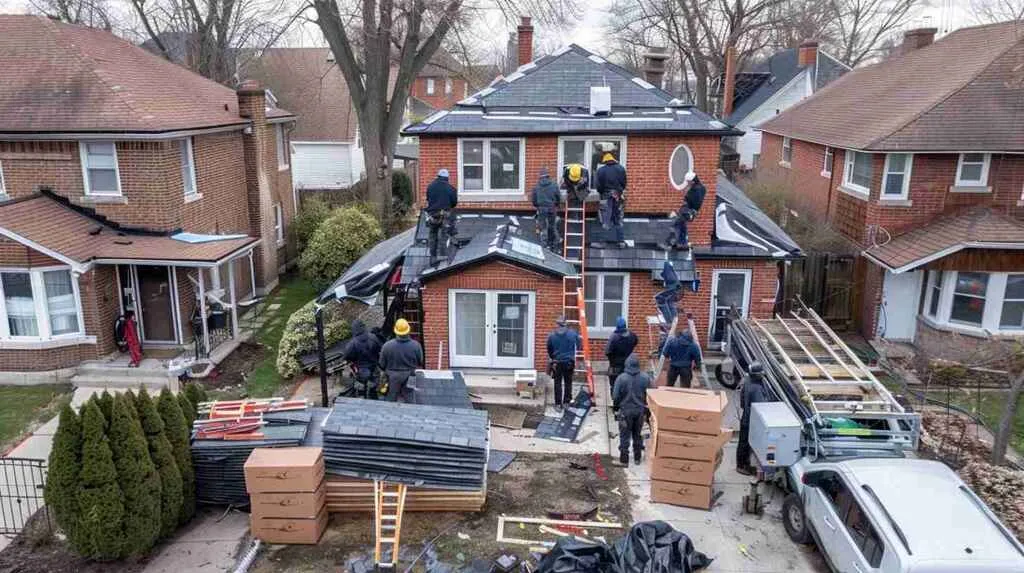
Chessboard thinking is what separates a commercial roof shingle repair that quietly protects your building for years from one that’s back in crisis mode by the next windstorm. The most expensive commercial shingle repair in Queens is almost always the one that was rushed or done halfway – and I can show you what a complete, code-compliant repair actually includes, where the weak squares are, and how to think three moves ahead so you’re not scrambling after every storm.
What a Complete Commercial Shingle Repair in Queens Really Includes
Let me be direct: most “cheap” commercial roof shingle repairs I get called in to fix had zero business being done with a caulk gun and wishful thinking. I walk onto Queens roofs every week where someone patched the obvious hole but ignored the drainage problem that caused it, or nailed down a few shingles without checking what’s happening at the parapet edges, valleys, and penetrations – the weak squares where wind and water always attack first. A complete repair means I’m thinking like I’m defending a chessboard: I look at edges, drains, penetrations, ventilation, and how water moves when the wind shifts, because protecting those vulnerable spots now saves you from emergency calls and equipment damage down the road. I’m licensed and insured, and I treat every Queens commercial building like it’s mine – which means no shortcuts and no ignoring the squares that matter most.
One January morning, about 6:30 a.m., I was on a low-slope shingle roof over a small printing shop in Maspeth after a windstorm had ripped a whole section off the corner. The owner was panicked because water was dripping right over a $60,000 cutting machine. I remember balancing a headlamp and my coffee on an HVAC curb while I showed him how a missing starter strip and improperly nailed end shingles created a wind tunnel right where the parapet meets the main roof. We ended up rebuilding that corner with high-wind-rated shingles and an ice & water shield – a classic case of trading a pawn for a queen, spending a bit more on materials now to prevent catastrophic leaks and even tighten up the building envelope. A year later he told me his electric bill even dropped because we sealed everything correctly. That’s the kind of three-moves-ahead thinking that turns a repair into an upgrade.
Complete vs. Bare-Minimum: What Your Commercial Shingle Repair Actually Covers
| Repair Type | What It Includes | Typical Lifespan Impact | Risk Level in Queens Weather |
|---|---|---|---|
| Rushed Patch Job | Caulk or roof cement smeared over visible damage, maybe a few replacement shingles without checking deck or underlayment | 3-8 months before leak returns | High risk – wind-driven rain and freeze-thaw will exploit every shortcut |
| Basic Repair | Replace damaged shingles in the field, check immediate area for soft spots, re-seal with matching shingles | 1-3 years if conditions stay stable | Moderate risk – works if problem was isolated and drainage is good |
| Complete System Repair (Rico’s Standard) | Interior moisture check, full perimeter and edge inspection, drain/scupper review, penetration and flashing check, deck and underlayment assessment, ventilation review, strategic shingle replacement with upgraded materials at vulnerable areas, code-compliant fastening | 5-12+ years depending on maintenance | Low risk – anticipates wind, drainage, and future weak points before they fail |
Why Shingle Masters Is a Safe Choice for Commercial Shingle Repair in Queens, NY
Full general liability and workers’ comp coverage, all permits pulled and closed properly
Deep experience with mixed-use buildings, retail spaces, and light industrial roofs across all Queens neighborhoods
Most urgent Queens commercial calls inspected same-day or next morning, emergency repairs often completed within 48 hours
Specialized in noise-reducing, leak-resistant shingle systems for buildings along busy streets and under LaGuardia flight paths
Every diagnosis and repair option explained like a chess strategy – clear, methodical, and focused on what happens three storms from now
How I Diagnose Your Commercial Shingle Roof Like a Chessboard
On a typical three-story mixed-use building along Queens Boulevard, the first thing I look at isn’t the shingles, it’s the way water wants to travel when the wind shifts. I walk the perimeter like I’m studying a chessboard: parapet edges where brick meets shingle and wind creates lift, drains and scuppers where debris can dam up water, valleys where two roof planes funnel everything into one narrow channel, then penetrations – HVAC curbs, kitchen exhausts, old sign posts, satellite mounts – because every one of those is a weak square that needs defending. Queens gets wind from every direction depending on the season, and our freeze-thaw cycles are brutal on any fastener or flashing that’s even slightly loose. By the time I’m standing over your main field shingles, I’ve already mapped out the three or four spots that are most likely attacking your building, and I’m thinking two or three storms ahead about how each one will behave in a northeaster versus a summer downpour.
I’ll never forget a steamy August afternoon in Jamaica when a property manager insisted the roof was “only five years old” but their third-floor accounting office had brown stains growing like islands on the ceiling. Once I got up there, I saw they’d used residential three-tab shingles on a commercial building with three kitchen exhausts and almost no ventilation. The shingles around the vents were curling like potato chips from heat and moisture attacking from below. I had to explain, very carefully, that we’d need to replace the damaged field with heavier laminated shingles, re-flash all the penetrations with proper boots and counterflashing, and cut in proper intake and exhaust ventilation, or they’d just keep cooking that roof from the inside out. That’s a strategic repositioning on the board – not just swapping a few pieces, but changing the whole game so heat and humidity can’t corner your roof. Indoor heat from commercial kitchens and laundries in Queens accelerates shingle failure faster than most people realize, and ignoring ventilation is like leaving your king undefended.
Step-by-Step: How I Inspect a Queens Commercial Shingle Roof
Before I even climb, I walk the top floor or attic space looking for ceiling stains, soft drywall, musty smells, or water trails on walls – helps me trace where the leak path starts
I walk every parapet, every rake edge, every eave looking for lifted shingles, missing starter strips, gaps in flashing, or places where sealant has dried and cracked
Check every drain, scupper, and valley for debris, ponding water, or signs that water is backing up or traveling sideways instead of down
Inspect every HVAC curb, vent pipe, kitchen exhaust, sign post, and rooftop equipment mount – these are the weak squares where most leaks actually originate
Look at intake and exhaust ventilation to see if heat and moisture are properly escaping, or if your shingles are being cooked from below by trapped air
When to Call: Urgent vs. Can-Wait Situations
🚨 Urgent – Call Same Day
- Active dripping inside over equipment, inventory, or workspaces
- Missing shingles or torn section visible from the street after a storm
- Soft or spongy deck areas near drains or edges
- Leak near or over electrical panels, server rooms, or sensitive equipment
✓ Can Usually Wait 2-5 Days
- Minor granule loss on field shingles with no curling or cracking
- Single small ceiling stain that hasn’t grown in weeks
- One lifted shingle tab still fully covered by the course above
- Old flashing that looks tired but isn’t leaking yet
Queens Commercial Shingle Repair Costs and Smart Trade-Offs
$750 might cover a quick patch, but it won’t buy you a strategic repair that’s thinking about your roof three storms from now. Costs depend on how many square feet are damaged, whether we need a lift or can ladder it, how many penetrations need re-flashing, and whether your deck or underlayment is wet and needs drying or replacement. I always frame pricing like a chess trade: spending a bit more now for high-wind shingles, upgraded ice & water shield, or properly counterflashed HVAC curbs is trading a pawn for a queen – you’re preventing equipment damage, tenant complaints, emergency calls, and business downtime, all of which cost way more than the incremental material upgrade. In Queens, you’ve also got to factor in tight alley access, traffic control if we’re blocking a lane, and weekend or after-hours premiums if your business can’t have noise or disruption during the day.
Waiting for “one more storm” is usually the move that tips the whole board over.
Typical Commercial Shingle Repair Scenarios in Queens, NY
| Scenario | Approx. Area Affected | Complexity | Estimated Price Range (Queens, NY) |
|---|---|---|---|
| Small corner blow-off on a low-slope retail roof | 10-25 sq ft | Low – if deck is dry | $750-$1,400 |
| Multiple missing shingles around a roof drain | 30-60 sq ft | Medium – drain needs cleaning, possible deck work | $1,200-$2,500 |
| Re-flashing around 1-2 HVAC units with shingle replacement | 40-80 sq ft | Medium-High – requires custom flashing and proper sealing | $1,800-$3,600 |
| Partial field replacement with upgraded laminated shingles on mixed-use building | 150-300 sq ft | High – multiple penetrations, edge work, ventilation check | $3,500-$6,800 |
| Emergency storm response over sensitive equipment (same-day or next-day service) | Varies | Urgent – tarping, drying, temporary protection, then repair | $1,500-$5,000+ |
Repair Now vs. Wait Until Next Season
| Option | Pros | Cons |
|---|---|---|
| Repair Immediately |
• Stops water intrusion before interior damage spreads • Avoids tenant complaints and business disruption • Prevents mold growth in walls or ceilings • More crew availability outside peak spring/fall rush • Protects inventory and equipment now |
• May cost slightly more if scheduling on short notice • Weather delays possible in winter months • Coordination needed with business operations |
| Wait Until Next Season |
• Can bundle with other deferred maintenance • More scheduling flexibility • Potentially better weather windows in spring |
• Water damage spreads – every storm worsens the problem • Mold and rot can develop in hidden deck/wall areas • Emergency calls during hurricane season or northeasters • Crews booked solid in peak season, longer wait times • Risk of ceiling collapse over workspaces or equipment |
Critical Mistakes I See on Queens Commercial Shingle Roofs
Here’s the blunt truth about commercial shingles in Queens: they’re being attacked from above by weather and from below by bad ventilation – and either one can ruin a repair. The mistakes I see most often are using residential-grade three-tab shingles on buildings with heavy commercial loads and foot traffic, skipping starter strips at edges so wind can lift the first course like opening a zipper, nailing too high or too shallow so shingles don’t seal, smearing roof cement over gaps instead of installing proper flashing, and completely ignoring ventilation even when there are three restaurant kitchens or a laundromat pumping heat and moisture straight into the roof cavity. Every one of those is a weak square – a vulnerability that wind, water, or heat will exploit within a year or two. I’m constantly explaining to building owners that these aren’t just “cosmetic” shortcuts; they’re strategic blunders that leave your king exposed and turn a $2,000 repair into a $15,000 emergency replacement.
A job that almost went sideways on me was a weekend rush repair for a daycare center on Northern Boulevard. A Friday night storm had blown shingles off over the toddler rooms, and by the time we arrived Saturday at dawn the maintenance guy had tried to “help” by screwing scraps of siding into the roof deck. We had to undo his emergency fix, dry out the exposed sheathing with fans, then re-deck a four-by-eight section before re-shingling it – all while kids were arriving for a special weekend program. I remember standing in the parking lot explaining to the director, using chess terms, why we had to sacrifice the schedule’s “rook” (some outdoor playtime) to protect the “king” (a completely watertight repair) before the next rain. That story illustrates how well-meaning but uninformed fixes create way more work and risk. These mistakes are avoidable if someone who knows Queens commercial roofs is thinking a few moves ahead and understands that every fastener, every piece of flashing, and every breath of ventilation matters.
⚠️ DIY and Handyman “Patches” That Make Your Commercial Shingle Roof Worse
- Screwing random materials (siding, plywood scraps, metal flashing) directly into the roof deck without sealing the screw holes – every screw is a new leak point
- Smearing roofing cement over open seams, lifted shingles, or gaps without reinforcing the underlying structure or flashing – cement dries, cracks, and makes the real repair harder
- Mixing shingle brands and ages in one repair area without matching thickness, color, or nailing pattern – creates uneven surfaces and visible patching that accelerates wear
- Blocking or redirecting drains with temporary plastic, tarps, or duct tape “fixes” – traps water, creates ponding, and guarantees a bigger leak
- Nailing through flashing instead of beside it or under it – penetrates the waterproof barrier and defeats the whole purpose of the flashing
Top Weak Squares on a Queens Commercial Shingle Roof
Where roof meets brick wall – wind lifts, water backs up, flashing fails first
Debris clogs, water ponds, shingles stay wet and rot from underneath
Heavy anchors and wind stress create cracks, and flashing is often an afterthought
Heat, grease, vibration, and poor flashing – triple threat to shingle integrity
Where two roof sections meet – highest wind exposure and most fastener stress
What to Do Before You Call and What to Expect from Shingle Masters
When I walk into your lobby or office, the first question I’ll usually ask is, “Where was the first stain you noticed, and what did the weather look like that day?” That question helps me trace leak paths backward in Queens’ wind-driven rains and snowstorms, because water doesn’t always drip straight down – it travels sideways along rafters, down walls, and across ceilings before it shows up as a stain. An insider tip: take photos during storms if you can, and note the wind direction and intensity, whether you saw pooling water on any balconies or flat sections, and whether the leak got worse as the storm continued or stopped right after. Those details are like chess notation – they tell me exactly which squares are under attack and help me find the real problem faster instead of chasing symptoms.
When you work with Shingle Masters, here’s what to expect: I’ll do an interior check first to see where water is traveling, then I’ll safely access your roof using proper fall protection and equipment. I’ll walk you through my findings in plain language, using simple chess analogies if it helps – no jargon, no upselling, just a clear explanation of what’s happening and what needs defending. You’ll get a written scope and pricing that breaks down materials, labor, and exactly what we’re fixing and why. My focus is always on minimizing noise and disruption for your tenants, customers, or employees – we schedule around your busy hours when possible, we protect landscaping and entrances, and we clean up thoroughly every day. You’re hiring a licensed, insured Queens commercial roofer who’s been thinking three moves ahead on these buildings for 19 years.
Before You Call: Quick Checklist for Commercial Shingle Repair in Queens, NY
Note where the first stain or drip appeared – room, ceiling corner, near what exterior wall or feature
Check for multiple rooms or just one – helps determine if it’s a localized penetration or a larger drainage issue
Snap phone photos of ceilings and exterior – especially any visible roof damage, stains, or wet spots
Look out a window at nearby rooflines if visible – sometimes you can spot missing shingles or lifted sections
Gather any past roof paperwork or warranties – age of roof, last repair, any guarantees still in effect
Know your building’s typical busy hours – so we can schedule work to minimize noise and disruption for tenants or customers
Common Questions About Commercial Roof Shingle Repair in Queens
Q: How fast can you get to my building in Queens?
For urgent situations – active leaks over equipment or workspaces – I typically inspect same-day or next morning. Non-emergency repairs are usually scheduled within 2-5 days depending on crew availability and weather.
Q: Can you work around my business hours or tenants?
Absolutely. We schedule most Queens commercial jobs early morning, late afternoon, or weekends to avoid disrupting business operations. We’re experienced at minimizing noise and keeping entrances clear for customers.
Q: Are shingles even appropriate for my low-slope commercial roof?
Shingles work well on commercial roofs with a slope of 3:12 or greater. Below that, you’re usually better off with a membrane system. I’ll tell you honestly during the inspection if shingles make sense or if you need a different strategy.
Q: Will a repair void my existing warranty?
It depends on your warranty terms and who does the work. If the warranty requires manufacturer-authorized repairs, we can coordinate with them. If it’s expired or a workmanship warranty from a different contractor, a proper repair won’t void anything – but I’ll review your paperwork with you first.
Q: How do I know if I need a full replacement instead of a repair?
If more than 30% of your roof is damaged, if the deck is rotted in multiple areas, or if your shingles are past their expected lifespan and failing in several spots, replacement is usually smarter than patching. I’ll walk you through the math and the trade-offs so you can make an informed decision.
Your Queens commercial roof is a chessboard, and every repair decision is a move that either defends your weak squares or leaves your building vulnerable. If you’re ready for a licensed, insured roofer who thinks three moves ahead and explains every step in plain language, call Shingle Masters today. I’ll walk the roof with you, show you exactly what’s under attack, and schedule a crew to protect your business the right way – no shortcuts, no wishful thinking, just strategic repairs that last.