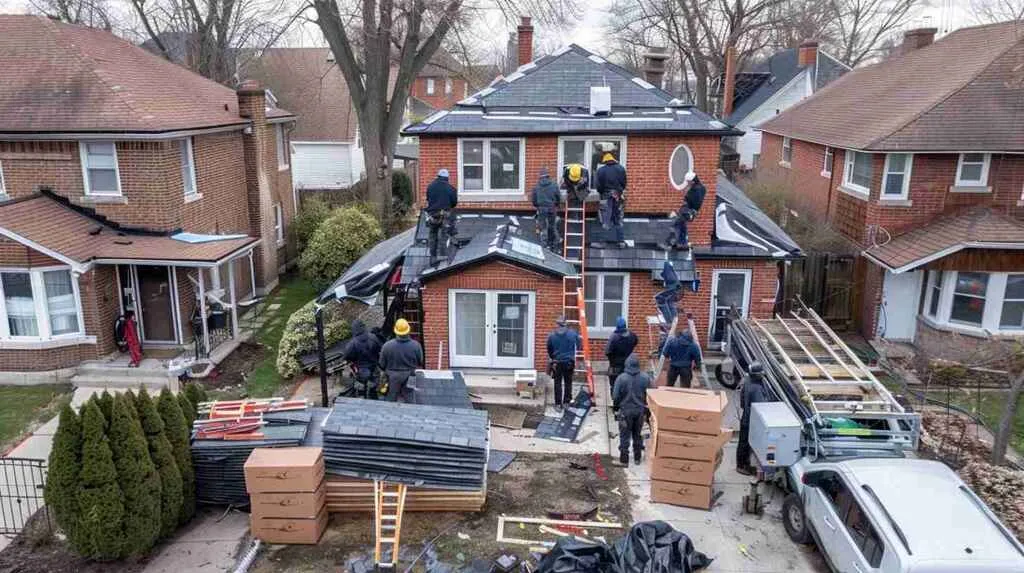
Commercial Shingle Roof Installation Queens NY – Free Estimates
Blueprint price for commercial shingle roof installation in Queens runs $6.00-$10.50 per square foot, which translates to $24,000-$52,000 for most small-to-midsize commercial buildings-think retail strips, three-story mixed-use, walk-up offices. At 43rd Avenue and 99th Street, I once stood on a strip-mall roof and saw six different leak paths all converging on one rusty transition where brick met steel, and the owner kept asking me why his brand-new shingles from another contractor were already dripping on his tenant’s insurance office. Here’s my blunt take: most building owners in Queens obsess over shingle brand-GAF versus Owens Corning, architectural versus three-tab-when the real money and real protection live in how you handle transitions, penetrations, and the code-mandated details that actually stop water from finding its express lane into your ceiling.
I’ve been doing this for 19 years in Queens, from Astoria to Jamaica, and I talk straight about what drives your roof from a $24,000 straightforward job to a $52,000 complicated one: roof size matters, obviously, but so does slope complexity, the number of penetrations-vents, chimneys, HVAC units, skylights-and the amount of existing damage hiding under those curled shingles. If your deck’s already sagging around an old equipment pad, or if your building dates back to the ’80s and code now requires upgraded ventilation and ice-and-water shield at every transition, those aren’t optional extras-they’re the difference between a roof that actually works and one that starts leaking the week after I hand you the final invoice.
Commercial Shingle Roof Costs in Queens, NY (Real Numbers, Real Buildings)
Commercial Shingle Roof Installation Pricing Calculator – Queens, NY
These scenarios assume full tear-off, new commercial-grade architectural shingles, synthetic underlayment, code-compliant flashing, ventilation upgrades, and proper transitions around equipment. Your actual price depends on your specific building and discovered conditions.
| Building Type & Example Location | Approx. Roof Size (Sq Ft) | Complexity (Equipment & Transitions) | Estimated Price Range | What Usually Drives Cost Up |
|---|---|---|---|---|
| Two-story retail strip near Elmhurst | 3,800 sq ft | Low-minimal HVAC, few penetrations | $24,000-$32,000 | Hidden deck rot from old flat roof, parapet flashing upgrades |
| Corner deli near Queens Boulevard | 2,900 sq ft | Medium-grease vents, walk-in cooler unit | $19,000-$27,000 | Loose HVAC lines, custom flashing around vent stacks |
| Jackson Heights daycare building | 5,200 sq ft | High-steel-to-brick transitions, multiple skylights | $36,000-$48,000 | Code-mandated ice shield at every beam, skylight re-curbs |
| Flushing church with basement rental | 7,100 sq ft | Medium-limited equipment, multiple chimneys | $44,000-$58,000 | Extensive decking replacement, chimney cricket rebuilds |
| Three-story mixed-use near Astoria | 4,600 sq ft | High-rooftop HVAC array, satellite dishes, low-slope sections | $32,000-$52,000 | Equipment pads, impact shingles for wind, hybrid low-slope membrane sections |
Why Queens Commercial Shingle Roofs Really Fail (And How We Install Them Right)
Leak Paths, Not Just Lifespan
Here’s my honest take: most commercial shingle roofs in Queens fail from details, not from age. One February morning at 6:15 a.m., I was on top of a Jackson Heights daycare building in 19-degree weather, trying to figure out why their “brand-new” shingle roof was leaking above the story-time corner. Turned out the previous contractor had skipped ice and water shield over a steel beam transition, so meltwater was basically taking an express lane under their shingles and dripping right on the kids’ carpet. That job taught me that on commercial shingle roofs, transitions are where the real game is played-especially in Queens freeze-thaw cycles. When we install shingles on a commercial building, we treat every transition like an intersection that has to stay open during rush hour-steel to brick, parapet to roof deck, chimney to shingle plane-because one poorly flashed joint turns into a backed-up flood the second you get a Nor’easter and twenty-degree overnight temps.
Queens has this specific combination that makes life hard for commercial shingles: you get freeze-thaw cycles all winter, wind pushing off the East River and the Atlantic, and tons of older mixed-use buildings where the roof wasn’t originally designed for equipment or even proper ventilation. I design the shingle system like a traffic map for your building-water routes down valleys like traffic lanes, transitions act as intersections, and penetrations are the bottlenecks you have to keep clear. If you’ve got a parapet wall wrapping the perimeter like most Queens commercial buildings do, that’s your highway guardrail-but if the flashing at that wall isn’t stepped and counterflashed correctly, water just pools there and finds a crack, then follows whatever path takes it down into your ceiling. That’s why we treat commercial shingle installations totally differently than a simple residential gable: on a commercial roof, you’re managing equipment pads, foot traffic from maintenance crews, multiple roof planes, and code requirements that residential jobs never see.
Where Cut Corners Turn Into Leaks in Queens
- No ice & water shield at steel or masonry transitions – meltwater takes the express lane straight under shingles and into your tenant spaces
- Improper flashing around parapet walls common on older Queens mixed-use buildings – step flashing skipped or just caulked instead of mechanically fastened
- Nails overdriven or misplaced on low-slope sections – creates puncture points where water pools and works its way through the deck
- Ignoring existing ponding patterns from previous flat or shingle roofs – water remembers where it used to sit, and if you don’t address deck slope, it’ll pond again
| Installation Detail | If Done Right | If Done Wrong on a Queens Building |
|---|---|---|
| Ice & water shield at transitions | Meltwater hits sealed membrane, can’t penetrate deck, routes safely to gutter | Water finds gap, travels horizontally under shingles, drips into ceiling 10 feet away from actual roof problem |
| Parapet wall step flashing | Each shingle course gets metal step, counterflashing covers, water never touches brick-roof joint | Contractor runs one continuous strip or just caulks; first winter freeze breaks seal, water runs down inside wall |
| Nail placement & depth | Nails hit sweet spot-flush with shingle, not breaking seal strip, creating weathertight surface | Overdriven nails puncture shingle, underdriven nails let wind lift tabs; both create leak entry points within 2 years |
| Equipment pad integration | HVAC sits on elevated, flashed curb; shingles route around it; water never ponds or backs up at pad | Unit sits directly on shingles or loose plywood; creates dam effect, ponding, and compression damage under equipment weight |
How Our Commercial Shingle Install Process Works on Your Queens Building
If I walked your building today, the first thing I’d ask you is where your last leak showed up inside. I’ll never forget a late-August job on a three-story corner deli near Queens Boulevard where the owner wanted the cheapest shingles and “no fancy extras.” Halfway through, a surprise thunderstorm rolled in and we learned he had three different HVAC lines just loosely run across the roof, no supports, no planning. We had to redesign the whole layout on the fly-shingles, pipe supports, and new flashing-so that every piece of equipment had a dry, stable path. That’s when I started telling every commercial client: if you treat your roof like a junk shelf, it’s going to fail like one. When you call us, I walk your leak backwards like a traffic cop following a jam upstream-if you’ve got a stain in the back office, I’m tracing that water route from the ceiling, through the insulation, across the deck, and up to whatever penetration or transition is letting it in, because that’s the only way to design a shingle system that actually solves your problem instead of just covering it up for eighteen months.
Here’s an insider tip most contractors won’t tell you: timing your commercial shingle install matters as much as the shingles themselves. We schedule Queens jobs around weather windows-not just “no rain,” but temps above 45 degrees so adhesive strips actually seal, and we stage material delivery so we’re not creating traffic jams on your roof with pallet stacks blocking our own work routes. During the install, we control foot-traffic patterns on the new shingles so my crew isn’t walking the same path fifty times and wearing grooves into your brand-new surface before we even hand you the keys. It sounds obsessive, but it’s the difference between shingles that last 25 years and shingles that start showing wear patterns in year three because nobody thought about how roofers, HVAC techs, and your maintenance guy are all going to move across that surface for the next two decades.
7-Step Commercial Shingle Roof Installation Process with Shingle Masters
I walk your roof and your ceilings, map every stain backwards to its source, and give you a straight answer about what’s failing and why-usually takes 45 minutes and you’ll know more about your building than you did before I showed up.
You get line-item pricing for tear-off, deck repair, shingles, flashing, ventilation, code upgrades, and-here’s the part most estimates skip-a diagram showing how we’re routing water around your equipment and transitions.
We handle all Queens building permits and schedule inspections-commercial roofs require sign-offs that residential jobs don’t, and we make sure you’re covered so you don’t get surprised six months later.
We strip your old roof down to the deck, assess actual conditions-rot, sag, fastener pull-through-and text you photos of anything we find before we proceed, because surprises should happen on day one, not day three.
Any bad plywood or OSB gets replaced, then we lay synthetic underlayment and install ice-and-water shield at every valley, transition, penetration, and code-required zone-this is where the leak protection actually happens.
We install shingles following our mapped water routes, nail each one correctly, and manage where my crew walks so we’re not creating wear patterns on your brand-new roof-sounds obsessive, but it adds years to lifespan.
Queens building inspector signs off, we clean every scrap and nail off your property, and you get a folder with photos of critical details, manufacturer warranty, our workmanship warranty, and a maintenance checklist so you know what to watch.
Call Shingle Masters Now (Urgent)
- Active interior leak – water dripping or staining during or right after rain
- Visible shingle blow-offs on low-slope retail – missing or lifted shingles exposing underlayment
- Sagging deck near equipment pad – structural failure in progress, safety risk
- Repeated ceiling stains after every Nor’easter – leak path established, getting worse each storm
Can Wait a Few Weeks (Still Call)
- Granules in gutters – sign of aging but not immediate emergency
- Minor lifted shingles at ridge – fixable before it becomes a leak source
- Aging shingles 18-25 years old with no leaks yet – plan replacement before next winter
- Planning a rooftop equipment change-out – coordinate roof work with HVAC upgrade
Is Shingle Roofing Right for Your Commercial Building in Queens?
Match the Roof System to the Traffic Pattern
Think of your roof like Northern Boulevard at rush hour-too many lanes, too many turns, and one bad design choice backs everything up. Not every commercial roof in Queens should be shingle, and I’ll tell you that straight even if it costs me the job. Shingles make sense when you’ve got moderate slope-at least 3:12, ideally 4:12 or steeper-controlled foot traffic from occasional maintenance, and limited heavy equipment crowding the surface. If your building checks those boxes, shingles give you better aesthetics than a flat membrane, easier repairs, and a price point that’s often $2-3 per square foot cheaper than a full commercial TPO or EPDM system. But if you’ve got a forest of HVAC units covering 40% of your roof, or if your building’s essentially flat with just a tiny pitch for drainage, then shingles are the wrong traffic pattern-you’re trying to run Boulevard traffic on a residential side street, and it’s going to jam up and fail. I’ll walk you through a hybrid approach or recommend a low-slope membrane if that’s what your building actually needs, because my reputation depends on your roof working, not on me selling you shingles you shouldn’t have.
| Pros of Commercial Shingle Roofs in Queens | Cons / Limitations |
|---|---|
| Lower upfront cost – typically $2-3.50/sq ft less than commercial TPO or EPDM, making it budget-friendly for smaller Queens buildings | Not suitable for low slopes – code requires minimum 3:12 pitch; many older Queens commercial buildings are flatter and can’t use shingles |
| Better curb appeal – architectural shingles match neighboring buildings in mixed-use Queens neighborhoods better than stark white membrane | Foot-traffic sensitivity – repeated walking on same path wears shingles faster than membranes; requires controlled access routes |
| Easier spot repairs – damaged shingle can be replaced individually without patching large membrane sections; faster, cheaper fixes | Equipment complications – heavy rooftop HVAC units can compress shingles over time; requires properly designed curbs and support |
| Proven wind performance – impact-resistant architectural shingles rated for Queens coastal wind zones; less blow-off risk than older three-tab | Lifespan vs membrane – commercial shingles last 20-30 years; quality TPO can hit 30-40; if you’re planning to hold building 40+ years, membranes might pencil out better |
What Happens If You Wait Too Long (And How to Avoid the Expensive Version)
I still remember a Tuesday afternoon when a restaurant owner asked me, “Carlos, can these shingles really handle grease vents and all this equipment?” On that job, we had to design traffic patterns for three exhaust vents pushing hot, greasy air-not just flashing them, but routing shingle courses so condensation and grease residue had a clear path to drip off the roof instead of sitting on the shingles and breaking down the asphalt. That project taught me to treat every piece of commercial equipment like an intersection in the water-traffic map: if you don’t give it a clear route, everything backs up. One Sunday night at 10 p.m., I got an emergency call from a small church in Flushing that rented out its basement to a dance studio. Their “small stain” turned into full-on ceiling collapse during a salsa class because the church board had ignored my estimate for a full commercial shingle re-roof a year earlier. I ended up replacing that whole section with impact-resistant shingles and upgraded ventilation, and now every time I drive by and see the packed parking lot, I remember how a $12,000 roof estimate became a $46,000 emergency plus repairs.
If you’re staring at a brown ceiling stain in Queens right now, the leak started making its own traffic pattern months ago.
Here’s the straight truth about maintenance: ignoring small stains in your commercial building’s ceilings is like ignoring a backed-up intersection on Queens Boulevard until the whole thing locks up at rush hour. You need simple, regular inspections-I’m talking twice-a-year visual walk-throughs where you or your maintenance person checks the obvious bottlenecks: around chimneys, at parapet walls, near equipment pads, in valleys. After major storms, spend fifteen minutes up there looking for lifted shingles, debris in drains, or new ponding spots. Every three to five years, call someone like me who actually knows how commercial shingle roofs fail in Queens-we’ll check things you can’t see, like whether your flashing’s still mechanically fastened or if your deck’s starting to sag under equipment weight. At fifteen to twenty years, you want a full professional inspection with photos and a realistic timeline, because that’s when you move from “routine maintenance” to “start budgeting for replacement.” Proactive inspections are your controlled traffic plan for water; skip them, and you’re just hoping the intersection doesn’t flood when the next Nor’easter rolls through.
Commercial Shingle Roof Maintenance Schedule for Queens, NY
- Walk all valleys and check for debris buildup or ponding patterns
- Inspect around every penetration-vents, chimneys, equipment pads-for lifted shingles or exposed flashing
- Clear all drains, scuppers, and gutters so water has a clean exit route
- Look for granule loss in concentrated areas (sign of traffic wear or hail damage)
- Check for any blown-off or lifted shingles, especially on low-slope sections and ridges
- Inspect all parapet wall flashing for wind damage or pulled counterflashing
- Look inside ceilings near known leak-prone areas for new stains
- Document and photograph any damage for insurance or contractor follow-up
- Verify all flashing is still mechanically fastened (not just relying on caulk or adhesive)
- Check deck condition from below if you have accessible attic or ceiling space
- Assess whether equipment pads are causing compression or deck sag
- Evaluate ventilation performance-improper airflow accelerates shingle aging
- Comprehensive inspection with photos documenting shingle condition, flashing integrity, deck status
- Realistic timeline for replacement-most commercial shingles in Queens hit end-of-life at 22-28 years
- Start budgeting so you can replace proactively instead of waiting for emergency leak
- Consider whether building use or equipment has changed enough to warrant different roof system
The roof above your Queens business isn’t just shingles-it’s a traffic system for water, equipment, and the occasional maintenance worker, and if you design it like Carlos does, treating every transition like an intersection and every penetration like a potential bottleneck, you’ll get decades of dry ceilings instead of emergency calls on Sunday nights. Call Shingle Masters today for a free commercial shingle roof estimate in Queens, NY, and let’s walk your building together so I can show you exactly where your current roof is routing water and where it’s about to fail. We’ll map it out, price it straight, and build you a roof that actually works the way your building needs it to-because in Queens, a commercial shingle roof is only as good as the guy who understands where the water wants to go.