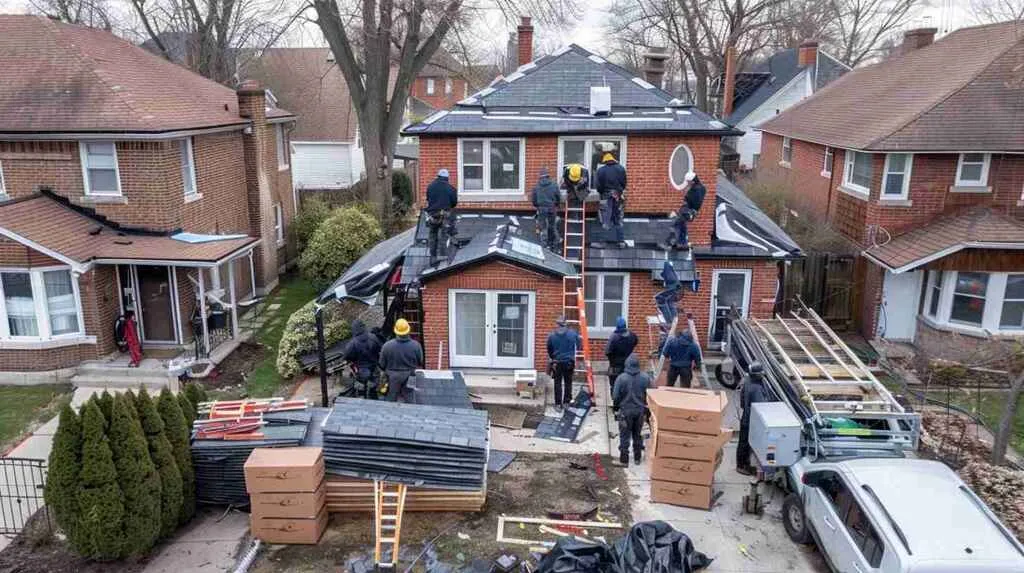
Impact Resistant Roof Shingles Queens NY – Class 4 Explained | Free Quotes
Oddly, most people think impact resistant shingles are just for tornado states with baseball-sized hail – but in Queens, the real value is stopping the sneaky, expensive leaks from sharp sleet, wind-blown branches, and that weird icy junk we get every March. I’m Luis Ortega, and after 19 years on roofs around here, I’ve learned that the worst damage isn’t the dramatic hole you see – it’s the spider-web cracking you don’t, the kind that turns into a $4,000 ceiling stain two winters later.
What Class 4 Impact Shingles Really Do on Queens Roofs
On 41st Avenue last winter, I climbed a roof that looked “fine” from the sidewalk. The owner had bought it two years earlier, and the inspector said the shingles had “plenty of life.” But when I pulled a few pieces to check a vent flashing, the mat underneath showed this pattern of tiny stress cracks – like someone had dropped the shingle fifty times and it finally gave up. That’s when I started carrying printed Class 4 test charts in Spanish and English to every estimate, because there’s a big difference between a salesman saying “impact resistant” and a shingle that actually passed the UL 2218 steel-ball test. I think of it as armor levels for your house: standard 3-tab is like a windbreaker, regular architectural is a winter coat, and Class 4 is body armor. When I walk blocks in Jackson Heights or Astoria, I can point to the roofs that’ll crack first in the next storm just by looking at the surface texture and knowing what’s underneath.
Here’s what the Class 4 test actually measures: they drop a two-inch steel ball from 20 feet onto the shingle twice in the same spot, and if it doesn’t crack or show rupture in the mat, it passes. Lower classes use smaller balls or lower drops. This isn’t about surviving a movie-style hailstorm – it’s about whether your roof can take a branch whipping off the maple tree during a winter wind gust, or whether that ice chunk sliding off your neighbor’s gutter will punch a slow leak that doesn’t show up until your ceiling is sagging. The armor-level idea matters because the test simulates repeated hits, not just one dramatic impact. And in Queens, we don’t usually get one dramatic impact – we get seasons of sleet, debris, thermal cycling, and freeze-thaw that wear down shingles from the inside out. Class 4 construction uses a heavier mat and better adhesive strips, so when something hits, the energy disperses instead of cracking through. That’s the difference between a roof that holds and a roof that starts feeding water into your attic.
| Myth | Fact |
|---|---|
| If the sales brochure says “impact resistant,” it’s automatically Class 4. | Real Class 4 is an actual lab rating (UL 2218); if it’s not on the documentation, the shingle may not pass the test Luis shows on his charts. |
| Class 4 shingles are only useful in states with huge hail like Texas or Colorado. | Queens gets sharp sleet, wind-driven debris, and tree branches that damage roofs in quieter, expensive ways – Class 4 helps with these too. |
| Impact resistant means the shingles will never crack or leak, no matter what. | Class 4 lowers the chance of cracking and granule loss, but no shingle is indestructible; it’s heavier armor, not magic. |
| Class 4 shingles all perform the same, so brand and install don’t matter. | Different Class 4 products have different mats, warranties, and installation requirements; the installer and nailing pattern matter a lot. |
| If my roof looks fine from the sidewalk, it’s handling storms just fine. | From the street you can’t see spider-web cracking in the mat or granule loss around vents – that’s where Luis finds the early failures. |
Cost, Insurance, and Real-World Savings in Queens, NY
Here’s my honest opinion: if you hate surprise repair bills, Class 4 shingles are usually worth the upgrade in Queens. I’ll show you numbers both ways at your kitchen table, but after watching what happens to roofs in Astoria, Bayside, Jackson Heights, and Queens Village – especially the ones near mature trees or on blocks with older power lines that drop branches every winter – the extra cost pays for itself fast. Most rowhouses and two-families around here run 1,200 to 1,800 square feet of roof, and the bump from standard architectural to Class 4 is typically $1,500 to $3,500 depending on pitch, valleys, and how much tear-off we’re doing. In October 2018, just before sunset, I was finishing an impact resistant shingle install in Bayside for an older couple who traveled a lot. A tree branch had punched a hole straight through their old 3-tab shingles the winter before, and water had run right down into their living room TV. While I was packing up, their insurance agent stopped by “just to take a look” and ended up on the roof with me, tapping the new Class 4 shingles and asking questions. That evening turned into a two-hour mini-seminar on why some roofs get discounted insurance rates and others don’t – and he told me that verified Class 4 documentation made claim approval way smoother when damage did happen.
Not every insurance carrier in New York gives a clear discount for Class 4, but the ones that do usually want photos of the packaging, the UL label, and sometimes a signed contractor statement that it was installed per manufacturer specs. That’s why I photograph every bundle before we open it and keep a project folder for each job – it’s not just about doing the work right, it’s about proving you did when someone from the insurance company shows up three years later. Think of it like upgrading from a light jacket to a winter coat for your house’s roof. You wouldn’t walk around Queens in February with just a windbreaker, and you shouldn’t trust a roof with standard shingles when we’re getting these wild freeze-thaw cycles and wind gusts that rip siding off buildings in Corona. The Class 4 upgrade isn’t about being fancy – it’s about not calling me back in five years to patch the same valley for the third time because the mat cracked and now water’s tracking sideways under the flashing.
| Roof Scenario in Queens | Standard Architectural Shingles Installed | Upgrade to Class 4 Impact Shingles Installed |
|---|---|---|
| Small rowhouse roof (800-1,000 sq ft) in Jackson Heights | $7,000-$9,000 | $8,000-$10,500 |
| Typical detached single-family (1,200-1,600 sq ft) in Queens Village | $9,500-$12,000 | $10,500-$13,500 |
| Two-family house (1,800-2,200 sq ft) in Astoria | $11,000-$14,000 | $12,500-$16,000 |
| Larger Bayside colonial (2,400-3,000 sq ft) with multiple valleys | $14,000-$18,000 | $16,000-$20,500 |
| Low-slope front-and-back extension on a Flushing home | $6,000-$8,000 | $6,800-$9,200 |
Quick Facts: Class 4 & Insurance in Queens
- Some New York carriers offer 5-15% premium credits for verified Class 4 roofs, but you need documentation and often a contractor affidavit to qualify.
- The average cost bump for Class 4 on a typical Queens home runs $1,500-$3,500, which one avoided leak repair can cover.
- Class 4 warranties are often longer (30-50 years limited) than standard architectural, but only if installed per manufacturer specs and registered within 60 days.
- During claim reviews, adjusters look for mat cracking and granule loss – Class 4 construction resists both, which can mean faster approval and fewer disputes.
How We Install Class 4 Shingles So They Actually Perform
Picture me at your kitchen table with that little notebook of mine, drawing a circle and punching a pen through it – that’s how I explain impact resistance. If the decking underneath is spongy or the nails are too short, you might as well have put standard shingles up there because the Class 4 armor can’t do its job when the foundation is weak. My crew follows a tight sequence: we inspect and replace any soft plywood or OSB first, roll out the right underlayment (usually synthetic for Class 4 jobs because it grips better and doesn’t wrinkle), and then we pay extra attention around every penetration – vents, pipes, chimneys, eaves – because that’s where most failures start. I’ll never forget a freezing March morning in 2016 on a Queens Village cape where everything went sideways. Forecast said “light flurries” – we ended up with icy pellets hammering us for an hour while half the old roof was torn off. I watched standard laminated shingles on the neighbor’s house lose granules in real time from that sleet, like someone was sanding them. Our crew covered the open deck fast, and that day convinced me to push impact resistant shingles in Queens – not just for hail, but for all the weird, sharp weather we get now. Speed matters, but so does making sure every nail hits solid wood and every starter course is locked down, because Class 4 shingles are heavier and if your nailing pattern is sloppy, they’ll blow off just like cheap ones.
Here’s a specific question you should ask any roofer before they touch your Class 4 job: show me the manufacturer’s spec sheet and point to the required nailing pattern and underlayment, then tell me how you’ll photograph the decking before and after for my records. If they fumble that question, walk away. Installing Class 4 shingles wrong is like wearing body armor with the straps loose – you paid for protection you’re not getting, and when something hits, you’ll find out the hard way. I’ve pulled up Class 4 roofs in Bayside and Astoria where the crew used roofing nails that were a quarter-inch too short, or they skipped the ice-and-water shield at the eaves to save twenty minutes. Those shortcuts turn a $16,000 impact resistant roof into a $16,000 standard roof that just happens to have fancy shingles on top, and when the next storm comes through, you’ll be calling me to fix what should’ve been done right the first time.
Shingle Masters Class 4 Install Process
- Complete deck inspection: We check every sheet of plywood or OSB for soft spots, nail pops, and water damage before a single shingle goes down.
- Proper underlayment selection: Class 4 jobs get high-traction synthetic underlayment and ice-and-water shield at eaves, valleys, and all penetrations per NYC code.
- Manufacturer-spec starter course: We use the exact starter shingle or strip the manufacturer requires – skipping this voids your warranty and invites blow-offs.
- Correct nail length and placement: Class 4 shingles are heavier; we use the specified nail length and hit the nailing zone every time, photographing random sections for quality control.
- Extra fastening around problem zones: Eaves, ridges, hips, and valleys get additional attention because wind uplift starts at edges and works inward.
- Documentation package for homeowner: You get photos of the UL label on every bundle, the installed underlayment, and the final roof, plus a signed statement for your insurance file.
⚠️ Warning: Not All Class 4 Installs Are Equal
Luis has seen these shortcuts on Queens roofs, and each one destroys the impact resistance you paid for:
- Wrong nail length: Nails that don’t penetrate ¾” into solid decking let shingles lift in wind, and the first gust starts the slow peel that ends in a $12,000 claim denial.
- Missing or incorrect starter strip: Without the right starter, the bottom course doesn’t seal, water tracks under the eave, and you get the classic “drip stain” on your fascia and soffit within two years.
- Skipping ice-and-water shield in key areas: Saving $300 on underlayment around chimneys and valleys is how you end up with a $4,000 ceiling leak, because Class 4 shingles can’t stop water that’s already under them.
Should You Upgrade to Class 4 Impact Shingles in Queens?
The blunt truth is, most roofs around here are built to pass inspection, not to take a beating from ice, branches, and wind-thrown junk. If your property has mature trees hanging over the roof, or if you’ve already done two or three leak repairs in the last decade, or if you’re planning to own this house for another ten-plus years, Class 4 is almost always the right call. On the flip side, if you’re flipping the house in eighteen months and the current roof is clean with no overhanging branches, you can probably get away with quality architectural shingles and save the upgrade cost for the next owner. $2,500 in one ceiling repair from a cracked shingle valley wipes out the entire Class 4 upgrade cost on most Queens homes. That’s the armor-level decision: do you want the winter coat that’ll handle most of what Queens throws at you, or do you want the body armor that laughs at the stuff that punches through the coat?
Is Class 4 Right for Your Queens Roof?
START: Is your roof due for replacement in the next 0-2 years?
→ YES: Do you have trees within 20 feet of the roof?
→ YES: Strong Yes for Class 4 – branches and debris are your biggest leak risk.
→ NO: Have you had storm damage or leaks in the past 5 years?
→ YES: Leaning Yes – get a quote both ways and compare insurance credits.
→ NO: Will you own this home for 10+ years?
→ YES: Leaning Yes – longer ownership makes the upfront cost pay off faster.
→ NO: Probably OK with quality architectural shingles – save the upgrade for the buyer.
→ NO (roof not due yet): Keep this info for when it’s time, and budget for Class 4 if you meet the tree/damage/ownership criteria above.
| Pros of Class 4 Impact Shingles | Cons of Class 4 Impact Shingles |
|---|---|
| Better resistance to hail, sleet, and wind-blown debris common in Queens winters and storms. | Higher upfront material cost compared to standard architectural shingles. |
| Lower risk of spider-web cracking and hidden leaks that show up as ceiling stains years later. | Not every insurer in New York offers a clear discount, even with documentation. |
| Potential for insurance premium credits or smoother claim handling when damage does occur. | If installed poorly, you pay for impact resistance you’re not really getting. |
| Often heavier construction and better granule retention, extending roof life when installed correctly. | Limited color or style choices with some Class 4 lines compared to standard lines. |
Straight Answers: Class 4 Shingle FAQs for Queens, NY
When a customer in Astoria asks me, “Luis, will this actually save me money?” I start with their last insurance claim, not the shingle brochure. These are the questions I hear most often in Queens kitchens and on sidewalks after storms, and here’s what I tell people when they want the straight shot, no sales pitch.
How much longer does a Class 4 roof last compared to standard architectural shingles in Queens?
Class 4 shingles typically carry 30-50 year limited warranties compared to 25-30 for standard architectural, but real-world lifespan depends more on install quality and attic ventilation than the shingle itself. In Queens, with our freeze-thaw cycles and wind, I see well-installed Class 4 roofs still looking solid at 20+ years, while sloppy standard installs start failing at 12. The heavier mat and better adhesive in Class 4 construction give you a buffer against the gradual wear that kills roofs here – it’s not magic, just better engineering.
Will Class 4 shingles make my house quieter during hailstorms or heavy rain?
The heavier mat in Class 4 shingles does dampen sound a bit compared to lightweight 3-tabs, but don’t expect a dramatic difference – you’ll still hear heavy rain and hail from inside. The real benefit isn’t the noise level, it’s that you’re not hearing the sound of your roof getting destroyed. I’ve been on roofs during storms where standard shingles are literally shedding granules with each hit, and Class 4 shingles on the next house are taking the same beating without losing surface. You might hear the storm the same, but your roof isn’t paying the price.
Do Class 4 shingles look different or uglier than regular architectural shingles?
Not at all – most Class 4 lines look identical to standard architectural from the street, with the same dimensional texture and color range. Some brands have slightly limited color palettes in their Class 4 offerings, but you’ll still find charcoal, weathered wood, slate gray, and all the popular tones. The difference is in the mat and backing layers you can’t see. I’ve installed Class 4 roofs in Bayside and Jackson Heights where neighbors ask for the color name because they want “that exact look” – they have no idea it’s impact resistant until I tell them.
Does NYC building code require Class 4 shingles, or is it just optional?
Class 4 is optional in New York City – code requires wind resistance and fire rating, but impact resistance is an upgrade you choose. That said, if you’re in a flood zone or if your insurance carrier is pushing back on coverage, they might nudge you toward Class 4 as a condition for renewal or to avoid rate hikes. I’ve had customers in Queens Village and Flushing where the insurer didn’t require it but made it very clear that claims would be smoother with documented impact resistance. Code allows it, insurance likes it, but it’s your call.
Can I replace just part of my roof with Class 4 shingles and leave the rest standard?
You can, but I don’t recommend it unless there’s a structural reason like a separate garage or addition. Mixing shingle types on one continuous roof plane creates warranty confusion, color-matching problems, and insurance documentation headaches – and if a storm hits, the adjuster will wonder why you only armored half the roof. If budget is tight, I’d rather see you do the whole roof in quality architectural now and upgrade to full Class 4 when it’s due for replacement again. Partial upgrades make sense for detached structures, not for chopping a single roof into two different protection levels.
How do I verify a roofer is actually installing real Class 4 shingles and not faking it?
Ask to see the UL 2218 Class 4 label on the shingle wrapper before they open any bundles, and take a photo yourself. Then ask for a copy of the manufacturer’s spec sheet and a signed contractor statement that the roof was installed per those specs. If the roofer wonbles or says “we don’t usually do that,” you’ve got your answer. At Shingle Masters, I hand you a folder at the end of the job with photos of every bundle label, the underlayment installation, and a signed affidavit for your insurance file – because the whole point of paying for Class 4 is having the documentation when you need it, not just pretty shingles.
Why Queens Homeowners Trust Shingle Masters for Class 4 Roofs
- 19 years serving Queens neighborhoods: Luis has personally walked roofs in Astoria, Bayside, Jackson Heights, Corona, Flushing, and Queens Village – he knows the weather, the trees, and the buildings.
- Fully licensed, insured, and city-compliant: We pull permits, carry full liability and workers’ comp, and follow NYC building code to the letter on every Class 4 install.
- Fast storm-damage inspections: When a storm rolls through Queens, we’re out within 24-48 hours doing free assessments and helping you document damage for insurance.
- Class 4 documentation package included: Every impact resistant roof gets a full photo set, UL label copies, and a signed contractor statement – no charge, just part of doing the job right.
And honestly, that last part – the documentation – is what separates a real Class 4 install from a “trust me, it’s impact resistant” job. If you’re thinking about upgrading your Queens roof to Class 4 shingles, or if you just want a straight answer about whether it makes sense for your house, give Shingle Masters a call for a free, no-pressure assessment. I’ll walk your roof myself, show you photos of what I find, and price out both standard architectural and Class 4 so you can decide with real numbers in front of you, not just a sales pitch.