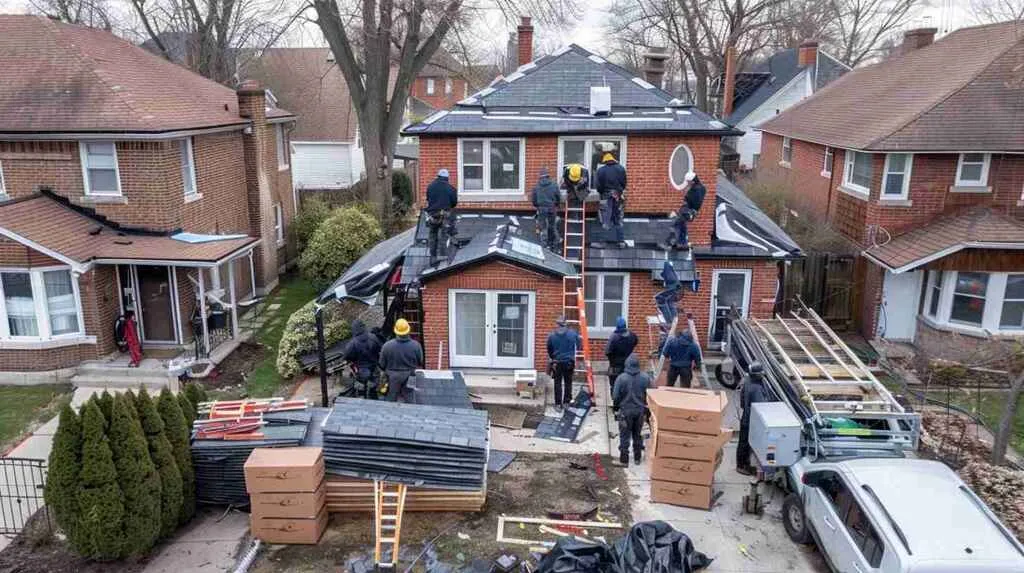
Presidential Shingles Queens NYC – Premium Look, Real Performance
Blueprint first: A properly installed presidential shingle roof in Queens runs $7.50 to $10.50 per square foot installed, while a basic 3-tab roof might cost $4 to $5. But over 25 years in Queens storms, that “cheap” roof will likely cost you two teardowns, multiple tarp visits, and interior damage-easily double the lifetime cost. From an engineering standpoint, I’ll tell you flat out: the extra $3 per square foot up front is the smartest money you’ll spend on a house that sits under nor’easters and summer microbursts.
What a Presidential Shingle Roof Really Costs in Queens, NY
When someone calls me for a quote on presidential shingles, the first thing I do is pull up their property on satellite and check the roof complexity-pitch, dormers, penetrations, and how exposed the block is to wind. Then I give them a per-square-foot number that includes everything: tear-off, deck inspection, proper underlayment, ice & water shield, ventilation upgrades, and the presidential shingles themselves with the fastening pattern they need to survive Queens weather. Yeah, it’s a higher number than the lowball bids floating around, but when I show them what’s actually included and what fails when corners get cut, they get it. Here’s the reality: even though the upfront cost per square foot looks steeper, the lifetime cost of a presidential system is dramatically lower because you’re not re-roofing in 12 years or calling for emergency repairs every time wind gusts hit 50 mph.
Picture this: It’s 2 a.m. on a Sunday in November, rain’s coming sideways, and you hear that slow drip starting in the ceiling. On a cheap roof, that sound is the beginning of a very expensive week-blown-off tabs from inadequate fastening, exposed nail heads where sealant failed, underlayment that wasn’t rated for the pitch or the wind exposure, and now you’ve got drywall damage, insulation to replace, maybe mold remediation if it sat for a few days. A presidential shingle system-properly engineered with matching components-doesn’t have those failure points because every layer was designed to work together under stress. Now, here’s where it connects to real life: over the 25-year lifespan of a good roof, that $3-per-square-foot premium saves you $8 to $12 per square foot in avoided repairs, replacements, and interior damage. The sections below break this down like a design problem, because that’s exactly what it is.
Presidential Shingle Roof Pricing: Real Queens Scenarios
| Scenario | Roof Size | Cost per Sq. Ft. | Total Range | Key Cost Driver |
|---|---|---|---|---|
| Small row house, Astoria | 12 squares | $8.50-$9.50 | $10,200-$11,400 | Tight access, party-wall flashing |
| Detached colonial, Bayside | 20 squares | $7.50-$8.75 | $15,000-$17,500 | Standard pitch, good access |
| Hip roof with dormers, Forest Hills | 24 squares | $9.00-$10.50 | $21,600-$25,200 | Multiple valleys, steep pitch, extra flashing |
| Semi-attached, Flushing | 18 squares | $8.25-$9.75 | $14,850-$17,550 | Multiple penetrations, shared wall complexity |
| Larger two-family, Woodhaven | 30 squares | $7.75-$9.00 | $23,250-$27,000 | Larger scale, moderate complexity |
All ranges include tear-off, deck inspection, proper underlayment, ice & water shield at critical areas, ventilation components, and presidential shingles installed to manufacturer wind-resistance specs for Queens, NY.
Upfront vs. Lifetime Cost: The Real Numbers
| Roof Type | Installed Cost/Sq.Ft. | Service Life (Queens) | Major Repairs (25 yrs) | Lifetime Cost/Sq.Ft. | Typical Failure Point |
|---|---|---|---|---|---|
| 3-Tab Basic | $4.00-$5.00 | 10-14 years | 2 full replacements, 3-5 storm patches | $11.00-$14.00 | Tabs blow off in 45+ mph gusts, exposed nails fail |
| Standard Architectural | $5.50-$7.00 | 15-20 years | 1 full replacement, 2-3 leak repairs | $8.50-$10.50 | Perimeter and ridge lift, underlayment tears in freeze-thaw |
| Presidential Shingles (System) | $7.50-$10.50 | 22-30 years | 0-1 minor repairs | $7.50-$11.00 | Rare; typically chimney flashing aging or penetration seals |
Why Presidential Shingles Outperform ‘Premium-Only-on-Paper’ Roofs
From an engineering standpoint, I’ll tell you flat out: not all “premium” shingles deserve the word. I saw this firsthand one July in Forest Hills, around 3:30 p.m., the kind of afternoon where you can feel the heat radiating off the roof deck before you even climb the ladder. The homeowner had hired another crew six years earlier for what was sold as a high-end roof-shingles looked great, color was still sharp-but they’d cut costs on underlayment and used mismatched ventilation. The result was a disaster: buckling on the south-facing slope, blistering along the ridge, and a persistent chimney leak that wouldn’t quit. We tore it down to the deck, and I could see exactly what happened-cheap felt underlayment had degraded under the tight attic heat typical of pre-war Forest Hills homes, and without proper vent channels, the shingles were cooking from below while baking from above. We rebuilt it as a true presidential system: synthetic underlayment rated for high temps, matching ridge vents, proper ice & water at every transition, and presidential shingles that were actually engineered to work with those components. Final thermal scan showed the attic was running 15 degrees cooler, and two years later, it’s still perfect.
So what makes a real presidential shingle system different? Start with the construction: heavier laminated tabs with deeper profiles, not just cosmetic texture printed on a thin base. The nail strip is wider and reinforced, which matters when wind tries to peel your roof back like a sardine can. The underlayment and ventilation aren’t afterthoughts-they’re specified to match the shingle’s weight, thermal expansion, and wind rating. And the wind rating itself is typically 110 to 130 mph, tested and certified, not marketing copy. Now, here’s where it connects to real life: that heavier laminate means the shingles age slower under Queens summer sun because the asphalt isn’t flexing and cracking every afternoon. The reinforced nail strip means less uplift when wind funnels between houses during a nor’easter. Proper underlayment means fewer leak paths when ice dams form after a January freeze-thaw cycle. And real ventilation means your attic stays 10 to 15 degrees cooler on a July heatwave, which extends the life of every component on your roof.
✅ True Presidential Shingle System: Engineering Features That Matter in Queens
- ✅ Multi-layer laminated construction (30+ year rated) – Stays flat and sealed when summer heat hits 95°F on your Bayside roof deck
- ✅ Reinforced, wider nail strip – Resists uplift when wind funnels down your Jackson Heights block at 50 mph
- ✅ Synthetic underlayment (rated for high temps and tear resistance) – Won’t degrade in tight Forest Hills attics or rip during freeze-thaw cycles
- ✅ Enhanced granule adhesion and UV blockers – Color and protection stay consistent through 20+ Queens summers
- ✅ Matching ventilation components (ridge, soffit, baffles) – Keeps attic temps down and prevents moisture buildup in older Queens homes
- ✅ Impact and algae resistance built into the shingle – Handles debris strikes during storms and stays clean longer in humid Queens summers
⚠️ Warning: Mixing Presidential Shingles with Bargain Components
Installing presidential shingles over low-grade underlayment, minimal ice & water shield, or mismatched ventilation is like putting race tires on a car with worn brakes-the weakest link kills the whole system. In Queens, this mistake shows up fast: chimney leaks after the first nor’easter, ridge vent failures when summer humidity spikes, and buckling on south-facing slopes after a few heatwaves. If you’re paying for presidential shingles, make sure every layer underneath is engineered to match. Otherwise, you’re just buying an expensive cosmetic that won’t last.
How Queens Weather Punishes Weak Roof Designs
In Queens, roofs don’t fail on clear days. They fail at the exact moment your “saved” dollars are least helpful.
On a typical block in Queens-let’s say 48th Avenue in Bayside-you can spot the presidential shingle roofs from half a block away. Not because of the color or the texture, though those are nice, but because they’re the ones that still look tight and flat after a storm while the neighbors are out with tarps and buckets. I remember one February consultation on a Bayside colonial, the kind of day where slushy snow was turning to ice pellets mid-fall and wind gusts were spiking to 40 mph. The homeowner wanted presidential shingles purely for curb appeal, and I spent an hour on his roof-yeah, in that weather-showing him how the laminated profile and nail strip design would actually resist uplift, not just look sharp from the driveway. His neighbors told him he was overbuilding, that a cheaper architectural shingle would be fine. Then Hurricane Ida hit in 2021, and he texted me a photo: his presidential shingle roof was completely intact, both houses next door had blue tarps and missing ridge caps. That’s not luck. That’s a simple design tradeoff-slightly higher cost per square foot up front, dramatically lower probability of catastrophic failure when the weather does what we all know it’s going to do. So here’s the question I ask every homeowner in Queens: are you designing for code minimums, or the actual storms you know are coming?
Engineering Trade-Offs: Code Minimum vs. Presidential Performance
| Roof Approach | Pros | Cons |
|---|---|---|
| Code-Minimum Asphalt Roof | Lower upfront cost ($4-6/sq.ft.); faster install; meets legal requirements; easy to find cheap bids | Wind rating often 60-90 mph (insufficient for Queens nor’easters); thinner shingles crack faster in heat; underlayment often felt (degrades quickly); high failure rate in storms; 10-15 year lifespan; multiple repairs likely |
| Presidential Shingle System Roof | Wind rating 110-130 mph (handles Queens storms); impact-resistant; thicker laminate lasts 22-30 years; proper underlayment and vents prevent heat/moisture damage; rare need for repairs; better resale value | Higher upfront cost ($7.50-10.50/sq.ft.); heavier (requires deck inspection on older homes); takes longer to install correctly |
Queens, NY Stress Factors: What Your Presidential Shingle Roof Has to Handle
Wind Gusts During Nor’easters
Typical range: 45-65 mph sustained, gusts to 75+ mph. Matters because: without proper fastening and reinforced shingles, perimeter and ridge shingles lift and tear.
Freeze-Thaw Cycles Per Winter
Average: 12-18 cycles per season. Matters because: cheap underlayment and sealant crack, creating leak paths along valleys and flashing transitions.
Typical Roof Pitch in Queens
Most colonials and row houses: 6/12 to 8/12 pitch. Matters because: steeper pitches shed water faster but amplify wind uplift; requires upgraded fastening patterns and ice & water coverage.
Housing Stock Age
Bayside, Forest Hills, Astoria: 50-90+ years common. Matters because: older deck boards and framing often need repair or reinforcement before a heavy presidential system goes on; hidden ventilation paths may be inadequate.
Designing Your Presidential Shingle Roof Like a Machine Under Stress
When I walk your property for the first time, the first thing I’ll ask is, “How long are you planning to stay in this house?” Not to be nosy-because that answer changes how I design your roof. If you’re staying five years, I might recommend a high-quality architectural shingle with some system upgrades but not the full presidential treatment. If you’re staying 15 to 25 years, or you’re handing this house down to your kids, then a presidential shingle system becomes a pure engineering decision: you’re designing for the longest possible service life at the lowest total cost, and that means heavier shingles, better underlayment, upgraded ventilation, and flashing that won’t corrode or crack. This is a classic load-versus-lifespan tradeoff. Presidential shingles weigh more-about 400 to 480 pounds per square versus 200 to 300 for standard architectural-so on older Queens homes, especially pre-war colonials in Flushing or Forest Hills, I’ll inspect the roof deck and framing first. If the structure can’t handle the weight, we reinforce. If you’re planning to stay long-term and the house can take it, the extra weight becomes an advantage: better wind resistance, less thermal flexing, longer life. It’s an if-this-then-that design scenario, and I walk you through every variable before we commit.
Here’s an insider tip that’ll save you thousands: on older Queens homes, always have your roofer inspect-and if needed, upgrade-the roof decking and hidden ventilation paths before you invest in presidential shingles. I can’t tell you how many times I’ve seen a homeowner in Woodhaven or Flushing pay top dollar for premium shingles, only to have the system fail early because the deck boards were warped, the soffit vents were blocked with old insulation, or there were zero baffle channels in the attic. Now, here’s where it connects to real life: if your deck is sagging or your attic has no airflow, even the best presidential shingles will buckle, blister, and age twice as fast because they’re sitting on a hot, moisture-trapped base. The shingles themselves might be rated for 30 years, but the system fails in 12. When I do a walkthrough, I’m not just looking at what’s visible from the street-I’m checking attic temps with an infrared thermometer, I’m crawling into tight spaces to see if vents are actually open, and I’m pulling up a test shingle to see if the deck is solid or spongy. That’s the kind of pre-work that determines whether your presidential roof lasts 15 years or 30.
Our Presidential Shingle Roof Process: Six Steps from Assessment to Storm-Ready
- Engineering-Style On-Site Assessment – We walk your roof and property like a design problem: measure pitch, check wind exposure (nearby tall buildings, open lots), inspect attic ventilation, and document current conditions with photos and thermal imaging.
- Detailed Documentation and Measurement – Precise square footage, penetration count, flashing transitions, and any structural concerns (sagging deck, loose framing). This becomes the basis for accurate material selection and pricing.
- System Design Selection – Based on how long you plan to stay and your budget, we recommend the specific presidential shingle line, underlayment grade, ventilation components, and flashing materials. Short-term vs. long-term owner? The system changes.
- Tear-Off and Live Deck Inspection – Once the old roof is off, we inspect every deck board in real time. Rotten or warped boards get replaced, not covered up. If we find ventilation blockages or inadequate structure, we address it before the new system goes on.
- Full Presidential System Installation – Synthetic underlayment, ice & water shield at all critical transitions, proper baffle and vent installation, then presidential shingles with the manufacturer-specified fastening pattern for Queens wind zones. Every step is photographed.
- Final Walkthrough and Storm Expectation Review – We walk the finished roof with you, explain what to expect during the first big Queens storm (spoiler: nothing dramatic, just quiet performance), and hand over warranty documentation and maintenance notes.
Is a Presidential Shingle Roof Right for Your Queens Home?
Start: Are you planning to stay in your home at least 10 years?
✓ YES
Next question: Is your house on a corner, near open lots, or exposed to wind from nearby tall buildings?
✗ NO (Staying <10 years)
Consider a high-quality architectural shingle with upgraded underlayment and ventilation. Presidential shingles can still help resale value, but the full system may be overkill.
If YES to 10+ years: Is your current roof older than 15 years or showing storm damage (missing shingles, leaks, buckling)?
High Exposure + Old/Damaged Roof
→ Recommendation: Go presidential system now. Your roof is in the failure zone and your location punishes weak systems. Invest in the engineered solution.
Lower Exposure or Roof Still Serviceable
→ Recommendation: Upgraded architectural with key components. You have time, but when you re-roof, consider presidential for long-term peace of mind.
Unsure About Condition or Exposure
→ Recommendation: Schedule an inspection before deciding. We’ll assess deck, ventilation, and storm risk, then give you the real engineering tradeoffs.
Real-World Impact: Nor’easters, Flying Debris, and 2 A.M. Leaks
I still think about a job I did in Woodhaven where the homeowner thought their “designer” shingles would handle anything. He was a sharp guy, used to work in construction management, and he’d done his homework-pulled out old site plans, asked me detailed questions about fastening patterns and wind zones. He was skeptical about spending extra on presidential shingles for what he saw as a small, well-protected row house. I pulled out my tablet and showed him wind maps for his block, explaining how even though his house sits mid-row, wind eddies off the taller apartment building two blocks over create uplift zones on his roof ridge and corners. He wasn’t convinced, but he let me spec a presidential system anyway. A year later, during a nasty November nor’easter with sustained winds around 55 mph, a metal fascia panel from that apartment building tore loose and slammed into his roof. He called me in a panic at 7 a.m. the next day. We got up there that afternoon, and I’ll never forget what we found: a scuff mark on the presidential shingle surface, no penetration, no cracked tabs, no exposed underlayment. He looked at me and said, “Okay, you won the argument.” That’s the difference between a shingle that looks premium and a shingle that’s engineered premium.
Think of a presidential shingle roof like a layered armor system, not just a pretty jacket for your house. When rain hits sideways at 2 a.m. in a Queens nor’easter, here’s what’s actually happening: the outer shingles deflect the water and resist wind uplift because they’re heavier and laminated. The synthetic underlayment beneath them is your second line of defense-it’s waterproof, tear-resistant, and doesn’t degrade in attic heat like old felt. The ice & water shield along the eaves, valleys, and penetrations is your third layer, sealing every nail hole and transition point where leaks love to start. The ventilation system-baffles, ridge vents, soffit vents-keeps air moving so moisture doesn’t condense inside and rot your deck from below. And the deck itself, if we’ve inspected and reinforced it, is the structural base that holds the whole system flat and tight. Every layer works together. When one layer is weak-cheap underlayment, missing ice & water, blocked vents-the whole system degrades faster, and that’s when you get the 2 a.m. drip, the interior stain, the emergency tarp call. A properly engineered presidential shingle system doesn’t have weak layers, which is why it quietly does its job for 25 to 30 years while cheaper roofs are failing every 10 to 15.
Common Questions About Presidential Shingle Roofs in Queens
How do presidential shingles handle Queens wind compared to regular architectural shingles?
Presidential shingles are rated for 110 to 130 mph winds, versus 90 to 110 mph for standard architectural shingles. In Queens, where nor’easters routinely gust to 60+ mph and microbursts can spike higher, that extra rating translates to dramatically better uplift resistance along ridges, eaves, and corners. The heavier laminated construction and reinforced nail strip mean the shingles stay put when regular shingles start lifting and tearing.
Is the extra weight of presidential shingles a problem for older Queens homes?
It can be if the deck and framing are compromised, which is why we inspect before installation. Presidential shingles weigh about 400-480 lbs per square, versus 200-300 for basic shingles. On pre-war homes in Flushing, Forest Hills, or Bayside, we check for sagging, rot, or undersized framing and reinforce as needed. Once the structure is sound, the extra weight is actually an advantage-it resists wind better and sits flatter in heat.
Are presidential shingle roofs louder or quieter during heavy rain?
They’re typically quieter. The thicker, multi-layer laminate dampens impact noise better than thin single-layer shingles, and the higher-quality underlayment adds another sound barrier. Most homeowners notice that rain sounds are softer and less “drumming” compared to their old roof, especially during those overnight Queens downpours.
How do presidential shingles affect resale value and insurance in Queens?
A documented presidential shingle roof with transferable warranty can add $8,000 to $15,000 to resale value in Queens neighborhoods like Bayside, Forest Hills, and Astoria, because buyers know they won’t need a new roof for 20+ years. Some insurance carriers also offer discounts for impact-rated shingles and high wind ratings, typically 5% to 10% off annual premiums, though that varies by insurer and your specific location.
How long does installation take, and what disruption should I expect?
For a typical 18- to 24-square Queens home, tear-off and installation of a presidential shingle system usually takes 3 to 5 days, weather permitting. You’ll hear noise during tear-off and nailing, and you’ll need to keep pets inside and clear the driveway for the dumpster. We protect landscaping, clean up daily, and use tarps if weather threatens overnight. Most homeowners say it’s less disruptive than they expected, especially compared to the alternative of living with a failing roof.
Why Trust Shingle Masters for Your Presidential Shingle Roof in Queens
- ✓ Licensed and Insured in NYC – Fully licensed for roofing and construction in New York City, with liability and workers’ comp coverage on every job.
- ✓ 19+ Years of Queens Shingle Experience – We’ve installed hundreds of presidential shingle roofs across Bayside, Forest Hills, Astoria, Flushing, Woodhaven, and beyond, and we know every neighborhood’s unique wind, heat, and structural challenges.
- ✓ Manufacturer-Trained and Certified – We’re trained and approved by leading shingle manufacturers to install their presidential systems to exact specifications, which activates full warranty coverage for you.
- ✓ Local Response and Storm Support – After major Queens storms-nor’easters, tropical remnants, summer microbursts-we offer priority inspections for our customers to check for damage and handle any claims documentation you need.
A presidential shingle roof isn’t a cosmetic upgrade-it’s an engineered system designed to handle the specific wind, heat, freeze-thaw, and storm conditions that Queens throws at a roof over 25 to 30 years. When I walk your property, I’m not selling you a color or a brochure; I’m pricing out a system that matches your block, your house structure, and your time horizon. If you’re serious about a roof that performs like the machine it needs to be, call Shingle Masters and let’s walk your roof like a design problem-measure the exposure, check the deck, talk through the tradeoffs, and price out a presidential shingle system built for your specific Queens address.