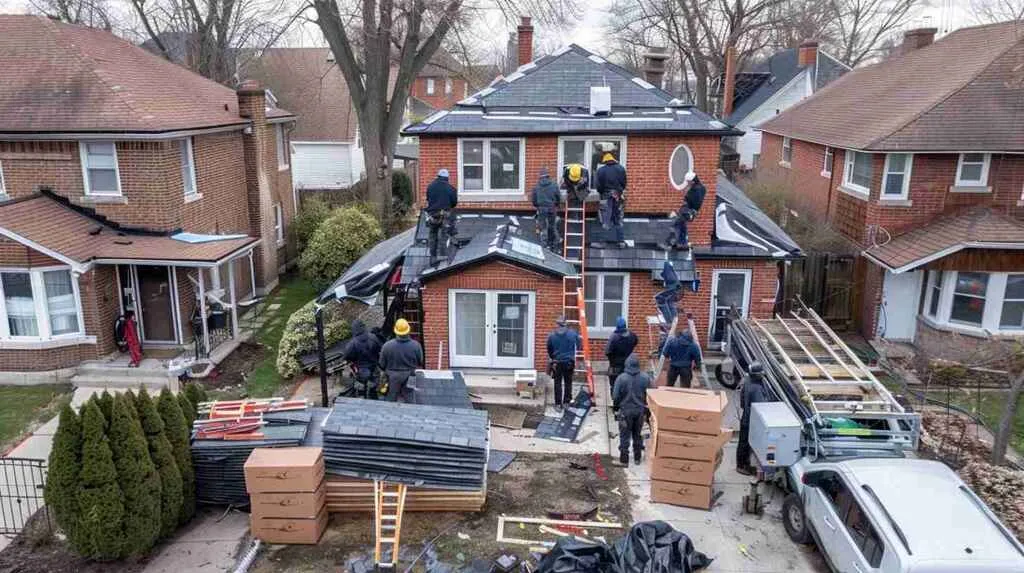
Shingle Barn Style Roof Queens NY – Gambrel Profile Done Right | Call Today
Sideways leaks at the gambrel break line will cost you more in repeat repairs than a proper install would have cost in the first place. I’ve seen it happen too many times across Queens-homeowner gets a “deal” on a barn-style shingle roof, then spends three years chasing water stains and calling different guys to patch the same spot over and over. My name’s Carlos Vega, and around here I’m known as the gambrel guy who sketches your roof on whatever’s handy-pizza box, envelope, back of a napkin-so you actually understand what you’re buying before any shingles go down.
Why Gambrel Shingle Barn Roofs in Queens Leak – and How I Stop It
On a row of attached houses in Astoria, I once saw three barn-style gambrel roofs back-to-back-to-back, and every single one had active leak issues at the break line and valleys because the installer treated them like standard colonials with a weird angle. The thing is, those transition points-where the steep upper slope meets the gentler lower slope-need to be overbuilt, period. I’m blunt about this: you should never, ever value-engineer the break line on a gambrel. If your roofer tries to skip the extra ice & water shield, the reinforced transition detail, or the proper valley protection at those slope changes, you’re gonna pay for it later. Repairs cost more than doing it right once. I think about a gambrel roof the same way I think about arranging a song from my old salsa band days-you’ve got your rhythm (the two different slopes), your chorus (the main faces everyone sees from the street), and your bridge (that critical gambrel break). If your bridge is off, the whole song sounds wrong. And if your break line isn’t tight, the whole roof leaks.
So what exactly is a gambrel profile? Picture a staircase laid on its side-you’ve got a steep upper slope that drops down, then hits a break line and transitions to a much gentler lower slope. That classic barn look. It’s handsome, it adds character, and it creates a ton of usable attic space. But Queens weather-wind whipping off the East River, driving rain that hammers those lower slopes, freeze-thaw cycles every winter-punishes cheap installs hard. A gambrel isn’t just “install asphalt shingles and go home.” The break, the valleys, the lower slope where snow sits and ice dams form-all of it needs more attention, more underlayment, more fasteners than a standard pitch. When you do it right, you avoid thousands in leak repairs and you get a roof that actually earns that barn-style charm instead of just looking the part for two years before the trouble starts.
⚠️ If your barn-style roof has these details, you’re on borrowed time in Queens
- No or minimal ice & water shield across the gambrel break and into the lower slope – that transition is where ice dams and wind-driven rain hit hardest
- Shingles run straight through the break without a reinforced transition detail – the slope change creates stress, and shingles need extra backing at that bend
- Open valleys without woven or metal-backed protection at the slope changes – valleys funnel water fast, and on a gambrel you’ve got double the pressure at each intersection
- No dedicated ventilation at the upper gambrel ridge – heat chokes at the top, curls shingles early, and turns your attic into an oven every summer
| Scenario | What’s Usually Wrong | Typical Scope of Work | Estimated Cost Range (Queens, NY) | Risk If You Delay |
|---|---|---|---|---|
| Minor leak at break line | Missing or poorly lapped ice & water shield at the gambrel transition; shingles lifting from wind stress | Strip 4-6 courses above and below break, install full-width ice & water shield, re-shingle with proper fastening pattern | $1,200-$2,800 | Water migrates under more shingles; plywood rot begins; interior ceiling damage shows up within 12-18 months |
| Chronic valley leaks | Open valleys with no metal flashing; shingles cut too short; inadequate underlayment at slope change intersections | Re-work both valley runs with woven valley technique or metal-backed protection; replace damaged deck sections; install continuous underlayment | $2,400-$5,500 | Framing damage spreads; fascia and soffit rot; possible attic mold; cost doubles if you wait another year |
| Full-profile rebuild for failed bargain install | Entire gambrel done with minimal prep, wrong shingle type, no ventilation planning, multiple corners cut at every step | Full tear-off, inspect and repair deck and framing, install proper underlayment system across all slopes and transitions, re-shingle with architect-grade materials, add ventilation | $9,500-$18,000+ | Complete structural failure; interior water damage to walls, insulation, electrical; risk of collapse in severe weather; potential code violations if you try to sell |
Getting the Gambrel Profile Right the First Time
Picture a staircase laid on its side-that’s how I think about a gambrel profile. You’ve got your steep upper riser that gives you all that vertical drama and attic headroom, then the break line where things flatten out into a gentler lower slope that extends down toward your gutters. Before I even pull a ladder off my truck, I’m pulling out a Sharpie and sketching your roof on whatever’s handy-envelope, pizza box, back of a permit-so you can see exactly how those two slopes interact, where the valleys run if you’ve got dormers, and where the stress points live. Around neighborhoods like Maspeth, Middle Village, and Queens Village, attic layouts are all over the map. Some houses have full-height second floors under that steep slope, some have kneewalls and crawl spaces, and that changes everything about how I frame and vent your gambrel. Local knowledge matters because a cookie-cutter approach to a barn roof in Queens will fail you every single time.
The first question I always ask a homeowner who wants that barn look is: are you optimizing for pure curb appeal from the street, or are you after 30-plus years of low-maintenance performance with minimal callbacks? Because here’s the thing-you can have both, but only if we align the underlayment, the framing tweaks, and the shingle selection with your actual priority from day one. Some folks want a specific color or texture to match the block; others just want bulletproof and they don’t care if it’s charcoal or weathered wood. Either way, I refuse to compromise on the critical transition details-the break line gets overbuilt, the valleys get extra protection, and the ventilation gets mapped out on paper before a single bundle goes up. That’s my process. You tell me what matters most, I show you how to get there without cutting the corners that cause leaks, and we shake hands on a plan that makes sense for your house and your budget.
How my gambrel shingle barn roof install or rebuild works in Queens, NY
- Initial call and sketch session: You call, I come out within 24-48 hours, and we stand in your driveway while I sketch your roof profile on something handy and walk you through what you’re looking at-slopes, breaks, valleys, ventilation path. No jargon, just a drawing and plain talk.
- Detailed written estimate with options: I measure everything, take photos of your deck and framing if there’s existing damage, then send you a line-item estimate that shows repair vs. rebuild options, material choices, and realistic timelines for Queens permitting and weather windows.
- Pre-work prep and permits: Once you approve, I pull the permits (if required by your neighborhood or building type), order materials to match your choice, and schedule the crew. You’ll get a start date and a day-by-day outline so you know exactly when to expect noise, dumpsters, and when we’ll be wrapping up.
- Install or rebuild with overbuilt transitions: Tear-off (if needed), deck inspection and repair, full underlayment with extra ice & water shield at the gambrel break and valleys, then shingle installation with proper fastening at every slope change. Ventilation goes in at the ridge and intake points before final caps.
- Final walkthrough and cleanup: I walk you around the house, show you the finished profile from multiple angles, answer any last questions, make sure gutters and yard are clean, then hand you copies of permits, warranty docs, and my cell number for the next decade if you ever need anything.
Why Queens homeowners call me for gambrel barn-style roofs
- ✓ 19 years roofing, 11 years focused on barn-style gambrel roofs – I’ve seen every failure mode and every fix, and I know which details matter most in Queens weather
- ✓ Licensed and insured in NYC and Nassau County – full liability and workers’ comp, so you’re covered if anything goes sideways on the job
- ✓ Typical response time for on-site gambrel inspections: 24-48 hours – I answer my phone, I show up when I say I will, and I bring my sketch pad every time
- ✓ Dozens of completed gambrel profiles in Astoria, Flushing, Maspeth, Middle Village, and Queens Village – I know your neighborhood, your weather, and the quirks of your local building stock
From Sketch on a Box to Finished Barn Roof
When I pull that Sharpie out and start drawing your gambrel on a pizza box lid, what I’m really doing is translating geometry into a conversation. You point at the break line on the sketch, I show you where the ice & water shield doubles up. You ask about the ridge, I draw the airflow arrows and explain why we need intake vents hidden behind those barn eaves. By the time we’re done, you’ve got a simple drawing that makes sense, and I’ve got a clear picture of what you’re worried about and what you’re hoping for. That sketch becomes the reference for the whole job-my crew looks at it, the supplier uses it to confirm material counts, and you keep it so you can see exactly what we promised to build.
Real Queens Barn Roof Fixes: What I Learned the Hard Way
There was this one job in Middle Village where a “bargain” install taught me more than any training course ever could. It was a freezing February morning, maybe 6:30 a.m., and I was standing in the dark with a thermos of coffee, staring at a half-finished gambrel roof while freezing rain started blowing sideways. The homeowner had tried to DIY the lower slope with bargain shingles from a big-box store, and every seam at the break line was already lifting-you could literally see daylight through the gaps. I stopped my crew, grabbed my notebook, and re-laid out the whole transition detail on the hood of my van right there in the sleet. We had to strip what he’d done, add a full run of ice & water shield across the break, then re-shingle with a proper woven starter and an extra row of fasteners at the slope change. That job took an extra day and cost him more to fix than it would’ve cost to hire a pro from the start. From that morning on, I decided I’d never install a shingle barn style roof without overbuilding the transition between the two slopes, no exceptions. Here’s an insider tip: if a contractor can’t clearly explain how they’re handling the break and show you a sketch-even a rough one-don’t sign anything. Walk away. You’ll save yourself thousands.
I’ll never forget a Saturday call from an older couple in Flushing with a red shingle barn style roof on a garage that they’d had done “cheap” three years earlier. It was raining hard, the gutters were overflowing, and water was literally pouring out of the ceiling light in the garage like someone had left a faucet on. I showed up in a yellow rain suit, climbed up on a slippery ladder, and instantly saw the problem: no ice & water shield at the break, and the starter course was backwards on the steep upper slope-shingles were shedding water straight into the seams instead of away. We tarped it tight, walked inside soaking wet, and I laid out two options on a napkin at their kitchen table-patch the worst spots and hope it holds another year or two, or strip and rebuild the whole gambrel profile the right way. They looked at each other, nodded, and chose the full rebuild. It wasn’t cheap, but it was honest, and they knew exactly what they were getting. I still drive by to check on “my red barn” every few months when I’m in that part of Flushing. It’s held up beautifully, and every time I see it I’m reminded that doing it right once always beats doing it twice.
| Myth | Fact |
|---|---|
| “Any roofer can handle a gambrel-it’s just shingles on a different angle.” | The break line and valleys create unique stress points that generic crews don’t account for. A gambrel needs specialized underlayment, transition detailing, and ventilation planning or you’ll be chasing leaks within two years. |
| “Gambrel barn roofs always cost twice as much as a standard colonial roof.” | A properly detailed gambrel costs maybe 15-25% more than a standard pitch because of extra underlayment and labor at transitions, not double. The real cost difference comes if you cheap out and have to redo it-then you’re paying twice. |
| “You don’t need ventilation on a barn-style roof because the attic space is so big.” | Big attic space traps even more heat if there’s no ventilation path. A poorly vented gambrel can run 15-20°F hotter than a properly vented one, cooking your shingles from underneath and shortening their life by years. |
| “Ice & water shield at the eaves is enough protection for a Queens winter.” | On a gambrel, the break line is where ice dams and wind-driven rain hit hardest-often harder than the eaves. You need ice & water shield across the entire break and well up into both the upper and lower slopes, not just a 3-foot strip at the gutter line. |
Ventilation, Heat, and Gambrel Roof Comfort in Queens
Key ventilation facts for gambrel shingle roofs in Queens
Aim for manufacturer-recommended net free area split between intake at the lower slope and exhaust at the upper ridge-usually 1:1 ratio, sometimes 60/40 intake-to-exhaust depending on gambrel geometry.
Low-profile ridge vents at the upper gambrel peak plus hidden soffit or under-eave intake vents behind the barn-style faces-keeps airflow invisible from the street while doing the job.
Poorly vented gambrels can run 15-20°F hotter in the attic than a properly vented profile-that extra heat bakes shingles from below, curls tabs early, and voids most manufacturer warranties.
Good ventilation can add several years of useful life to asphalt shingles in Queens’ hot summers-worth every dollar when you consider replacement costs down the road.
If your attic feels like a Queens subway platform in August, your gambrel roof is trying to tell you something.
When you stand on the sidewalk and look up at a gambrel roof, what you don’t see is how hot air chokes at the upper slope if the ridge is framed wrong or there’s no dedicated venting up there. One July afternoon in Queens Village, it was 95° outside and the plywood on a gambrel dormer was so hot you could’ve cooked an egg on it-I’m not exaggerating. The customer was an engineer who kept emailing me spreadsheets about ventilation ratios, and halfway through the install we discovered the original builder had run the ridge beam too low, choking off airflow at the upper slope. I grabbed my tape measure, climbed back down, and used his own spreadsheet to show him why we needed to pop in two low-profile ridge vents and add hidden intake vents behind the barn eaves. He approved it on the spot because the numbers made it obvious. That roof rides cooler today than most of the flat colonials on his block, and his AC bills dropped noticeably the first summer. Heat management isn’t some luxury add-on-it’s part of getting a gambrel right.
Here’s what that job taught me to tell every homeowner: a well-ventilated gambrel can actually run cooler inside than many standard roofs because you’ve got more volume and better airflow geometry if you plan it correctly. You reduce AC costs, you extend shingle life by years, and you keep your attic from turning into a sauna every July. Now, here’s where that really matters for you-when I’m quoting your barn roof rebuild or install, I’m going to map out the intake and exhaust paths on that same sketch we did in the driveway. You’ll see exactly where air comes in at the lower slope or hidden soffits, how it flows up through the attic space, and where it exits at the ridge. One very practical insider tip: ask your roofer to show you those airflow paths on a simple drawing before work starts, especially if you’ve got dormers or barn eaves that complicate the geometry. If they can’t sketch it out in 60 seconds, they probably haven’t thought it through, and you’re gonna have a hot, miserable attic and shorter shingle life as a result.
| Pros of Adding/Improving Ventilation | Potential Drawbacks/Considerations |
|---|---|
| Cooler attic temps in summer-often 15-20°F drop-which reduces AC load and makes upper floors more comfortable | Retrofit work on an existing gambrel may require cutting new openings or modifying soffits, adding $800-$1,800 to the project cost |
| Extended shingle lifespan by preventing heat buildup that curls and degrades asphalt from below | If your attic has insulation issues or air leaks, ventilation alone won’t solve comfort problems-you may need to address the building envelope too |
| Better moisture control in winter, reducing risk of mold, rot, and ice dam formation at the lower slope | Low-profile ridge vents are visible from some angles; if strict historical preservation applies to your Queens block, you may need special approval |
| Protects manufacturer warranty-most shingle warranties require adequate ventilation or they’re void | Ventilation effectiveness depends on proper balance between intake and exhaust; adding only ridge vents without intake does almost nothing |
Do You Need Repair or a Full Gambrel Rebuild?
Let me be blunt about this part of your barn-style roof: once leaks keep returning at the break, valleys, or around dormers, patching is usually throwing money away. I treat a gambrel like arranging a song-you’ve got your roof rhythm (the slopes), your chorus (the main faces everyone sees), and your bridge (that critical break line and all the transitions). If your bridge is out of rhythm and the transitions are wrong, I don’t try to tape over the bad notes-I rewrite that section. You can’t fix a structural mistake with another tube of caulk and a prayer. Now, here’s where that really matters for you: when you see stains spreading across your ceiling, paint peeling on interior walls, drafts coming from the attic in winter, or you’re calling a different guy every six months to patch the same leak, your roof is telling you the fundamentals are wrong. And every time you pay for another patch, you’re burning money you could’ve put toward a proper fix that actually solves the problem once.
So how do I decide between focused repair and full rebuild when I show up at your house? I look at three things: the condition of the deck (is the plywood solid or starting to sag and rot?), what’s under the shingles (is there any underlayment at all, or did the last guy skip it?), and how many corners were cut the first time around. If the deck is good, there’s decent underlayment in most areas, and the problem is isolated to one valley or a small section of the break line, a targeted repair with upgraded details can absolutely work. But if I’m pulling back shingles and finding backwards starter courses, no ice & water shield, open gaps at the slope change, and the deck’s spongy in multiple spots, we’re past repair territory. At that point I walk you through the options with simple sketches and plain numbers-what a patch will cost and how long it might hold versus what a proper rebuild costs and what you get for that investment. The choice is yours, always, but I make sure it’s an informed choice, not a sales pitch. You’ll know exactly what you’re buying and why it makes sense for your house and your budget.
Should you repair or rebuild your shingle barn-style gambrel roof in Queens?
START: Have you had more than one leak in the last 2 years from the gambrel break, valleys, or dormers?
→ NO
Targeted repair and detail upgrade may be enough. Schedule an inspection to pinpoint the issue and reinforce that specific transition or valley with proper underlayment and flashing.
→ YES
Continue below ↓
Is your current roof less than 10 years old?
→ YES
Likely a bad install. Full or partial gambrel profile rebuild recommended-the fundamentals are wrong and patching won’t fix it.
→ NO
Continue below ↓
Is the sheathing still solid with no sagging or rot?
→ YES
Re-skin with full underlayment and correct details. Strip old shingles, inspect deck, install proper ice & water shield across break and valleys, then re-shingle with attention to transitions.
→ NO
Full tear-off, repair framing, and rebuild gambrel profile. Deck damage means water has been getting in for a while-address the structure, then rebuild the roof system from sheathing up with all the right details.
Can you just fix the one leak at my gambrel break line?
Sometimes, yes-if the deck is solid, the rest of the underlayment is intact, and the leak is truly isolated to a small section where a seam failed or a few shingles lifted. I’ll strip back 4-6 courses above and below that spot, install a full-width run of ice & water shield across the break, and re-shingle with proper fastening. But if I get up there and find no underlayment at all, backwards details, or soft deck, I’m gonna tell you straight that a patch will just move the problem six feet over in another year. Honesty first.
What shingle brands and types work best on barn-style roofs here?
I typically spec architectural-grade asphalt shingles from GAF, CertainTeed, or Owens Corning for Queens gambrel roofs-thicker, better wind resistance, longer warranties. For the barn look, a lot of homeowners like the dimensional “woodgrain” or “shake” profiles that add texture and shadow lines. Color choice depends on your neighborhood and your goal (blend in or stand out), but I always recommend darker tones if you’re adding ventilation because they hide ridge vents better. And I won’t install anything that doesn’t meet the manufacturer’s wind rating for coastal Queens-we get serious gusts off the water, and cheap 3-tab shingles lift at the break every single time.
How long does a full gambrel rebuild usually take in Queens?
For a typical single-family gambrel-say 1,400-1,800 square feet of roof surface-plan on 4-7 working days from tear-off to final cleanup, assuming decent weather and no major framing surprises. Day one is usually tear-off and deck inspection/repair. Days two and three are underlayment, flashing, and starting the shingle courses. Days four through six are finishing the install, adding ventilation, and doing all the detail work at the break, valleys, and ridge. Day seven (if needed) is cleanup, final inspection, and walkthrough. Weather delays happen-this is Queens, after all-so I build a little buffer into every schedule and keep you updated if we have to pause for rain or high wind.
Do you handle permits and HOA/landmark approvals for my barn-style roof?
Yes. If your property requires a building permit (common for full rebuilds or structural work in many Queens neighborhoods), I pull it, handle the inspections, and make sure we close it out properly so you’ve got a clean record when you sell. If you’re in a landmarked district or an HOA with design review, I’ll prepare the drawings and material specs you need for approval and walk you through the submission process. I’ve done this enough times in Astoria, Flushing, and Middle Village that I know what the reviewers want to see, and I can usually get approvals without a lot of back-and-forth. You shouldn’t have to become a permit expert just to fix your roof-that’s my job.
The difference between a charming barn look and a chronic leak problem comes down to how the gambrel profile is detailed at the break line, the valleys, and the ventilation points. I’ve been doing this for 19 years, and the last 11 have been all about getting those transitions right so you don’t end up calling me-or anyone else-every time it rains. If you’ve got a shingle barn style roof in Queens that’s giving you trouble, or you’re thinking about adding that gambrel profile to your house and you want it done right the first time, call Shingle Masters today. I’ll come out, sketch your roof on whatever’s handy, and give you a straight answer about repair versus rebuild with real numbers and no pressure. Let’s get your barn roof sorted.