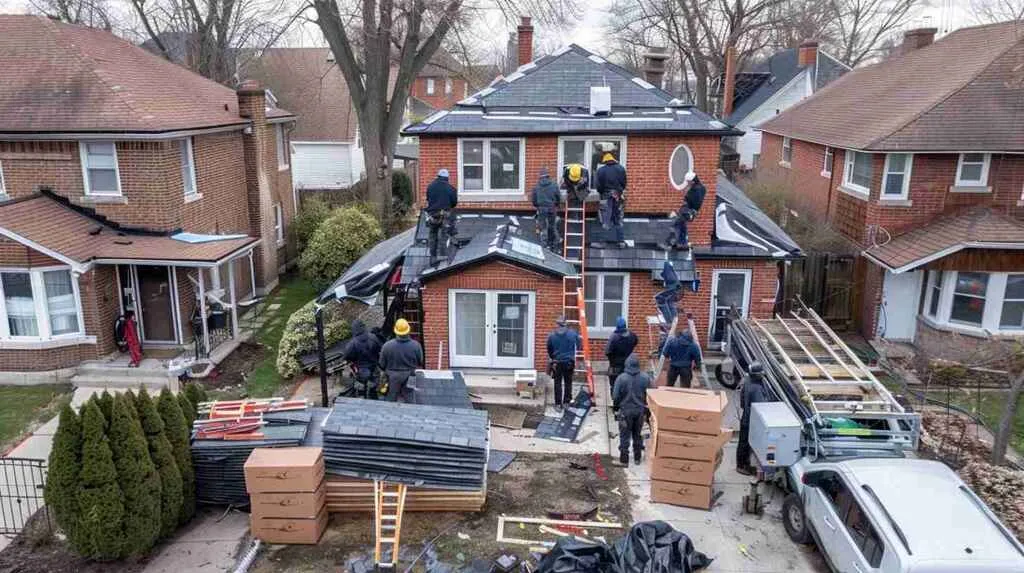
Residential Asphalt Shingle Roofing Queens NY – Trusted Local | Free Quotes
Blueprint: a full tear-off and replacement on a standard Queens 1,600-2,000 square-foot residential asphalt shingle roof – the kind you’ll find on most two-families and rowhouses from Jackson Heights to Howard Beach – runs between $9,500 and $19,000 in 2024, and the big chunk of that range depends on your roof’s shape, pitch, valley complexity, and ventilation, not the shingle brand you pick. A simple gable with minimal penetrations sits at the low end; a multi-plane roof with dormers, hips, and aging decking that needs spot replacement hits the upper tier, and if you’re on a corner lot or near the water where wind really whips, you’ll want high-wind nailing and upgraded underlayment that push the number higher still.
Real Queens Asphalt Shingle Roof Costs (And Why Shape Beats Shingle Brand)
If you think of your roof like the NYC subway, the brand of shingle is just the color of the train cars – nice to look at, sure, but the real schedule and reliability come from the tracks, signals, and ventilation “platforms” underneath. I’ll tell homeowners straight up: on most Queens residential asphalt shingle roofs, what drives your price and your long-term performance isn’t whether you pick Brand X architectural versus Brand Y three-tab. It’s how many planes your water has to cross to reach the gutter, how your attic breathes (or doesn’t), and whether the crew knows how to flash a valley or a chimney so it actually drains instead of pooling. Queens housing stock is a patchwork – attached rowhouses with shared walls, detached corner lots catching wind from three sides, older two-families with mixed-era framing and minimal vents – so a flat quote per square foot doesn’t cut it. You need someone who looks at your specific roof map, counts the “transfer points” where water switches direction, and prices the labor for doing those details right.
Queens Asphalt Shingle Roof Cost Guide (2024)
| Roof Scenario | Approx. Roof Size | Typical Price Range (Labor + Materials) |
|---|---|---|
| Flat-ish 20×40 two-family, simple gable, minimal vents | 1,600-1,800 sq ft | $9,500-$13,000 |
| 20×40 with two dormers and older decking needing spot repairs | 1,700-1,900 sq ft | $11,500-$15,500 |
| Corner lot 1-family with hips, valleys, and full ridge vent upgrade | 2,000-2,400 sq ft | $14,000-$19,000 |
| Attached rowhouse with limited access and code-mandated ventilation fixes | 1,200-1,500 sq ft | $8,500-$11,500 |
| Wind-exposed property near the water (Rockaways/Howard Beach) with high-wind nailing and ice/water upgrade | 1,800-2,200 sq ft | $15,000-$21,000 |
One March afternoon around 3 p.m., I was on a Howard Beach two-story where wind gusts were hitting 40 mph off Jamaica Bay, and the homeowner had just replaced his shingles three years earlier with a “great price” from a guy who skipped starter strips and nailed high – half the south slope was peeled back like a banana. I knelt there in the cold wind with my tape measure, showed the owner exactly how far off the nailing pattern was, and watched his face fall when he realized the problem wasn’t bad shingles but a bad install. He’d already paid once. Now he was paying again, and the second time cost more because the exposed decking had taken water damage over three winters. That job is why I take photos at every stage for Queens homeowners who’ve already been burned – you can’t shortcut the “tracks and signals” just because the train cars look shiny, and when wind funnels down a Queens street or barrels in off the water, every nail, every flashing strip, and every starter course matters or the whole line backs up.
On a typical 20-by-40 two-family in Queens, what actually matters on your shingle roof?
On a typical 20-by-40 two-family in Queens, the first things I look at aren’t the shingles themselves but the drainage map: how many planes does water cross before it hits a gutter, where are the valleys and hips that act like “transfer stations,” and how does your attic or top-floor space breathe? Most of these houses were framed decades ago, sometimes in waves – original structure from the ’40s or ’50s, dormer added in the ’80s, skylight punched in during a renovation – so you end up with mixed ventilation (maybe a couple of old gable vents, maybe none, maybe a hodgepodge of soffit and roof vents that don’t talk to each other). Water “commutes” across your roof like passengers trying to get from Flushing to Manhattan during signal problems: if there’s a bottleneck at a valley or a poorly flashed dormer, the backup happens fast and you get pooling, then leaks. In attached rowhouses or two-families with shared party walls, you’ve also got parapet flashing and step flashing along the sides, and if those aren’t done right, wind-driven rain will find the seam. Queens wind doesn’t just come from one direction, either – a corner lot in Forest Hills or Astoria catches gusts from multiple angles, so slopes that look sheltered on paper aren’t always sheltered in practice.
I’ll be honest: most leaks I see in this borough aren’t about “old shingles,” they’re about lazy details. One sticky August night around 8:30 p.m., I got an emergency call from an older couple in Flushing whose bedroom ceiling was dripping onto a plastic salad bowl – nothing crazy weatherwise, just a passing thunderstorm, but their ridge vent had been nailed straight through the open slot so water was funneling right in like a downspout. I went up with a headlamp while it was still lightly raining, carefully popped the ridge cap off, and showed the husband, who was a retired engineer, how the slot should be cut and the cap should cover it without blocking airflow. A correct ridge vent detail on an asphalt shingle roof means cutting a clean one-inch slot along the peak, laying a breathable filter fabric, then capping with vented ridge shingles that let hot, humid air escape while keeping rain out. When it’s done backwards or skipped entirely, you trap heat and moisture in the summer – which shortens shingle life and can rot the decking from the inside – and you funnel water straight into the house during storms. We ended up having a half-hour talk on their porch about airflow and shingle longevity while the cicadas screamed in the background, and he sketched out his own little diagram to show his wife why the fix mattered. That detail – a ridge vent done right – can be the difference between a roof that lasts fifteen years and one that pushes past twenty-five in humid Queens summers.
✓
Key Inspection Points Before Quoting Your Queens Asphalt Shingle Roof
-
✅
Roof shape and pitch – how many planes, hips, and valleys your “water commuters” have to cross before reaching the gutter, and where bottlenecks or pooling are likely. -
✅
Existing attic or top-floor ventilation – soffit vents, ridge vents, gable vents, or none at all; mismatched or blocked vents trap heat and shorten shingle life. -
✅
Flashing at chimneys, skylights, dormers, and party walls – these “switches” determine whether water flows cleanly or backs up into your house during wind-driven rain. -
✅
Decking condition – spongy spots, past patches, or signs of long-term moisture around penetrations; rotted plywood won’t hold nails and can spread fast if covered up. -
✅
Access and safety constraints – tight side yards, power lines, neighboring buildings; limited access adds time and equipment costs but can’t be ignored for a safe, legal job.
If you think of your roof like the 7 train, here’s how we keep traffic flowing
If you think of your roof like the 7 train, your shingles are just the cars – the real magic is in the tracks and signals underneath. The underlayment is the track bed that keeps everything aligned and prevents derailments (leaks). Flashing at valleys, dormers, and chimneys acts like the switches that route water trains onto the right line and away from your living space. Ventilation – soffit intake and ridge exhaust – is the signal system that keeps air moving so heat and humidity don’t back up and stall the whole operation. When I walk a roof with a homeowner, I sketch this out on my notepad, literally drawing little arrows to show how water flows from ridge to eave, and where it could “transfer” the wrong way if a valley or step flashing isn’t installed with the right overlap and sealant. Here’s my insider tip: before you sign any contract, ask the roofer to show you – with photos or a simple diagram – exactly how they’re going to detail your ridge, your valleys, and your step flashing, not just which shingle brand they’ll use. If they can’t or won’t walk you through those “signal points,” they’re selling you train cars without checking the tracks.
Covering up a bad deck is like running full rush hour on broken tracks – eventually something’s gonna derail, and it’ll cost you way more to fix the mess than if you’d replaced the bad tie in the first place.
There was a Saturday morning in late October in Astoria when a client insisted we could lay new shingles directly over a sunken, soft area near his dormer because “it’s just cosmetic.” I pulled out my utility knife, cut a clean square out of the old decking right there on the roof, and my hand went straight through to the insulation – the plywood was black and crumbling from years of a tiny, hidden leak around the dormer step flashing. He went quiet when he saw daylight coming through from the side. That one stuck with me, and it’s when I started my firm policy: if your roof feels like a bad floorboard, I’m not covering it up. Rotted decking spreads, it won’t hold fasteners in high wind, and it voids most manufacturer warranties. A proper tear-off lets you find and replace those compromised sheets before you invest in new shingles, and in the long run it protects your budget because you’re not paying twice – once for the “cheap” overlay and again a few years later when the real damage finally shows up inside your house.
When a Queens asphalt shingle roof is an emergency-and when it can wait
Here’s the blunt truth: Queens roofs get abused from every direction – wind off the water in the Rockaways and Howard Beach, constant temperature swings that make shingles expand and contract daily, pollution and debris from highways and airports, and the fact that most of our housing stock is older and packed tight so limited airflow can accelerate wear. Not every issue is a midnight call, but certain leaks and missing shingles can’t wait because the damage compounds fast once water gets past your first line of defense. I take a calm, measured approach when a homeowner calls panicked – a quick five-minute conversation about what you’re seeing, when it started, and where it’s happening lets me triage whether this is a same-day emergency repair, a next-week scheduled fix, or something we can plan for the next dry season without risking your ceiling or your belongings.
Call ASAP (Same Day / Next Day)
-
•
Active leak during or right after rain – drips, ceiling stains spreading fast, water near fixtures or outlets. -
•
Multiple shingles missing or lifted on a main slope, especially after a wind event or storm. -
•
Sagging or soft spots you can feel from inside the top floor – possible decking failure or structural issue. -
•
Water near electrical fixtures, panels, or the service mast – safety hazard that needs immediate attention.
Can Usually Wait a Few Weeks
-
•
Small, dry ceiling stain that hasn’t changed size in months – worth inspecting, but not an active emergency. -
•
Granules in gutters but shingles still lying flat – normal aging; schedule an inspection to plan replacement timing. -
•
Isolated shingle curls on an older but not leaking roof – monitor it, plan a replacement in the next season or two. -
•
Planning to sell in 6-12 months and roof is aging but functional – gives time to budget and schedule properly.
Straight answers to Queens asphalt shingle roofing questions
I get these questions weekly from Queens homeowners comparing quotes, so I figured I’d answer them here the same way I do on the stoop: no sales talk, just numbers and sketches. These are the real concerns folks bring up when they’ve been burned before or when they’re trying to decide between three wildly different bids.
Q
How long should a new asphalt shingle roof last in Queens?
On paper, most architectural asphalt shingles carry warranties from 25 to 30 years, and some premium lines claim “lifetime” (which really means 50 years under perfect conditions). In Queens, with our temperature swings, humidity, wind, and pollution, you’re looking at realistic lifespans between 18 and 28 years for a well-installed roof. The big variable isn’t the shingle brand – it’s how well your attic ventilates and whether the installation followed manufacturer specs for nailing, underlayment, and flashing. A roof with proper soffit-to-ridge airflow that keeps your deck cool in summer and dry in winter can hit the upper end of that range or beyond. A roof with blocked vents, backwards ridge details, or improper fastening might start showing problems in fifteen years or less, no matter what the warranty says. Wind exposure matters too: properties near the water or on open corner lots take more abuse and may age faster even with perfect install.
Q
Are architectural shingles worth the extra cost on my Queens home?
For most Queens residential roofs, yes – architectural (also called dimensional or laminate) shingles are worth the modest upcharge over basic three-tab, and honestly most modern installs default to architectural for good reason. They’re heavier, more wind-resistant (usually rated to 110-130 mph winds versus 60-70 for traditional three-tab), and they lie flatter so water drains cleaner. The thicker profile also hides minor deck imperfections better and tends to last longer because there’s more asphalt and granule protection. The price difference on a typical Queens roof runs about $800 to $1,500 total, which spreads out to pennies per year over the roof’s life. If you’re in a wind-prone area – Rockaways, Howard Beach, corner lots in Astoria or Bayside – or if your house has curb appeal you want to maintain for resale, architectural shingles are a no-brainer. The only time I’d even consider three-tab today is on a very small, low-slope utility building where appearance and longevity aren’t priorities.
Q
Can you roof in cold or very hot weather here?
Asphalt shingles are designed to seal down with heat – the sun warms the adhesive strips on the back and bonds each course to the one below. In Queens, that means I prefer to schedule installs when daytime temps are consistently above 45°F and below about 85°F, roughly late March through June and September through early November. You can install in colder weather if the forecast gives a few sunny days afterward to activate the seal, but shingles get brittle below freezing and you risk cracking them during handling or nailing. Very hot weather – mid-summer heat waves in the 90s – makes shingles soft and easy to scuff or dent when you’re walking on them, and the deck can get dangerously hot for the crew. I’ll work around those extremes by starting very early in the morning on hot days or hand-sealing tabs in cold installs, but if you have flexibility, spring and fall are the sweet spots for both shingle performance and crew safety in this climate.
Q
Do I need new plywood if I don’t see any leaks inside?
Not necessarily, but you won’t know until someone walks the roof and checks from above. Decking rot often starts around penetrations – chimneys, vent pipes, dormers – where a small flashing leak sends water into the same spot for years without ever dripping through your ceiling. The plywood turns soft and black, loses its nail-holding power, and can spread outward from that hidden point. When I do an inspection, I’m literally walking every square foot, feeling for spongy areas with my boots, and pulling back old shingles at valleys and edges to peek at the deck. If I find isolated soft spots, I’ll usually recommend replacing just those sheets during tear-off – adds a few hundred dollars and a couple hours, but it’s way cheaper than discovering the problem mid-install or, worse, having your new roof fail in wind because the nails pulled out of rotten wood. If the entire deck feels solid, we photograph it during tear-off to document condition and move forward. You don’t replace good plywood, but you absolutely don’t shingle over bad.
Q
How do your estimates work, and will I see photos?
Every Shingle Masters estimate includes photos of your current roof from multiple angles, simple hand-drawn diagrams showing the work zones and critical details (valleys, ridges, flashing points), and a line-item breakdown so you see what you’re paying for – tear-off and disposal, new decking if needed, underlayment type and coverage, shingle brand and quantity, flashing materials, ventilation upgrades, labor, and cleanup. I started doing this because too many Queens homeowners told me horror stories about vague one-page quotes that didn’t match the work performed. You’ll get a digital packet via email within 48 hours of the site visit, and I’m happy to walk through it over the phone or in person so you understand every line. During the actual install, I take progress photos at key stages – deck inspection, underlayment and flashing, shingle courses, final ridge and cleanup – and text or email them to you so you’re never guessing what’s happening on your roof. It’s how I’d want to be treated if I were spending ten or twenty thousand dollars.
Why Queens Homeowners Trust Shingle Masters
Luis and the Shingle Masters team handle everything from emergency leak hunts and spot repairs to full residential asphalt shingle roof replacements across Queens. Call Shingle Masters today for a photo-backed, line-item quote on your Queens home – no pressure, just clear answers and a plan that actually makes sense for your roof and your budget.