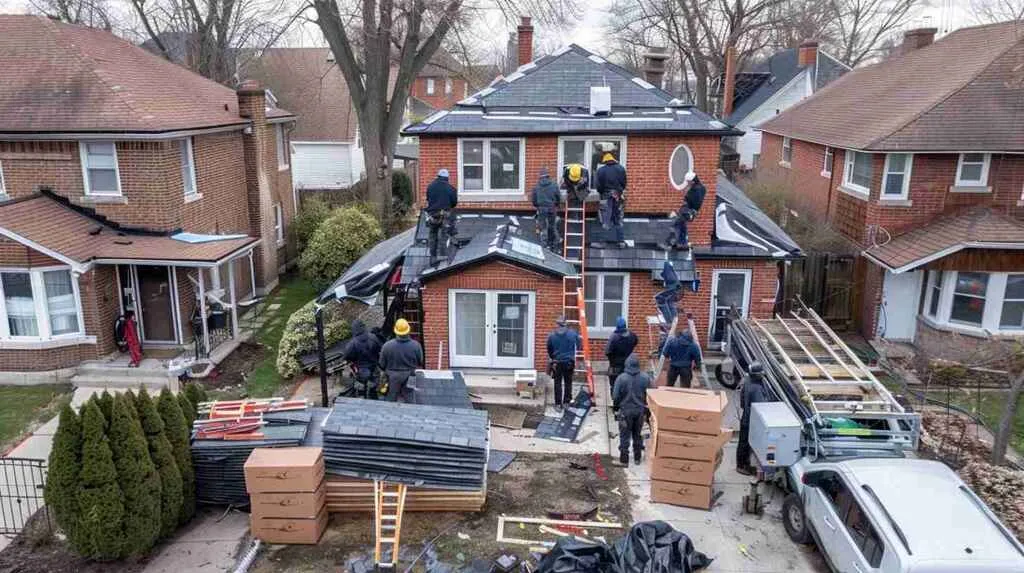
What Is a Shingle Roof Made Of Queens NYC – Every Layer Explained
Blueprint time: most people think shingles are the main event, but on Queens roofs they’re just the visible lobby carpet-the real engineering is in the layers you never see. We’re about to walk you up through your roof layer by layer, like riding the elevator in a six-story walk-up, so you understand what a shingle roof is really made of and why leaks usually start below the part everyone’s looking at.
Every Layer of a Queens Shingle Roof, From the Deck Up
One August afternoon, about 3 pm, I was on a two-family in Flushing, sun just beating down, and the homeowner kept asking why her roof was leaking when the shingles ‘still looked new.’ We started peeling it back and found out the last guy skipped the underlayment on a whole valley-looked fine from the street, disaster underneath. That job is why I always tell people, the visible part of the shingle roof is like the lobby of your building; the real safety is in the hallways and beams you never see. And here’s my blunt opinion after 19 years: most ‘mystery leaks’ in Queens aren’t about shingle age-they’re about someone skipping or cheaping out on one of the hidden layers, especially valleys and eaves.
On a typical Queens row house, the first thing I look at isn’t the shingles at all-it’s the wood deck under everything. That’s your floor structure, the actual bones holding up the whole roof system. Usually it’s plywood sheets or OSB (oriented strand board), nailed to the rafters. When it goes wrong, you’ll see spongy spots, old boards that were “patched” with whatever scrap was lying around, or sections that feel like they’re about to give under your weight. That deck is the first floor of your roof building-if it’s compromised, nothing above it stays put for long.
Walk one floor up and you hit the ice and water shield and underlayment, the layers that actually keep moisture out when Queens weather gets serious. Ice and water shield is a peel-and-stick rubberized membrane that goes at the eaves and valleys-places where water likes to sit or back up. Above that, synthetic underlayment (or old-school tar paper if the job was done years ago) wraps the whole deck like wallpaper. These layers matter in Queens because we get humidity off the water in summer, wind-driven rain in fall, and freeze-thaw cycles all winter. Your shingles? They’re just the hallway carpet laid on top of all that structure-they get the credit, but the underlayment does the work.
| Layer (Bottom to Top) | Typical Material | What It Actually Does |
|---|---|---|
| Roof Deck | Plywood or OSB sheets | Structural base-holds nails, transfers load to rafters, gives everything above a solid platform |
| Ice & Water Shield | Rubberized peel-and-stick membrane | Seals eaves, valleys, and chimneys where water backs up or sits; self-seals around nails |
| Underlayment | Synthetic felt or tar paper | Secondary water barrier over entire deck; sheds water that gets under shingles |
| Drip Edge | Aluminum or galvanized metal | Directs water off edge into gutters; prevents fascia rot and wind-driven rain backup |
| Starter Shingles | Special first-course shingles | Covers gaps at eaves so first row of field shingles seals properly; prevents wind lift |
| Field Shingles | Asphalt-fiberglass composite with granules | Main waterproof layer; protects underlayment from UV, sheds bulk of rain and snow |
| Ventilation & Ridge Caps | Ridge vents, box vents, soffit vents | Balances attic temperature and humidity; prevents shingle baking and ice dams |
What Each Hidden Layer Is Made Of (And How It Fails in Queens)
Roof Deck, Ice Shield, and Underlayment
I’ll be honest with you: if a roofer only talks to you about ‘the brand of shingles,’ they’re skipping the most important chapters of the story. Let’s start with the roof deck-usually half-inch plywood or OSB nailed across your rafters. It’s supposed to be dry, flat, and solid. In Queens, where houses were often built in waves (1920s, 1950s, 1980s), you’ll find everything from tongue-and-groove boards to particle board someone swore would hold up. When it fails, it sags, gets spongy from moisture, or splits around old nail holes.
Above that deck, ice and water shield is a sticky, rubberized membrane that goes down first at the eaves (at least three feet up in NYC by code) and in every valley. It’s literally peel-and-stick, and it self-seals around nails so water can’t sneak back. Then comes the underlayment-modern synthetic felt that looks like black fabric, or old-school tar paper that crumbles after a decade. I’ll never forget a January job in Howard Beach, wind whipping off the water, feels-like temperature in the teens. A retired school principal asked me why her attic was frosty on the inside of the roof deck. I walked her through every layer-deck, ice shield, underlayment, shingles, vents-right there in the cold, and she laughed and said it felt like being back in science class. That’s when I realized some folks actually want the full ‘roof anatomy lesson’ before they trust you to touch their shingles. In coastal Queens, where you get wind-driven rain and freeze-thaw cycles all winter, cheap underlayment or missing ice shield turns into ceiling stains by March.
✅ Key Hidden Components Under a Queens Shingle Roof
- ✅ Roof Deck (Plywood/OSB): The structural floor-must be solid, dry, and properly nailed to rafters
- ✅ Ice & Water Shield: Peel-and-stick membrane at eaves, valleys, chimneys-self-seals around every nail
- ✅ Synthetic Underlayment: Secondary water barrier across entire deck; better than old tar paper for Queens humidity
- ✅ Drip Edge: Metal channel at eaves and rakes that directs water into gutters and off fascia boards
- ✅ Flashing: Metal (aluminum or galvanized) around chimneys, skylights, vents-seals every roof penetration
- ✅ Starter Strip Shingles: Special first course at eaves so field shingles have something to seal against-prevents wind peel-back
Flashing, Drip Edge, and Starter Shingles
Flashing is thin aluminum or galvanized metal bent into shape and tucked around anything that pokes through or interrupts the roof-chimneys, vent pipes, skylights, sidewalls. Think of it like the fire doors or window flashing you see in brick Queens buildings: it’s the metal that keeps water from sneaking into joints. Drip edge is a simple L-shaped metal strip nailed along every eave and rake edge; it hangs over slightly so water drips into the gutter instead of wicking back under the shingles or rotting the fascia board. Starter shingles are a special first course, usually just a strip of shingle adhesive and backing, laid at the very bottom so the first row of field shingles has something to seal against and won’t peel up in wind.
Here’s where Queens shortcuts show up: no drip edge at all (water runs down the fascia and rots it), bad patchwork flashing where someone used tar instead of metal, or no starter strip so the first shingles curl and lift every time the wind blows off the Grand Central or the LIE. I’ve seen jobs where three layers of old shingles were hiding the fact that nobody ever installed proper step flashing at a chimney-so every rain, water ran down inside the wall. If you’re not seeing these components listed by name on a quote, you’re getting a ‘lobby-only’ job, and the real structure of your roof is being ignored.
⚠️ Warning: Common Hidden-Layer Shortcuts in Queens
Missing underlayment in valleys, no ice & water shield at eaves, or bare edges without drip edge are three of the most common reasons ‘new roofs’ leak in Queens, even when the shingles look fine from the street.
These hidden failures don’t show up in the first month-they show up two winters later, when water backs up under an ice dam, runs down a valley with no membrane, or wicks behind a fascia board that was never protected by drip edge. By then, the cheap roofer is long gone and you’re calling someone else to fix the layers that were never done right in the first place.
Shingles, Ventilation, and the ‘Apartment Building’ Inside Your Roof
What the Shingles Themselves Are Made Of
One afternoon in Elmhurst, standing on a two-story with the 7 train rattling in the background, I showed a homeowner how her underlayment had turned to tissue paper. But let’s talk about what the shingles themselves are: an asphalt-fiberglass mat base, coated top and bottom with asphalt, then covered with ceramic granules for UV protection and color. The bottom has adhesive strips that heat-seal the shingle above it when the sun hits. Most Queens homes get either three-tab shingles (flat, three cut-outs per strip, cheapest option) or architectural shingles (thicker, dimensional, longer warranty, better wind rating).
There was this Saturday morning in Corona, light rain, where a landlord swore his ‘cheap three-tab shingles’ were the only problem. When we opened it up, we found patched plywood, no drip edge on half the eaves, and two different types of underlayment taped together like a bad craft project. That job turned into a full tear-off and rebuild, and ever since, when someone asks ‘what is a shingle roof made of,’ I answer, ‘Either smart decisions stacked on each other-or every shortcut anyone ever took on your house.’ The shingles are just the top floor; if every floor underneath is a mess, the penthouse doesn’t matter.
| Option | Pros for Queens Homes | Cons / Tradeoffs |
|---|---|---|
| Architectural Shingles | Thicker (two layers laminated), better wind resistance (110+ mph rated), dimensional look, 25-30 year warranty, hides roof imperfections well | Higher cost per square, heavier (need solid deck), slightly longer install time |
| 3-Tab Shingles | Lowest cost, lighter weight (good for older decks), uniform flat look, easier to replace individual damaged tabs | Lower wind rating (~60-70 mph), thinner (wears faster in Queens sun/freeze cycles), shorter warranty (15-20 years), dated appearance |
Ventilation, Ridge Caps, and Other Small Parts That Matter
Think of your shingle roof like a classic six-story walk-up in Astoria: you’ve got floors, ceilings, pipes, and locks-shingles are just the nice hallway carpet everyone notices. Ventilation is the radiators and windows of that building, keeping the air inside your attic balanced so heat and moisture don’t cook the underside of your deck or turn your shingles into potato chips. Ridge vents run along the peak and let hot air out. Soffit vents or low intake vents let cool air in at the eaves. Box vents are the little square hatches you see on older Queens roofs. Ridge cap shingles are special bent pieces that cover the ridge vent or the peak itself, sealing it from rain while letting air flow through.
Here’s my insider tip after 19 years in Queens attics: don’t just add more vents randomly. You need balanced intake (soffit area) and exhaust (ridge or box vents at the top). If you cut in three more box vents but your soffits are packed with insulation or painted shut, you didn’t fix anything-you just created short-circuit airflow that pulls from one vent to another instead of pulling through the whole attic. In Queens, where summer heat can turn an attic into an oven and winter condensation can frost the underside of your deck, proper ventilation isn’t an upsell-it’s the HVAC system for the ‘apartment building’ inside your roof.
📅 Roof Layer Checkups Over 25 Years
How to Tell If Your Shingle Roof’s Layers Were Done Right in Queens
From the ground and the attic, you can spot hints without climbing anything: wavy shingle lines mean bad deck or bad nailing; mismatched shingle colors mean patch jobs; dark ceiling stains in the attic mean water’s getting through somewhere; rusty nail heads poking through the deck mean somebody used the wrong fasteners; condensation or frost on the underside in winter means ventilation’s broken. Think of it like walking through your building-lobby looks fine, but the stairwell ceiling is stained and the hallway smells like mildew. You know something’s wrong in the structure, not just the carpet.
✓ Before You Call a Queens Shingle Roofer – Quick Self-Checks
- From the curb: Look for wavy or sagging rooflines, missing or curled shingles, rust stains below vents
- Gutters: Excessive granule buildup (looks like coarse sand) means shingles are aging fast
- Attic (if accessible): Check for daylight leaks, water stains on rafters, or condensation on underside of deck
- Ceilings inside: Brown rings, peeling paint, or bubbling drywall near exterior walls or chimneys
- Fascia and soffits: Peeling paint, soft wood, or visible rot where roof edge meets the trim
- After storms: Photograph any lifted, cracked, or missing shingles and any debris in gutters
- Ventilation test: In summer, if your attic feels 20°+ hotter than outside, airflow is probably blocked or unbalanced
🚨 Call Shingle Masters Right Away If:
- Active leak during or right after rain
- Ceiling sagging or bulging from water weight
- Missing shingles or flashing after storm
- Large sections of shingles lifted or peeling back
📞 Can Usually Wait for Scheduled Visit:
- Minor granule loss on older shingles (normal aging)
- Slightly curled edges on a few shingles, no leaks yet
- Cracked ridge caps that aren’t actively leaking
- Faded or discolored shingles (cosmetic, not structural)
Common Questions About Shingle Roof Layers in Queens, Answered
These are the questions Queens homeowners ask me at the kitchen table when they hear phrases like “tear-off” or “full roof system.” Understanding the layers helps you compare quotes fairly and avoid paying for a job that only fixes the lobby while ignoring the broken elevator and leaking pipes inside.
Do you always need to replace the wood deck when you replace shingles in Queens?
Not always, but you won’t know until you pull the old shingles off. If the plywood or OSB is solid, dry, and flat-no soft spots, no rot, no major gaps-you can re-use it. But in Queens, where houses are often 50+ years old and have had leaks, I’d say about 40% of tear-offs reveal at least some deck sections that need replacing. Budget for the possibility, and don’t let a roofer tell you the deck is “fine” sight-unseen.
Is ice and water shield actually required by code in NYC and Queens?
Yes-NYC building code requires ice and water shield (or an equivalent self-adhering membrane) at eaves, extending at least 24 inches inside the exterior wall line (which usually means 3 feet up the roof in practice). It’s also required in valleys and around any roof penetration. Code inspectors check for it on permitted jobs. If someone tells you it’s “optional” or an “upgrade,” they’re either cutting corners or don’t know the code.
How long does underlayment really last under the shingles?
Modern synthetic underlayment (the black fabric-like stuff) can last 25-30 years if it’s installed right and the shingles above it stay intact. Old-school tar paper (organic felt) breaks down faster-maybe 15-20 years in Queens humidity and freeze-thaw cycles. But here’s the thing: if shingles fail and water sits on the underlayment for months or years, even synthetic will rot or tear. Underlayment is your backup-not meant to be the only thing between you and a leak for long.
Does ventilation really affect shingle lifespan, or is it just an upsell?
It’s real. A poorly ventilated attic can hit 150-160°F in Queens summers, baking your shingles from below and making them brittle years early. In winter, warm moist air condensing on a cold deck can rot the wood and create ice dams at the eaves. Balanced ventilation (intake at soffits, exhaust at ridge or high vents) keeps attic temps and humidity closer to outside conditions, which directly extends shingle life. Not an upsell-just physics most roofers don’t bother explaining.
What should I see listed by name on a proper Queens shingle roof quote?
At a minimum: tear-off and disposal (number of layers), deck inspection and repair (with a per-sheet price if needed), ice and water shield (where and how many linear feet), underlayment type and brand, drip edge (eaves and rakes), valley treatment (open metal or closed-cut), flashing details (step, counter, chimney, vent boots), starter shingles, field shingles (brand, style, color, warranty), ridge cap shingles, ventilation plan (ridge vent, box vents, soffit work), and cleanup/permit if required. If the quote just says “re-roof with GAF Timberline, $X,” you’re missing about eight critical details.
Why Queens Homeowners Trust Shingle Masters With Full Roof Systems
- Fully licensed in NYC (HIC, insured, bonded)
- 19+ years installing and repairing shingle roofs specifically in Queens neighborhoods
- Familiar with NYC building codes-ice shield, flashing, ventilation requirements, permit process when needed
- Experience diagnosing multi-leak problems other contractors missed or band-aided
- Typical response time: non-emergency inspections scheduled within 3-5 business days; emergency tarping/leak stops same-day or next-day
- Warranty: workmanship warranty on full tear-off systems; manufacturer shingle warranty registered; we don’t warranty shingle-only layovers because the hidden layers weren’t addressed
Your shingle roof isn’t one thing-it’s a whole system of layers stacked from deck to ridge cap, each with its own job, and cutting corners on any single layer is what usually causes the leaks you can’t figure out. If you’re a Queens homeowner who wants a full ‘roof anatomy’ inspection-not just a shingle quote-call Shingle Masters and have R.J. walk your own roof floor by floor, explain what’s actually there versus what should be there, and price a proper full-layer replacement or targeted repair that fixes the real problem, not just the part you can see from the street.