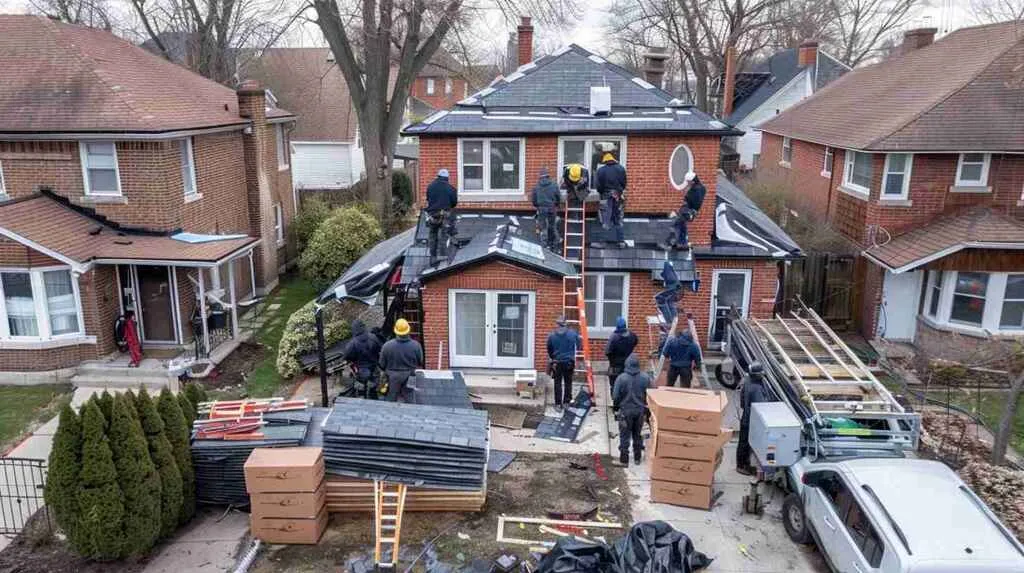
Most Common Type of Roof Shingle Queens NY – Why Asphalt Wins | Free Quotes
Blueprint first: In Queens, over 8 out of 10 residential roofs are asphalt shingles for three practical reasons – climate fit, cost, and code – and if you understand the first one, the rest falls into place. Right now, picture a typical cape on your block after a January freeze, sun hitting hard by noon, and ice melting back into eaves – that cycle, repeated five months a year, is exactly why asphalt dominates here if it’s properly chosen and layered.
Why Asphalt Is the Most Common Type of Roof Shingle in Queens, NY
On a typical block in Flushing between Northern Boulevard and 35th Avenue, you’ll see rows of attached homes with nearly identical rooflines and what looks like the same dark gray shingles – but if I climbed up and pulled samples, I’d find three or four different asphalt grades, some with thick fiberglass mats and UV-resistant granules that’ll hit 25 years, others with paper-thin backing that’s already cracking at year seven. That’s the thing nobody tells you when they say “asphalt is the most common type of roof shingle” – it’s not one material, it’s a spectrum from builder junk to engineered systems, and Queens weather sorts them fast. Our freeze-thaw cycles crack brittle shingles, summer sun at that low angle bakes south-facing slopes, humidity off the bay traps heat in poorly vented attics, and wind funneling down cross streets lifts tabs if they’re not nailed to spec.
The reason asphalt wins isn’t just cost – though yeah, you can reroof a cape for half what metal would run – it’s that a properly spec’d asphalt shingle actually matches what Queens throws at it. Metal expands and contracts with our temperature swings and needs expert flashing around every penetration or it leaks; slate and tile are beautiful but way too heavy for most of our wood-frame colonials and rowhouses without serious structural work. Asphalt sits in the sweet spot: it sheds water fast on our typical 6/12 to 8/12 pitches, it meets fire and wind code without a fight, and when a storm tears off a section, any decent roofer in the borough can patch it same-week because the supply chain is everywhere.
One January morning in Bayside, about 7:15 a.m., I was standing on a frozen driveway with a retired accountant who’d collected eight quotes telling him to “rip everything off and go luxury shingles.” His roof was only 8 years old. I pulled one shingle, showed him the brittle fiberglass mat and burned-out granules, and explained that the “builder grade” asphalt he got was never meant for our Queens sun and freeze-thaw cycles. That was the job that made me start pushing homeowners to understand that the most common type of roof shingle isn’t generic – there’s cheap asphalt, and there’s Queens-ready asphalt. Code and insurance will approve almost any asphalt product, but only the ones with thicker mats, ceramic-coated granules, and proper algae resistance survive two decades here without turning into a liability.
Queens Asphalt Shingle Snapshot
| Factor | Asphalt Shingles (Most Common) | Metal Roofing | Slate/Tile or Specialty |
|---|---|---|---|
| Climate Fit | Handles freeze-thaw and UV if grade is right; sheds water fast on typical slopes | Expands/contracts with temp swings; needs expert flashing in Queens humidity | Too heavy for most Queens frames without reinforcement; overkill for our climate |
| Upfront Cost | $5-12k typical for 1-family; wide range by grade and tear-off layers | $15-25k+ for standing seam; fewer contractors willing to warranty it | $25-50k+ and requires structural engineering on attached homes |
| Local Code & Norms | Meets NYC fire/wind ratings easily; neighbors won’t complain about appearance | Code-compliant but stands out on blocks of asphalt; resale perception mixed | Requires variance or engineer stamp in most Queens zoning; rare to see |
| Repair Practicality | Any local crew can patch or replace sections; shingles stay available for years | Dent repair tricky; matching panels years later often impossible | One cracked slate means custom sourcing; labor rates spike for specialty work |
Not All Asphalt Shingles Are Equal in Queens Weather
From a strictly technical standpoint, I’ll tell you this: asphalt shingles win in Queens because the upgraded versions – the ones with thick fiberglass mats, ceramic-coated granules, and wind ratings above 110 mph – actually outperform cheap alternatives by a factor of two in our specific conditions. If we sliced a shingle in half like a sandwich, you’d see a bottom asphalt layer for waterproofing, a fiberglass mat in the middle for tensile strength, and a top layer of colored mineral granules that reflect UV and resist algae. Builder-grade 3-tabs have a mat so thin you can almost see through it, and the granules are basic limestone that washes off in five winters, leaving bare asphalt exposed to Sunnyside sun and Elmhurst truck exhaust. Standard architectural shingles double up that mat and use better adhesive, which is why they last 20-25 years here instead of 12-15. The premium stuff – sometimes called “impact resistant” or “high-wind architectural” – adds a rubberized asphalt blend that stays flexible below freezing and ceramic granules that don’t chalk out under UV, and that’s the grade I’d put on my own Flushing house if I still lived there.
On a humid August afternoon in Jackson Heights, I got called to a three-family brick building where the owner swore the slate tiles were leaking. Except it wasn’t slate – it was a laminated asphalt shingle designed to mimic slate. The previous contractor had sold it as “indestructible,” but they’d installed it without proper ventilation, so the shingles were curling at year six. I remember sweat literally running into my eyes as I showed the owner how the attic felt like a sauna and how even the best asphalt option fails early if you ignore Queens humidity and trapped heat. The lesson there isn’t that designer asphalt is bad – it’s that the whole system matters. A $400-per-square luxury shingle on top of a poorly vented attic with no ridge vent and blocked soffit intakes will die faster than a $180-per-square standard architectural shingle on a properly breathing roof deck.
| Shingle Type | Pros for Queens Homes | Cons in Queens Conditions |
|---|---|---|
| 3-Tab Asphalt |
|
|
| Standard Architectural Asphalt |
|
|
| Upgraded Architectural / High-Wind Rated |
|
|
Warning: Buying Asphalt Shingles by Price Tag Only
Don’t walk into a big-box store in Rego Park and grab the cheapest “builder grade” bundle just because the total comes in $2,000 under the next quote. Those thin fiberglass mats and low-grade granules burn out fast under Queens sun and our freeze-thaw cycles, often leaving you with brittle, leaking shingles well before year 10. I’ve torn off roofs that were only seven years old because the homeowner chased the lowest bid and got the lowest-performing asphalt on the market – and then paid twice to do it right the second time.
How the Whole Roof System Works: A Simple Queens Cross-Section
Let me ask you the same question I ask at kitchen tables all over Queens: what do you actually want your roof to do besides “not leak”? Because if we sliced your roof like a cake – a vertical cut from ridge down to soffit – you’d see five layers working together, and the asphalt shingle is only the top one. Below that shingle sits your underlayment (usually felt or synthetic membrane, plus ice-and-water shield at the eaves and valleys where melt backs up), then the plywood or OSB decking that the nails bite into, then your attic space where air needs to flow from soffit vents up and out through a ridge vent, and finally your insulation sitting on the ceiling joists. In Queens, that cross-section has to handle humidity rolling in off Flushing Bay, freeze-thaw ice dams along the Grand Central Parkway corridor, and summer attic temps that hit 140°F if ventilation is blocked. The shingle is your first defense, but if any other layer fails – decking rots, underlayment tears, ventilation gets covered by blown insulation – even the most common, most expensive asphalt product won’t save you.
Key Layers in a Queens Asphalt Roof Cross-Section
The structural base; in older Queens homes this is often original 1950s boards that need inspection for rot, especially around chimneys and where two roof planes meet.
Your backup waterproof layer; ice-and-water at eaves is critical for homes near the Grand Central where snow melts and refreezes, pushing water under shingles.
The visible layer everyone focuses on; your choice here (3-tab vs architectural vs premium) dictates lifespan, but only if the layers below are sound.
Keeps conditioned air inside your house, not heating the attic; in Queens rowhomes and attached colonials, this is often missing or compressed by storage.
Cool outside air enters through soffit vents, warm attic air exits through ridge or gable vents; blocked soffits are the #1 reason asphalt shingles curl early in humid Queens summers.
Do You Need Repair, Upgrade, or Full Replacement?
Asphalt shingles under 15 years old + only 1-2 isolated leaks + no widespread curling or cracking visible
Replace damaged shingles, check flashing, confirm ventilation isn’t blocked
Shingles 12-18 years old + visible curling on south slope + attic feels like sauna in summer + multiple small leaks
Move to architectural grade, add ridge vent, install ice-and-water at critical areas
Shingles over 18 years or widespread brittleness + granules in gutters + two or more layers already present + active leaks in multiple rooms
Complete tear-off to decking, inspect and repair substrate, install proper system top to bottom
Real Queens Asphalt Shingle Failures I Get Called to Fix
One bad decision with the “most common shingle” can undo all the supposed savings.
I still remember a Saturday in 2016 when a homeowner in Astoria asked me, “Victor, why does everyone keep pushing asphalt if it’s so… common?” And here’s what I told him while we sat at his kitchen table with my sketches on a pizza-box lid: asphalt is common because it’s practical – it works in our climate, it’s affordable for most budgets, and any crew in the borough can service it – but whether it behaves like a cheap roof or a premium roof depends entirely on three details most contractors never mention. First, which grade of asphalt you choose (that fiberglass mat thickness and granule coating I keep coming back to). Second, whether the installer follows the manufacturer’s nailing pattern and uses the right number of nails per shingle – because in Queens wind, under-nailing is how tabs lift and whole sections peel. And third, whether your attic ventilation is designed to pull humid air out before it cooks the underside of the shingles from below. The worst “oops” I ever saw was in Corona on a windy March evening, sun going down, when a DIY enthusiast asked me to “just patch” a few missing shingles. He’d mixed three different types of asphalt shingles from the clearance rack – three tabs, architectural, and some off-brand thin ones – all on one slope. The pattern looked like a checkerboard. Wind hit it like a set of dominoes, and half that slope peeled off. That job turned into a full replacement, and it’s the story I tell whenever someone asks me if “all asphalt shingles are basically the same since it’s the most common type of roof shingle.” No, they are not.
Here’s the blunt truth nobody puts in the brochures: the wrong “most common” shingle will fail faster than an average metal roof in our salt air and soot. I’ve seen builder-grade asphalt installed over skip-sheathing (not even solid decking) on a Sunnyside colonial, and it lasted six years before the homeowner called with water stains spreading across the second-floor ceiling. I’ve seen high-end architectural shingles installed beautifully but with zero ice-and-water shield at the eaves, so the first real winter brought ice-dam leaks into the living room. And I’ve seen contractors mix leftover shingles from two different manufacturers on the same roof because “they’re both brown architectural, what’s the difference?” – except one had a self-sealing strip that activated at 110°F and the other at 140°F, so half the roof never sealed down properly and wind just kept peeling tabs all summer. The material is fine; the decisions around it are where Queens homeowners get burned.
| Myth | Fact in Queens, NY |
|---|---|
| “All asphalt shingles are basically the same” | Builder-grade 3-tabs have half the mat thickness and quarter the wind rating of premium architectural shingles; in Queens wind and freeze-thaw, that difference shows up as a 10-year gap in lifespan. |
| “If everyone uses asphalt, it must be the cheapest junk” | Asphalt dominates because it’s practical for our climate, meets code easily, and can be spec’d from budget to luxury; calling it “junk” is like saying all cars are junk because Corollas are common. |
| “Designer asphalt never curls or fails early” | I tore off $500-per-square “slate look” laminated asphalt at year 6 in Jackson Heights because the attic had no ventilation – even premium shingles die young if the system below them cooks them from the inside. |
| “Ventilation doesn’t matter if the shingle is good” | Blocked soffit vents or missing ridge vents trap 140°F air in Queens summer attics, baking shingles from below and cutting their lifespan nearly in half regardless of grade. |
| “You can safely mix leftover shingles from different brands” | Different manufacturers use different adhesive activation temps, granule coatings, and nailing specs – mixing them on one roof is how you get uneven wind performance and mismatched aging that looks terrible and leaks early. |
What a Queens-Ready Asphalt Shingle Roof Includes (and What It Costs)
Imagine your roof like a layered pastry from a Chinatown bakery – if you cheap out on one layer, the whole thing collapses under its own weight. A proper asphalt roof in Queens starts with a sound plywood or OSB deck (which means inspecting and replacing any soft, water-damaged sections before you lay a single new shingle), then a continuous underlayment – usually synthetic because it doesn’t tear in wind like old felt – plus ice-and-water shield running at least three feet up from every eave and through every valley where melt and rain concentrate. Then comes the shingle itself, and this is where you pick your grade and your warranty based on realistic Queens performance, not the inflated “lifetime” claims that exclude labor and pro-rate coverage to almost nothing by year 10. Finally, ventilation: soffit intake vents that actually pull air (not blocked by insulation or aluminum fascia covers) and a continuous ridge vent or multiple roof vents positioned to let that 140°F summer attic air escape. Miss any of those layers and even the most common, most trusted asphalt product won’t hit its rated lifespan here.
Cost-wise, you’re looking at a pretty wide range depending on your house type, how many layers we’re tearing off, and which shingle grade you choose – but a well-designed asphalt roof is still the smartest value for most Queens homes because you’re not over-building for a climate that doesn’t demand slate or under-building with materials that’ll fail in eight years. I’ve done enough of these jobs to give you realistic numbers without the “call for quote” runaround, and honestly, if you’re serious about understanding what you’re paying for, I’d rather sit down at your kitchen table with a sketch and a real estimate than try to win your business with a lowball number that leaves out half the work. That’s how Shingle Masters operates – we treat your roof like a forensic case, figure out what it actually needs for this specific Queens block and house style, and give you a written quote that explains every layer of the cross-section so you’re not guessing.
Typical Queens Asphalt Shingle Roof Price Ranges
$5,500-8,000
- ≈ 1,200-1,600 sq ft roof area
- Standard synthetic underlayment + ice-and-water at eaves
$8,500-13,000
- ≈ 1,800-2,400 sq ft, includes valley and chimney flashing upgrades
- Ridge vent installation or upgrade if missing
$10,000-15,500
- Crane or manual carry-up adds cost; tight working envelope
- High-wind-rated shingles (110+ mph) and soffit vent clearing included
$16,000-24,000
- ≈ 3,000-4,000 sq ft, multiple penetrations and complex geometry
- Custom metal flashing fabrication, full deck inspection with selective replacement
$2,500-6,500
- Depends on whether we can match existing shingles (discontinued styles cost more)
- Includes blend-in nailing pattern so repair isn’t obvious from street
Note: Ranges reflect typical Queens conditions as of 2024. Your actual quote will depend on roof pitch, number of tear-off layers, decking condition discovered during removal, permits if required, and whether we find hidden issues (rotted fascia, missing drip edge, etc.) once old shingles come off.
Queens Asphalt Shingle Questions
How long should an asphalt shingle roof last in Queens, NY?
▼
Realistic lifespan depends entirely on shingle grade and whether your attic ventilation is working. Builder-grade 3-tab asphalt in Queens usually hits 12-15 years before you see widespread curling and granule loss. Standard architectural shingles (the most common upgrade) should give you 20-25 years if ventilation is good and you don’t have two layers of old shingles baking underneath. Premium architectural or impact-resistant shingles with proper ridge and soffit vents can push 28-32 years here.
The big killer in Queens isn’t the shingle itself – it’s trapped attic heat and humidity cooking the underside of the roof deck all summer, plus freeze-thaw cycles splitting brittle shingles every winter. If your attic feels like a sauna in July or you see frost on the underside of the roof deck in January, your shingles won’t hit their rated lifespan no matter what grade you bought.
Can I just replace the visible damaged shingles instead of the whole roof?
▼
Sometimes yes, sometimes no – it depends on three things I check during every inspection. First, can I still get your exact shingle or a close color match? (Discontinued styles mean visible patching.) Second, is the damage isolated to one small area from a tree branch or wind gust, or is it scattered across multiple slopes because the whole roof is aging out? Third, what’s the condition of the shingles around the damaged area – if they’re brittle and the granules rub off when I touch them, patching is just buying you a year or two before the next failure.
That Corona DIY checkerboard story I mentioned earlier? That started as “just patch a few shingles” and turned into a full replacement because mixing different asphalt products created a wind-failure domino effect. I won’t patch if I think it’s unsafe or if you’ll be calling me back in six months with a bigger leak.
Do Queens building codes limit which shingle types I can use?
▼
NYC code requires a Class A fire rating (which pretty much every asphalt shingle on the market meets), and you’re limited to a maximum of two layers of shingles total before you have to tear off down to the deck. Most inspectors also want to see proper slope – asphalt shingles aren’t approved for anything flatter than a 2/12 pitch, and practically speaking you want at least 4/12 in Queens so water sheds fast and doesn’t pool.
Beyond that, code doesn’t care if you choose 3-tab, architectural, or designer laminated asphalt – but your homeowners insurance might give you a discount for impact-resistant shingles rated for hail, and some neighborhoods have informal appearance standards (like co-op boards or historic district guidelines) that push you toward certain colors or styles so your roof doesn’t stick out on the block.
How fast can Shingle Masters inspect my roof and give a free quote in Queens?
▼
I can usually schedule an inspection within 2-4 business days, depending on the season – spring and fall are busiest because that’s when most homeowners finally look up and notice the curling. The inspection itself takes 45 minutes to an hour because I’m not just walking the roof and taking photos; I’m checking your attic ventilation, looking at the underside of the deck for moisture stains, and sketching that cross-section diagram I keep talking about so you understand what’s actually going on up there.
You’ll get a written quote usually within 24-48 hours, and it’ll break down every layer – tear-off, decking repairs if needed, underlayment type, shingle grade options with realistic Queens lifespan estimates, flashing work, ventilation upgrades, and what the whole system costs. No pressure, no “this price expires tomorrow” games – just a clear explanation of what your roof needs and what it’ll cost to do it right the first time.
Why Queens Homeowners Hire Shingle Masters for Asphalt Roofs
Fully licensed and insured in NYC with workers’ comp and liability coverage you can verify before we set foot on your roof
19+ years specializing in Queens asphalt roofs – from Flushing capes to Astoria rowhouses to Bayside colonials, we know the neighborhood roof types and what fails here
Forensic leak-diagnosis approach – we don’t default to “rip and replace” if a targeted repair or ventilation fix will actually solve your problem
Familiar with every Queens microclimate – we adjust shingle specs and ventilation design for sun exposure near the bay, wind corridors along the Grand Central, and humidity in dense rowhouse blocks
Free, written quotes with roof cross-section explanation at your kitchen table – no high-pressure sales, just a calm walkthrough of what you’re paying for and why each layer matters
Look, the right asphalt shingle system – proper grade for Queens sun and freeze-thaw, solid underlayment and ice-and-water where it counts, ventilation that actually moves air – is usually the best value you’ll find for a residential roof in this borough. You’re not over-building with materials that cost three times as much for climates we don’t have, and you’re not under-building with junk that’ll fail before your next mortgage refinance. If you want to understand exactly what your roof needs and what it’ll cost to do it correctly, call Shingle Masters for a free inspection – I’ll walk your roof, check your attic, sketch that cross-section on whatever’s handy, and give you a written quote that makes sense. No runaround, no hidden fees, just honest answers from someone who’s been fixing Queens roofs since before smartphone photos made it easy to show you what’s actually wrong up there.