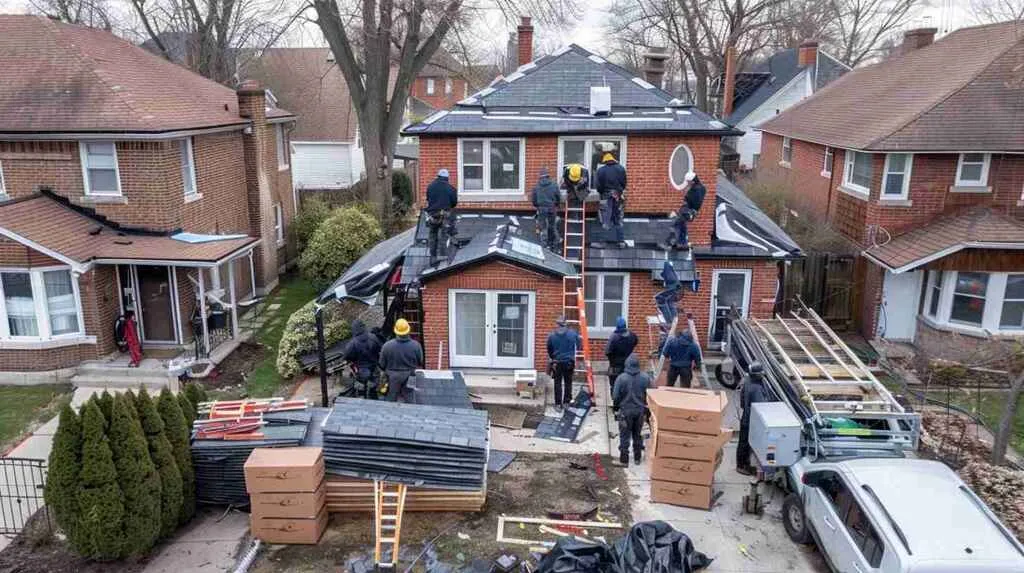
Slate-Look Roof Shingles Queens NY – Elegant Look for Less | Free Estimates
Whisper two numbers before we go any further: a premium slate-looking roof shingle install on a typical 1,600-square-foot Queens home runs about $11,000 to $17,500, while actual slate on that same house would cost you $45,000 to $70,000 and might require structural reinforcement your 1940s two-family just doesn’t have. That’s not a typo, and that’s the visual math I help people work through every single week on kitchen tables across Astoria, Woodside, and Forest Hills.
Two numbers you should know right away about slate-look shingles in Queens
Here’s what I tell people when they call me after seeing a Tudor in Bayside with what they think is a real slate roof: the difference between high-end slate appearance and actual slate is about $35,000 and roughly 10,000 pounds of extra weight. Modern architectural shingles designed to mimic slate texture, shadow lines, and color variation will give you that same upscale curb appeal without forcing you to sister every rafter in your ceiling and drain your savings account. The “visual math” I’m always sketching out for clients adds up like this-if your goal is that rich, dimensional roofline that makes people slow down as they drive past your house, slate-looking roof shingles get you 90% of the way there at about 25% of the cost.
One July afternoon in Sunnyside, with the 7 train rattling overhead and sweat dripping off my clipboard, I stood on a 1920s semi-detached explaining to a couple why their dream of real slate just wasn’t going to work. Their framing was original, the budget was tight, and adding the structural support alone would have eaten half their roof fund before we even touched a shingle. We mapped out a staggered pattern using premium slate-look architectural shingles instead, matching the charcoal tones in their brick and creating those irregular edges that give old European slate its character. Six months later their neighbor knocked on my truck window and asked for a quote because he was convinced it was the real thing-and honestly, from the sidewalk in that Queens afternoon light, I can see why he thought so.
Queens Roof Cost Snapshot (Labor + Materials)
| Scenario | Typical Queens Home Type | Approx. Roof Size (sq ft) | Estimated Cost Range |
|---|---|---|---|
| Slate-look architectural asphalt shingles | Detached home in Middle Village | 1,400 sq ft | $9,800 – $15,200 |
| Premium slate-look designer shingles | Semi-detached in Sunnyside | 1,800 sq ft | $13,500 – $19,800 |
| Real slate (for contrast) | Similar 1,800 sq ft semi-detached | 1,800 sq ft | $48,000 – $72,000 |
| Basic 3-tab shingles (baseline) | Rowhouse in Ridgewood | 1,200 sq ft | $6,500 – $9,200 |
| Partial slate-look (front slope only) | Two-family in Jackson Heights | 1,600 sq ft total roof | $7,200 – $11,500 |
All figures assume complete tear-off, standard complexity, and code-compliant underlayment. Queens-specific pricing as of 2024.
Why Queens Homeowners Hand Me Their Roof Sketches
- ✓ Licensed & insured in NYC with 19+ years on Queens roofs specifically
- ✓ Specializing in slate-look asphalt shingle systems that match your block’s character
- ✓ Free on-roof inspections with written estimates, never pressure tactics
- ✓ Most slate-look installs completed in 1-3 days, weather permitting
- ✓ I literally sketch your roof while we talk so you see exactly what I’m planning
From where I’m standing on your sidewalk, looking up at that roofline…
When I pull up to a house in Jackson Heights or Bayside, I spend the first two minutes just standing on the sidewalk with my pencil and notepad, looking at how your brick catches the afternoon light, whether your neighbors went with earth tones or cooler grays, and how much of your roof is actually visible from the street. That’s the start of the visual math-before I even climb the ladder, I’m already sketching shadow lines and noting whether your house is brick, vinyl siding, or stucco, because a slate-looking roof shingle that pops beautifully against tan brick in Forest Hills might look completely wrong on a white colonial in Whitestone. In Queens, every block has its own rhythm, and a two-family in Corona presents different visual challenges than a Tudor in Kew Gardens, so the “slate” color and texture I recommend has to fit not just your house but your whole streetscape.
Late one windy November evening in Bayside, I got an emergency call from a couple whose “designer” shingles had started peeling off after only three years. When I climbed up there by headlamp, the problem was obvious and infuriating-the previous contractor had mixed three different color batches across the roof, creating a patchy, cheap look that ruined the whole slate illusion, and worse, he’d used a low-grade product with terrible wind resistance for a house sitting in the open near the bay. Standing in that cold wind, I walked them through exactly how we’d fix it: premium slate-look shingles from a single batch run, proper ice-and-water shield at the eaves and valleys, and a nail pattern that would actually hold in Queens storms. The performance issues and the aesthetic problems were two sides of the same equation-cut corners on materials or installation, and you lose both the durability and that high-end slate appearance you paid for in the first place.
Dialed-In Slate Look
- Consistent color batches ordered together, installed sequentially
- Shingle pattern planned to complement your façade and street view
- Correct nail placement (not over-driven) with quality underlayment
- Ridge and hip caps color-matched to blend seamlessly
What I See on Too Many Queens Roofs
- Mixed bundles creating patchy, uneven tones across slopes
- Missing or improper starter strip at eaves and rakes
- Nails overdriven through shingle or placed too high
- Mismatched flashing around chimneys, vents, and valleys
⚠️ The Fastest Way to Make a “Slate” Roof Look Cheap in Queens
- Mixing color batches from different production runs creates visible tonal shifts that scream “budget job” from the sidewalk
- Using bargain-bin “designer” shingles with thin backing and weak adhesive strips leads to curling, blow-offs, and warranty nightmares
- Skipping proper underlayment means your beautiful slate-look shingles sit on a foundation that fails in the first ice storm
- Installing in windy spots like Bayside without checking the shingle’s actual wind rating is asking for a callback in the next nor’easter
I still remember a Monday morning in Woodside when a client asked me this exact question…
She poured me coffee in her kitchen and asked, point-blank, whether spending the extra money on slate-looking roof shingles would actually boost her home’s value or if it was just vanity, and I told her about a job I’d done the previous spring in Forest Hills during a rainstorm-I was up on that slate-look roof checking for storm damage, watching water sheet off those textured tabs, and the homeowner mentioned her real estate agent had bumped her suggested list price almost $40,000 partly because every buyer who walked up commented on the “slate roof.” The visual math worked perfectly there: darker charcoal shingles made the Tudor brick look richer, the dimensional texture created shadow lines that photographs beautifully, and buyers simply assumed it was real slate because the color variation and staggered pattern mimicked exactly what you see on those $70,000 installations. Not gonna lie, when curb appeal translates directly into list price and faster offers, that’s an equation that makes sense even if you’re not planning to sell anytime soon-you still get to enjoy looking at your own house every time you come home.
How Your Roof Choice Shows Up When You Sell in Queens
| Roof Type | Perceived Style From Street | Typical Buyer Reaction | Relative Impact on List Price |
|---|---|---|---|
| Old 3-tab shingles (18+ years) | Dated, flat, worn | “When does this need replacing?” | Low – often deducted from offers |
| Mid-range architectural shingles | Clean, standard, functional | “At least the roof is done” | Moderate – meets expectations |
| Premium slate-look shingles | Upscale, textured, dimensional | “Is that real slate?” (often mistaken on Tudors) | High – noticeable curb appeal boost |
| Real slate (where structure allows) | Luxury, historic, permanent | “This is a serious property” | Very High – premium positioning |
Let me be blunt, because the wind in Queens doesn’t care about anyone’s aesthetic…
A slate-looking roof shingle that creates gorgeous shadow lines and rich color variation is absolutely worthless if it starts curling in two years or blows off in the next storm, and I’ve seen way too many homeowners in Rego Park and College Point learn this lesson the expensive way. The visual math I’m always talking about has to include durability as one of the variables-your roof faces freeze-thaw cycles all winter, brutal summer heat that can hit 160 degrees on a black shingle surface, and wind gusts coming off the water or funneling between buildings that can test even properly installed materials. Queens weather doesn’t negotiate, so when I’m selecting a slate-look product for your house, I’m checking wind ratings (you want at least 110 mph in exposed areas), making sure the adhesive strip is actually thick enough to seal down, and planning underlayment based on your specific roof pitch and sun exposure.
A beautiful roof that leaks is a failed equation.
Here’s an insider tip I give everyone before they sign any roofing contract in Queens: ask to see the manufacturer’s wind rating certificate for the specific shingle they’re proposing, not just a brochure with pretty pictures, and make them spell out exactly what underlayment they’ll use and where. If you’re in an open area like parts of Bayside near the water, or if high-rise buildings nearby create wind tunnels like they do in some Rego Park neighborhoods, you need ice-and-water shield in valleys and along eaves, plus a quality synthetic underlayment across the entire deck-not the cheapest felt they can find. The difference in material cost is maybe $800, but the difference in performance is the gap between a roof that lasts 25 years and one that needs repairs after the first bad storm.
When we do a slate-look shingle installation at Shingle Masters, the process runs like this, and I don’t skip steps: First, I’m on your roof with a camera, documenting every soft spot, checking flashing, measuring slopes, and marking problem areas so you see exactly what I see. Second, we sit at your kitchen table with sample boards, my pencil sketches of your roof, and honest conversation about which slate-look patterns and colors will actually work with your brick, trim, and neighborhood-I’ll tell you straight up if your Instagram inspiration makes zero sense for a Jackson Heights two-family. Third comes tear-off, deck repair where needed, and code-compliant underlayment with proper ice shield, because this foundation is what keeps the beautiful part from becoming a nightmare. Fourth is the actual shingle installation with attention to batch numbers, nail placement, flashing details around chimneys and vents, and ridge caps that blend seamlessly. Fifth is cleanup, a full magnet sweep of your yard and driveway (I’ve got grandkids, I know what a stray nail can do), a final walk-through where I show you everything we did, and warranty documents you’ll actually be able to find when you need them.
From First Look to Final Sweep
Call Me Now – Urgent Situations
- Active leaks staining your finished ceilings
- Shingles missing or loose after a Queens windstorm
- Soft, spongy spots when you walk the roof
- Visible gaps in flashing around chimneys or skylights
Can Plan It Out – Schedule Within Weeks
- Roof older than 18-20 years but not actively leaking
- Planning to sell within 1-2 years and want curb appeal
- Want to upgrade from flat 3-tab to slate-look for aesthetics
- Minor granule loss with no exposed fiberglass yet
When I spread my sample boards across your dining table, here’s what I’m really thinking…
I’m not just looking at the shingle samples themselves-I’m watching how that 4 p.m. Queens light comes through your window and hits the texture, I’m mentally placing those colors against the brick or siding I photographed outside, I’m thinking about the maple tree that shades your front slope and how that affects what you’ll actually see from the sidewalk, and I’m considering whether your neighbors went warm or cool so your house fits the block without disappearing into it. This is the visual math in action: your two-family in Jackson Heights has different requirements than a Tudor in Forest Hills, and that Instagram photo you saved of a slate roof in suburban Connecticut probably won’t translate to your semi-detached with a front stoop and street parking. I’ll tell you honestly when a color or pattern just won’t work, and I’ll sketch out alternatives right there on my notepad so you can see what I’m thinking instead of just hearing words.
If you’re ready to get that upscale slate appearance without the $50,000 price tag and structural headaches, call Shingle Masters for a free estimate and on-site roof sketch session-I’ll come out, walk your roof, spread samples on your kitchen table, and show you exactly how slate-looking roof shingles can give your Queens home that elegant, dimensional look for a fraction of the cost. The visual math is simple: better curb appeal, solid performance, and a roof that actually fits your house, your block, and your budget.
My Roof Color “Visual Math” Cheat Sheet
Existing brick or stone tone – warm reds need different slate colors than cool grays
Siding and trim colors – white trim pops with darker slate-look, tan trim needs careful balancing
Visible neighbors’ roofs on your block – you want to fit in without blending into invisibility
Amount of direct sun vs shade – trees and buildings change how color reads from the street
Style of the house – Tudor, colonial, semi-detached, rowhouse all have different visual needs
How steep the roof is – affects how much shingle texture you actually see from the sidewalk
Common Questions About Slate-Looking Roof Shingles in Queens, NY
Do slate-look shingles really hold up in Queens wind and storms?
Premium slate-look architectural shingles rated for 110+ mph winds absolutely hold up in Queens weather when they’re installed correctly with proper nailing and quality underlayment. The key is using actual name-brand products with thick adhesive strips, not bargain “designer” shingles with weak backing. I spec different underlayment and installation details for exposed areas near the water in Bayside versus sheltered blocks in Forest Hills, because wind loading isn’t uniform across the borough. When the install is done right, you’re looking at 20-30 years of solid performance even in nor’easters.
Will my roof structure handle real slate, or should I stay with slate-look?
Most Queens homes built before 1960-and honestly many built after-weren’t framed to carry the 800-1,500 pounds per square of real slate, especially the older two-families and semi-detached houses in Sunnyside, Jackson Heights, and Woodside. You’d need an engineer to evaluate your framing, and then likely need to sister rafters and reinforce bearing walls, which can cost $15,000-$25,000 before you even buy the slate. Slate-look architectural shingles weigh about the same as standard asphalt (roughly 250-400 pounds per square depending on the product), so your existing structure handles them fine, and you get 85-90% of the visual impact for a fraction of the cost and zero structural work.
Can you match my new slate-look roof to the rest of my block in Jackson Heights or Forest Hills?
That’s exactly what I do before recommending any color or product-I walk your block, I photograph neighboring roofs, and I bring sample boards to your house so we can see them in your specific light and against your specific brick or siding. In Jackson Heights where you’ve got rows of attached homes, the goal is usually a cohesive palette that fits without screaming for attention. In Forest Hills where houses are more individual, you’ve got more flexibility to go dramatic with darker charcoals or blended tones. Either way, the visual math includes your street context as a major variable, not just what looks good in a manufacturer’s brochure.
How long does a slate-look shingle roof usually last in Queens?
A quality slate-look architectural shingle roof installed properly with good ventilation and underlayment will give you 20-30 years in Queens conditions, sometimes longer if you keep up with basic maintenance like clearing debris and checking flashing. The premium “designer” slate-look products with thicker profiles and better granule adhesion tend toward the upper end of that range, while mid-grade architecturals land in the 18-25 year window. Real slate lasts 75-100+ years, but when you factor in the cost difference, even replacing your slate-look roof twice still comes out way ahead financially, and your house structure doesn’t need reinforcement. Regular maintenance-keeping valleys clear, replacing damaged shingles promptly, maintaining proper attic ventilation-adds years to any roof.