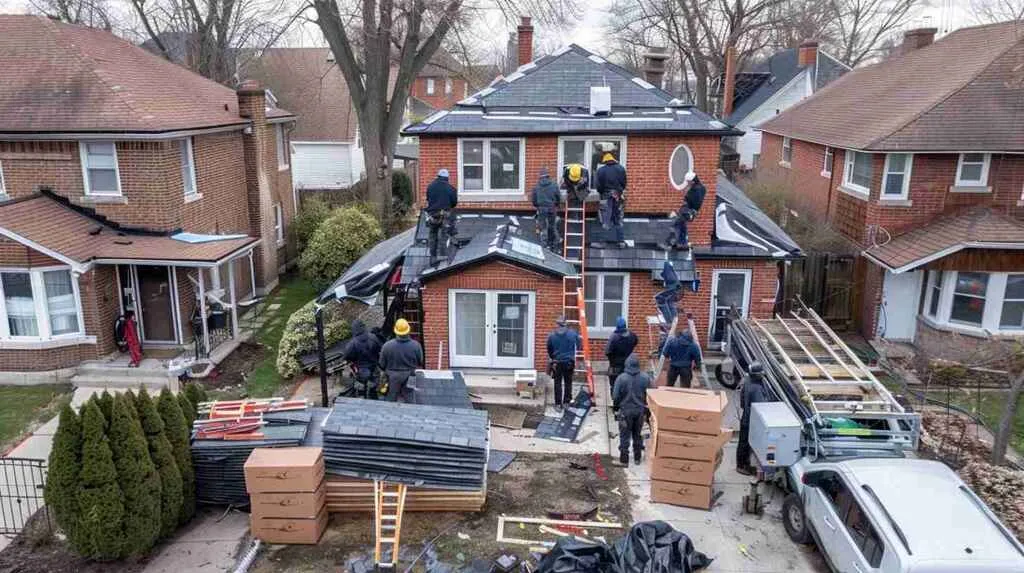
When Is It Too Hot to Shingle a Roof Queens NY – Know the Limit
Scorched. On my truck thermometer at 9:15 a.m. in Queens, I’ve seen 82°F air turn into 135°F on the roof surface, and that’s where the real trouble starts-shingles soften, adhesives smear, and nails punch through instead of holding. Most people think “too hot” means workers sweating or air temps in the high 90s, but shingle failure begins hours earlier when your roof deck crosses about 120°F, which can happen by mid-morning on a sunny July day over black asphalt. This article will walk you through the exact temperature limits where your roof starts to cook, how to spot when a roofer is ignoring the heat, and how I schedule around Queens summers so the roof I install doesn’t fail before the first storm even hits.
How Hot Is Too Hot to Shingle a Roof in Queens, NY?
On my truck thermometer at 9:15 a.m. in Queens, I’ve seen 82°F air turn into 135°F on the roof surface, and that’s where the real trouble starts. The practical limit isn’t just one number-it’s a combination of air temperature (anything over about 90°F gets dicey), roof surface temperature (the real killer, which needs to stay below 120-130°F for safe shingle application), and worker safety, because nobody can nail straight when they’re dizzy from heat. Queens roofs heat up fast thanks to dark shingles, flat or low-slope designs common in neighborhoods like Jackson Heights and Ozone Park, and limited tree shade, so by the time your weather app says 88°F, the roof deck is already pushing 125°F in full sun.
I’ll be blunt: if your roofer is happily nailing shingles at 2 p.m. on a 90-degree day in July, they’re choosing speed over quality. Think of your roof like a stage set under bright lights-if the props are melting before the show starts, you don’t keep pushing actors out there. Act One is installation, and if you fry the shingles on day one, Act Two (the first couple of summers) and the Finale (storm season) are going to be rough. My policy is simple: no mid-day installs during heat waves, no matter how rushed the schedule is, because I’ve seen too many roofs fail early from being cooked the moment they went on.
| Air Temp (°F) | Typical Roof Surface in Queens (°F) | Risk for Shingle Install | What I Do |
|---|---|---|---|
| 70-80 | 95-115 | Low – ideal conditions | Work all day, normal pace |
| 80-88 | 110-125 | Moderate – watch sun and timing | Start early, wrap by late morning if sunny |
| 89-92 | 125-135 | High – adhesives soften, shingles mark easily | Mornings only, constant surface temp checks |
| 93-98 | 135-150 | Very high – shingles deform, adhesives smear | Short early window, often reschedule |
| 99+ | 150+ | Extreme – do not install | No install, emergency patch only if needed |
⚡ Heat Thresholds Every Queens Homeowner Should Know
What Queens Heat Really Does to Your Shingles (Act One vs. the Finale)
I still remember one Elmhurst job where the shingles felt like warm tortillas-fold them once, and you’ve already ruined the edge. One August afternoon about five years ago in Jackson Heights, we started a job at 11 a.m. because the homeowner overslept and insisted we begin late, and I watched the thermometer on my truck climb to 96°F. When I checked the shingle bundles on the roof, they were so soft I could leave a fingerprint just by resting my thumb on them, tar sticking to my pants. I remember kneeling there and seeing a row of brand-new shingles already sliding a hair downhill because the asphalt underneath was practically melting. I shut the job down for the day-the homeowner was furious until I showed him, in slow motion on my phone, how easily a hot shingle would crease and crack just from being lifted. Those creases don’t show up right away, but when a big storm hits a couple of summers later (Act Two or the Finale), those weakened edges crack, lift, and let water in, and nobody remembers it was day one’s heat that ruined them.
Now, let’s switch scenes to your attic and roof deck. Queens has a patchwork of microclimates-Astoria near the water might catch a breeze, but inland Jackson Heights, Ozone Park, and Corona can be 5-8 degrees hotter with dead-still air. When your deck heats up past 120°F, it’s not just the shingles on top that suffer-the heat radiates up through the underlayment, bakes trapped humidity into the adhesive strips, and speeds up granule loss from day one. If your attic ventilation is poor (common in older Queens row houses and semi-detached homes), the deck stays hot for hours after the sun moves, which means even an early-morning install can turn risky by 10 a.m. The heat doesn’t just slow you down-it quietly ages the roof faster, like leaving film props under stage lights too long and wondering why they’re faded and brittle by opening night.
| ❌ Myth | ✅ Fact (What I’ve Seen in 19 Years) |
|---|---|
| “Heat helps the shingles seal better, so hotter is always better.” | Shingles need warmth to seal (around 70-85°F), but over 120-130°F surface temp, the adhesive can smear and never bond where it should-I’ve peeled up rows where the strips stuck to each other instead of the deck. |
| “If the manufacturer says it’s okay up to 110°F, Queens sun is no problem.” | Manufacturer ratings assume controlled lab tests, not a black Queens roof baking in direct sun with 60% humidity-real-world surface temps can hit 150°F while the air’s only 92°F. |
| “Once the shingles are nailed, the heat can’t hurt them anymore.” | Overheated shingles crease, lose granules, and age faster even after they’re nailed down-the damage is baked in from minute one, and it shows up as leaks and blow-offs a few summers later. |
| “As long as it passes inspection, mid-day summer installs are fine.” | Inspections catch code issues like nailing patterns and flashing, not early heat damage that shows up as curling, blistering, and premature failure years down the line-long after the inspector is gone. |
⚠️ Hidden Damage from Installing Shingles in Peak Queens Heat
Heat-damaged roofs don’t usually fail right away-they limp through the first couple of seasons, then fall apart when you need them most. Here’s what happens when shingles go on too hot, and why you won’t see it for a year or two:
- Adhesive Misalignment: Adhesive strips meant to bond each shingle to the one below instead stick to the shingle above during installation, leaving no seal at all-wind lifts them like playing cards in the first storm.
- Nail Pull-Through: Nails driven into soft, overheated shingles tear through instead of gripping, creating tiny holes that expand with every freeze-thaw cycle and leak quietly for months before you notice ceiling stains.
- Accelerated Granule Loss: Shingles installed above 130°F shed protective granules 2-3 times faster than normal, leaving bald gray spots after just a couple of summers and exposing the asphalt to UV decay.
- Permanent Creasing and Buckling: Shingles bent or walked on while hot develop memory creases that never flatten out, creating raised edges that catch wind, trap water, and curl up or crack during the next heat wave or cold snap.
These issues rarely appear during the final inspection or in the first mild season-they show up two summers later during a thunderstorm or nor’easter, long after the roofer’s truck is gone.
Best Times of Day to Roof in Queens (and When to Call It Off)
Around 7 a.m. one July in Ozone Park, we were working for an older couple who’d just had their first grandchild, and they were terrified of roof leaks ruining the nursery. The night before, the forecast changed to a heat advisory, so I brought an infrared thermometer and started checking the roof deck every hour. By 9:30 a.m., the deck temp was already at 128°F, and my crew’s nail gun was blowing nails right through the shingles because the asphalt was too soft-you could see the nail heads punching clean through instead of sitting flush. I pulled everyone down, sat at their dining table, and sketched out on a napkin how over-heated shingles lose their granules early, making a “gray bald spot” in 3-5 years; that little drawing convinced them to spread the job over two cooler mornings instead. My policy now: on hot days, we start at first light (sometimes 6 a.m. in July), wrap by late morning, and if the forecast shows three days of 90°F+, we push the whole job to the following week or split it into early-morning-only shifts, even if it drags the schedule out.
Here’s the first question I ask a homeowner who wants July roofing: are you more worried about finishing fast, or about the roof lasting 25 years? Queens has great roofing weather in late April, May, September, and early October-mild temps, lower humidity, and roof surfaces that stay in the sweet spot all day. If you’re planning a re-roof and it’s not an emergency, aim for those windows. If you’re stuck with summer, insist on early-morning starts (before 8 a.m.) and ask your roofer what the roof surface temp is, not just the air temp-if they don’t own or use an infrared thermometer, that’s a red flag. I’ve walked away from jobs where the homeowner demanded we work straight through a 95°F afternoon, because I’m not putting my name on a roof that’s fried on day one and fails in Act Two or the Finale when a real storm rolls through.
🔍 How I Decide If We Work or Walk Away on a Hot Queens Day
I look at highs, humidity, and cloud cover-if it’s 88°F+ with full sun predicted, I’m already planning early starts or calling to reschedule.
I use an infrared thermometer on the deck before we lay any shingles-if it crosses 120°F, we’re done for the day and picking up the next cool morning.
If they’re leaving marks from my fingers or sliding at all, that’s the end-I don’t care if we’ve only laid three rows, we’re stopping and regrouping.
Dizziness, nausea, or confusion means we’re off the roof immediately-no exceptions-and cooler work (cleanup, material staging) only, or we call it a day.
I walk them through the temp readings, show them photos of soft shingles or over-driven nails, and give them the option: push through today and risk problems, or wait for cooler weather and do it right.
📞 Should You Call a Roofer Now or Wait for Cooler Weather?
🚨 Call Now (Emergency Work Only)
- Active leak dripping into living space
- Missing or blown-off shingles before a forecast storm
- Torn underlayment or exposed deck after wind damage
- Immediate storm protection needed within 48 hours
✅ Wait for Cooler Days (Better Choice)
- Aging roof with no active leak, just reaching end of life
- Cosmetic issues like curling or minor granule loss
- Planned full tear-off and replacement
- Preventive work you’re scheduling ahead of winter
Queens reality check: Summer thunderstorms hit fast, but a temporary patch applied in safe temps will outlast a full roof installed at 140°F. If you can wait until September or early October, you’ll get a better install and a longer-lasting roof.
Quick Self-Check: Is Your Roofer Ignoring the Heat?
I’ll be blunt: if your roofer is happily nailing shingles at 2 p.m. on a 90-degree day in July, they’re choosing speed over quality. You’re watching the wrong part of the show in Act One-it might look like progress now, but you’re setting up for a rough encore in the Finale when the first nor’easter blows those shingles off or water starts dripping through your ceiling.
🚩 Red Flags vs. ✅ Good Signs on a Hot-Day Roofing Job
Working straight through mid-day
Crew never stops between 11 a.m. and 3 p.m. on a 90°F day-means they’re racing the clock, not protecting your roof.
Pausing when deck temp crosses threshold
Roofer checks surface temp and calls a stop when it hits 120°F, even if only half the job is done-that’s discipline.
No thermometer, just guessing by feel
If they can’t show you actual deck temps, they’re flying blind and hoping for the best with your investment.
Shingles stored in shade with tarps
Materials kept out of direct sun and covered so they stay cool until they’re installed-shows attention to detail from the start.
Shingles left baking in full sun
Bundles sitting on the hot roof for hours before install are already soft and compromised before the first nail goes in.
Early morning start, done by 11 a.m.
Crew arrives at dawn and wraps the install before the roof hits danger temps-that’s planning for success instead of hoping to survive the heat.
🌳 Should You Stop a Hot-Weather Roofing Job in Progress?
START: Is the crew installing between 11 a.m. and 4 p.m. on a sunny 85°F+ day?
├─ NO → Continue watching, check again in an hour
└─ YES → Has anyone checked the roof surface temp today?
├─ NO → STOP and ask roofer to measure it now
└─ YES → Do the shingles feel soft or mark easily when touched?
├─ NO → Proceed cautiously, re-check every 30 min
└─ YES → Is this an emergency patch or a full re-roof?
├─ Emergency patch → Acceptable if done quickly and with reinforced adhesive
└─ Full re-roof → STOP the job immediately, call Shingle Masters at [number] for a second opinion-you’re risking the entire roof’s lifespan
What I Do Differently on Emergency Hot-Weather Calls in Queens
One job that still bothers me was a mid-day emergency patch in Corona after a microburst storm tore off a section of an almost-new roof. It was 2 p.m., 92°F in the air, and you could see humidity shimmering off the black underlayment like a bad desert movie. The homeowner’s previous roofer had rushed a July install in the middle of the day, and when I peeled up the first row of shingles to assess the damage, half the adhesive strips were still stuck to each other instead of the roof-heat had turned them into taffy when they went on. Standing there sweating through my shirt, I realized this roof had technically “failed” on day one because someone ignored the heat, and all I could do now was stabilize it with a heavy-duty patch and explain why we’d need a full re-roof the next spring. That’s the ugly truth: shingles don’t fail in a storm out of nowhere; they usually start failing quietly on the hottest day they were installed.
When I get an emergency call in brutal heat-active leak, missing shingles before a storm-I don’t pretend I can do a perfect full re-roof at 2 p.m. in July. Instead, I stabilize: I use reinforced underlayment, mechanically fasten temporary patches with extra nails and high-temp adhesive, and get the homeowner through the immediate crisis without baking in long-term problems. Then we schedule the real fix for September or early October. Think of your roof like a stage set under bright lights-if the props are melting before the show starts, you don’t keep pushing actors out there. Act One is installation, Act Two is the first couple of summers when heat damage starts to show (curling, granule loss, lifted edges), and the Finale is storm season when all those early mistakes blow up into leaks and failures. If you skip proper conditions in Act One, Act Two and the Finale are going to be rough-maybe a standing ovation for the contractor who finished fast, but a disaster for you when the curtain goes up on the first nor’easter.
✔️ Before You Call About a Hot-Weather Roof Problem in Queens
Check these seven things first-it’ll help me (or any roofer) give you a faster, more accurate answer:
❓ Queens Hot-Weather Roofing Questions I Get All Summer
What’s the exact temperature where you stop installing shingles in Queens?
I stop when the roof surface hits 120°F, which usually happens around 9-10 a.m. on a sunny 88°F+ day in Queens. Air temp doesn’t tell the whole story-dark shingles can be 40-50°F hotter than the air, so I measure the deck with an infrared thermometer and make the call based on what’s actually under our feet, not what the weather app says.
Do shingle warranties cover heat damage from mid-day summer installs?
No. Manufacturer warranties cover defects in materials, not installation problems caused by ignoring temperature guidelines. If your shingles fail early because they were installed at 140°F, the manufacturer will say it’s installer error, and most contractors’ workmanship warranties have fine print excluding “Acts of God” or environmental conditions-leaving you stuck with the bill for a premature re-roof.
Can I insist my roofer only works early mornings in July and August?
Absolutely, and you should. Any reputable Queens roofer will agree to early-morning-only shifts during heat waves-it protects the crew, the materials, and your investment. If a contractor pushes back and insists they can work all day in 95°F heat, that’s a sign they’re prioritizing their schedule over your roof’s longevity, and you should walk away.
How long should I wait after a heatwave to start roofing in Queens?
One cooler day is usually enough if it drops the high below 85°F and there’s some cloud cover or breeze. The roof deck needs to shed stored heat, which takes a few hours overnight, so I check surface temps first thing in the morning-if it’s under 100°F by 7 a.m., we’re good to go. If the forecast shows another 90°F+ spike later that day, we’ll wrap early before it heats up again.
Will adding attic fans or better ventilation help during a hot-day install?
Ventilation helps a little by venting some attic heat, but it won’t cool the roof surface enough to matter on a 95°F day-the sun’s direct radiation on dark shingles is the problem, and no amount of airflow fixes that. Better ventilation is great for long-term roof health and energy savings, but it’s not a magic fix that lets you ignore surface temps during installation. The only real solution is working early or waiting for cooler weather.
🛡️ Why Queens Homeowners Call Shingle Masters When It’s Blazing Out
All permits, liability coverage, and worker’s comp in place-no shortcuts, no surprises.
I’ve worked through every heatwave, nor’easter, and surprise storm this borough can throw at a roof.
Infrared thermometer on every hot-weather job-I measure the deck, not just guess by feel.
Summer jobs start at dawn and wrap before the roof crosses 120°F-no exceptions, even if it takes longer.
If it’s too hot to do it right, I’ll tell you to your face and reschedule-I don’t gamble with your roof’s lifespan.
The ugly truth is that shingles don’t fail in a storm out of nowhere; they usually start failing quietly on the hottest day they were installed. Act One-the installation-decides how your roof performs in Act Two (the first couple of summers) and the Finale (when a real storm tests everything). If you cut corners in Act One by letting someone nail in brutal heat, the encore is guaranteed to be rough: leaks, blow-offs, and a premature re-roof that could’ve been avoided.
If you’re staring at a roofing estimate for July work in Queens, or if you’ve got a crew on your roof right now at 2 p.m. and something feels off, call Shingle Masters for an early-morning inspection or a second opinion. I’ll measure your roof surface temp, show you exactly what’s safe and what’s risky, and help you reschedule if needed so your roof isn’t ruined on day one. Don’t let anyone rush you into frying your investment just because they want to finish fast-your roof deserves a proper opening night, not a meltdown under the lights.