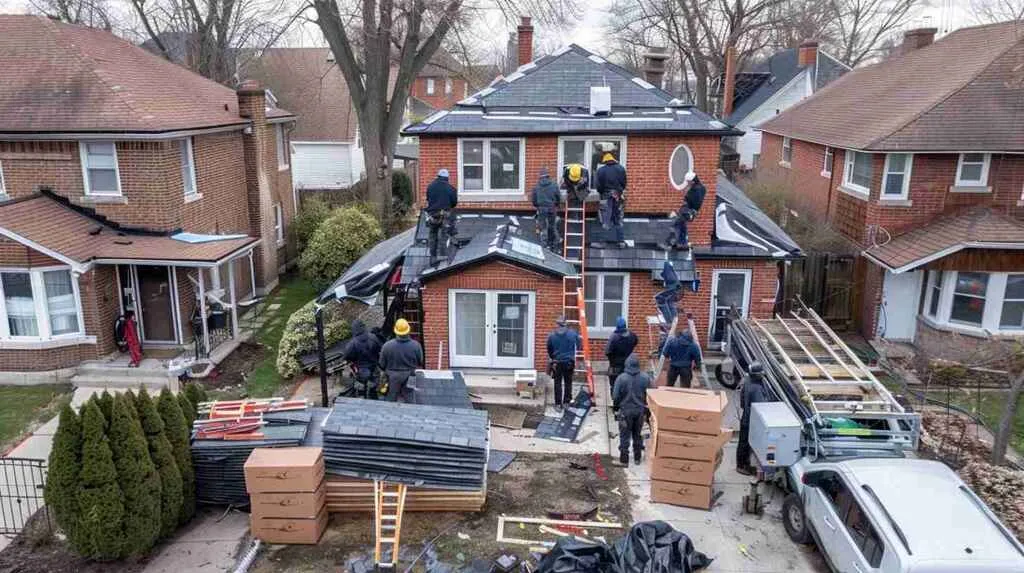
What Is a Shingle Roof Queens NY – The Simple Clear Answer | Free Estimates
Blueprint: a shingle roof is not just a material-it’s a system of overlapping, individual pieces designed to throw water off your house in a very specific way, like overlapping panels in a jacket, where each layer sheds water to the one below it and off the edge. On a typical Queens block-whether you’re looking at semi-attached homes in Woodhaven, row houses in Jackson Heights, or small single-family houses in Ozone Park-you’ll see dozens of different roof shapes, but the ones that work are all doing the same thing: throwing water downhill, fast, before it finds a crack to sneak into.
So What Exactly Is a Shingle Roof on a Queens House?
On a typical Queens block, you’ll see roofs of all kinds-some low and flat on row-house extensions, some steep gables on corner properties, some chopped-up L-shapes on semi-attached homes where additions were tacked on over the decades. A shingle roof is a system of overlapping, individual pieces (usually asphalt, sometimes wood or composite) that throw water off the house in a controlled way, not just “a roof with flat things on it.” Think of each shingle like a small overlapping panel in a well-fitted coat: if the seams and layers don’t overlap the right way around shoulders and the zipper, water will run straight inside. One January afternoon, right after a slushy snowstorm, I got a call from a retired MTA conductor in Jackson Heights who swore his “brand-new” roof was leaking. When I climbed up, I saw the guys before me had used three different shingle brands on one slope and nailed straight through the seams-looked like someone patched a winter coat with duct tape. Water had a perfect little highway under the mismatched shingles, and I had to strip the whole section in freezing wind and show him what a proper shingle roof actually is.
The main material you’ll see in Queens is asphalt shingles-they come in two basic types: architectural (thicker, laminated, with a dimensional look) and 3-tab (flatter, simpler). But here’s my honest take after 19 years: brand and color matter a lot less than how those shingles overlap and align on your house. In Queens climate-snow, wind off the water in winter, brutal summer heat bouncing off asphalt streets-the way shingles overlap and the way nails are placed is what keeps you dry. Improper nailing or mixing brands creates “water highways” under the roof surface. That MTA conductor’s roof? Three brands meant three different thicknesses and edge profiles, so water just followed the gaps like a zipper left open in a winter coat.
| Myth | Fact |
|---|---|
| A shingle roof is just any roof with flat pieces on top | Shingles are a specific overlapping system that sheds water by slope and layering, not just a surface covering |
| Shingles and rolled roofing are basically the same thing | Rolled roofing is a continuous sheet for very low slopes; shingles are individual overlapping pieces for pitched roofs |
| All Queens houses have shingle roofs | Many Queens homes mix systems-shingles on the main pitched roof, membrane or metal on flat back extensions |
| If it looks layered, it’s shingles | Coated roofs and some membrane systems can look layered from the street but lack the overlapping, individual-piece structure of true shingles |
| You can put shingles on any roof, flat or steep | Shingles need a minimum slope (usually 2:12 or steeper) to shed water; flatter roofs require different waterproofing systems |
Now, Take That Same Idea and Zoom In: How a Shingle Roof Actually Works
When I first step onto a roof, the first question in my head is: “Is this jacket cut right for this house?” Then I break it down layer by layer. Under the shingles, you’ve got the roof deck (usually plywood), then underlayment (felt or synthetic), then the shingles themselves, with flashing tucked around walls, chimneys, vents, and pipes, and finally a ridge cap running along the peak. Water travels from the ridge down to the gutter, and every seam, every overlap, every piece of metal flashing is there to keep it moving in one direction: down and off. Think of those layers like seams, buttons, and lapels in a coat-each detail directs rain away from the “body” of your house. Queens storms-especially sideways wind on corner lots in Woodhaven, Maspeth, or Ozone Park-test every seam. On a hot August morning in Ozone Park, I was redoing a roof on a two-family house where the owner thought “shingle roof” just meant “any roof with flat things on it.” Another contractor had put cheap siding panels on the low-slope section, which is not what shingles are for at all. I remember marking out with chalk the exact line where shingle roofing should stop and a different system should start, and the owner said, “No one has ever drawn my roof like that before.” That’s when it clicked for him what a shingle roof really is-and isn’t.
Shingles are a water-shedding system, not waterproof by themselves. They work on slopes steep enough for gravity to do the job-typically anything above a 2:12 pitch (that means 2 inches of rise for every 12 inches of horizontal run). On very low-slope back extensions-common in Queens row houses and attached homes-shingles won’t do the trick; you need a membrane or metal system that can handle standing water. If you’ve got a low back roof behind your main pitched roof, chances are it’s not shingled, or if it is, it shouldn’t be. That’s where leaks start, especially after a heavy spring rain when water pools and finds the tiniest gap.
✅ Key Parts of a Proper Shingle Roof System
- Roof Deck: The structural base (plywood or OSB) that everything else sits on; must be solid and dry before shingles go down
- Underlayment / Ice & Water Shield: Waterproof barrier that protects the deck if shingles blow off or water backs up; critical along eaves and valleys in Queens winters
- Starter Shingles: Special first course along the eaves that seals the edge and gives the field shingles a proper starting line
- Field Shingles: The main overlapping courses that cover the roof slope, nailed in rows from bottom to top
- Flashing (Walls, Chimneys, Vents): Metal pieces that seal the seams where roof meets walls, pipes, or structures-these are the “buttonholes” in your roof jacket
- Ridge Cap & Ventilation: Capping along the peak that seals the top edge and allows hot attic air to escape, preventing ice dams and extending shingle life
| Roof Area / Slope Type | Can You Use Shingles? | Better Option in Queens, NY |
|---|---|---|
| Main pitched roof (steep gable or hip, common on single-family homes) | Yes – ideal for shingles | Asphalt architectural shingles with proper underlayment and ventilation |
| Moderate slope addition roof (4:12 to 6:12, often on row-house back) | Yes – shingles work fine | Same as main roof; just ensure flashing at wall junctions is tight |
| Low-slope back extension (1:12 to 2:12, common on attached Queens homes) | Maybe – not recommended; water can back up | Torch-down membrane, EPDM rubber, or modified bitumen for better waterproofing |
| Nearly flat or flat roof (less than 1:12, typical on row-house backs or commercial buildings) | No – shingles will fail | Full membrane system (TPO, EPDM, or modified bitumen) with proper drainage |
If you remember nothing else, remember that shingles are there to throw water off, not to hold water out forever.
Now, Take That Same Idea and Zoom In Again: Is Your Roof Actually a Shingle Roof?
Let me be clear about something most people get wrong right away: a lot of Queens homeowners mislabel their roofs. They call a rolled roof or a coated flat roof “shingles” just because it’s layered or textured, but that’s not the same thing. To tell if you truly have shingles, look from the sidewalk or zoom in on a phone photo-you should see individual overlapping pieces with clear rows, not continuous sheets or painted-over surfaces. One evening right before a thunderstorm, I inspected a tiny attached house in Ridgewood for a young couple who just bought their first place. The inspector’s report only said “asphalt shingle roof in fair condition,” but they had no idea what that meant. I was sitting on their stoop as the sky turned that weird purple color, using a scrap shingle and a bottle of water to show them how overlapping works and where the water actually goes. When it started to pour, we watched how the water ran exactly where I said it would-that’s when they decided to hire us to redo the whole thing before the next storm. Here’s a simple insider tip: take a zoomed-in photo of your roof from across the street and look for clear rows of overlapping pieces and any irregularities-curling edges, missing tabs, different colors. I often have homeowners text those photos before I even visit, and nine times out of ten I can tell them what they’re looking at and whether they actually have shingles.
Decision Guide: Do You Have a Shingle Roof?
START: Look at your roof from the street or a second-floor window across the yard
Do you see individual overlapping pieces arranged in clear horizontal rows?
✓ YES – You likely have shingles
Next: Look closer at the condition
✗ NO – Continuous sheets or very low slope
You likely have a different roofing system
IF YES: Check the shingle condition
Are shingles curling, cracked, or missing in spots? Do you see dark streaks or bare patches?
→ If YES: Schedule an inspection soon – these are signs of wear
→ If NO: Do a visual check every 6-12 months and after major storms
How old is your roof?
Do you know when the shingles were last installed or replaced?
→ 15+ years old: Get a professional inspection within the next few months
→ 10-15 years: Monitor closely, especially after winter
→ Under 10 years: Routine checks are fine, unless you see visible damage
IF NO: Your roof may be nearly flat or covered with a different material
Is your roof almost flat (like many Queens row-house backs)?
→ Likely a membrane system (EPDM, TPO, tar & gravel, or rolled roofing)
→ Call to confirm what you have – shingles aren’t appropriate for very low slopes
FINAL STEP: Not sure or seeing leaks inside?
Call Shingle Masters for a free inspection and we’ll tell you exactly what you have and what it needs
✅ Before You Call: What to Check About Your Queens Shingle Roof
- ✅ Take 3 photos: one from the street showing the full front slope, one from the backyard, one close-up of shingle detail if you can zoom safely
- ✅ Note any interior leaks: write down which rooms, which walls or ceilings, and when the stains appeared (after rain, after snow melt, etc.)
- ✅ Check gutters for granules: if you see a lot of dark, sandy grit in the gutters or downspouts, shingles are losing their coating
- ✅ Look for missing or crooked shingles: even one or two missing tabs can let water in during the next storm
- ✅ Note the age if you know it: check old paperwork or ask the previous owner; if it’s over 15 years, plan for replacement soon
- ✅ Identify low-slope areas: if your house has a flat or nearly flat back section, note whether it looks like the same material as the main pitched roof
- ✅ List previous “repairs”: if someone tarred over spots, used roof coating, or patched with mismatched shingles, mention that-it tells me what went wrong before
Now, Take That Same Idea Right Down to the Stitching: What We Actually Do to Your Shingle Roof
Think of the top of your house like a tailored coat-it’s not a one-size-fits-all rectangle. A proper shingle installation or replacement in Queens is like fitting and sewing a custom jacket: I measure your slopes, plan the seams where valleys, hips, and wall lines meet, and choose details based on your house’s “body shape”-whether it’s an L-shaped semi-attached home in Maspeth or a simple gable in Ozone Park. I’d rather re-cut valleys and flashing details than accept a sloppy fit where shingles don’t line up cleanly. Every roof in Queens is different, and the way shingles break around chimneys, dormers, and back additions makes all the difference between a roof that lasts 20 years and one that leaks in year three.
Here’s what you can expect when you work with us: I’ll walk the roof with you (from the ground if you’re not comfortable climbing), take photos, and sketch how water actually moves across your specific roof shape. Then we’ll talk about shingle type-architectural or 3-tab, color, warranty-but more important, I’ll explain how we’ll handle the seams, the underlayment, and the flashing. You’ll see how water will move before any shingles go on. During installation, we protect your landscaping and your neighbors’ property, tear off the old roof (if needed), repair any soft or rotten deck boards, install new underlayment and ice shield, then lay shingles in clean, aligned rows. At the end, I do a final inspection on the roof and then walk you through it at ground level so you understand what we did and why.
Step-by-Step: How a Queens Shingle Roof Replacement with Shingle Masters Works
- On-site walk-through and photos: I’ll inspect your roof from ground and roof level, take detailed photos, and note problem areas like soft spots, old flashing, or mismatched repairs
- Sketching your roof and water paths: I draw a simple diagram showing your roof shape, slopes, valleys, and chimneys, then trace how water should move from peak to gutter-this is where you’ll “see” what a shingle roof does
- Proposal with materials matched to your roof shape and slope: You’ll get a written estimate that lists shingle type, underlayment, flashing details, and ventilation, tailored to your house’s specific “fit”
- Protection of landscaping and neighbors’ property: Before we start, we cover plants, move grills and furniture, and set up tarps to keep debris off your neighbor’s yard (especially important on tight Queens lots)
- Tear-off, repairs, and precise shingle installation: We strip the old roof, replace any damaged deck boards, install ice & water shield and underlayment, then lay new shingles in clean rows with proper overlap and nailing-no shortcuts
- Final inspection on the roof and explanation at ground level: I walk the finished roof to check every seam and flashing joint, then meet you at the stoop to explain what we did, show you photos of the work in progress, and answer any questions
Why Queens Homeowners Trust Ricardo and Shingle Masters
Licensed & Insured in New York State
Full liability and workers’ comp coverage, so you and your neighbors are protected during every job
19+ Years Installing Shingle Roofs in Queens
Hundreds of roofs across Jackson Heights, Ridgewood, Woodhaven, Ozone Park, Maspeth, and beyond
Fast Response for Leak Inspections
We typically schedule inspections within 24-48 hours of your call, especially for active leaks
Photo and Sketch Documentation
Every estimate includes photos of your current roof condition and a hand-drawn diagram showing how water flows
Now, Take That Same Idea to the Calendar: Caring for a Queens Shingle Roof Over Time
Even a well-fitted shingle “jacket” needs regular checks, especially after Queens weather swings-freeze-thaw cycles in February, brutal summer sun in July, Nor’easters that blow sideways rain into every seam in October. Simple habits like annual visual inspections from the ground, cleaning gutters twice a year, and checking after big storms can add five to ten years of life to your roof and help you catch small seam problems before they turn into leaks over the couch.
Simple Maintenance Timeline for Queens Shingle Roofs
Every Spring (April-May)
Walk around your house and look up at the roof from all four sides. Check for missing or lifted shingles after winter winds, and clear any debris from valleys and behind chimneys. If you see shingle granules collecting in gutters or downspouts, note that for your next inspection.
Every Fall (October-November)
Clean gutters and downspouts thoroughly before winter. Check for any new stains on ceilings or walls inside, especially in upper rooms and attics. Look for curling or cracked shingles that might let ice and snow sneak under during the next freeze.
After Major Storms (any season)
After heavy rain, high winds, or snow, do a quick visual check from the street. Look for lifted, torn, or missing shingles. If you notice new leaks inside or see shingle pieces in the yard, call for an inspection right away-small damage caught early is cheap to fix.
Every 5-7 Years
Schedule a professional roof inspection even if nothing looks wrong. A roofer can walk the surface, check flashing, probe soft spots, and catch problems you can’t see from the ground-like worn underlayment or early deck rot-before they become expensive tear-offs.
Common Queens Questions About Shingle Roofs
How long does an asphalt shingle roof last in Queens, NY?
A properly installed asphalt shingle roof in Queens typically lasts 18 to 25 years, depending on shingle quality (architectural shingles last longer than 3-tab), ventilation, and maintenance. Queens weather-freeze-thaw cycles, summer heat, and coastal wind-can shorten that if the roof wasn’t installed correctly or if gutters stay clogged and cause ice dams.
Is my roof too flat for shingles?
If your roof is nearly flat (less than a 2:12 slope-that’s 2 inches of rise for every 12 inches horizontal), shingles won’t shed water properly and you’ll get leaks. Many Queens row houses and attached homes have low-slope back extensions that need membrane systems (EPDM, TPO, or torch-down) instead of shingles. I can tell you in five minutes whether your slope is right for shingles.
Can you just patch the area that’s leaking?
Sometimes, yes-if the roof is relatively new and the leak is isolated to one damaged area (like a torn valley or a missing flashing around a pipe). But if your shingles are over 15 years old or if multiple areas are failing, patching is like putting a Band-Aid on a coat with a ripped seam-it might hold for a season, but the rest of the roof is aging at the same rate and you’ll be calling again next year.
Do I need to replace plywood when I change shingles?
Not always-most of the time the plywood deck is still solid. But if there’s been a long-term leak, poor ventilation, or ice dam damage, you’ll have soft, spongy, or rotten spots that must be cut out and replaced before new shingles go down. I check the deck during tear-off and only replace what’s actually damaged, and I’ll show you photos if we find problems so you see exactly what needs fixing.
If you’re a Queens homeowner who’s not sure what you’re looking at on your roof-or if you already have a leak over the couch and nobody’s been able to explain what’s actually wrong-call Shingle Masters for a free, visual walkthrough of your shingle roof. I’ll sketch your roof, explain how the “jacket” of your house should really fit, and show you exactly what needs to be done to keep water moving down and off, not into your living room.