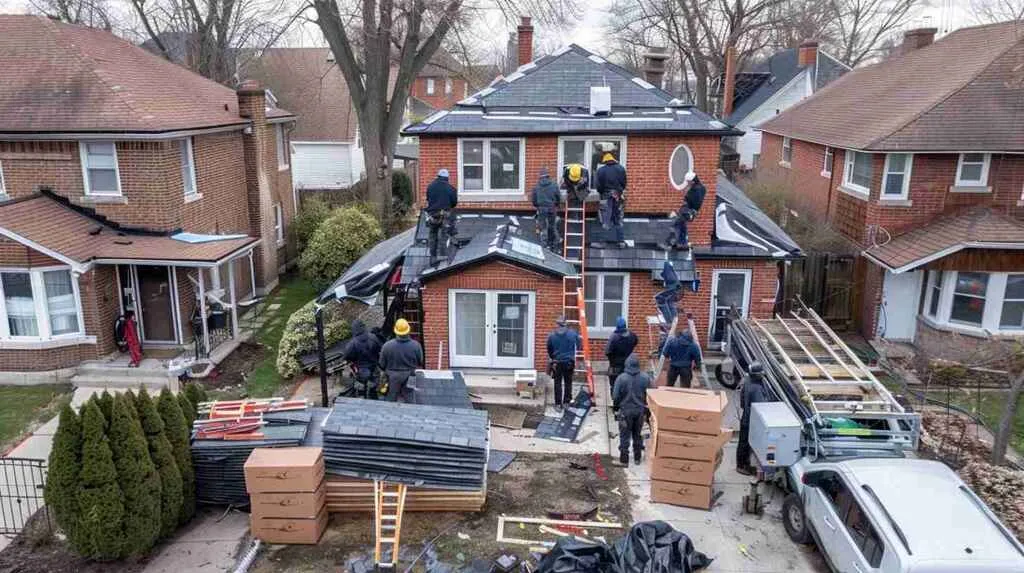
Rubber Roof Over Asphalt Shingles Queens NY – Does It Work? | Free Quotes
Honestly, the “$2,500 rubber roof right over your old shingles” people hope for around Queens usually turns into a $9,000 tear-off and ceiling repair when the whole thing starts leaking three winters in. I’m going to walk you through exactly why that happens on these old two-family homes, what the one acceptable exception looks like, and what a proper job actually involves when you stop trying to take shortcuts.
Rubber Over Shingles in Queens: Why the “Cheap Fix” Blows Up Your Budget
Let me be blunt: rubber directly over old asphalt shingles in Queens is usually a band-aid on a broken bone. Picture your roof like a layered sandwich-if the meat’s rotten, changing the bread doesn’t make it lunch-worthy. That’s my analogy, and I use it on every stoop conversation because it’s exactly what happens when you try to skip proper prep. You’re not buying fifteen more years; you’re buying maybe three to seven before the whole assembly starts moving, pulling, and leaking in ways that cost twice what a proper replacement would’ve run in the first place.
One February morning around 6:30 a.m., I was on a two-story in Maspeth with frost still on the shingles, looking at a rubber roof another crew had laid right over old asphalt. Every time the sun hit, the whole thing “breathed” and pulled away from the chimney flashing, so the homeowner had water running down into her kitchen light fixture. I remember standing there, seeing the steam come off that roof as the sun came up, thinking, “This is what happens when you ignore ventilation and expansion joints.” Queens weather-freeze-thaw cycles all winter, brutal summer sun, humidity that just sits there-turns every little crack and bump in those old shingles into a stress point on the membrane above. The rubber can’t lay flat over ridges and curls, so it bridges the gaps like a stretched tarp, and when the seasons shift, those high spots pull and crack.
Here’s where that bites you: heat gets trapped between the membrane and the old shingles because there’s no ventilation path, and the whole assembly “breathes” with temperature swings. The rubber expands and contracts at a different rate than brittle asphalt underneath, so seams open, adhesive fails around penetrations, and water finds its way in-not all at once like a dramatic gusher, but slow drips that soak into walls and ceilings for months before you see the first stain. By then, you’re not just fixing the roof; you’re cutting out drywall, sistering studs, and dealing with mold remediation that could’ve been avoided if the job had been done right from day one.
The Real Cost of a “Cheap” Rubber-Over-Shingle Job in Queens
- A $2,500 rubber-over-shingle job that fails can easily become a $8,500-$9,500 full tear-off plus interior repair when water damage shows up.
- Added weight over multiple shingle layers can stress older Queens framing, especially over rear additions and extended back sections where rafters were sized for lighter loads.
- Most manufacturer warranties are void when rubber is installed directly over asphalt shingles-you’re on your own if it fails in year two.
| Myth | Fact |
|---|---|
| “Rubber over shingles is a quick, cheap way to buy 15 more years.” | In Queens, I usually see these start leaking in 3-7 years because of movement, UV exposure, and bad substrates that telegraph through the membrane. |
| “If it doesn’t leak right away, it must be fine.” | Slow seepage around chimneys and skylights can drip inside walls for months before you see a stain-by then the framing’s already compromised. |
| “The rubber will smooth out all the old shingle bumps.” | Those ridges telegraph through like a lumpy lasagna-every hump is a stress point on the membrane where it flexes and eventually cracks. |
| “My neighbor did it and saved a fortune.” | You only hear about the install price, not the hidden structural repairs when it eventually fails-or the fact they might be living with a slow leak they just haven’t found yet. |
Where Rubber-Over-Shingle Jobs Fail First on Queens Homes
On 43rd Avenue last winter, I saw something that explains this perfectly-a few summers back, around 9 p.m., I was finishing an emergency call in Jamaica after a thunderstorm. A landlord had put rubber over three layers of shingles to save money, and the added weight plus ponding water bowed the rafters over a rear bedroom. I’ll never forget the sound of my boot squishing on that spongey roof as lightning lit up the sky, and realizing the “cheap fix” had turned the whole structure into a trampoline with a drain leak right over a kid’s bunk bed. This is the reality on older Queens housing stock-two-family homes, rear additions cobbled together over decades, multiple shingle layers because nobody ever tore off the first or second roof. When you add rubber on top of all that, you’re not solving a problem; you’re just piling weight and water-trapping layers onto framing that was sized for a single asphalt roof back in 1952.
Failure points show up fast around here: chimneys are the number-one culprit because the rubber pulls away as the roof moves with temperature swings and the brittle shingles underneath shift or crack. Skylights and roof vents are close behind-improper flashing ties the new membrane to old, degraded materials that can’t hold a seal. Low-slope rear sections over kitchens and back bedrooms pond water after every rain, and when that standing water sits on top of uneven shingles, seams open and adhesive lets go. Parapet walls on attached row houses in Jackson Heights and Woodside leak where the membrane ties into brick because there’s no solid, flat transition. And don’t get me started on gutters sagging under the weight of multiple layers-water runs backward under the membrane edge and rots out soffits before you even know there’s a problem. Queens storms and that sticky summer humidity make every one of these weak spots show up within a couple of seasons.
| Area | What Goes Wrong | How It Shows Up Inside |
|---|---|---|
| Chimney transitions | Rubber pulls away as the roof “breathes” and shingles shift underneath | Stains around chimney chase, water near living room ceiling |
| Rear low-slope additions | Ponding over old shingles, seams open under standing water | Soft plaster over kitchens/back bedrooms, musty smell |
| Skylights and roof vents | Improper flashing ties rubber to brittle shingles that crack | Drips around skylight framing, bubbling paint |
| Gutters and eaves | Weight of multiple layers causes sagging, water runs backward under membrane | Rotten soffits, peeling paint near exterior walls |
🚨 Call Shingle Masters ASAP
- You feel soft, spongey spots when you walk the roof
- There’s active dripping near light fixtures or outlets
- You see bowing or sagging in ceilings under a rubber-over-shingle section
📅 Can Usually Wait a Week
- Small, dry stains that haven’t grown in months
- Minor surface cracking but no soft spots
- You’re planning a renovation and want an honest roof assessment first
The One Time I’ll Even Consider Rubber Over Asphalt Shingles
There’s one exception I’ll grudgingly allow-and it only shows up on maybe one roof out of twenty I see around Queens. One humid August afternoon in Astoria, a retired engineer grilled me for an hour on whether we could do rubber over his old architectural shingles. We ended up cutting a test section, and I showed him how the curled tabs and soft sheathing underneath would telegraph right through and stress the membrane seams. We sat on his back stoop drinking iced tea while I drew out cross-sections of “good” versus “bad” assemblies on a pizza box lid-he later told me the cardboard sketches convinced him more than any glossy brochure. The “exception” only works if you’ve got a single layer of flat, uncurled shingles over solid sheathing, the roof pitch is already low enough that shingles are borderline inappropriate anyway, and you’ve got room in the budget to add proper edge metal and upgrade all the flashings-not just smear goop over what’s already there.
Here’s the non-negotiable checklist: only one existing shingle layer with no visible curling, cupping, or missing granules; a roof pitch low enough that you’re already in “near-flat” territory on rear sections (not your steep front gable); solid, dry sheathing confirmed by test cuts-I drop to my knees and knock with my knuckles to feel for any give; adequate ventilation so the assembly doesn’t bake like a sealed lasagna pan; and the willingness to add proper chimney, wall, and edge flashings as part of the job, not as an afterthought. If even one of those conditions fails, you’re back to tearing off. My insider tip: always cut a small test section down to the deck before approving any rubber-over-shingle idea-never rely only on what you see from the surface, because shingles hide rot, and rot hides under shingles until you peel them back and look.
✅ Bare-Minimum Conditions for a “Maybe” Rubber-Over-Shingle in Queens
Only one existing shingle layer and no visible curling or cupping.
Roof pitch low enough that shingles are already a compromise (near-flat back sections).
Solid, dry sheathing confirmed by test cuts-no give underfoot.
Room to add proper edge metal, chimney, and wall flashings-not just goop over what’s there.
Adequate ventilation so the assembly doesn’t bake like a sealed lasagna pan.
Should You Even Talk About Rubber Over Shingles on Your Queens Home?
START: Do you have more than one layer of shingles now?
If YES → Stop. You need a tear-off, not rubber over shingles. Call Shingle Masters for an inspection.
If NO → Is the deck solid with no soft spots or leaks?
If NO → Tear-off and repair framing/sheathing first.
If YES → Is this a low-slope rear section (not your main steep front roof)?
If NO → Switch to a proper shingle or other pitched-roof system.
If YES → You may qualify for a carefully detailed rubber system-only after an in-person inspection.
What a Proper Queens Rubber Roof Job Over Old Shingles Really Involves
Picture your roof like a layered sandwich-if the meat’s rotten, changing the bread doesn’t make it lunch-worthy. That analogy matters here because a “proper” rubber job over old shingles almost always means removing those shingles or doing serious prep work, so it’s not the cheap shortcut people imagine when they first call me. Every roof is a stack of layers: framing that holds everything up, sheathing (usually plywood or boards) that gives you a nailing surface, underlayment that’s your first water barrier, sometimes insulation if you’re lucky, the membrane itself (EPDM or modified bitumen), and finally all the flashings that tie into chimneys, walls, vents, and edges. If any layer in that stack is compromised-rotten wood, curled shingles, missing underlayment, sagging rafters-everything above it fails eventually, just like a lasagna where the noodles are undercooked and the cheese is already moldy. You can’t just pour sauce on top and call it dinner.
$7,500 for a small Queens rear flat roof done right with tear-off and deck repair is still cheaper than the $9,500 you’ll spend after a $2,500 band-aid fails and takes your kitchen ceiling with it.
How Shingle Masters Fixes a Bad Rubber-Over-Shingle Roof in Queens
- Full inspection: walk the roof, check attic or top floor ceilings, probe for soft spots, and map ponding areas.
- Careful tear-off: remove rubber and shingles down to the deck so we see every piece of rotten wood.
- Framing and deck repair: sister weak rafters, replace spongy sheathing, and re-nail loose boards.
- Rebuild layers: install proper underlayment, insulation (where feasible), and ventilation paths.
- New membrane install: lay quality EPDM or modified bitumen with correct adhesives, seams, and expansion joints.
- Detail work: upgrade flashing at chimneys/walls, rehang gutters, and water-test vulnerable areas before we leave.
💰 Typical Queens Rear-Roof Scenarios and Realistic Price Ranges
| Scenario | Description | Typical Range in Queens |
|---|---|---|
| Band-aid coating | Quick roll-on coating, no tear-off, no structural repair | $1,500-$3,000 (short-term, not recommended) |
| Small rear flat (up to 200 sq ft) |
Remove rubber and one shingle layer, minor deck repair, new membrane | $5,500-$7,500 |
| Medium addition (200-400 sq ft) |
Multiple soft spots, some rafter sistering, new membrane and flashings | $7,500-$10,500 |
| Three-layer mess | Remove multiple layers, serious framing reinforcement, full rebuild | $10,500-$15,000+ |
| Proactive replacement | Single-layer shingle tear-off in decent shape, new low-slope system | $6,000-$8,500 |
Queens Rubber-Over-Shingle Questions I Get on Every Job
When a homeowner in Jackson Heights asks me, “Can’t you just go over what’s there?”, here’s what I walk them through-and honestly, neighbors in Woodside, Astoria, and Jackson Heights all ask the same five questions about trying to skip the tear-off. I’d rather answer them straight than sell a quick patch that comes back to bite everyone in three years.
▶
Is it even legal to put rubber over asphalt shingles in Queens?
NYC building code generally limits the number of roof layers you can have-most times you’re already at that limit if you’ve got two layers of shingles underneath. Even if code technically allows it in your specific case, no reputable manufacturer warranties rubber installed directly over asphalt shingles as a standard assembly. You’re in a gray zone where it might pass inspection but you’re totally on your own if it fails, and insurance adjusters love finding reasons to deny claims on non-standard installs.
▶
Will it at least get me through one more winter?
Maybe-but you’re gambling with hidden damage and the real cost of a failed roof plus interior repairs. One bad Queens nor’easter with driving rain can push a marginal rubber-over-shingle job over the edge, especially if you’ve got compromised flashing or soft spots you don’t know about yet. I’ve seen roofs that looked fine in September start dripping by January because freeze-thaw cycles opened seams that were barely holding to begin with.
▶
Can you just do the back flat and leave the front shingle roof alone?
Yes-and honestly that’s one of the smartest approaches for older two-family homes where the steep front gable is still in decent shape but the low-slope rear addition over the kitchen is a mess. I isolate the two systems and tie the flashings cleanly at the transition so each roof does its own job without compromising the other. You save money by only replacing what actually needs it, and you’re not putting a band-aid over a structural problem that’s confined to one section.
▶
How long should a properly done low-slope membrane last in Queens?
With good prep, proper drainage, and quality materials, you’re looking at 20-30 years from a well-detailed EPDM or modified bitumen system. Over bad shingles with no tear-off? It can fail in a fraction of that-three to seven years is what I typically see before leaks show up and the whole thing needs to be ripped off anyway. The membrane itself might last decades, but only if the substrate underneath is solid, dry, and stable.
▶
Do you offer free quotes in Queens for this kind of job?
Absolutely. Shingle Masters offers free on-site assessments throughout Queens, NY-I’ll come out, walk your roof, check the attic or top floor, and give you a written estimate that shows the difference between a band-aid and a proper fix, complete with photos of what I found. You’ll see exactly what layers you’ve got, where the problems are, and what your realistic options cost, so you’re not guessing or relying on someone’s sales pitch.
Why Queens Homeowners Call Shingle Masters for Problem Roofs
-
✓
27+ years roofing in Queens neighborhoods like Maspeth, Astoria, Jackson Heights, and Jamaica. -
✓
Fully licensed and insured in NYC. -
✓
Specialized in flat-over-shingle and low-slope problem roofs-this is where other contractors call us in. -
✓
Free, no-pressure written quotes and photos of what we find so you can actually see the layers.
A rubber roof over asphalt shingles in Queens, NY, is almost never the bargain it looks like on paper-those “cheap” installs turn into expensive tear-offs when they fail, and around here they usually fail within a few seasons because of movement, weather, and substrate problems nobody addressed up front. Shingle Masters can inspect your specific roof, photograph every layer, and quote you proper options that’ll actually last instead of turning into a crisis the next time we get a nor’easter. Call or request a free quote today before the next Queens storm turns a cheap patch into a major repair-because fixing it right the first time is always cheaper than fixing it twice.