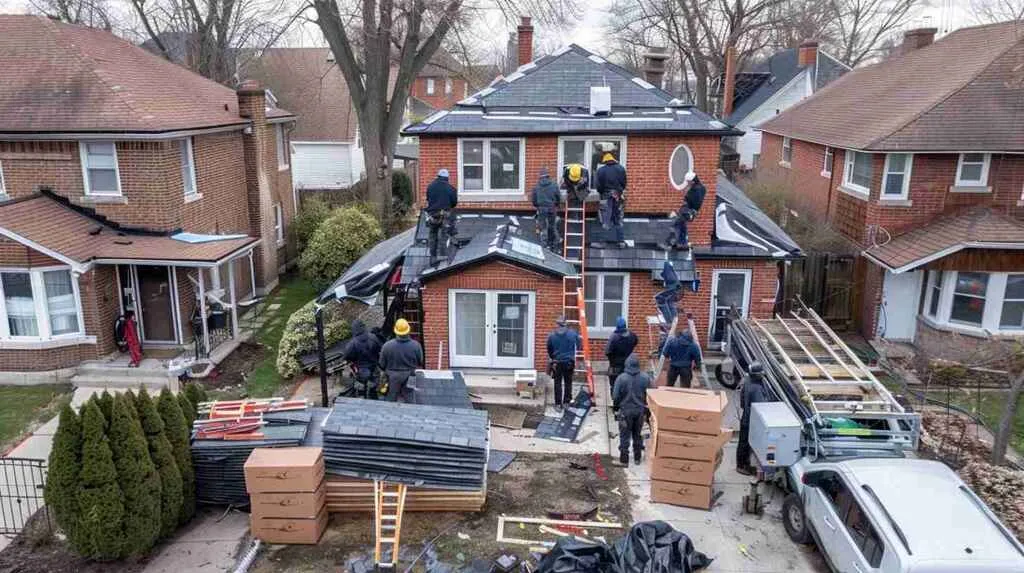
Clean a Shingle Roof Safely Queens NY – Methods That Don’t Damage
Invisible organisms are spreading across thousands of Queens roofs right now, leaving those black streaks homeowners want to scrub away-but the trick to how to clean a shingle roof isn’t blasting harder, it’s killing and lifting that growth the way a conservator would treat grime on a painting. You’re not cleaning dirt off concrete; you’re restoring a protective surface that has to survive 20 more winters, and the wrong method strips years off that lifespan faster than wind or weather ever could.
Invisible Organisms, Visible Damage: What Those Black Streaks Really Are
Here’s the thing: those black streaks covering north-facing shingles across Bayside and Forest Hills aren’t just stains you can wipe away like fingerprints on glass. They’re colonies of living algae-usually Gloeocapsa magma-along with moss, lichen, and a thin biofilm of microorganisms that grip the shingle surface and hold moisture against it. When you try to “clean” that growth the wrong way, you’re not removing dirt; you’re scraping, dissolving, or blasting away the protective granule layer that keeps your asphalt shingles from aging prematurely. I always tell customers to think of their roof like a painting in a museum: if you scrub a 200-year-old canvas with a stiff brush and industrial cleaner, you’ll take off the grime and the paint underneath. Same logic applies up on your roof.
Queens homes face the perfect storm for this growth: we’ve got humidity rolling in from the water, tree cover in neighborhoods like Douglaston and Forest Hills Gardens, and those cool, shaded north slopes that never fully dry out. The algae and moss that thrive in those conditions aren’t just cosmetic-they trap water, accelerate granule loss, and create paths for leaks once the shingle mat starts to degrade. The rest of this article walks you through exactly how to clean a shingle roof in Queens without turning a stain problem into a structural one, separating the gentle restoration methods that work from the harsh abrasion tactics that wreck what you’re trying to protect.
Myth vs. Fact: Black Streaks and Roof Cleaning Basics
| Myth | Fact |
|---|---|
| Those black streaks are just dirt that needs scrubbing. | Most black streaks on Queens shingle roofs are Gloeocapsa magma algae that spread and hold moisture. |
| More pressure means a cleaner, longer-lasting roof. | High pressure strips protective granules like sandpaper on a painting, shortening roof life. |
| Bleach poured straight from the jug is the fastest solution. | Strong, un-diluted bleach can corrode gutters, harm plants, and age shingles prematurely. |
| If stains are gone, the job was done right. | A proper clean kills growth at the roots without leaving hidden damage or loose granules behind. |
| Any cleaning product labeled “roof cleaner” is safe. | You need cleaners specifically rated for asphalt shingles and applied at the right strength and dwell time. |
On 90% of the Queens Roofs I Clean, the First Villain Isn’t Dirt-It’s Algae
One drizzly November morning in Bayside, a retired teacher called me because her roof was “leaking from those black stains.” I got up there and saw classic algae streaks-dark, uniform lines running down from the ridge-but the actual leak was from a tiny cracked pipe boot tucked near her bathroom vent, not the stains at all. While I was explaining the difference, she pulled out a bottle of household bleach and a spray nozzle, ready to “help,” and I had to stop her mid-reach. That undiluted mix would’ve corroded her aluminum gutters on contact and killed every azalea in her side yard once it ran off. We ended up doing a proper soft wash instead, and I still remember standing in light rain, explaining chemical dwell time and dilution ratios like it was a science lab. The lesson: algae, moss, and lichen are the main culprits on Queens roofs, especially on north-facing slopes and near overhanging trees in neighborhoods like Bayside, Astoria, and parts of Jackson Heights where older capes and colonials sit close together and shade each other. Coastal humidity and that Atlantic moisture rolling through means these organisms find a home faster than you’d think.
Before you clean anything, you’ve got to diagnose what you’re actually looking at: are those streaks active growth, old dead stains, or discoloration from a ventilation issue? I use a jeweler’s loupe up on the shingles sometimes, just like examining a canvas under good light, to see if the algae is still alive and spreading or if it’s already been killed by zinc strips and just needs time to wash away naturally. Not every stain needs aggressive intervention, and that’s where targeted soft washing comes in-killing the roots without scraping the surface. If you treat every mark like it’s emergency-level and grab the nearest power tool or chemical jug, you’re going to over-clean, and that’s where the real damage starts.
⚠️ Big Warning for Queens Homeowners
- Straight household bleach sprayed from a bottle can pit aluminum gutters and stain siding.
- Runoff from strong mixes can burn lawn strips, shrubs, and garden beds below the eaves.
- Many generic “outdoor cleaners” are too harsh for asphalt shingles or require rinsing pressures that damage granules.
- Spraying chemicals from a ladder without fall protection is one slip away from a serious injury.
- If you smell strong bleach from the sidewalk, the mix is probably too hot for your roof and your plants.
Common Places Algae and Moss Show Up on Queens Roofs
-
✓
North-facing slopes shaded by neighboring buildings in Jackson Heights and Elmhurst. -
✓
Under overhanging trees in Bayside, Douglaston, and parts of Forest Hills Gardens. -
✓
Above bathrooms and kitchens where warm, moist air vents below keep the roof slightly damp. -
✓
Along lower edges near clogged gutters where water backs up. -
✓
Around skylights and chimney bases where debris tends to collect.
Let Me Be Blunt: If Your Cleaning Method Involves Blasting, Your Shingles Are Getting Blasted
One August afternoon in Astoria, around 3 p.m., I was on a two-family brick house where the owner had taken his new pressure washer to his 10-year-old shingles that very morning. When I stepped up, the sun was bouncing off bare fiberglass where protective granules used to be, and his gutters were literally full of gray “sand”-thousands of ceramic granules stripped right off. I had to explain that he’d basically taken 180-grit sandpaper to his roof, and then carefully show him how a low-pressure, detergent-based clean could have removed the algae without stripping his shingles down to the mat. It’s the day I started describing bad roof cleaning as “over-cleaning a painting until the color comes off,” because that’s exactly what happens: you blast away the growth and the protection, leaving raw asphalt and fiberglass exposed to UV, rain, and freeze-thaw cycles. That roof, which should’ve had another 12-15 years left, was suddenly looking at replacement within five.
Do not pressure wash your shingle roof. Any contractor who brags about PSI numbers on asphalt shingles is telling you they don’t understand restoration versus abrasion.
High-pressure washing might look “clean” instantly, but it’s a destructive shortcut. The ceramic granules on your shingles aren’t decorative-they’re your roof’s sunscreen, armor, and fire rating all in one, and once they’re gone, the asphalt base starts to age rapidly. You’ll see bare spots, groove marks where the wand passed, and within a year or two, curling edges and brittleness that lead to leaks. In Queens, where a lot of brick two-families have relatively low-slope roofs that look walkable from the street, homeowners are tempted to rent a unit and DIY from the sidewalk. Don’t. Most shingle manufacturers will void warranties if they find evidence of pressure washing, and any pro proposing it as a primary method should be a red flag. The restoration approach-chemistry, dwell time, and a gentle rinse-is the only way to clean a shingle roof without aging it prematurely.
| Method | Pros | Cons |
|---|---|---|
| High-pressure washing |
• Looks “clean” instantly • Removes loose debris fast |
• Strips protective granules • Can drive water under shingles • Often voids manufacturer warranty • Visible groove marks and scars • Shortens roof life |
| Low-pressure soft washing |
• Preserves granules and shingle surface • Kills algae, moss, and lichen at the roots • Safer for siding, gutters, and landscaping • Recommended by most shingle manufacturers |
• Requires correct detergents and dwell time • Results develop over hours to days • Needs trained application to avoid runoff issues |
Should You Ever Let Someone Pressure Wash Your Shingle Roof?
Start: Is the contractor proposing more than 100 psi directly on the shingles?
↓ Yes
Walk away. That’s abrasion, not restoration, and it will age your roof fast.
↓ No
Next: Are they describing a “soft wash” using detergents and a gentle rinse, with protection for gutters and plants?
↓ Yes
This is closer to a museum-style cleaning-ask about their mix, dwell time, and how they protect landscaping.
↓ No
Get more details or a second opinion before anyone sprays your shingles.
On the North-Facing Slopes, the Story Is Different: Safe Cleaning Methods Step-by-Step
How a Professional Soft Wash Works
A proper soft-wash process for Queens shingle roofs is closer to art conservation than construction work-it’s all assessment, protection, chemistry, and patience. First, I walk the property and take photos like I’m documenting a painting before restoration: where are the stains, what’s the slope, are there signs of actual leaks versus just cosmetic growth? One freezing January evening in Jackson Heights, right before sunset, I inspected a co-op building where the handyman had been throwing rock salt on a low-slope shingle section to “melt the moss.” The north side was scarred and curling from years of this, with weird clean patches where salt had concentrated and eaten away at the shingle edges. I took photos under a headlamp and showed the board exactly what gentle seasonal care could’ve prevented. That experience taught me to never skip the documentation phase-homeowners need to see the “before” so they understand why restoration, not abrasion, is the right move. After assessment, we protect surroundings: cover sensitive plants, wet down soil near the drip line, and set up ground tarps so runoff doesn’t hit anything we care about.
Then comes the chemistry part. We mix a manufacturer-approved roof wash solution calibrated specifically for algae, moss, and lichen on asphalt shingles-not a generic “outdoor cleaner,” and definitely not straight bleach. The application uses low-pressure equipment, closer to a garden sprayer than a pressure washer, and we let the solution sit for a controlled dwell time, adjusting for temperature, humidity, and shade just like timing a solvent on old varnish. On north-facing slopes with thick moss, sometimes two or three gentle treatments over a season beat one harsh scrub every time. I use my jeweler’s loupe to check granule integrity and confirm the growth is dying at the roots, not just getting pushed around. After the dwell period, we rinse at low pressure, retreat any stubborn spots without scrubbing hard enough to loosen granules, and finish with a final inspection of shingles, gutters, and downspouts. It’s methodical, it’s technical, and it works without shortening your roof’s lifespan.
Soft-Wash Roof Cleaning Process Shingle Masters Uses in Queens, NY
- Assessment and photos: Walk the property, note stains, growth, and any leak suspects; take photos like documenting a painting before restoration.
- Protect surroundings: Cover sensitive plants, set up ground tarps, and wet down soil near the drip line.
- Mix shingle-safe solution: Prepare a manufacturer-approved roof wash blend calibrated for algae, moss, and lichen on asphalt shingles.
- Low-pressure application: Apply the solution using low-pressure equipment-closer to a garden sprayer than a pressure washer.
- Dwell time monitoring: Let the chemistry work for a set time, adjusting for temperature, humidity, and shade, just like timing a solvent on an old varnish.
- Gentle rinse and spot treatment: Rinse at low pressure, retreat stubborn spots, and never scrub hard enough to loosen granules.
- Final inspection: Check shingles, gutters, and downspouts; confirm growth is neutralized and no damage has occurred.
What You Can Safely Do From the Ground
When customers in Queens ask me, “Can I just walk up there with a brush and some soap?” I ask them how steady they feel on a wet ladder at 18 feet, and that usually ends the conversation. Most Queens roofs are too steep, too complex, or too risky for untrained foot traffic, especially once they’re damp from cleaning solutions or morning dew. Even on milder slopes-those flat-looking sections on brick two-families-you’re one slip away from a serious fall, and every step risks dislodging granules or cracking a brittle shingle you didn’t know was there. The safer play is ground-level monitoring: check your gutters from below for granule buildup, take photos from the sidewalk or an upstairs window every few months to track how stains are spreading, and never throw anything aggressive like rock salt, bleach jugs, or scraping tools up there hoping it’ll help. That’s the opposite of restoration-it’s random abrasion you can’t control.
| Call Shingle Masters ASAP | Can Wait or DIY from the Ground |
|---|---|
|
• You see thick moss cushions or lichen “dots” gripping shingles.
• There are dark, uniform streaks spreading year over year. • Stains appear near a suspected leak or interior ceiling spot. • A previous owner or handyman has pressure-washed or salted the roof. • You’re not confident on ladders or your roof is steep/complex. |
• Light surface dirt that rinses off gutters in rain.
• A few leaves or twigs visible at the very edge. • Taking photos from the sidewalk or upstairs window for monitoring. • Clearing ground-level downspouts and checking for overflow in storms. |
Here’s How I Think About It: Protecting Your Investment in a Queens Roof
Your shingles are like a painted mural on a brick wall-clean the wall wrong, scrub too hard or spray too hot, and the art pays the price while the structure underneath stays untouched. Every roof cleaning choice comes down to restoration versus abrasion: either you’re using the right chemistry, the right pressure, and the right patience to preserve what’s there, or you’re trading short-term “clean” for long-term damage that costs you the last 10-15 years of roof life. Don’t gamble that lifespan for one aggressive afternoon with a rented pressure washer or a bucket of straight bleach. Call Shingle Masters for a gentle, diagnostic-first visit that treats your Queens roof the way a conservator treats a valuable piece-careful, technical, and built to last.
Typical Soft-Wash Roof Cleaning Scenarios and Pricing in Queens, NY
| Home Type / Roof Size | Condition | Estimated Soft-Wash Range* | Notes |
|---|---|---|---|
| Small rowhouse (up to 1,200 sq ft of roof) | Light algae streaking, no moss | $400-$550 | Usually 1 half-day visit; focuses on killing algae and gentle rinse. |
| Typical detached Queens one-family (1,200-2,000 sq ft) | Moderate algae, small moss patches on north side | $550-$850 | Includes targeted moss treatment and extra dwell time in shaded areas. |
| Two-family or small multi-family | Heavy streaking, widespread moss/lichen | $850-$1,300 | Often needs sectional work and follow-up check to confirm full die-off. |
| Older complex roof with many valleys | Mixed stains plus prior bad cleaning attempts | $1,000-$1,600 | Requires careful inspection, documentation, and tailored chemistry. |
*Final pricing depends on roof pitch, access, condition, and surrounding landscaping. On-site inspection in Queens is the only way to nail it down.
Common Questions About How to Clean a Shingle Roof Safely in Queens, NY
Will soft washing void my shingle warranty?
When it’s done with manufacturer-approved solutions and low pressure, soft washing is usually within warranty guidelines. High-pressure washing, abrasive brushing, or unapproved chemicals are what get homeowners in trouble with warranties.
How long will the roof stay clean after a soft wash?
On most Queens homes, you can expect 3-5 years before noticeable streaks return, depending on shade, tree cover, and moisture. On heavy shade or by the water, growth may appear sooner, but follow-up treatments are lighter and gentler.
Can I be home while you’re cleaning the roof?
Yes. We just ask you to keep windows closed and move vehicles away from downspouts while we’re working and rinsing. We’ll walk you around afterward like a curator giving a tour of a restored piece.
Is it ever safe to walk on my own roof to clean it?
Most Queens roofs are too steep or complex for untrained foot traffic, especially when wet. Even on milder slopes, the risk of a slip and hidden shingle damage make DIY roof-walking a bad trade-off.
Do you clean gutters at the same time as the roof?
Often, yes. Because roof cleaning can loosen dead algae and debris, we usually include a gutter check and basic clean-out or recommend it as an add-on so the water has a clear path off your roof.
Treating a Queens shingle roof like a mural-restoring instead of scouring-adds years of life, prevents leaks, and keeps your landscaping safe from harsh chemical runoff. The right soft-wash approach kills algae and moss at the roots without stripping the protective granules that keep your home dry. Call Shingle Masters today for a gentle, diagnostic roof cleaning that protects your investment the way a conservator protects art-with the right tools, the right chemistry, and zero shortcuts.