Best Shingles for High Winds Queens NY – Wind Ratings Explained
Counterintuitively, a high wind rating stamped on a shingle wrapper means almost nothing if the Queens roof beneath it isn’t built and installed to support that rating-and over 31 years, I’ve climbed onto way too many roofs where homeowners paid for premium shingles but still lost tabs in the first nor’easter. I’m Vic Lasky, an engineer-turned-roofer who focuses on wind physics so you don’t have to reattach shingles after every big storm.
Why Wind Ratings on Shingle Wrappers Don’t Tell the Whole Queens Story
On 43rd Avenue last winter, I stood on a roof that had just survived 65 mph gusts with zero missing shingles, and it wasn’t by accident. The owner had called me after his neighbor-with the exact same shingles-lost a dozen tabs overnight. One November afternoon about five years ago, I was on a Howard Beach bungalow roof in 30 mph gusts, trying to figure out why only one corner of the house kept losing shingles every fall. I finally lay flat on the ridge, watched how the wind funneled between the houses, and realized the original roofer had used standard 60 mph-rated three-tabs right in that wind tunnel. Once we swapped to a 130 mph-rated architectural shingle and changed the nailing pattern, that corner survived two nor’easters without losing a single tab. Here’s what I learned: the wrapper rating tells you what the shingle can survive in a controlled lab, but your roof’s real wind performance comes from how the whole system-decking, underlayment, nails, starter strips, and installation pattern-works together. You can strap the toughest shingle on the market to rotten plywood with four nails and a prayer, and it’ll still blow off.
Think of wind flowing over your roof like air moving over an airplane wing parked at LaGuardia during a storm. The shingles themselves are just the skin-the structure underneath and how that skin is attached determines whether the wing stays bolted on or tears away. The 43rd Avenue roof survived because it had synthetic underlayment sealed at every seam, six nails per shingle driven into solid OSB decking, and sealed starter strips at every edge and rake. The neighbor’s roof had the same shingles but half the nails and no starter seal. Wind doesn’t read packaging; it finds the weak link and exploits it.
I watched a properly rated system on a Bayside colonial hold tight through a 60 mph event while a generic 3-tab setup two blocks over-advertised as “wind resistant”-shed pieces into the yard like autumn leaves. Queens wind doesn’t behave like the steady flow engineers model in a wind tunnel; it funnels between buildings like air rushing through a subway tunnel, creating sudden pressure spikes and suction zones that change every few feet depending on your neighbors’ rooflines and how your street is oriented. A shingle might test at 130 mph in a lab where airflow is smooth and predictable, but strap it onto a Queens rowhouse roof where gusts swirl and reverse direction around chimneys and dormers, and you need every installation detail perfect to hit that number in real life.
Myth vs. Fact: Wind Ratings & Real Queens Roof Performance
| Myth | Fact (specific to Queens, NY roofs) |
|---|---|
| A 130 mph rating means my roof will hold in any storm | That 130 mph number only applies if your decking is solid, your underlayment is sealed, and the roofer uses the exact nailing pattern the manufacturer specifies-skip one step and your real rating drops to maybe 70 mph in Queens wind tunnels between rowhomes. |
| Higher-rated shingles cost way more | The shingle upgrade from 60 mph to 130 mph architectural usually adds $15-$30 per square, but the real cost is in proper installation (extra nails, sealed starters, better underlayment)-and that investment pays off the first time a nor’easter rolls through without leaving your yard covered in shingle debris. |
| My old 3-tabs have lasted 20 years so they’re fine | Old 3-tabs lose sealant strength and become brittle over time, so even if they survived past storms when new, they’re now vulnerable to winds that wouldn’t have fazed them in 2005-Queens microclimates and increased storm intensity make replacing aging 3-tabs with modern high-wind architectural shingles a smart move before you have a problem. |
| All roofers install high-wind shingles the same way | In July 2012, after a violent overnight thunderstorm, I got an emergency call at 6:15 a.m. from a retired teacher in Bayside whose brand-new roof had shed shingles like confetti into her backyard-turned out the crew “saved time” with four nails instead of six and skipped the sealed starter, proving that how your roofer interprets “high-wind install” makes all the difference. |
Best Shingle Types and Wind Ratings for Queens, NY Homes
Architectural vs three-tab shingles in high winds
From an engineer’s standpoint, most people are worrying about the wrong number when they ask about “best shingles for high winds”-they fixate on the 110 or 130 mph label and ignore the installation details that actually determine whether those shingles stay put. In July 2012, after a violent overnight thunderstorm, I got an emergency call at 6:15 a.m. from a retired teacher in Bayside whose brand-new roof had shed shingles like confetti into her backyard. Turned out the shingles themselves were high-wind rated, but the crew had “saved time” with four nails per shingle instead of six, and skipped sealing the starter strip along the eaves. The wind didn’t care how pretty the shingles were-it just found the weak installation and peeled them back. That job is why I now refuse to install “high-wind” products without following the manufacturer’s exact fastening schedule. In Bayside neighborhoods and along the Rockaway peninsula, where you’re dealing with coastal exposure and open stretches, you absolutely need higher wind ratings and proper fastening; more sheltered interior blocks in Forest Hills or Jackson Heights can sometimes get by with slightly less, but honestly, 130 mph architectural is still the smart default across Queens because our wind patterns are unpredictable and gust speeds spike without warning.
I clearly recommend 130 mph-rated architectural shingles for any Queens roof that needs replacing, and here’s why: their thicker profile-usually two or three laminated layers instead of a single mat-gives them more mass and structural integrity, their staggered pattern disrupts wind flow like rocks breaking up water in a stream instead of letting it race smooth across the surface, and their stronger sealant line locks each course down with more grip. Three-tab shingles are thinner, lighter, and rely on a narrow strip of adhesive that ages faster and offers less resistance to uplift forces-so when wind gets under the edge of a 3-tab, it can lever the whole piece up and back like flipping a page in a book. Architectural shingles make the wind work harder to find a grip point, and when installed with six nails and sealed starters, they distribute wind load across more fasteners and a wider bonded area, turning your roof into a continuous surface instead of a bunch of individual flaps waiting to catch a gust.
| Shingle Type | Typical Wind Rating | Best Used In Queens For | Pros | Limitations |
|---|---|---|---|---|
| Standard 3-Tab | 60-70 mph | Budget-conscious projects on very sheltered blocks, garages, sheds | Lower upfront cost, lighter weight, faster install | Thin profile, weak sealant, high risk of tab loss in Queens nor’easters and summer thunderstorms |
| Standard Architectural | 90-110 mph | Interior Queens homes with nearby windbreaks (trees, taller buildings) | Better durability than 3-tab, dimensional look, reasonable price | Still vulnerable at edges and ridges unless installed with care; may not meet code in high-wind zones near water |
| High-Wind Architectural | 130 mph (Class H) | Any Queens home, especially Bayside, Rockaway, waterfront, and open blocks | Thicker laminate, stronger sealant, holds up to gust spikes and coastal exposure; typically meets or exceeds NYC code | Requires strict 6-nail pattern and sealed starters to hit rated performance; slightly higher material cost |
| Designer/Premium Architectural | 110-130 mph | Homeowners prioritizing curb appeal alongside wind performance (historic districts, high-end renovations) | Unique color blends, longer warranty, often Class H wind rating, premium look | Higher cost, sometimes longer lead times for specialty colors, still requires perfect installation to deliver wind resistance |
What wind rating actually makes sense in Queens
✓ High-Wind Architectural Shingles
- Pro: Survive 60+ mph gusts and sudden pressure spikes common in Queens wind tunnels between buildings
- Pro: Thicker laminate and stronger sealant line resist uplift better, especially at edges and penetrations
- Pro: Longer manufacturer warranties (often 30-50 years) and Class H wind coverage if installed per spec with 6-nail pattern
✗ Standard Three-Tab Shingles
- Con: Thin single-layer design offers minimal resistance to wind uplift; sealant strip ages quickly in Queens freeze-thaw cycles
- Con: Typically rated only 60-70 mph, which is marginal for nor’easters and severe thunderstorms hitting Queens yearly
- Con: Edges and corners prone to creasing and tearing under wind stress, leading to progressive failure after each storm
The Installation Details That Actually Keep Shingles On in a Nor’easter
Here’s the blunt truth I tell every Queens homeowner: the wind doesn’t care what the brochure promises-it cares about physics, and physics says that a shingle is only as wind-resistant as the weakest link in how it’s attached to your roof. The strangest wind job I’ve seen was an early spring morning in 2018 on a multifamily in Jackson Heights, right after one of those freak 60+ mph wind events. Only the shingles along the edges and near a satellite dish were ripped up, but the rest of the roof looked untouched. When I pulled a couple of pieces, I found the owner had tried to “upgrade” himself-he’d mixed two brands of shingles with different thicknesses and sealant lines. The uneven surface created little wind catchers. I showed him with my manometer how the pressure changed across the roof surface, and he just shook his head-he’d never imagined mismatched shingles could turn into mini wind scoops. Wind flowing over a Queens roof accelerates and compresses when it hits a step or lip, just like a gust funneling through a subway tunnel picks up speed when the tunnel narrows-those mismatched thicknesses acted like tiny ramps that gave the wind leverage to peel back the next course. Every installation detail either helps the wind slide smoothly over or gives it a handhold to start lifting.
The non-negotiables for high-wind installs in Queens are pretty straightforward once you see the physics. You need solid decking-no soft spots, no gaps wider than an eighth inch, no water damage-because nails driven into spongy plywood just pull out under stress. You need synthetic underlayment, not old felt paper, sealed at every seam and fastened flat so wind can’t sneak under the shingle and lever the underlayment up first. You need sealed starter strips running along every eave and every rake edge; those are the spots where wind hits first and tries hardest to get under the shingle layer. You need a six-nail pattern driven into the nailing strip at the correct depth-not overdriven through the shingle, not left proud where the head can catch wind. And you need to pay special attention to edges, ridges, valleys, and around penetrations like satellite dishes, vent pipes, and chimneys, because those are where airflow gets disrupted and pressure spikes the hardest-it’s like water hitting a rock in a stream and swirling around it with more force than the main current.
✓ Critical High-Wind Installation Must-Haves on Queens Roofs
| Item | Why It Matters in High Winds |
|---|---|
| ✓Solid Decking (no soft spots or gaps) | Nails driven into damaged or gapped plywood pull out under wind stress; solid OSB or plywood gives fasteners full holding power to resist uplift |
| ✓Synthetic Underlayment (sealed at seams) | Acts as second line of defense if a shingle lifts; sealing seams prevents wind from getting underneath and creating a bubble that levers shingles up from below |
| ✓Sealed Starter Strips (eaves and rakes) | Wind attacks edges first; starter strips create a continuous bonded surface so the first course of shingles can’t be peeled back like lifting the corner of a sticker |
| ✓Six-Nail Pattern (per manufacturer spec) | Distributes wind load across more fasteners; four nails leaves too much unsupported shingle area that can lift and catch wind like a sail |
| ✓Proper Nail Depth (flush, not overdriven) | Overdriven nails tear through the shingle and lose holding power; nails left proud create snag points where wind can grab and lever the shingle up |
| ✓Extra Attention at Penetrations and Ridges | Airflow disrupts and pressure spikes around chimneys, vents, satellite mounts, and ridge caps-these spots need careful flashing, sealant, and often extra fasteners to handle localized wind stress |
⚠️ Warning: Risks of Cutting Corners on Nailing and Starter Strips
Under-nailing (using four nails instead of six) or skipping sealed starter strips at eaves and rakes will void most manufacturers’ wind warranties-and in Queens, where gust corridors form between rowhomes and wind funnels off taller buildings, those shortcuts turn a 130 mph-rated shingle into a 70 mph shingle in real-world conditions. I’ve pulled up “high-wind” shingles after nor’easters and found only four nails, no starter seal, and the homeowner holding a warranty that’s worthless because the roofer didn’t follow the installation manual. Even worse, once wind gets under one edge and lifts a course, the progressive failure spreads-each lifted shingle exposes the one behind it, and a small corner problem becomes a full roof tear-off by morning.
How to Tell If Your Current Roof Will Hold Up in the Next Big Wind
Before I even talk brands or colors with a customer, I ask them one question: “How did your roof do in the last big wind we had?” If you lost shingles, saw lifted corners, or noticed granules washing down your downspouts after the last nor’easter, your roof is already telling you it won’t survive the next one.
Should You Upgrade to High-Wind Shingles in Queens?
✓Before You Call: Quick Checks You Can Do
| Check | What to Look For |
|---|---|
| Walk around your house after a windstorm | Shingle pieces in the yard, gutters, or flowerbeds mean you’re already losing coverage-even one or two tabs signal a bigger problem |
| Look up at edges and corners from the ground | Lifted, curled, or wavy shingle edges visible from below indicate sealant failure or inadequate fastening-wind will exploit these spots next storm |
| Check your downspouts and splash blocks | Heavy granule wash (looks like coarse sand) after rain means your shingles are aging and losing their protective coating, making them more vulnerable to wind |
| Go into your attic on a windy day | If you hear flapping, whistling, or see daylight through the roof boards near edges or ridge, wind is getting under the shingles or through decking gaps |
| Note any recent nearby roof work | If your neighbors upgraded to high-wind shingles after losing coverage in the same storm that left yours intact, you’re living on borrowed time-your roof is aging into the failure zone |
What to Expect When Shingle Masters Upgrades You to a High-Wind Roof System
Step-by-step: a Queens high-wind shingle install
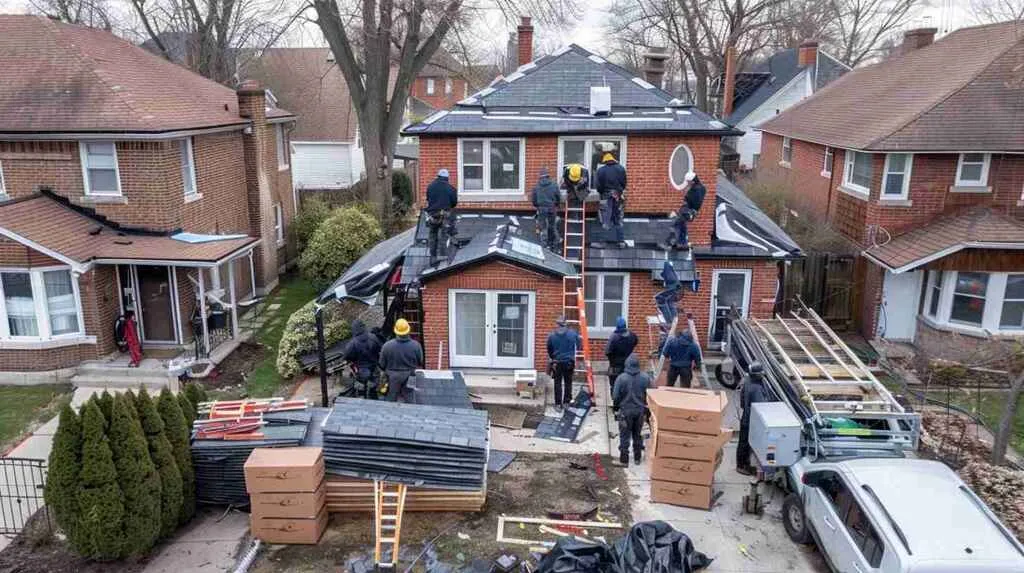
Think of your roof like a wing on a small airplane parked on the tarmac at LaGuardia during a storm-the shape, surface smoothness, and how everything is bolted together determine whether it stays attached or tears away when wind speeds spike. When Shingle Masters designs a high-wind roof upgrade, we’re not just swapping shingles; we’re engineering the whole roof as a wind-managed surface. It starts with an inspection to map your existing decking condition, measure exposure (are you near open water, on a corner lot, or sheltered between taller buildings?), and identify weak spots where wind historically attacks-edges, ridges, valleys, and around penetrations. From there, we sequence every step like following a blueprint: tear-off and haul-away of old shingles, repair or replace any damaged decking so every nail has solid wood to bite into, install synthetic underlayment with sealed seams so wind can’t sneak underneath, run sealed starter strips along every eave and rake to lock down that first course, lay high-wind architectural shingles with a six-nail pattern driven to the exact depth the manufacturer specifies, and finish with sealed ridge caps and careful flashing around every vent, pipe, and chimney. Each layer builds on the one before, turning your roof into a continuous, interlocked system instead of a stack of individual pieces waiting to blow off.
Common questions from Queens homeowners
You’re not just buying shingles when you upgrade-you’re buying an engineered system tuned to your specific block’s wind patterns, whether you’re facing coastal gusts off Jamaica Bay in Rockaway or swirling turbulence between rowhomes in Astoria. That system approach is what keeps your roof on during the next big nor’easter, and it’s what Shingle Masters has been doing in Queens for over three decades.
Shingle Masters High-Wind Roof Upgrade Process in Queens
✓
Why Queens Homeowners Trust Shingle Masters for High-Wind Roofs
| Fully Licensed & Insured in NY | Licensed home improvement contractor with full liability and workers’ comp coverage-you’re protected if anything goes wrong on the job |
| 31+ Years Roofing Queens | Three decades of experience with Queens microclimates, building codes, and the specific wind patterns that affect neighborhoods from Astoria to Rockaway |
| Engineer-Led Wind Expertise | Vic’s mechanical engineering background means we design roof systems based on airflow physics and code requirements, not just “that’s how we’ve always done it” |
| Fast Response for Inspections | We typically schedule roof inspections within 2-3 business days, with same-day or next-day service available after storm damage for Queens homeowners |
Frequently Asked Questions: High-Wind Shingles in Queens
▸
Do high-wind shingles void my warranty if the roofer doesn’t follow the exact install pattern?
Yes-most manufacturers require a specific nailing pattern (usually six nails per shingle for Class H high-wind rating) and sealed starter strips to activate the wind warranty. If your roofer uses four nails or skips the starter, you’re technically back to the base warranty, which is typically only 60-70 mph coverage. Always ask to see the manufacturer’s installation instructions and verify your roofer will follow them exactly, or you’re paying for wind protection you won’t legally have.
▸
Are high-wind shingles louder during rain or hail compared to standard shingles?
No meaningful difference-the noise you hear during rain comes mostly from the attic insulation, ventilation, and decking, not the shingle thickness. High-wind architectural shingles are thicker and heavier than 3-tabs, but that actually tends to dampen sound slightly rather than amplify it. If your roof is loud during storms, the issue is usually inadequate attic insulation or gaps in the decking, not the shingle type.
▸
How much more does a high-wind shingle upgrade cost versus standard architectural shingles?
For most Queens homes, upgrading from standard architectural to 130 mph-rated high-wind shingles adds roughly $20-$35 per square in material cost. The bigger cost difference comes from proper installation-six nails instead of four, sealed starter strips, and extra time at edges and penetrations typically adds $500-$1,200 to labor on an average 1,500-2,000 square foot roof. That’s a small price compared to emergency repairs and deductibles after wind damage, and it often pays for itself in lower insurance premiums and avoided claims.
▸
How long does a high-wind shingle install take on a typical Queens home?
Most Queens single-family homes take 2-4 days for a complete tear-off and high-wind shingle install, depending on size, pitch, and complexity (dormers, chimneys, skylights). The extra nailing and sealing steps add roughly half a day compared to a standard install, but we won’t rush through them-every nail and every sealed edge is what keeps your roof on in the next big wind. We work in all but the most extreme weather, and if we have to pause for heavy rain or high winds during install, we tarp and secure everything overnight so your home stays protected.
The best shingles for high winds in Queens aren’t just about a number on a wrapper-they’re part of a whole engineered system where decking, underlayment, nails, and installation technique all work together to handle the wind physics that happen on your specific roof. If you’re ready to stop worrying every time the forecast calls for 50+ mph gusts, call Shingle Masters to schedule a roof inspection and high-wind upgrade consultation tailored to your Queens block-because losing shingles shouldn’t be part of your nor’easter routine.