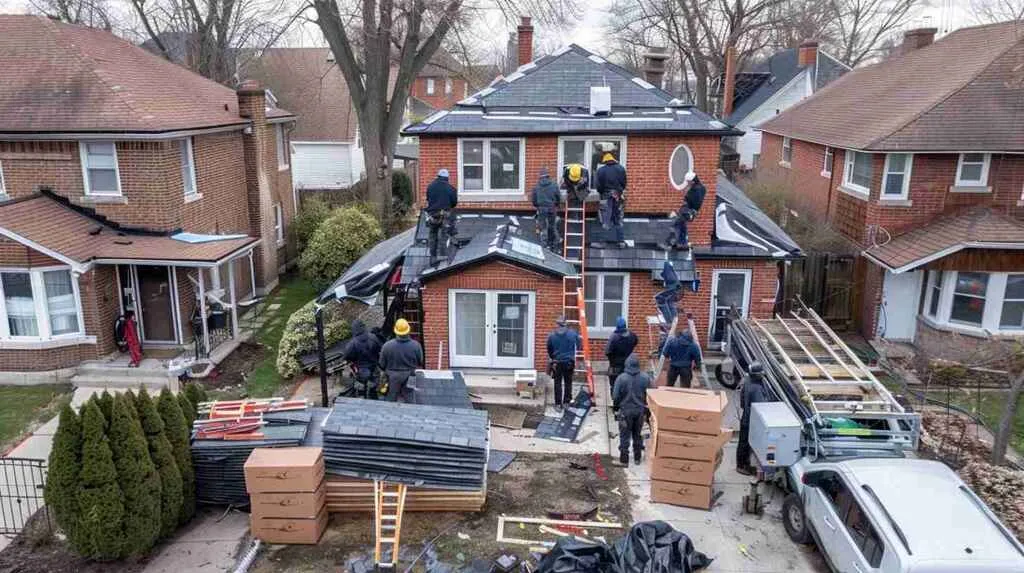
How Long Is a Roof Shingle Queens NY – Dimensions Explained | Free Quotes
Blueprint for understanding shingle size: almost every asphalt shingle laid across every rowhouse, cape, and colonial from Flushing to Jamaica is exactly 36 inches long, and that single number affects how your roof looks, how many bundles you need, and what you pay for materials and labor. On a humid Saturday in Astoria last summer, I laid a shingle on a homeowner’s driveway next to a tape measure and watched the recognition click – she’d lived under that roof for 12 years but never held the actual panel that covered it, never realized that the neat horizontal lines she saw from the street were really just 5 inches of a much longer piece hiding under the row above.
The Real Answer: How Long Is a Roof Shingle in Queens, NY?
On a Tuesday morning in Queens Village, with the Q1 bus rumbling by, I laid a shingle on the sidewalk and asked the homeowner, “You ever actually seen one of these up close?” Almost every asphalt shingle you’ll find in Queens – whether it’s a basic 3-tab or a chunky architectural – measures 36 inches long, and that’s not some random number the manufacturers picked out of a hat. That fixed length is what lets roofers plan how many panels fit across your roof like a comic strip, how they stagger the joints so water can’t sneak through, and how they calculate bundles without wasting your money on material that ends up in the dumpster. Here’s my honest opinion: most confusion about “how long is a roof shingle” comes from people never actually holding one and understanding how that 36-inch panel works once it’s nailed down – you only see about 5 inches of artwork per row, while the rest is hidden under the panel above it, creating the layered waterproof system that keeps your bedroom ceiling dry.
One August afternoon in Corona, it was 96° and you could feel the heat bouncing off the blacktop. A homeowner swore his “architectural shingles” were longer than standard and that’s why his contractor ran short. I made him grab a tape with me, right there on the driveway, and we measured three random bundles together – 36 inches on the dot, every time. Turned out the problem wasn’t the length; the crew had just ignored the manufacturer’s exposure line and overlapped way too much, eating up an extra bundle per square. Understanding the difference between the full 36-inch length and the 5 to 5.5 inches you actually see when you look up from the street is what separates a clean estimate from a budget disaster.
Standard Shingle Dimensions & What You Actually See
| Shingle Part | Typical Size (Queens, NY asphalt roofs) | Why It Matters |
|---|---|---|
| Full shingle length | 36 inches | Used to calculate how many panels fit across your roof like a comic strip. |
| Visible exposure (what you see on the roof) | 5 to 5.5 inches per course | Determines how many rows you need from eave to ridge. |
| Headlap/hidden portion (covered by shingle above) | About 6.5 to 7 inches | Too much overlap wastes bundles; too little risks leaks. |
| Typical shingle width | 12 inches | Affects how many shingles fit across each row and how the roof lines up at edges. |
⚡ Fast Shingle Size Facts for Queens Homeowners
- Standard asphalt shingles in Queens are 36 inches long – this hasn’t changed in decades, whether you’re buying basic 3-tab or premium architectural.
- You only see 5 to 5.5 inches of each shingle from the ground – the rest is hidden under the row above, creating the layered waterproof barrier.
- One “square” of roofing covers 100 sq ft and typically uses three bundles of shingles, with each bundle holding about 29 shingles depending on the style.
- Waste goes up fast on chopped-up Queens roofs with dormers, skylights, and valleys – even though the shingles are still 36 inches, you’ll cut more of them short.
Length vs Exposure: What You See on the Roof Isn’t the Whole Story
Here’s my honest opinion: most confusion about “how long is a roof shingle” comes from people mixing up what you see with what you don’t see. When you stand on the sidewalk in front of a rowhouse in Jackson Heights or a cape in Bayside and look up at the roof, those neat horizontal lines that seem to stack like shelves are really just the bottom 5 inches of a much longer panel – the other 7 inches are tucked under the shingle above, invisible but doing the real work of shedding water. Typical Queens roof styles make this even trickier to judge: the steep gables on older Bayside colonials hide way more overlap than the shallow slopes on Queens Village ranches, and from the street it all looks like one continuous sheet instead of overlapping comic panels with deliberate gutters between them.
I still remember a weird job in Bayside at 7:30 in the morning, fog rolling in off the bay so thick you couldn’t see the end of the ridge. The house had a chopped-up roof with dormers everywhere, and the architect had drawn it like the shingles were one continuous sheet. The owner was panicking because the supplier said he needed 15 more bundles than budgeted. I sat at his kitchen table, sketched his roof like a comic page with panels for each slope, and showed him how the standard 36-inch shingle breaks into three tabs, how much exposure you actually see, and why all those little cuts on the dormers meant more waste. Once he understood that each dormer created new edge cuts and off-angle pieces that couldn’t be reused, the bundle count made sense and he stopped thinking his contractor was padding the estimate.
👁️ What You See From the Street
- Only the bottom 5-5.5 inches of each shingle row
- Neat horizontal lines that look like one sheet
- Tabs that seem to be individual small shingles
- Color blend and pattern across the roof plane
🔍 What’s Actually There on the Roof
- A full 36-inch shingle with a big hidden overlap
- Staggered panels layered like overlapping comic frames
- One 36-inch piece pre-cut into three connected tabs
- Extra hidden material under ridges, valleys, and around dormers
From One Shingle to the Whole Roof: How Length Affects Bundles and Cost
If I were sitting at your dining table right now, I’d start by asking: are you asking how long the shingle is in your hand, or how much of it you see on your roof? Because the 36-inch shingle you buy at the lumberyard becomes something different once it’s nailed down – only that 5 to 5.5-inch exposure determines how many rows you need to cover the distance from your eave to your ridge, and that’s the number that drives your bundle count. Here’s a quick rule of thumb for Queens homeowners: on a simple rectangular roof with no weird cuts, you’re looking at about three bundles per 100 square feet (one “square”), but once you add skylights, chimneys, valleys, or those corner-lot roofs with hips on all four sides, waste can jump from 10 percent to 20 percent or more – even though every shingle is still exactly 36 inches long, you’re cutting more of them short and throwing away the pieces that don’t fit.
One December evening in Forest Hills, it started snowing halfway through a tear-off and the temp dropped fast. The GC wanted to finish the shingle layout in the dark using phone flashlights, and his guy started staggering the shingles wrong, leaving joints lined up. I stopped them and literally laid a few shingles on the ground in the snow, measured the 5-inch exposure, and walked them through the right offset pattern using the actual 36-inch length as our guide. We redid two rows that night, and I promised the GC that fixing 40 feet now was better than fixing leaks over the kitchen all winter. The cost difference between laying shingles correctly the first time and coming back in February to tear out soaked drywall and re-shingle over ice dams was about $3,000 – all because someone didn’t understand how the 36-inch length creates the stagger pattern that keeps water moving downhill instead of sneaking sideways through aligned seams.
📊 Shingle Bundle Estimates for Queens Roofs
📐 How a Queens Pro Uses Shingle Length to Estimate Your Roof
- Measure the roof planes – I walk the perimeter with a tape, measure slope using a pitch gauge, and sketch each section like a comic panel with dimensions labeled at the edges.
- Calculate square footage and convert to “squares” – multiply length times width for each plane, add them up, divide by 100, then add extra percentage for waste based on roof complexity (10% for simple, 15-20% for dormers/valleys).
- Figure exposure and row count – using the standard 5-inch exposure, I divide the eave-to-ridge distance by 5 to see how many rows of 36-inch shingles I’ll lay, checking if the math lands cleanly or needs a starter adjustment.
- Multiply squares by three to get bundles – one square needs three bundles, so a 12-square roof gets 36 bundles, plus a few extra for ridge caps, starter strips, and any repair work that pops up during tear-off.
DIY Reality Check: When Shingle Length Can Get You in Trouble
Blunt truth: in Queens, you’re not getting some “special longer shingle” just because the salesman said so – you’re getting a standard-size product with different thickness and shape, and just knowing “36 inches” is not enough to DIY your layout without getting into trouble. Misreading the exposure lines printed on the back of the shingle, staggering joints wrong so seams line up vertically instead of offset, and ignoring the manufacturer’s nailing diagram will lead to waste, callbacks, and leaks that show up the first time we get a driving rain from the northeast. I care enough to tell you straight: if you’ve never shingled before and you think you can eyeball it based on length alone, you’re gonna end up with either way too many leftover bundles or a mid-job panic trip to the supplier, and neither one saves you money.
⚠️
DIY Shingle Risks: When “36 Inches” Isn’t Enough Info
- Staggering joints only by eye – the 36-inch length tempts people to offset by exactly half (18 inches), but manufacturers often specify 6-inch offsets to avoid creating weak vertical seams.
- Ignoring starter strips – first-timers assume the first row of 36-inch shingles goes right on the eave, but you need a separate starter course underneath or wind will peel the tabs up like Post-it notes.
- Miscounting rows and running short mid-roof – if you calculate exposure wrong or forget to add extra for the ridge, you’ll discover you’re three bundles short when you’re 20 feet up and the supplier closes at 5.
- Cutting around vents and chimneys with no plan – each penetration breaks your neat 36-inch panel layout and creates custom cuts; without a strategy, you waste half a bundle figuring out one flashing detail.
Queens-Specific Questions About Shingle Length and Coverage
$600 is about what one bad miscalculation in shingle coverage can cost you in extra bundles and labor on a typical Queens roof. Before you spend that, let’s hit the questions I get the most on the sidewalk and in driveways from Flushing to Jamaica.
❓ Common Queens Shingle Questions Answered
Are all asphalt shingles in Queens the same 36-inch length?
Almost every standard asphalt shingle – 3-tab, architectural, and most designer styles – measures 36 inches long and 12 inches wide. Some specialty products like certain luxury or hip-and-ridge shingles run different sizes, but for the typical Queens residential job, you’re working with that 36-inch standard every single time.
How does shingle length affect how many bundles I need?
The 36-inch length determines how many shingles fit horizontally across your roof and how the stagger pattern works to prevent leaks. Combined with the 5-inch exposure (vertical measurement), that tells you how many rows you need and how much material gets used vs wasted on cuts. On simple roofs, waste is around 10%; on roofs with valleys, dormers, and hips, it jumps to 15-20% even though shingle length stays the same.
Do different Queens neighborhoods use different shingle sizes?
No – whether you’re in a Jackson Heights rowhouse, a Bayside colonial, or a Douglaston Tudor, the shingles are still 36 inches long. What changes is roof complexity: older neighborhoods with steep gables and lots of dormers waste more material on cuts, while newer construction with simpler roof lines uses bundles more efficiently.
Can I estimate bundles myself using just the 36-inch length?
You can get a rough ballpark by measuring your roof’s square footage, dividing by 100 to get squares, and multiplying by three bundles per square – but you’ll miss waste, starter strips, ridge caps, and all the little cuts around penetrations. A pro measurement accounts for the real layout, not just the math, and it’s free when you call for a quote.
When should I call Shingle Masters instead of guessing bundle counts?
Call before you buy a single bundle – especially if your roof has dormers, skylights, multiple roof planes, or you’re not sure about the slope. We’ll come out, measure everything in person, explain exactly how the 36-inch shingle layout works on your specific roof, and give you a written quote with no guessing and no surprises when the crew shows up.
🏆 Why Queens Trusts Shingle Masters
-
✓
Fully licensed and insured in New York State – all permits pulled, all work code-compliant, all liability covered so you sleep easy. -
✓
17 years of Queens-specific roofing experience – we know every neighborhood, every roof style, every quirky building code from Astoria to Rosedale. -
✓
Free on-site measurements with real tools – we bring the tape measure, pitch gauge, and sample shingles to your house and walk you through the whole layout in plain English. -
✓
Written quotes with bundle counts and exposure diagrams – no “we’ll figure it out when we get there,” just a clear plan you can actually understand before we start.
Think of your roof like a comic page: each row of shingles is a panel, and the part you see is just the artwork, while the rest is hidden under the panel above it. Once you understand the 36-inch shingle as a repeating panel that overlaps to create the whole waterproof story, the rest is just smart layout and local Queens experience – knowing which roofs waste more, which neighborhoods have tricky slopes, and how to measure every dormer and valley so the bundle count is right the first time. Call Shingle Masters for a free on-site measurement and quote anywhere in Queens, and I’ll walk you through your own roof “page layout” in your driveway with a tape measure and a shingle in hand, so you know exactly what you’re paying for before you buy a single bundle.