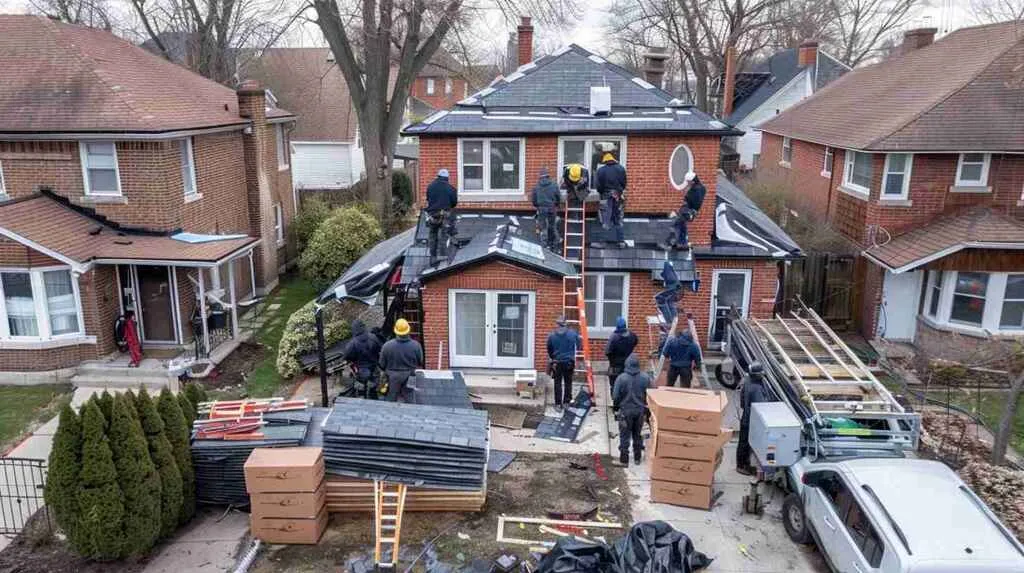
Shingle Roof Waterproof Coating Queens NY – What’s Worth Using | Call Today
Underneath most shiny shingle roofs in Queens, something’s trapped – and it’s not just dirt. Most whole-roof “waterproof coatings” sprayed or rolled onto asphalt shingles either void manufacturer warranties or seal in moisture that’ll rot your plywood before you realize what’s happening. In the next few minutes, I’ll lay out exactly which limited products are actually worth using, where they belong on a shingle roof, and when you should skip coatings entirely and put your money into proper repairs instead.
What Shingle Roof Waterproof Coatings Really Do on Queens Homes
On a roof over on 108th Street in Jackson Heights last winter, I watched meltwater run under a shiny elastomeric coating – the kind designed for flat commercial roofs – get trapped, then drip right through a bedroom light fixture. It was about 6:30 in the morning, February after a nor’easter, with wind so strong it kept flipping my clipboard. The owner had paid someone the year before to “waterproof” his shingle roof, thinking he was buying peace of mind. Instead, that coating sealed in water against the underlayment and plywood, and I still remember the burnt-plastic smell when moisture hit the electrical box. That job taught me how the wrong coating on shingles can actually speed up rot, and I’ve been warning people about “one-size-fits-all” coatings ever since.
Here’s the blunt part nobody with a bucket of coating in their truck will tell you: whole-roof “waterproof coatings” on asphalt shingles in Queens are almost never worth using. Shingles and their underlayment are designed to shed and breathe – water runs downslope between layers and evaporates back out through ventilation. When you seal the top surface with the wrong product, you don’t stop water; you just trap it in new places. Most elastomeric or “rubber paint” coatings are repurposed from flat-roof systems, and they act like a plastic bag wrapped around something that needs to breathe.
If we were standing in front of your house right now, I’d ask you one thing first: “Where does the water go, and how does it get out?” I treat roofs like breathing systems, not just surfaces, and that question is the difference between a quick bandaid and a real fix. The idea of slapping a “waterproof” coating on every shingle sounds simple, but it ignores the fact that water always finds a way in – and then it needs a way back out. Limited, targeted products can help, but only in specific spots like flashing joints or pipe boots, not as a universal paint-on fix.
⚠️ Big Warning Before You Paint Your Shingles
- Many shingle manufacturers will void your warranty if you apply aftermarket coatings.
- Coatings meant for flat roofs can trap meltwater and rain under the shingle layers.
- Trapped moisture leads to plywood rot, mold, and soft spots you can’t see from the ground.
- A “quick” coating job can hide active leaks, making real diagnosis and repair more expensive later.
- Once coated, shingles are harder to strip; you may pay more for disposal and labor at replacement time.
| Myth about Shingle Coatings | What Actually Happens on Queens Roofs |
|---|---|
| “A shiny white coating will make my old shingle roof waterproof again.” | Coating seals in existing cracks and gaps; water finds its way under and gets trapped, often leaking into ceilings and walls. |
| “If it says ‘elastomeric’ or ‘roof sealant,’ it must work on any roof.” | Many elastomeric coatings are designed for flat, continuous surfaces (like torch-down or EPDM), not layered asphalt shingles. |
| “Coating the roof is cheaper and safer than replacing worn shingles.” | Short-term, maybe; long-term, coatings can accelerate rot, void manufacturer warranties, and force a full replacement earlier. |
| “Once coated, I won’t have to worry about leaks for 10+ years.” | UV, expansion/contraction, and trapped moisture cause cracking and peeling in a few seasons, especially with Queens freeze-thaw cycles. |
| “Any contractor offering a ‘waterproof paint’ for shingles is using a proven method.” | Many are using repurposed flat-roof products or generic ‘rubber paint’ that shingle manufacturers specifically warn against. |
Where Coatings Go Wrong: Real Queens Examples and What to Watch For
One sticky July afternoon in South Ozone Park, I met a retired school bus driver who’d bought a bargain “miracle spray” off the internet and coated just the top half of his roof because he ran out. When I got there, you could see a literal line where the coated shingles had curled like potato chips from trapped heat, while the uncoated section looked older but stable. Queens summer sun bakes attached homes hard – especially in neighborhoods like South Ozone Park where houses are jammed together and attics turn into ovens. That coating turned the shingles into little solar collectors with nowhere to vent the heat, and the granules started peeling off in clumps. We ended up replacing an entire slope that should’ve had five more years, and I kept a couple of those curled shingles in my truck as a show-and-tell piece about using untested products on asphalt.
From a leak detective’s point of view, coatings do one of three things on Queens shingle roofs. First, they overheat shingles and cause curling at the edges – you’ll see it most where sun hits hardest. Second, they blister and peel when moisture gets underneath, usually starting near valleys or vents where water concentrates. Third, and worst, they hide rot at the plywood level until you’re walking the roof and your foot goes soft. Now, follow the water with me for a second: rain hits your coated shingle, finds a tiny crack or seam, slips under the coating, spreads across the underlayment, can’t evaporate back out, soaks into the plywood. You don’t see a drip inside for weeks, then one storm pushes it over the edge and suddenly you’ve got a brown stain spreading across your ceiling.
| Approach | Pros | Cons |
|---|---|---|
| Targeted sealing (flashings, nail heads, vents) |
– Uses products designed for those details – Addresses actual leak points – Less risk of trapping bulk moisture – Usually keeps manufacturer warranty intact |
– Won’t save a worn-out roof – Requires careful inspection and skill |
| Full-surface shingle coating with generic “waterproof” product |
– Looks freshly “painted” at first – Can slightly reduce UV on very short term |
– Can overheat shingles and cause curling – Often traps moisture and hides leaks – Likely to void shingle warranty – Makes future tear-off harder and pricier |
Red flags your shingle coating is failing:
- ❌ Fine cracks or alligator-skin look on the coated surface
- ❌ Shingles starting to curl at the edges near coated areas
- ❌ Soft or spongy spots when you walk the roof (a pro should do this)
- ❌ Brown ceiling stains getting bigger after storms, even though the roof was “just coated”
- ❌ Coating peeled back or separating at ridge, valleys, or eaves
What’s Actually Worth Using on a Shingle Roof in Queens, NY
Follow the Water: Where Limited Coatings Make Sense
A Saturday evening in early fall, I was finishing up a leak diagnostic on a two-family in Astoria with a handyman landlord who swore his “rubber paint” solved everything. It had rained lightly that afternoon, and while we were on the roof, I gently peeled back a strip of that “rubber” coating off his shingles, and steam literally puffed out – the trapped moisture had nowhere to go. A week later he called me back after a passing shower turned that steam into interior condensation and drips over his tenant’s baby crib. That’s when I started telling people, “Your roof needs to breathe more than it needs to shine,” especially when they ask about waterproof coatings. Here’s the insider tip: the only time I reach for coating-like products on shingles is at details – proper flashing sealants rated for metal-to-shingle joints, pipe boot repairs with compatible rubberized compounds, and maybe limited manufacturer-approved reflective treatments in very specific spots. Never as a whole-roof paint-on fix.
When You’re Past Coatings and Need Real Work
Picture a wet winter jacket sealed inside a trash bag on a warm day – that’s your shingle roof under the wrong coating. If shingles are at the end of their life (curling, missing granules, multiple leaks), or if you’re dealing with more than one problem area, your money belongs in repair or replacement plus ventilation improvements, not any “miracle” coating. The rule of thumb I give people: coatings are only for specific detail work – flashing sealants, pipe boots, maybe selective reflective treatments if the manufacturer allows it in writing. If you’re chasing more than a couple isolated leaks, it’s time for a real roof evaluation, not a spray can.
How a proper shingle roof waterproofing assessment works with Shingle Masters:
- Exterior walk-around: We start at ground level, looking at siding stains, gutter overflow marks, and where water wants to land around your Queens house.
- Attic and ceiling check: We follow the water from inside out – stains, insulation moisture, and ventilation problems tell us where it’s getting trapped.
- Roof inspection: On the roof, we focus on valleys, chimneys, skylights, vents, and previous patch work – these are the real leak factories.
- Targeted product choices: Only if it’s right for shingles, we’ll specify things like flashing sealants, pipe boot repairs, or small-area coatings rated for asphalt.
- Written plan and photos: You get a clear breakdown: what needs repair now, what can wait, and whether any coating makes sense – or should be skipped.
Do you need coating, repair, or replacement on your shingle roof?
Start: Do you have more than one active leak or widespread shingle curling?
Yes → Skip coatings. Get a full roof evaluation and likely replacement/major repair.
No → Next question: Are leaks coming from around chimneys, skylights, or pipes only?
Yes → Consider targeted flashing/penetration repairs with compatible sealants, not whole-roof coating.
No → Next question: Is your roof under manufacturer warranty?
Yes → Do not coat. Call a certified shingle roofer to preserve your warranty.
No → Last question: Is the main goal to extend a borderline-old roof 1-3 years?
Yes → Ask for a written plan that prioritizes selective repairs and ventilation; only use limited, shingle-safe products if your roofer puts it in writing.
No → Save your coating money and budget for a proper replacement instead.
What It Costs in Queens: Coatings vs Smart Repairs
$1,200 buys you either a gamble on a shiny coating that might trap water and void your warranty, or targeted repair work that addresses the actual leak points – flashings, vents, valleys – plus a written diagnostic that tells you what’s really wrong and how long you’ve got before replacement.
| Scenario on a Queens Shingle Roof | What Most People Are Offered | Smarter Alternative with Shingle Masters | Typical Price Range |
|---|---|---|---|
| Older but mostly flat shingles, one small leak by a vent | $800-$1,500 for “full waterproof coating” over entire slope | Targeted vent/boot repair, sealant at specific details, attic check | $350-$900 depending on access and roof height |
| Multiple stains inside, past patch jobs around chimney | $1,500-$3,000 for “elastomeric system” over whole roof | Chimney flashing rebuild, shingle replacement around chimney, counterflashing, inspection of valley nearby | $900-$2,200 depending on scope |
| End-of-life shingles (20+ years), several missing or curled areas | $2,000+ for “lifetime waterproof coating” promise | Honest assessment and quote for proper tear-off, new underlayment, shingles, and improved ventilation | $7,500-$16,000+ depending on size and complexity |
| Flipped house, fresh coating hiding unknown age roof | No quote; buyer assumes coating is “upgrade” | Pre-purchase roof inspection, moisture probing, and written report | $250-$600 as a stand-alone roof inspection |
Why Queens homeowners call Shingle Masters for leak diagnostics and coatings advice:
- Licensed and insured in New York City for roofing work
- 19+ years of hands-on roofing experience across Queens neighborhoods
- Known locally as the “leak detective” for solving stubborn, multi-contractor leak problems
- Detailed photo inspections and plain-English explanations before any work
- Familiar with manufacturer requirements so your shingle warranty stays intact when possible
Before You Call About a Shingle Roof Coating in Queens
The moment you see a shiny, painted-looking shingle roof in Queens, your first thought should be, “What’s trapped under there?” Not every coating job turns into a disaster, but enough do that it’s worth a quick self-check before you commit to anything. Walk around your block in Astoria, Jackson Heights, or South Ozone Park and look at the roofs – the ones that’ve aged naturally often outlast the ones somebody tried to “seal” with the wrong product. Your goal is to follow the water: where does it land, where does it go, and is it getting back out?
Before you spend a dollar on any coating, grab your phone and take a few photos from the street and, if it’s safe, from a window looking onto your roof. Send them over to Shingle Masters along with a quick list of what you’re seeing – stains, curls, old patches, whatever. I’ll give you straight talk about whether any coating makes sense for your situation or if you should skip it and put that money toward real repairs. We’re not gonna sell you something that’ll bite you two winters from now.
Simple checks to do before calling about shingle waterproof coating:
- ✅ Look for ceiling stains after a good rain, not just during it, and note which rooms they’re in.
- ✅ Step outside and see if any shingles look shiny, painted, curled, or blistered from the sidewalk.
- ✅ Check around chimneys, skylights, and plumbing vents for old tar patches or lumpy “rubber” blobs.
- ✅ Think about how old your roof is (or when it was last replaced, even roughly).
- ✅ Grab 3-4 photos from the street and, if safe, from a window looking onto the roof to share with us.
- ✅ Make a quick list of any past roof work or coatings you’ve been told were applied.
Will a clear spray or invisible sealer help my shingle roof last longer?
Most “clear” sealers still change how shingles breathe and shed water. On an older roof, they can lock in moisture and speed up the breakdown of the shingle and plywood underneath. We’d rather see you invest in fixing actual weak points and improving airflow.
Can you coat just the worst-looking slope to buy time?
Coating one slope usually creates uneven heat and aging, just like the South Ozone Park job where half the roof curled. It’s sometimes safer to repair the worst slope and monitor the rest than to create a hot, sealed patch on one face of the roof.
Are there any situations where you’d recommend a coating on shingles?
Very rarely, and only with manufacturer-approved products in tightly defined areas – for example, certain transition zones or small sections that catch extreme sun and are otherwise sound. Even then, we put it in writing and explain the trade-offs first.
How fast can you come out to look at a suspected coating problem in Queens?
For active leaks, we aim for same-day or next-day visits in most Queens neighborhoods. For general coating questions and roof health checks, we can usually schedule within a few business days.
What if another contractor already coated my roof – can you still help?
Yes. We’ll assess how the coating is behaving, check for hidden moisture, and give you a plan, whether that’s selective removal, repairs around details, or planning for a proper replacement.
And honestly, the goal is to follow the water, not chase shiny coatings. Call Shingle Masters for a straight-shooting roof inspection and leak diagnostic in Queens – send over a few photos and we’ll schedule a visit so I can walk you through exactly what your shingle roof really needs, whether that’s a targeted repair, ventilation work, or a plan for replacement down the road.