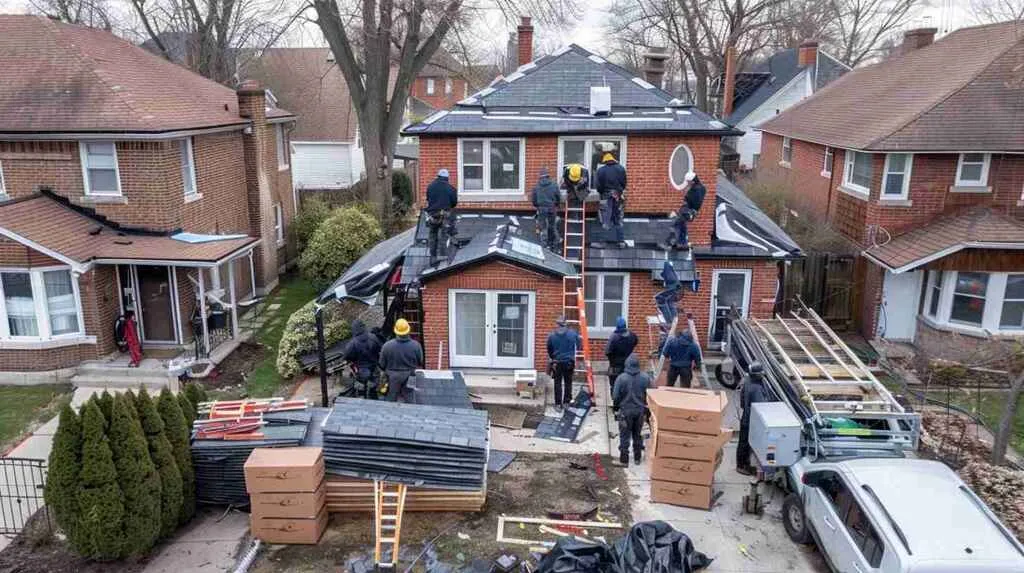
Wood Shake Shingle Roof Queens NYC – Install, Repair and Maintain
Stage right: you’re looking at what appears to be a beautiful wood shake shingle roof, and stage left: water is finding a path you didn’t know existed. I’m going to start by telling you that in Queens, a properly installed and maintained wood shake shingle roof can last 25-35 years, and then I’ll explain why most of the ones I’m called to fix start failing from sideways, wind-driven rain long before the wood itself is ‘worn out.’ I’ve spent 19 years sketching out roof diagrams for homeowners across Queens, showing them how water moves like an actor crossing a stage, and once you see where the “entrances” and “exits” are on your particular roof, the whole script makes sense.
How Long Wood Shake Shingle Roofs Really Last in Queens (and Why Wind-Driven Rain Is the Villain)
Here’s what I’ve learned from nearly two decades on wood shake roofs all over Queens: when I’m setting the stage for how long your roof will last, I’m not just counting years-I’m looking at how water behaves when a nor’easter slams sideways across your ridge or when summer thunderstorms drive rain up under shakes at the valleys and walls. Most failures I see don’t start because the shakes themselves wore out. They start where water changes direction: ridges, hips, valleys, chimney flashings, and that spot where the dormer meets the main roof plane. In Queens, between our coastal storms and the salt air drifting up from Jamaica Bay, a wood shake roof is constantly being tested by wind-driven rain that doesn’t fall straight down-it sneaks in from angles most homeowners never picture.
One February morning, about 6:45 a.m., I was on a steep wood shake roof in Forest Hills Gardens, watching my breath fog up while we tried to find a leak that only showed up in nor’easters. The owner was an architect who thought the shakes were ‘purely decorative,’ and I had to prove to her with a garden hose and a flashlight where the wind-driven rain was sneaking under some badly done ridge caps. I used my usual theater language-“the water’s entering here at the ridge cap, riding along this felt seam like it’s crossing from stage left to stage right, and exiting right there into your attic”-and once she saw it, the whole mystery collapsed. We ended up redoing just the ridge and a few courses instead of tearing off the whole roof, and she still emails me every time there’s a big storm to report ‘no drips-bravo performance.’
Let’s shift the scene for a second and zoom out to the whole system. A properly installed wood shake shingle roof in Queens-complete with correct underlayment, balanced ventilation, and quality fasteners-will give you 25 to 35 years of solid service. But I can’t count how many times I’ve been called to a 15-year-old roof that’s already leaking, and when I climb up there with my moisture meter and pry bar, the problem isn’t age. It’s that the ridge was detailed wrong, or the valley flashing was skipped, or someone used the cheap nails and now shakes are lifting in every windstorm. My job isn’t to sell you a replacement the moment you see a stain on the ceiling; my job is to figure out where your roof’s “blocking” went wrong and whether we can rewrite that one scene instead of tearing down the entire set.
Queens Wood Shake Roof Lifespan at a Glance
-
1
Typical Lifespan in Queens: 25-35 years with proper install + maintenance -
2
Most Common Early Failure Cause: Wind-driven rain at ridges, valleys, and walls -
3
Signs You’re in Trouble: Interior stains only during sideways storms, loose or lifted shakes, dark streaks -
4
Typical Inspection Time: 45-90 minutes for a full wood shake assessment in Queens
| Myth | Fact |
|---|---|
| If the shakes look okay from the street, the roof isn’t leaking. | Wind-driven rain can sneak under perfectly decent-looking shakes at the ridge or valleys and only show up as stains during big storms. |
| Wood shakes are just a decorative layer; the real waterproofing is always underneath. | On a proper wood shake system, the shakes and the underlayment work together; if either is wrong, sideways rain will find a way in. |
| Age alone tells you when to replace a wood shake roof. | In Queens, detailing, ventilation, and maintenance history matter as much as the calendar when deciding to repair or replace. |
| All wood roofs are doomed in coastal climates like NYC. | With the right install and upkeep, wood shake roofs routinely reach 25-35 years in neighborhoods like Douglaston and Forest Hills Gardens. |
Installation: Setting the Stage for a 25-35 Year Wood Shake Roof in Queens
What a Proper Wood Shake Install Looks Like Here
Here’s my plain opinion: if your contractor doesn’t talk about ventilation and underlayment when they talk about wood shakes, they’re just selling you a costume, not a working roof. A proper installation in Queens starts with the stuff you can’t see from the curb. I’m talking about correctly spaced shakes-about a quarter-inch gap so the wood can breathe and expand without buckling-double-course starters at the eaves so the first row doesn’t cup and lift, and interlayered felt or synthetic between every course so that when sideways rain rides up the shakes, it hits a barrier and exits safely instead of soaking into your deck. You’ll also want stainless steel or hot-dipped galvanized nails, not the cheap bright stuff that rusts out in three years under salt air. And ventilation-balanced intake at the soffits, exhaust at the ridge or gable-is the thing that keeps your attic dry and your shakes from cooking or rotting from the underside. I see a lot of beautiful Tudor and Colonial homes in Bayside, Douglaston, and Forest Hills Gardens where the bones are solid, but someone skipped these fundamentals on the roof and now the whole “stage set” is falling apart prematurely.
Queens-Specific Choices That Make or Break Your Roof
One July, in the middle of a brutal heat wave, I got called to a wood shake repair in Bayside for an older couple who had tried to pressure-wash their shakes to ‘freshen them up.’ By the time I got there at 3 p.m., the south side of that roof was practically sizzling, and half the shakes were furred up and cracked from the pressure-looked like someone had blasted the scenery flats off a theater set with a fire hose. I showed them side-by-side pieces-one ruined, one sound-and we made a plan to selectively replace damaged shakes and then set up a gentle maintenance schedule instead of more DIY experiments. The lesson there was that wood shakes aren’t asphalt; you can’t treat them rough and expect them to bounce back. For new installs, I always tell clients: specify ventilation details and underlayment patterns in your contract up front, before anyone drives the first nail, because those choices are what keep your roof handling Queens’ sideways storms year after year. If the proposal doesn’t spell out felt interlayment, fastener type, and ventilation strategy, you’re buying a script with half the scenes missing.
| Component | Better for Queens (Recommended) | Risky Choice | Why It Matters in Queens |
|---|---|---|---|
| Fasteners | Stainless steel or hot-dipped galvanized nails | Electro-galvanized or mixed metals | Salt air and year-round moisture can corrode cheap nails and let shakes lift in high winds. |
| Underlayment/Interlayment | Properly stepped felt or synthetic between shake courses | Single layer of generic felt under entire deck only | Sideways rain rides up the shakes and needs those interleaving layers to exit safely. |
| Ventilation | Balanced intake and exhaust (soffit + ridge or similar) | No dedicated intake, blocked vents, or fan only | Trapped heat and moisture shorten shake life and boost ice-dam and leak risks. |
| Shake Layout | Correct exposure, staggered joints, double starter course | Over-exposed, lined-up joints, skipped starter | Improper layout opens direct pathways for wind-driven rain into the deck. |
Why Queens Homeowners Bring Shingle Masters In for Wood Shakes
Local Experience
19+ years working on wood shake shingle roofs across Queens neighborhoods like Bayside, Douglaston, and Forest Hills Gardens.
Specialty Focus
Known for repairing and preserving older shake roofs that other contractors want to rip off.
Licensed & Insured
Fully licensed and insured in NYC for wood shake installation, repair, and maintenance.
Storm-Tested Work
Roofs inspected after major nor’easters and summer thunderstorms with ongoing ‘no drips’ reports from clients.
Repairs: When You Can Save Your Wood Shake Roof Instead of Replacing It
How I Decide Between Spot Repairs and Bigger Work
Picture me standing in your driveway with a handful of old shakes in one hand and a moisture meter in the other-that’s usually how I explain what’s happening before I suggest any work. I start by asking where you see leaks inside and when they show up: every rain, or just the wild sideways storms when the wind is howling off the water? Then I go up on the roof and check the moisture content of the deck, poke around the ridges and valleys, look at the flashing details around chimneys and walls, and test how secure the shakes are. I’m not just counting cracked pieces; I’m watching how the whole “scene” is set up and whether one weak area-say, a poorly done valley-is throwing off the performance of an otherwise solid roof. Now, if we move one step upstage and look at the bigger system, a lot of times what seems like a roof-wide disaster is actually a localized problem at one ridge cap, one flashing transition, or one patch where someone tried a quick fix years ago and created a new water pathway instead of closing the old one.
Queens Examples: From Emergency Stabilization to Smart Rebuilds
A Sunday afternoon last fall, right as the Jets game kicked off, I got an emergency call from a small synagogue in Kew Gardens Hills with a wood shake section over their entry that was shedding pieces in the wind. I found out a handyman had nailed shakes straight through with bright roofing nails, no proper underlayment repair, and every wind gust was lifting them like bad scenery flats about to blow off the stage. We stabilized it that day with proper fasteners and temporary weatherproofing, and came back in the week to rebuild the entry roof correctly-new felt interlayment, staggered joints, hot-dipped nails, the whole script. I still remember the rabbi joking that I’d ‘rewritten the script’ for how their roof should behave in a storm. The bigger point there is that repairs make sense when the damage is localized, the underlying deck structure is still sound, and you’re only seeing leaks during the really wild sideways storms-not every time it drizzles. If that’s your situation, you’re a candidate for targeted work rather than a full tearoff, and we can usually get you another 10 or 15 solid years without writing a check for an entire new roof.
Do You Need Wood Shake Repair or Full Replacement in Queens?
START: Do you see leaks only during heavy sideways or nor’easter-type storms?
→ YES: Are the shakes mostly lying flat and solid, with damage limited to a few areas (ridge, valleys, or one slope)?
✓ YES: You’re likely a candidate for targeted repairs and detailing work rather than full replacement.
✗ NO: You may need partial section rebuilds or a deeper inspection of the deck and underlayment.
→ NO: Do you have frequent leaks in normal rain, widespread curling, rot, or missing shakes across multiple slopes?
✓ YES: It’s time to talk about a structured replacement plan, possibly in phases.
✗ NO: Schedule a full inspection to catch early issues; you might just need maintenance and minor repairs.
When Wood Shake Roof Problems in Queens Are an Emergency
Call Shingle Masters Right Away
- Active dripping inside during a storm, especially near electrical fixtures.
- Shakes or ridge pieces visibly lifting or blowing off in real time.
- Large sagging area in the roof deck under a wood shake section.
- Entryways or walkways where shakes are falling and could hit someone.
Can Usually Wait a Few Days
- Small ceiling stains that only grow during the biggest sideways-rain events.
- A few visibly cracked or split shakes with no interior leaks yet.
- Cosmetic weathering, graying, or light moss without softness underfoot.
- Gutters overflowing but no signs of interior water yet.
Maintenance: Keeping Your Wood Shake Shingle Roof Storm-Ready in Queens
The blunt truth about wood shake shingle roofs in Queens is that most of the damage I fix started with tiny maintenance tasks that got ignored for five or ten years. I’m talking about cleaning the gutters so leaves and twigs don’t dam up water at the eaves, checking ridge caps and flashings every year or two for lifted fasteners or cracked sealant, clearing debris out of valleys before it traps moisture against the wood, and doing gentle surface cleaning when moss or algae shows up-never with a pressure washer. Think of it like resetting the stage between scenes: if you don’t take 20 minutes twice a year to sweep the “set” and make sure all the “props” are where they belong, the next big storm is going to write its own script, and you won’t like the ending. A little attention to where water collects, where shakes are exposed to constant shade, and where flashing meets wood will extend the life of your roof by years and save you from those surprise emergency calls on a Sunday afternoon.
$300 spent on routine maintenance every year or two beats $15,000 in surprise replacement when a nor’easter finally exposes ten years of neglect. Schedule a maintenance check before the next storm season hits and you’re setting the stage for your roof’s next act instead of waiting for an unplanned intermission.
Seasonal Wood Shake Roof Care for Queens Homes
Every Spring
Inspect for winter damage, check ridges and valleys for lifted shakes, clean leaves and branches, verify gutters/downspouts are clear.
Every Fall
Clear debris before nor’easter season, check flashings around chimneys and walls, confirm attic ventilation intakes/exhausts aren’t blocked.
Every 1-2 Years
Professional wood shake inspection and tune-up: replace cracked/loose shakes, reseal critical flashings, check nail integrity.
Every 5-7 Years
Discuss gentle cleaning and wood treatment options appropriate for your specific shakes and exposure; avoid harsh pressure washing.
What to Note Before You Call Shingle Masters About Your Wood Shake Roof
-
✓
Note where inside you see stains or drips (rooms, ceilings, walls). -
✓
Write down which storms cause issues (every rain vs only heavy sideways wind). -
✓
Take clear photos of any missing, curled, or split shakes you can safely see from the ground. -
✓
Check if gutters are overflowing or visibly clogged during rain. -
✓
Look for dark streaks or moss patches, especially in shaded valleys. -
✓
Find any previous roofing paperwork if you have it (age of roof, past repairs).
Understanding how wind-driven rain moves across your specific Queens wood shake shingle roof is the key to deciding whether you need installation, repair, or just smart maintenance-and once you see the “blocking,” the whole performance makes sense. Call Shingle Masters or schedule an inspection so I can come out, block out the scenes on your particular roof with diagrams and photos, and put a clear plan in writing that matches your budget and your timeline instead of handing you a one-size-fits-all estimate.