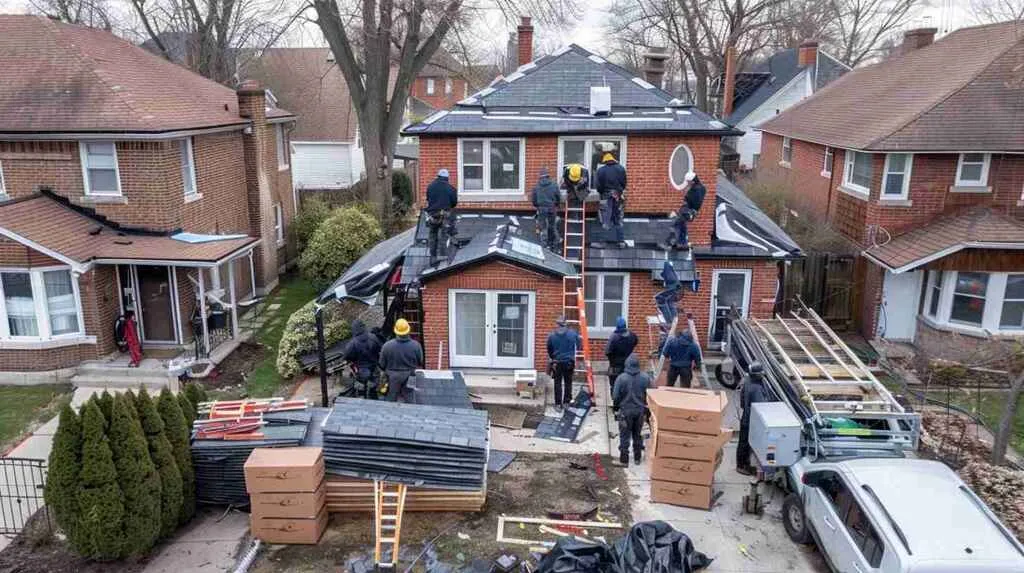
What Is a Wood Shingle Roof Queens NY? Sawn vs. Shake Explained
Underneath most so-called “wood roofs” that fail early in Queens is not bad wood, but bad assumptions-people mixing up shingles and shakes and having them nailed down like asphalt. This article will walk you through exactly what a wood shingle roof actually is, how it should be installed in Queens, and how to choose between shingles and shakes using a coffee shop approach that’ll stick in your head.
What a Wood Shingle Roof Really Is in Queens, NY
A wood shingle roof is a thin, precision-sawn cedar roof system built from relatively uniform pieces that overlap in tight, consistent courses to shed water fast. Here’s my honest opinion: most problems with wood roofs in Queens start at the lumberyard and end with a lazy installer. People confuse shingles with shakes, treat them like thick asphalt tabs, and wonder why they’re calling me three years later with cupping, leaks, and gray stains on the ceiling. A real wood shingle roof-sawn smooth, laid over proper ventilation, fastened with stainless or hot-dipped galvanized nails-looks sharp, drains clean, and lives decades longer than those hack jobs.
When a customer in Queens asks me, “Carlos, what is a wood shingle roof, exactly?” I don’t start with looks; I start with how the water moves. Shingles overlap like fish scales, each piece shedding rain down to the next layer, and they’re thin enough-usually 3/8″ to 1/2″ at the butt-that they don’t trap moisture or flex wildly. The sawn face matters: smooth, consistent thickness means every row sits flat and tight, unlike hand-split shakes that can be twice as thick and way more textured. In Queens, where we swing from freeze-thaw winters to humid summers, that consistent profile keeps water flowing off instead of pooling or freezing in gaps. The roof doesn’t just sit there like asphalt; it breathes through the deck, dries between storms, and handles seasonal movement without cracking apart.
On one Ridgewood project last spring, I laid a cedar shingle flat in my palm and told the owner, “This is more like a piece of carpentry than a roofing tile.” He’d been sold cheap, thin sawn shingles as “premium shakes” by a guy in Forest Hills one August, the kind of day where it’s 92 degrees and dead still, and when I flipped the shingle over to show him the perfectly smooth saw marks and the way it had cupped from trapped heat, you could see the moment he realized he’d paid for the wrong thing. That roof had no ventilation layer, no airflow, just shingles nailed tight over solid felt like asphalt, cooking all summer. We tore it off, built a proper ventilated deck, and installed actual cedar shingles with the right spacing and fasteners. The lesson: correct product plus proper ventilation equals a roof that actually works.
Key Traits of a True Wood Shingle Roof (Not a Shake Roof)
Sawn, relatively smooth faces with uniform thickness
Typically thinner than shakes, around 3/8″-1/2″ at butt
Installed in tight, even courses with consistent exposure
Designed to shed water quickly, not store it in big gaps
Needs airflow and the right underlayment, not a solid, trapped system like asphalt
| Spec | Standard Carlos Uses | Why It Matters in Queens |
|---|---|---|
| Material | Premium Western Red Cedar | Fire-retardant treated options available for NYC code compliance |
| Typical exposure per course | 5″-5.5″ | Adjusted for roof pitch and manufacturer spec |
| Recommended roof pitch | Minimum 4:12 | Steeper pitches shed water better in Queens storms |
Sawn Shingles vs. Wood Shakes: Espresso vs. French Press
Think of sawn shingles as a smooth espresso shot and shakes as a rough, strong French press; same bean, totally different experience. Shingles are thinner, more refined, machine-sawn to uniform thickness-they give you a clean, almost formal look that fits brownstones and tight Queens row houses where neighbors will notice if your roof sticks out. Shakes, on the other hand, are thicker, hand-split or rough-split by machine, with deep texture and a bold, rustic vibe that works better on detached homes or places where you’ve got room to let the roof be a statement piece. In Queens, where housing stock runs from attached brick two-families in Astoria to standalone colonials in Bayside, that difference in “roofing personality” matters-espresso blends in, French press stands out.
I still remember the first time I saw a true hand-split shake roof out in Long Island-thick, irregular, and almost too pretty for its own good. Years later, one winter morning in Bayside right after a nor’easter, I got a call from an older couple worried their “old wood roof” was done for. Snow was still sliding off the cars when I climbed up and saw a beautiful, 30-year-old cedar shingle roof installed the right way, with open gaps and a skip-sheath deck so it could breathe. The only problem was someone had added asphalt shingles over a small addition and choked the airflow. That’s the core difference: shingles rely on tight, even courses and ventilated decks; shakes often use spaced sheathing or a ventilation matrix to let those thick pieces dry between storms. Both can work in Queens, but you can’t detail them the same way and expect both to last.
Sawn Cedar Shingles
-
•
Thinner, more uniform pieces -
•
Smoother, more formal appearance (good for brownstones/row houses) -
•
Typically installed over solid or ventilated deck with specific underlayment -
•
Great where codes or neighbors want a refined, low-profile look
Hand-Split Cedar Shakes
-
•
Thicker, irregular, split by hand or machine -
•
Very textured, rustic look (more common in suburbs than central Queens) -
•
Often needs spaced/sheath deck or ventilation matrix to breathe -
•
Can last longer if detailed right but costs more and stands out more visually
| Myth | Fact |
|---|---|
| All wood roofs are banned in NYC. | Treated wood roofing meeting fire rating and local code is allowed in many parts of Queens-check zoning and building department rules. |
| Shingles and shakes are just different names for the same thing. | Shingles are sawn and thinner; shakes are split and thicker, and they’re installed to different details. |
| Any roofer who does asphalt can handle wood. | Wood needs specific spacing, ventilation, and fasteners-wrong technique kills the roof early. |
| Wood roofs always leak in heavy Queens storms. | Properly layered and flashed wood shingles handle nor’easters and summer downpours if installed to spec. |
How Wood Shingle Roofs Must Be Installed (Not Like Asphalt)
Here’s my honest opinion: most problems with wood roofs in Queens start at the lumberyard and end with a lazy installer. Wood shingles demand correct underlayment that lets moisture vapor escape, a ventilation gap or spaced sheathing so the wood can dry between rains, and stainless or hot-dipped galvanized fasteners that won’t rust out before the cedar’s done. You need precise course spacing-usually 5″ to 5.5″ exposure-snapped with chalk lines so every row sits straight and water flows smooth. My insider tip: ask any roofer exactly how they plan to ventilate the deck and what nails they’ll use. If they stutter or hand-wave about “standard procedure,” walk away; they’re planning to nail it down like asphalt and hoping for the best.
Blunt truth: if your roofer is nailing wood down tight like asphalt, it doesn’t matter whether it’s shingle or shake-you just paid for trouble. A few years back, around 6 p.m. in early fall, I was finishing a job in Astoria when a neighbor leaned out his third-floor window worried about fire and local code. I ended up standing on the ridge cap explaining that treated wood shingles meet NYC fire ratings when installed right, but nailing them over three layers of felt with no air gap traps moisture, invites cupping and rot, and guarantees early failure in Queens’ mixed climate. By the time the sun dropped behind the buildings, he’d booked me to replace his own worn asphalt with a proper sawn cedar shingle roof, ventilated and fastened correctly so it could actually breathe and last.
Basic Process Carlos Follows to Install a Wood Shingle Roof in Queens
Strip old roofing and inspect deck for rot or previous ventilation mistakes.
Install appropriate underlayment and, where needed, ventilation mat or skip-sheathing to let the wood breathe.
Snap precise layout lines so shingle courses stay straight and exposures are consistent.
Install cedar shingles with correct side-lap, nail placement, and stainless or hot-dipped galvanized fasteners.
Finish with ridge details, flashings, and final inspection focused on water pathways and airflow.
⚠️ Mistakes I See All the Time on Queens Wood Roofs
-
•
Solid decking with no ventilation so shingles cook and cup in summer heat. -
•
Three layers of felt or ice shield everywhere, trapping moisture instead of letting it dry. -
•
Roofers using electro-galvanized nails that rust out long before the cedar is done. -
•
Treating hips, valleys, and chimneys like an asphalt roof, with no attention to wood movement and drainage.
Is a Wood Shingle Roof Right for Your Queens Home?
So how do you know if a wood shingle roof actually fits your Queens house and your lifestyle?
The choice depends on budget, how much maintenance you’ll accept, and whether you prefer the “espresso” look-sharp, clean, refined sawn shingles that blend with brownstones and tight city blocks-or the “French press” personality of thicker, bolder hand-split shakes that make a statement on detached homes.
Choosing Between Wood Shingles, Shakes, or Staying with Asphalt in Queens
Start: Do you want the classic wood look on your Queens home?
→ No? Stay with quality asphalt or composite-wood might not be your thing.
→ Yes? Next question: Do you prefer a cleaner, lower-profile look that blends with brownstones and row houses?
→ Yes: Consider sawn cedar shingles-espresso: smooth, refined, and code-friendly when detailed right.
→ No: Is your house more standalone (detached or semi-detached) with room to show off texture?
→ Yes: Look at hand-split shakes where allowed by code-French press: bolder and thicker.
→ No: You may still be better off with sawn shingles or a high-end architectural asphalt that won’t visually fight with your neighbors.
Typical Wood Shingle Roof Cost Scenarios in Queens, NY
Note: These are ballpark ranges, not guarantees. Every roof is different.
Small front slope on a Queens row house (tear-off + new cedar shingles)
$9,000-$14,000
Limited area but more detail work around shared walls and cornices.
Full cedar shingle roof on a two-family in Astoria or Jackson Heights
$18,000-$32,000
More square footage plus dormers, skylights, and typical city obstacles.
Cedar shingle accent roof over porch or bay window
$3,500-$7,500
Great way to get the wood look without redoing the whole roof.
Strip failing “fake shake” roof and reinstall proper ventilated cedar system
$22,000-$38,000
Includes correcting deck, ventilation, and flashing mistakes from previous work.
Call ASAP
-
🔴
Active dripping or stained ceilings after a storm. -
🔴
Large areas of missing, split, or sliding shingles you can see from the sidewalk. -
🔴
Soft or spongy spots when someone walks the roof.
Can Usually Wait a Bit
-
🟡
Gray, weathered color change with no leaks (often normal aging). -
🟡
A few individual shingles cupping or curling. -
🟡
Moss or light organic growth in shaded areas, as long as the wood underneath is still solid.
Care and Expectations for Wood Shingle Roofs in Queens
A properly detailed cedar shingle roof in Queens can last 20 to 30-plus years if you give it reasonable attention-regular inspections, gentle debris removal, and small repairs before they become big ones. I circle back to that Bayside couple with the 30-year-old roof and skip-sheathing: their secret wasn’t magic, it was correct installation and not ignoring obvious signs of wear. Every few years, walk the perimeter with a good set of eyes; look for missing or heavily cupped shingles, check flashings around chimneys and dormers, and clear gutters so water doesn’t back up under the edges. Don’t wait until you see ceiling stains to call someone.
Wood shingles age naturally-they’ll turn a silver-gray patina, develop small checks and splits as they dry and swell with the seasons, and that’s perfectly normal. I tell Queens homeowners to think of a cedar shingle roof as a strong dark roast coffee: bold, long-lasting, but it needs occasional attention-not a cheap gas-station cup you forget about until it’s cold and stale. If you accept that wood is a living material that moves, breathes, and shows character over time, you’ll enjoy decades of classic looks and solid performance. If you want set-it-and-forget-it, asphalt might be a better fit.
Wood Shingle Roof Maintenance Schedule for Queens Climate
Visual check from the ground after big storms; look for missing, slipped, or heavily cupped shingles.
Pro inspection to check fasteners, flashings, ventilation, and any early rot in shaded areas.
Gentle cleaning where safe-remove debris and light moss, never pressure wash.
Plan for partial replacements, heavier repairs, or a full system evaluation as the roof nears end-of-life.
Common Questions About Wood Shingle Roofs in Queens, NY
Are wood shingle roofs legal in all parts of Queens?
Many areas of Queens allow code-compliant, fire-retardant-treated wood roofs, but some buildings or historic zones have specific restrictions. You’ll want to check with the NYC Department of Buildings and, if you’re in a landmark district or co-op, confirm with your board or local preservation office. A licensed contractor familiar with Queens will know the common pitfalls and can walk you through the permit process.
Do I need special fire treatment on a wood shingle roof in the city?
Yes, in most cases. Fire-retardant-treated cedar shingles are available and meet the fire ratings required by NYC code. Not every supplier stocks them, and they cost more than untreated wood, but they’re often the difference between legal and illegal in Queens. Don’t skip this-treated shingles give you peace of mind and keep you on the right side of local inspectors.
How long will a cedar shingle roof last in Queens?
With proper installation, ventilation, and regular care, you’re looking at 20 to 30-plus years. I’ve seen well-built cedar roofs in Bayside hit 30 years and still shed water fine. On the other hand, cheap installs with no ventilation and wrong fasteners fail in under 10. The difference is details: correct underlayment, stainless or hot-dipped galvanized nails, and a roofer who knows wood isn’t asphalt.
Can you put cedar shingles over my existing asphalt roof?
No, not if you want it done right. Cedar shingles need a clean, inspected deck with proper ventilation and underlayment-things you can’t assess or fix if you leave the old asphalt in place. I’ve seen too many jobs where someone skipped the tear-off to save money and ended up with trapped moisture, rot, and a roof that failed years early. Bite the bullet, strip it clean, and build the wood system correctly from the deck up.
Why Call Carlos at Shingle Masters for Wood Roofs in Queens
19+ years roofing in Queens neighborhoods from Astoria to Bayside.
Licensed and insured in New York City, familiar with local codes and inspections.
Specialized experience in cedar shingles and shakes, not just asphalt.
On-site evaluation with clear sketches and explanations before you sign anything.
If you’re in Queens and unsure whether you’re looking at shingles, shakes, or just a mess someone sold you years ago, Carlos at Shingle Masters can walk you through it on-site with a notebook and a straight answer. Call for a no-pressure inspection and a clear quote on wood shingle or shake roofing that actually fits your house, meets Queens code, and lasts the way wood roofs are supposed to.