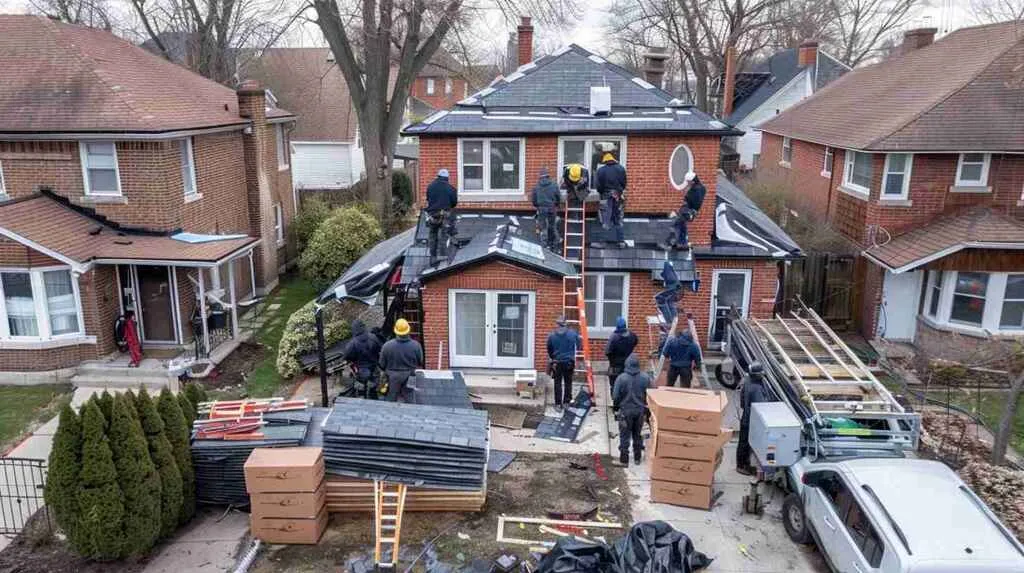
What Is an Asphalt Shingle Roof Queens NY – Roofers Explain | Free Quotes
Layers matter more than most people think. If you own a house here in Queens and somebody sold you on a “20 to 30 year asphalt shingle roof,” I’ll tell you straight: most of them die closer to fifteen years unless you understand what’s under those gray tabs. That doesn’t mean asphalt shingles are a bad choice – far from it – but it does mean most homeowners are picturing only the visible surface instead of the whole water-shedding system keeping rain out of your living room.
Layers: What an Asphalt Shingle Roof Really Is on a Queens House
Three different times this year, I’ve climbed onto a Queens roof where the homeowner thought shingles were “just the gray stuff you see from the street.” Then they’re shocked when I explain that one missing nail or a bad piece of felt paper can turn a $200 repair into a $4,000 leak. From the raindrop’s point of view – and yeah, I think about roofs that way – every asphalt shingle roof is really a series of overlapping barriers designed to move water downhill and out. If you don’t understand all the layers working together, you’re missing the whole picture.
When I walk into a house and the owner asks me, “So what exactly is an asphalt shingle roof, anyway?” I usually grab my notepad and draw them a side view. Picture a sandwich built on top of your rafters: first the plywood or OSB deck, then a waterproof underlayment (usually felt or synthetic), then the asphalt shingles themselves nailed in overlapping rows, plus metal flashing anywhere two surfaces meet, and vents that let hot air escape from the attic. In Queens and Brooklyn, where we get humid summers, freeze-thaw cycles every winter, and wind-driven rain off the bay, every one of those layers is under constant stress. Miss one detail – high nailing, cheap underlayment, blocked vents – and water finds the shortcut into your house.
| Layer (bottom to top) | What it is | What it does for water control |
|---|---|---|
| Roof deck | Plywood or OSB sheathing nailed to rafters | Provides the structural surface; any gaps, rot, or nail pops create leak entry points |
| Underlayment | Felt paper (#15 or #30) or synthetic membrane | First waterproof barrier; catches water that sneaks under shingles and channels it downward |
| Asphalt shingles | Fiberglass mat coated in asphalt and ceramic granules, laid in overlapping courses | Main water-shedding layer; overlaps force rain to roll down and off the roof, never back up |
| Flashing | Galvanized or aluminum metal strips at valleys, chimneys, walls, vents | Bridges the gap where two surfaces meet; directs water away from vulnerable seams |
| Ventilation | Ridge vents, soffit vents, gable vents | Removes heat and moisture from attic; prevents condensation and extends shingle life |
✅ Quick signs you’re only seeing the “gray stuff” and not the full roof system:
- You’re only asking your roofer about shingle color and warranty years, not about underlayment grade or ventilation
- You think all asphalt shingle roofs are installed the same way, so price is the only difference
- You’ve never looked at your attic or crawl space to check if vents are blocked or if condensation is forming
- You assume a leak means “replace the whole roof” instead of tracing where water actually entered the system
How Queens Weather Really Treats Asphalt Shingles
Here’s my honest opinion: if you own a house in Queens and don’t understand what’s under those shingles, you’re gambling with every heavy rain. The marketing on a shingle bundle will say “25 year limited warranty,” but that number is for laboratory conditions in Oklahoma or somewhere flat and dry. Here in Queens, we get July heat waves that turn attics into 140-degree ovens, January freeze-thaw cycles that crack sealant, and humid summers where mold creeps under shingles that never fully dry. One August afternoon about ten years ago, around 3 p.m. in a brutal heat wave, I got a call from a retired teacher in Jackson Heights whose “brand new” asphalt shingle roof was already curling and shedding granules. I climbed up, and within five minutes I saw the shingles were a cheap three-tab, nailed too high and laid over a roof deck with barely any ventilation holes. I remember kneeling on that scorching roof, sweating through my shirt, explaining to her how asphalt shingles are like winter coats – if you trap heat under them with no airflow, they cook from the inside out. North-facing slopes stay damp and mossy; south-facing slopes bake and curl.
Around here in Woodhaven and Glendale, I see microclimates nobody thinks about: shade from big trees keeps shingles wet, semidetached party walls catch wind-driven rain at weird angles, and flat sections over porches pond water when gutters clog. Your shingles aren’t on a calendar, they’re in a climate – and Queens’ climate is harder on asphalt than the Midwest suburbs where those warranties were written. If your roof has poor ventilation, dark shingles absorbing heat, and an unvented attic, you’re looking at twelve to fifteen real-world years, not twenty-five.
| Myth | Fact in Queens, NY |
|---|---|
| “My 30-year shingles will last 30 years.” | Expect 15-20 years in Queens unless you have perfect ventilation, quality underlayment, and low-traffic slopes; most fail sooner. |
| “All asphalt shingles are basically the same.” | Three-tab shingles cook faster and curl worse than architectural; fiberglass mat and granule quality vary wildly between brands. |
| “I don’t need attic vents if my roof isn’t leaking yet.” | Poor ventilation voids most warranties and can cut shingle life in half; heat and moisture build up and rot the deck from inside. |
| “Dark shingles look better and work just as well.” | Dark colors absorb more heat, causing faster granule loss and curling; south-facing dark roofs in Queens can hit 160°F in July. |
| “If it’s not dripping inside, the roof is fine.” | Most damage starts invisible: nail pops, lifted tabs, worn flashing; by the time you see a stain, water’s been soaking wood for months. |
⚠️ Heat, moisture and poor ventilation cooking shingles from the inside out
- Unvented or blocked attics trap heat that bakes the underside of shingles, causing them to curl and lose granules years before the warranty expires.
- Queens summer heat waves combined with dark-colored shingles can push surface temps above 150°F, essentially slow-cooking the asphalt and accelerating aging.
- Humidity and condensation from bathrooms, kitchens, and unvented dryers migrate into attics, wetting underlayment and deck, which leads to mold, rot, and nail rust.
- Most manufacturers void warranties if they find inadequate ventilation during an inspection, so you’re left paying for premature failure out of pocket.
How Water Tries to Sneak Through an Asphalt Shingle Roof
Think of an asphalt shingle roof like a stack of playing cards sitting on a slanted table – the way they overlap and shed water is the whole game. Each shingle is laid so the top edge is covered by the shingle above it, creating a continuous downward path where rain can’t climb back up under the tabs. The nails holding the shingles penetrate through the top of one shingle and into the deck, but they’re covered by the next course, so water never hits a nail head directly if it’s done right. From the raindrop’s point of view, landing on your roof should be a one-way trip: hit the granules, roll down the slope, slide under the edge of the gutter, and out. But here’s where it gets tricky – nails driven too high expose the head, seams between shingles can lift in wind, and edges around chimneys or walls are natural leak paths if the flashing isn’t tight.
Trace a raindrop with your finger right now on your ceiling or wall – imagine where it landed on the roof and follow the easiest downhill path; that’s how I find leaks.
Now, follow this to the next part: even one weak link in the system – a torn piece of underlayment, a rusted nail, a gap in the flashing around a vent pipe – gives that raindrop a shortcut straight into your house. One winter night after a wet snow, around 9 p.m., I got an emergency call from a pizzeria owner off Queens Boulevard: water was dripping onto his pizza oven hood. I went up on the roof under a headlamp and found an older architectural asphalt shingle roof where somebody had cut corners around a vent pipe – no proper flashing, just gooped on sealant. The snowmelt was running right under the shingles and into the duct. Standing up there in the cold, steam rising from the kitchen exhaust, I walked him through how an asphalt shingle roof is actually a whole system – shingles, underlayment, flashings, vents – and if one weak link fails, the whole thing might as well be leaking. Pro tip: if you want to know where a leak starts, watch where water wants to go in a wind-driven rain, especially around vents, chimneys, and where two roofs meet; picture the raindrop hunting for the easiest downhill lane, and you’ll find it.
The path a raindrop takes on a properly installed asphalt shingle roof:
| Pros for Water Control | Cons / Vulnerabilities |
|---|---|
| Overlapping design naturally sheds water downward with gravity; almost impossible for water to climb back up under tabs when installed correctly. | Wind-driven rain and ice dams can force water sideways or uphill under lifted or curled shingles, bypassing the overlap. |
| Asphalt and granules are waterproof and UV-resistant when new; affordable compared to metal or tile for the same coverage area. | Granule loss from age, hail, or foot traffic exposes asphalt to UV; once brittle, shingles crack and leak at every nail and seam. |
| Underlayment beneath shingles provides a second waterproof layer; even if a shingle lifts, water often still drains down the felt. | Cheap felt paper degrades in heat and tears during high winds; once torn, there’s no backup and water goes straight to the deck. |
| Easy to repair: individual damaged shingles or small sections can be replaced without tearing off the whole roof in most cases. | Repairs are only as good as the installer; improper nailing, mismatched shingles, or skipped sealant leave new weak spots for leaks. |
Real Queens Problems: What Fails First on Asphalt Shingle Roofs
Truth is, most of the expensive problems I fix didn’t start with a storm; they started the day the wrong shingles were nailed on the wrong way. I see cheap three-tab shingles all the time – thin, no real thickness, they curl within five years in Queens heat. High nailing is another killer: if the roofer drove nails above the manufacturer’s line, those nail heads are exposed to rain and the shingle tabs aren’t held down, so they lift in wind. Nail pops happen when moisture swells the plywood deck, pushing nails up through the shingle; every popped nail is a hole letting water into your house. And bad flashing around vent pipes, chimneys, and sidewalls? That’s where most leaks actually start. Early one March morning, drizzle coming down sideways, I inspected a semi-attached house in Glendale where the owner swore his “asphalt shingle roof was fine” because it was only eight years old. I found nail pops all along the north-facing slope, where the shingles stayed damp in the shade and the plywood had started to swell. When I showed him the lifted shingle tabs and rusting nails, he looked shocked – no one had ever explained that moisture and freeze-thaw cycles can wreck a roof long before the age on the warranty.
I still remember a roof in Woodhaven where the first clue something was wrong with the asphalt shingles wasn’t on top, it was a brown ring on a bedroom ceiling. Homeowner thought it was a plumbing leak. I traced it back to a vent pipe on the roof where somebody had skipped the metal flashing and just smeared on a tube of sealant that cracked after two winters. Water ran under the shingles every time it rained. Same thing at the pizzeria off Queens Boulevard: the vent pipe leak happened because the detail work – the flashing, the sealant, the way the shingles were cut around the penetration – was rushed. Leaks almost always start at the details, not out in the open field of the roof. Watch for shingle tabs that look wavy or curled, dark streaks (that’s algae feeding on moisture trapped under the shingles), granules washing down into your gutters (means the shingles are dying), and any soft spots or sagging when you walk on the roof.
When to call a Queens roofer about your asphalt shingles
Call Right Away (Within 24 Hours)
- Water stains spreading on your ceiling or walls after rain
- Shingles blown off or hanging loose after high wind
- Visible daylight through roof boards in attic
- Sagging or soft spots when walking on the roof
- Ice dam causing water to back up under shingles and leak inside
Can Wait a Short Time (Schedule an Inspection)
- Curling, cracked, or missing granules on multiple shingles
- Dark streaks or moss growing on north-facing slopes
- Shingles that look wavy or uneven from the street
- Granules collecting in gutters or downspouts after rain
- Your roof is approaching 15 years old and you’ve never had it inspected
✅ What to quickly check on your asphalt shingle roof or ceilings before calling Shingle Masters:
- Walk around your house and look up at the roofline from the street – note any missing, curled, or displaced shingles you can see
- Check your gutters and downspouts for piles of shingle granules (they look like coarse sand or tiny pebbles)
- Go into your attic on a sunny day and look for any pinhole light coming through the roof deck or stains on the wood
- Inspect ceilings and walls in upstairs rooms for brown rings, bubbling paint, or soft spots – take photos with your phone
- Notice when the leak happens: during rain, after snow melt, or only in heavy wind – timing helps us trace the entry point
- If safe, look at vent pipes, chimney edges, and valleys from a window or ladder (don’t climb on the roof yourself) for obvious gaps or lifted flashing
What to Expect from a Proper Asphalt Shingle Roof in Queens, NY
Three different times this year, I’ve climbed onto a Queens roof where the homeowner thought shingles were “just the gray stuff you see from the street,” and then they’re confused why a ten-year-old roof is already leaking. A proper asphalt shingle install means quality architectural shingles (not the cheapest three-tab), synthetic or heavy felt underlayment that won’t tear in wind, nails driven at the right depth in the right spot (usually four to six per shingle), metal flashing custom-fitted at every penetration and transition, and real attic ventilation – ridge vents, soffit vents, or gable vents that actually move air. With that setup and normal maintenance, you’re looking at a realistic fifteen to twenty years in Queens before you need a full replacement. The shingles themselves can last longer, but the system – the nails, the sealant, the flashing – is what usually dictates when it’s time.
Here’s my honest take: asphalt shingles are still the smartest choice for most Queens homes if you treat them as a system and not just a color you picked from a sample. They’re affordable, repairable, and when installed right with good ventilation, they handle our freeze-thaw, heat, and humidity better than people think. I’d put them on my own house – and I have. If you’re not sure how your roof is handling water, or if you’re seeing any of the warning signs we just covered, don’t wait until the next storm to find out. Give me a call at Shingle Masters, and I’ll come walk your roof with you, sketch out what I’m seeing, and give you a written quote with no pressure. I’ve been doing this for over thirty years in Queens and Brooklyn, and I’d rather catch a small problem now than get an emergency call at nine o’clock on a rainy night.
Typical Queens asphalt shingle roof scenarios and ballpark price ranges
| Roof Scenario in Queens | What’s Usually Included | Typical Price Range* |
|---|---|---|
| Small attached rowhouse (800-1,000 sq ft) | Tear-off, synthetic underlayment, architectural shingles, new drip edge, basic flashing | $6,500-$9,000 |
| Semi-attached house (1,200-1,500 sq ft, one shared wall) | Full tear-off, ice & water shield at eaves, ridge vent install, new pipe flashings | $9,500-$13,000 |
| Detached house, simple gable (1,500-1,800 sq ft, low complexity) | Tear-off to deck, new underlayment, architectural shingles, all new flashing, soffit & ridge vents | $11,000-$16,000 |
| Detached with valleys & dormers (1,800-2,200 sq ft, complex) | Full tear-off, deck inspection/repair, ice & water in valleys, custom chimney/dormer flashing | $15,000-$22,000 |
| Emergency leak repair (tarping, flashing, small section replacement) | Temporary weatherproofing, leak tracing, targeted repair of damaged area, warranty on work | $450-$1,800 |
*Prices depend on access, pitch, material choice, and current lumber/disposal costs. Free written quote provided after on-site inspection.
Why Queens homeowners call Vic at Shingle Masters for asphalt shingle roofs
- 31+ years of roofing experience exclusively in Queens and Brooklyn – I know how your neighborhood’s weather and building styles affect shingle performance
- Fully licensed and insured in New York City with workers’ comp and liability; all permits pulled and inspections coordinated for you
- Specializes in leak tracing and asphalt shingle diagnostics – when other contractors can’t find the leak, I usually can
- Free written quotes with detailed breakdown of materials, labor, and warranty coverage – no surprises, no pressure tactics
- Typical same-day or next-day response for emergency leak calls in Queens; permanent repairs scheduled within the week in most cases
Common asphalt shingle roof questions from Queens homeowners
How long will my asphalt shingle roof actually last in Queens, NY?
Realistically, expect 15 to 20 years with a quality install – architectural shingles, good underlayment, proper ventilation, and regular maintenance. Cheap three-tab shingles or poor installation can cut that to ten years or less. The “25 or 30 year” numbers on the package assume perfect lab conditions, not Queens freeze-thaw cycles and summer heat.
Should I repair my asphalt shingle roof or replace the whole thing?
If your roof is under ten years old and the damage is localized (a few missing shingles, one bad flashing), repair makes sense. If you’re seeing widespread curling, granule loss, multiple leaks, or the roof is over fifteen years old, replacement is usually more cost-effective than chasing leaks. I’ll walk you through both options during the inspection and show you exactly what I’m seeing.
Can you install new asphalt shingles over my old roof to save money?
Technically yes, NYC code allows up to two layers of asphalt shingles in some cases, but I don’t recommend it for most Queens homes. Layering over hides problems in the deck and underlayment, traps heat that shortens the new shingles’ life, adds weight to your framing, and usually voids the manufacturer warranty. A proper tear-off lets me inspect and fix the deck, install fresh underlayment, and give you a roof that’ll actually last.
Can you install asphalt shingles in winter, or do I have to wait until spring?
Yes, I can install in winter as long as temps are above freezing during the work and for 24 hours after. Shingles need warmth to seal properly, so I use hand-sealing techniques and sometimes store materials in a warm truck. If it’s an emergency leak, I’ll get up there and patch it safely no matter the season, then schedule the permanent work when conditions are better.
Do I need permits or inspections for a new asphalt shingle roof in Queens?
In New York City, a full roof replacement usually requires an ALT-2 permit from the Department of Buildings, and the work must be done by a licensed contractor. I handle all the permit paperwork, coordinate inspections if needed, and make sure the job is signed off properly. For small repairs under a certain square footage, permits typically aren’t required, but I’ll tell you up front what’s needed for your specific job.
If you own a house in Queens and aren’t sure how your asphalt shingles are handling water – or if you’ve spotted any of the warning signs we covered – don’t wait for the next big storm to find out. Call Vic at Shingle Masters for a free on-roof inspection and written quote. I’ll walk the roof with you, sketch out what I’m seeing layer by layer, and give you straight answers before water finds its way into your living room.